Arc Length Calculator
Circle geometry tool • 2026 edition
$$s = r\theta$$
The arc length formula calculates the length of a circular arc given the radius and central angle in radians.
Components:
- s = arc length
- r = radius of the circle
- θ = central angle in radians
Conversion between Degrees and Radians:
Radians = Degrees × π/180°
Degrees = Radians × 180°/π
Alternative Arc Length Formula (for degrees):
$$s = \frac{\theta°}{360°} \times 2\pi r$$
Examples:
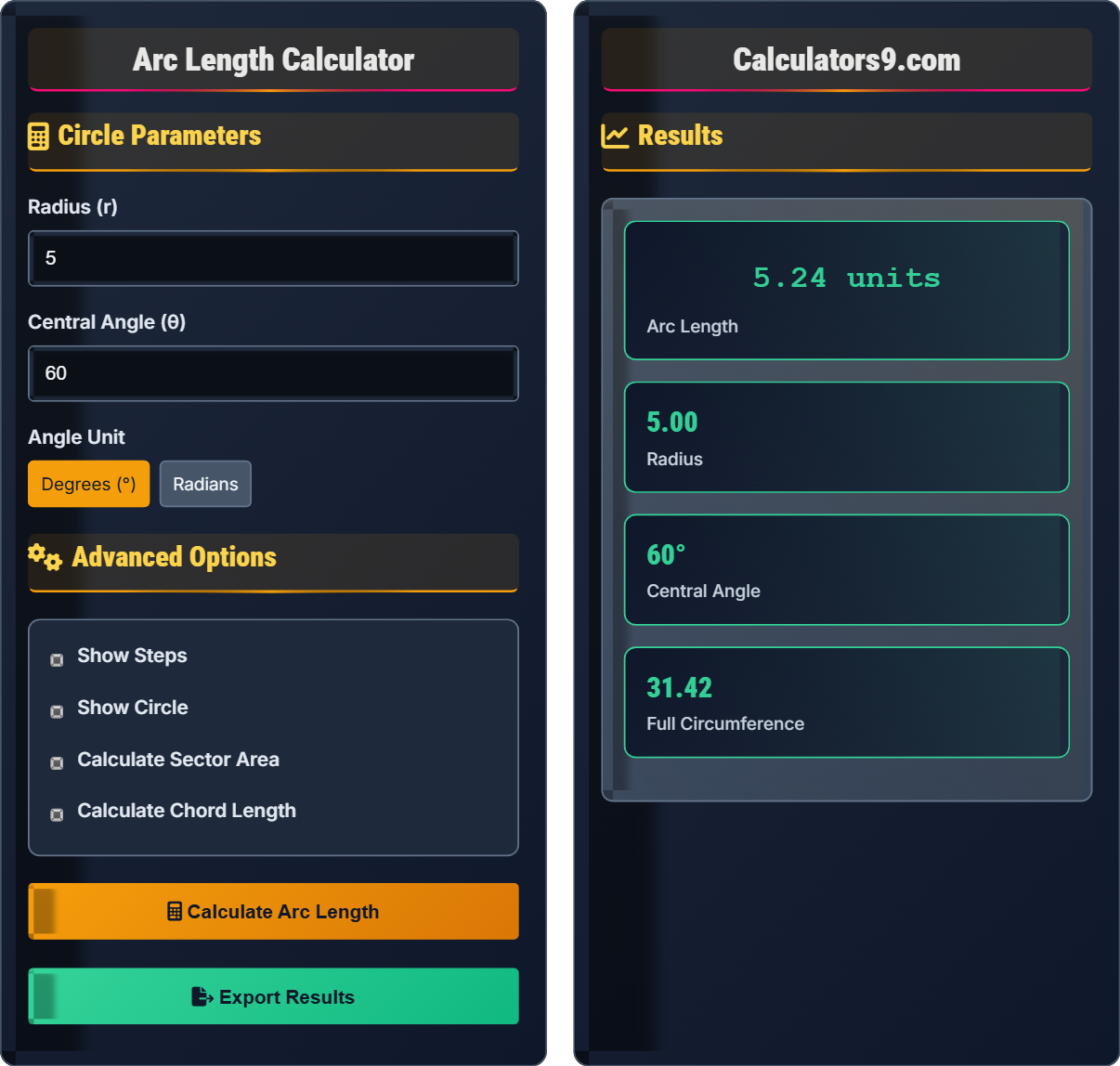
- Radius = 5, Angle = 60° → s = (60°/360°) × 2π(5) = 5π/3 ≈ 5.24 units
- Radius = 3, Angle = π/4 rad → s = 3 × π/4 = 3π/4 ≈ 2.36 units
Circle Parameters
Advanced Options
Results
Comprehensive Circle Geometry Guide
Arc length is the distance along the curved line making up the arc of a circle. It is a fraction of the circle's circumference determined by the central angle that subtends the arc. The arc length is proportional to both the radius of the circle and the central angle.
The formula s = rθ comes from the proportion of the angle to the full circle:
- Full circumference = 2πr
- Full angle = 2π radians
- Arc length is proportional: s = (θ/2π) × 2πr = rθ
For degrees: s = (θ°/360°) × 2πr
Converting between degrees and radians:
- 180° = π radians
- 1° = π/180 radians ≈ 0.01745 radians
- 1 radian = 180°/π ≈ 57.296°
- To convert degrees to radians: multiply by π/180
- To convert radians to degrees: multiply by 180/π
- Engineering: Design of curved roads, bridges, and architectural elements
- Physics: Calculating distances in circular motion and planetary orbits
- Astronomy: Measuring angular distances between celestial objects
- Manufacturing: Creating curved parts and determining material lengths
- Surveying: Calculating boundaries and land measurements
Circle Fundamentals
Arc length is the distance along the curved line making up the arc of a circle, measured in linear units.
One radian is the angle subtended at the center of a circle by an arc equal in length to the radius.
- Always ensure angle unit matches calculation method
- For arc length formula s = rθ, θ must be in radians
- Larger radius produces longer arc for same angle
- Larger angle produces longer arc for same radius
Advanced Concepts
A sector is the region bounded by two radii and their intercepted arc. Area = (1/2)r²θ for θ in radians.
- Formula: c = 2r sin(θ/2)
- Requires angle in radians
- Chord is the straight-line distance between arc endpoints
- As θ approaches 0, chord length approaches arc length
- Maximum chord length is diameter (when θ = π radians)
- Sector area is proportional to central angle
Circle Geometry Learning Quiz
Find the arc length of a circle with radius 8 cm and central angle 45°. Show all steps and convert to radians if necessary.
Step 1: Identify the given values: radius r = 8 cm, central angle θ = 45°
Step 2: Convert angle to radians (required for the formula s = rθ):
θ (in radians) = θ (in degrees) × π/180°
θ = 45° × π/180° = π/4 radians
Step 3: Apply the arc length formula: s = rθ
s = 8 × π/4 = 2π cm
Step 4: Convert to decimal form: s = 2π ≈ 6.28 cm
Alternatively, using the degree formula: s = (θ°/360°) × 2πr
s = (45°/360°) × 2π(8) = (1/8) × 16π = 2π ≈ 6.28 cm
Therefore, the arc length is 2π cm or approximately 6.28 cm.
This problem demonstrates the importance of unit consistency when using the arc length formula. The formula s = rθ requires the angle to be in radians, which is why we must convert from degrees. The alternative formula s = (θ°/360°) × 2πr allows working directly with degrees, showing that both methods yield the same result.
Understanding the relationship between radians and degrees is crucial for trigonometric calculations involving circles.
Radian: The angle subtended at the center of a circle by an arc equal in length to the radius
Arc Length: The distance along the curved line making up the arc of a circle
Central Angle: An angle whose vertex is at the center of a circle and whose sides pass through two points on the circle
• Always check the unit of the angle before applying the arc length formula
• The formula s = rθ requires radians, not degrees
• Both formulas (with radians and with degrees) give the same result
• Remember that π radians = 180°
• Common angles in radians: 30° = π/6, 45° = π/4, 60° = π/3, 90° = π/2
• Use the degree formula when working with degree measurements
• Using degrees with the formula s = rθ without converting to radians
• Forgetting to convert between degrees and radians
• Confusing arc length with chord length
A circular track has a radius of 50 meters. A runner covers an arc that subtends a central angle of 120° at the center of the track. How far did the runner travel? If the runner continues at the same pace, how much further must they run to complete one full lap?
Distance traveled (arc length):
Given: radius r = 50 m, central angle θ = 120°
Using the degree formula: s = (θ°/360°) × 2πr
s = (120°/360°) × 2π(50) = (1/3) × 100π = 100π/3 ≈ 104.72 meters
Distance to complete one lap:
Full circumference = 2πr = 2π(50) = 100π ≈ 314.16 meters
Remaining distance = 100π - 100π/3 = 300π/3 - 100π/3 = 200π/3 ≈ 209.44 meters
Therefore, the runner traveled approximately 104.72 meters and needs to travel about 209.44 more meters to complete one full lap.
This application problem connects arc length calculations to a real-world scenario. The key insight is that the runner's path follows the arc of a circle, allowing us to use the arc length formula. The second part of the question requires understanding that the full circumference is 2πr and subtracting the distance already traveled to find the remaining distance.
Proportional thinking is important: 120° is one-third of 360°, so the arc length is one-third of the full circumference.
Circumference: The total distance around the edge of a circle, equal to 2πr
Subtend: To form an angle at a particular point when straight lines from the angle's sides meet the ends of an arc
Proportional Relationship: Arc length is proportional to the central angle that subtends it
• Arc length is proportional to the central angle
• Full circle corresponds to 360° or 2π radians
• Remaining distance = Total circumference - Distance traveled
• Think of the fraction of the circle covered: 120°/360° = 1/3
• Always verify that your answer makes sense in the context of the problem
• Draw a diagram to visualize the situation
• Confusing arc length with chord length (straight line distance)
• Forgetting to convert between degrees and radians when needed
• Not accounting for the proportional relationship between angle and arc length
FAQ
Q: What's the difference between arc length and chord length, and when would I use each?
A: Arc length and chord length measure different things:
Arc Length: The distance along the curved edge of the circle between two points. Formula: s = rθ (for θ in radians).
Chord Length: The straight-line distance between two points on the circle. Formula: c = 2r sin(θ/2) (for θ in radians).
When to use each:
- Use arc length when measuring along a curved path (like running on a circular track)
- Use chord length when measuring straight-line distance between two points on a circle
- Arc length is always greater than or equal to chord length (equal only when θ = 0)
For small angles, the arc length and chord length are nearly equal. As the angle increases, the difference becomes more pronounced.
Q: How is arc length related to sector area and other circular measurements?
A: Arc length is connected to other circular measurements through the central angle:
Arc Length: s = rθ (for θ in radians)
Sector Area: A = (1/2)r²θ (for θ in radians)
Chord Length: c = 2r sin(θ/2) (for θ in radians)
Segment Area: A = (1/2)r²(θ - sin θ) (for θ in radians)
Notice the relationship: Sector Area = (1/2)rs, where s is the arc length. This shows that the sector area is proportional to the arc length.
All these measurements depend on the radius r and the central angle θ. As θ increases, all these measurements increase proportionally.