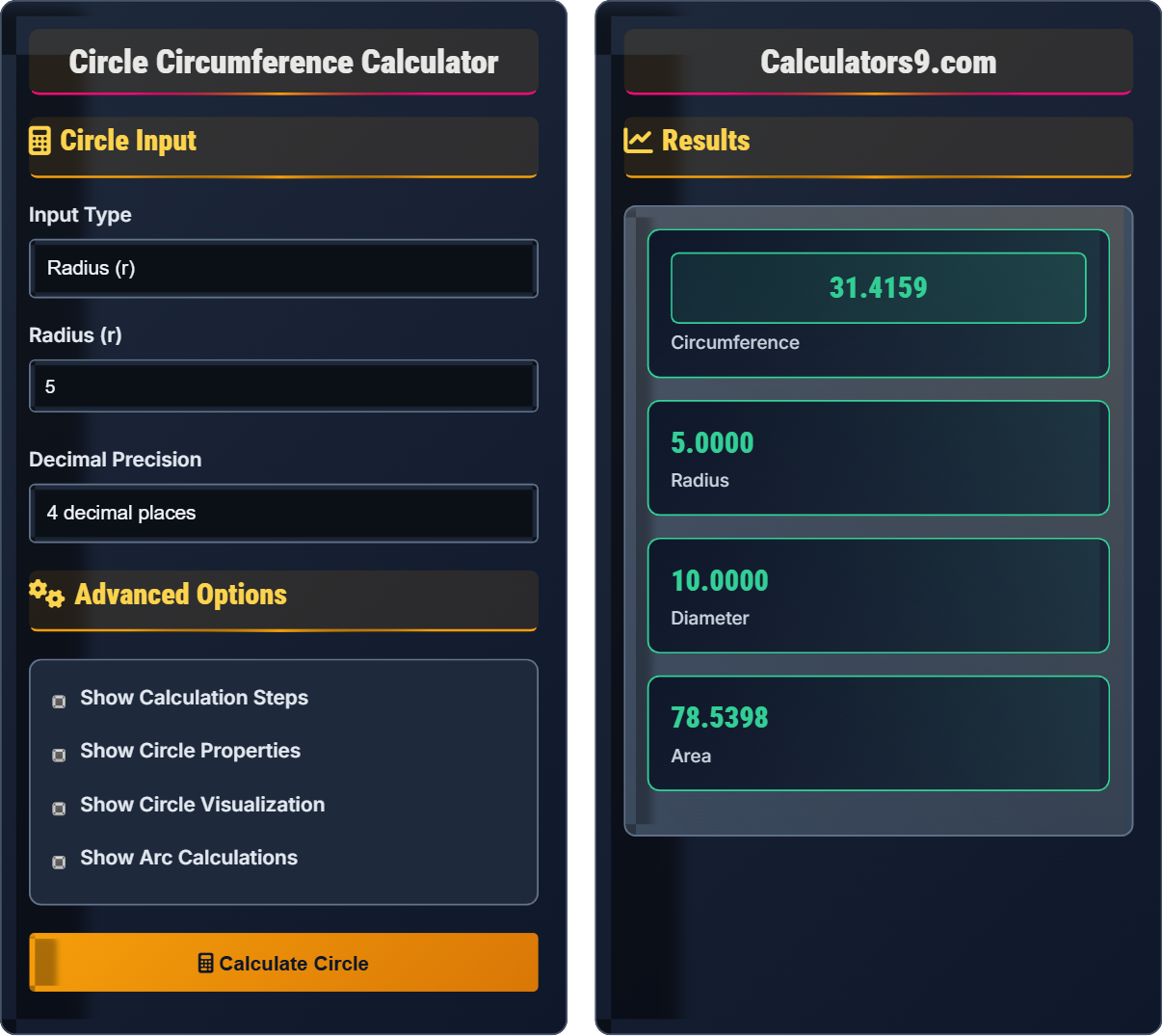
Circle Circumference Calculator
Advanced geometry tool • Circle properties
Circle Formulas:
Show the calculatorCircumference: C = 2πr = πd
Area: A = πr²
Diameter: d = 2r
Arc Length: s = rθ (in radians)
Sector Area: A = ½r²θ (in radians)
Circle Properties:
- Radius: distance from center to any point on circle
- Diameter: distance across circle through center
- Circumference: distance around the circle
- π (pi) ≈ 3.14159... is the ratio of circumference to diameter
- All radii of a circle are equal in length
Key Relationships: C/d = π, A/r² = π, d = 2r, C = 2πr.
Circle Input
Advanced Options
Results
Circle Circumference Fundamentals
The circumference of a circle is the linear distance around its edge. It's the perimeter of the circle. The relationship between circumference and diameter is constant for all circles and is represented by the mathematical constant π (pi). This relationship makes circles unique among geometric shapes.
-
1Basic Formula: C = 2πr (using radius)
-
2Alternative: C = πd (using diameter)
-
Relationship: C/d = π (constant ratio)
-
Area Connection: A = πr², C = 2√(πA)
-
Derivative: dA/dr = C (rate of area change)
- π is a transcendental number ≈ 3.14159...
- Diameter = 2 × radius
- All circles are similar (same shape, different sizes)
- Circumference is directly proportional to radius
Circle Properties
Circles have several important properties that relate circumference to other measurements. Understanding these relationships helps in solving complex geometric problems.
- Radius (r): Distance from center to any point on circle
- Diameter (d): Distance across circle through center (d = 2r)
- Circumference (C): Distance around the circle (C = 2πr)
- Area (A): Space enclosed by circle (A = πr²)
- Chord: Line segment connecting two points on circle
- C = 2πr = πd
- A = πr² = πd²/4
- C² = 4πA (relationship between circumference and area)
- For sectors: Arc length = rθ (θ in radians)
- For sectors: Area = ½r²θ (θ in radians)
Circle Circumference Learning Quiz
If a circle has a radius of 7 cm, what is its circumference? (Use π ≈ 3.14159)
The answer is B) 43.98 cm. Using the circumference formula C = 2πr, where r = 7 cm: C = 2π(7) = 14π ≈ 14 × 3.14159 ≈ 43.98 cm. This demonstrates the fundamental relationship between radius and circumference, where the circumference is directly proportional to the radius with the constant of proportionality being 2π.
This question tests the basic application of the circumference formula. The key insight is that the circumference is always 2π times the radius. This relationship is fundamental in geometry and appears in many applications, from calculating the distance traveled by a wheel to determining the length of curved paths.
Circumference: The distance around a circle
Radius: Distance from center to any point on the circle
π (Pi): Ratio of circumference to diameter, approximately 3.14159
• C = 2πr for any circle
• C = πd (where d is diameter)
• Always verify units are consistent
• Remember: C = 2πr is the fundamental formula
• Use 2πr when radius is given
• Use πd when diameter is given
• Using πr instead of 2πr
• Confusing radius with diameter
• Forgetting to multiply by 2
A circular garden has a diameter of 12 meters. Calculate both the area and circumference of the garden. Show your work.
Step 1: Find the radius
Given diameter d = 12 meters
Radius r = d/2 = 12/2 = 6 meters
Step 2: Calculate the circumference
C = 2πr = 2π(6) = 12π ≈ 12 × 3.14159 ≈ 37.70 meters
Step 3: Calculate the area
A = πr² = π(6)² = π(36) = 36π ≈ 36 × 3.14159 ≈ 113.10 square meters
Step 4: Verification
Check: C² = (12π)² = 144π² and 4πA = 4π(36π) = 144π²
Therefore, the circumference is approximately 37.70 meters and the area is approximately 113.10 square meters.
This problem demonstrates the relationship between diameter, radius, circumference, and area. The key insight is that knowing any one of these measurements allows us to calculate all others. The relationship C² = 4πA is a useful verification tool that connects circumference and area directly.
Diameter: Distance across the circle through the center
Area: The space enclosed by the circle
Verification: Checking calculations using known relationships
• Always find radius first when given diameter
• Use exact values (with π) when possible
• Verify with relationships like C² = 4πA
• Convert diameter to radius first
• Keep π in calculations until final step
• Use C² = 4πA to verify results
• Forgetting to divide diameter by 2 to get radius
• Using the wrong formula for area
• Arithmetic errors with π
A circular swimming pool has a circumference of 50.27 feet. If the pool needs a new cover that extends 2 feet beyond the edge all around, what area of material is needed for the cover? (Assume the cover extends equally in all directions.)
Step 1: Find the radius of the original pool
Given: C = 50.27 feet
C = 2πr, so r = C/(2π) = 50.27/(2π) ≈ 50.27/6.283 ≈ 8 feet
Step 2: Find the radius of the cover
The cover extends 2 feet beyond the edge all around
New radius = original radius + 2 feet = 8 + 2 = 10 feet
Step 3: Calculate the area of the cover
Area of cover = π(new radius)² = π(10)² = 100π ≈ 100 × 3.14159 ≈ 314.16 square feet
Step 4: Verification
Original area = π(8)² = 64π ≈ 201.06 square feet
Cover area is larger, which makes sense ✓
Therefore, approximately 314.16 square feet of material is needed for the cover.
This practical problem demonstrates how to work backwards from circumference to find radius, then apply that knowledge to solve a real-world problem. The key insight is that when a circular cover extends equally in all directions, we simply add the extension amount to the original radius.
Circular Cover: Circular material extending beyond original circle
Extension: Additional distance beyond original boundaryArea Calculation: Using new dimensions for expanded circle
• Work backwards: C → r when circumference is given
• Add extension to radius for expanded circle
• Use new radius to calculate required area
• Always find original dimensions first
• Add extensions to radius, not diameter
• Sketch the problem to visualize
• Adding extension to diameter instead of radius
• Forgetting to account for the extension in area calculation
• Confusing the original and extended measurements
A circular track has a radius of 100 meters. If a runner completes 1/4 of a lap around the track, how far did the runner travel? Also, calculate the area of the sector corresponding to the runner's path.
Step 1: Calculate the total circumference of the track
C = 2πr = 2π(100) = 200π ≈ 628.32 meters
Step 2: Calculate the distance traveled (arc length)
The runner completes 1/4 of a lap
Distance = (1/4) × 200π = 50π ≈ 157.08 meters
Alternatively, using central angle: 1/4 lap = 90° = π/2 radians
Arc length s = rθ = 100 × π/2 = 50π ≈ 157.08 meters ✓
Step 3: Calculate the area of the sector
Sector area = (central angle in radians)/(2π) × total area
Sector area = (π/2)/(2π) × πr² = (1/4) × π(100)² = (1/4) × 10,000π = 2,500π ≈ 7,854.0 square meters
Alternatively: Sector area = (1/2)r²θ = (1/2)(100)²(π/2) = 2,500π ≈ 7,854.0 square meters ✓
Therefore, the runner traveled approximately 157.08 meters and the sector area is approximately 7,854.0 square meters.
This problem introduces arc length and sector area calculations. The key insight is that arc length is proportional to the central angle, and sector area is also proportional to the central angle. Working in radians often simplifies these calculations compared to degrees.
Arc Length: Distance along the curved path of a circle
Sector: Region bounded by two radii and an arc
Central Angle: Angle whose vertex is at the center of the circle
• Arc length s = rθ (θ in radians)
• Sector area = (1/2)r²θ (θ in radians)
• Convert degrees to radians when using these formulas
• Remember: θ must be in radians for these formulas
• π radians = 180°
• Arc length is proportional to central angle
• Forgetting to convert degrees to radians
• Using wrong formula for arc length
• Confusing chord length with arc length
Which of the following statements about circles is TRUE?
The answer is B) The ratio of circumference to diameter is π. This is the fundamental definition of π. By definition, π = C/d, where C is circumference and d is diameter. This relationship is constant for all circles. Let's verify the other options: A) C/r = 2π (not π), C) A/r = πr (not π), D) A/d = πr²/(2r) = πr/2 (not π). The constancy of the ratio C/d = π is what makes circles unique among geometric shapes.
This question tests the fundamental definition of π. The key insight is that π is defined as the ratio of circumference to diameter, not radius. This is why the formula is C = πd or equivalently C = 2πr. Understanding this definition is crucial for all circle-related calculations.
π (Pi): Ratio of circumference to diameter of any circle
Ratio: Relationship between two quantities
Constant: Value that remains the same in all cases
• π = C/d (by definition)
• C = πd = 2πr
• This ratio is constant for all circles
• Remember: π is circumference to diameter ratio
• Always double-check which measurement is in denominator
• This ratio is the same for all circles (similarity)
• Confusing radius and diameter in π definition
• Thinking π = C/r instead of C/d
• Not recognizing this as the fundamental definition
FAQ
Q: Why is the ratio of circumference to diameter always the same for all circles?
A: This is due to the principle of similarity in geometry. All circles are similar shapes, meaning they have the same shape but can differ in size. When shapes are similar, corresponding linear measurements are proportional.
For circles, if one circle has radius r₁ and another has radius r₂, then their circumferences C₁ and C₂ satisfy: C₁/C₂ = 2πr₁/2πr₂ = r₁/r₂. This shows that the ratio of circumferences equals the ratio of radii.
More importantly, the ratio C/d = C/2r = 2πr/2r = π is constant for all circles. This constant ratio is what we call π. This property is fundamental to Euclidean geometry and is one of the reasons why π appears in so many mathematical contexts.
Q: How do I calculate arc length and sector area?
A: Arc length and sector area are proportional to the central angle:
Arc Length: s = rθ, where r is radius and θ is the central angle in radians
Alternatively: s = (central angle in degrees/360°) × 2πr
Sector Area: A = (1/2)r²θ, where θ is in radians
Alternatively: A = (central angle in degrees/360°) × πr²
Conversion: θ radians = θ° × π/180°
Example: For a circle with radius 5 and central angle 60°: θ = 60° × π/180° = π/3 radians. Arc length = 5 × π/3 = 5π/3 ≈ 5.24 units. Sector area = (1/2) × 5² × π/3 = 25π/6 ≈ 13.09 square units.