Volume of Cone Calculator
3D geometry tool • 2026 edition
$$V = \frac{1}{3}\pi r^2 h$$
The volume of a cone is one-third the product of the area of its circular base and its height.
Components:
- V = volume of the cone
- r = radius of the circular base
- h = height of the cone
- π ≈ 3.14159
Alternative Formulas:
- If diameter d is known: V = πd²h/12
- If base area A is known: V = Ah/3
- If slant height l is known: V = (1/3)πr²√(l² - r²)
Related Formulas:
- Base Area: A = πr²
- Lateral Surface Area: LSA = πrl
- Total Surface Area: TSA = πr² + πrl
- Slant Height: l = √(r² + h²)
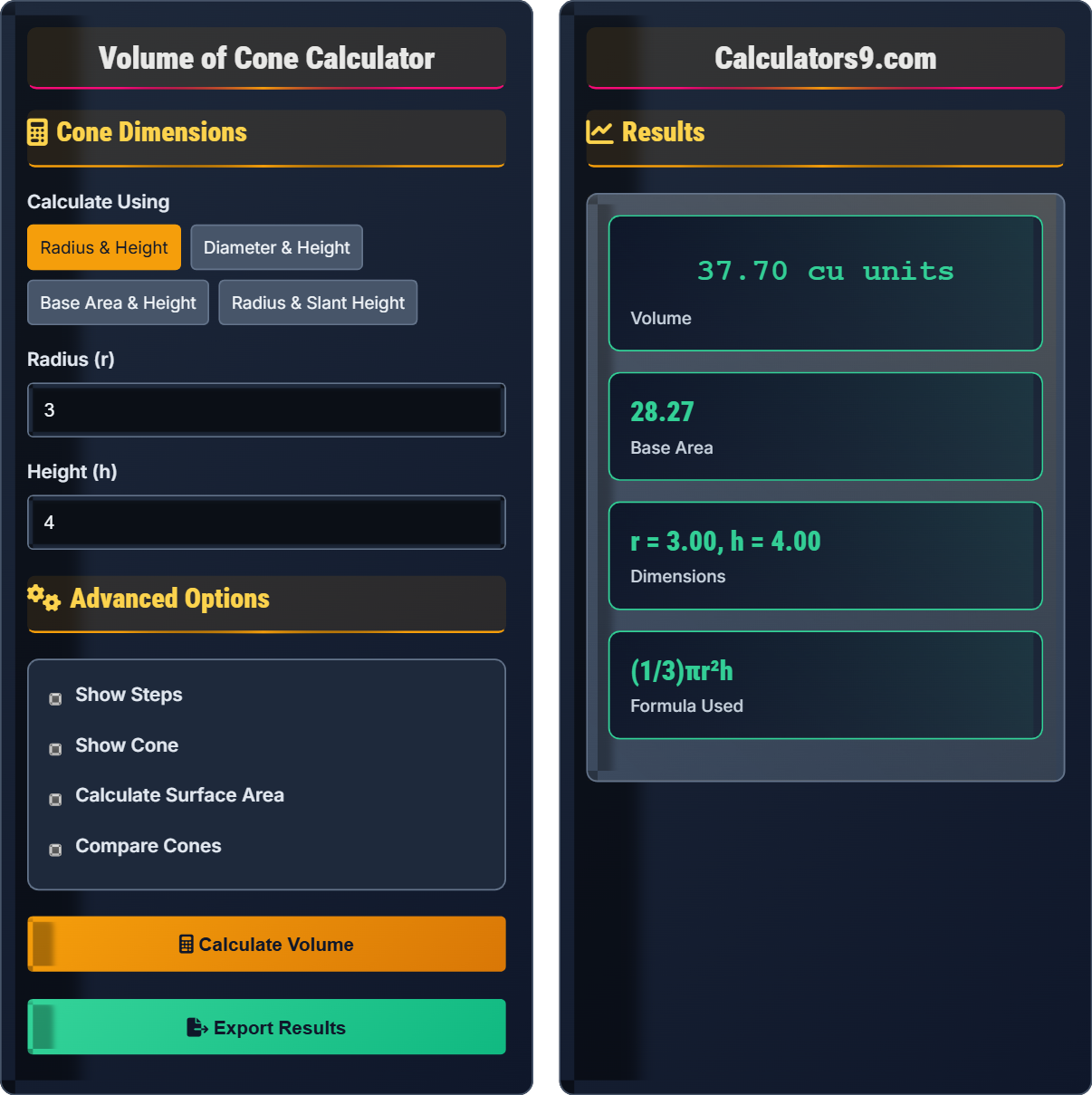
Example: For a cone with radius r = 3 units and height h = 4 units:
V = (1/3)π × 3² × 4 = (1/3)π × 9 × 4 = 12π ≈ 37.70 cubic units
Cone Dimensions
Advanced Options
Results
Comprehensive Cone Geometry Guide
A cone is a three-dimensional geometric shape that tapers smoothly from a flat circular base to a point called the apex or vertex. The volume of a cone is one-third the volume of a cylinder with the same base and height. This relationship is fundamental to understanding the cone's volume formula.
The volume formula V = (1/3)πr²h comes from the relationship between a cone and a cylinder:
- It takes exactly 3 cones of the same base and height to fill a cylinder
- Volume of cylinder = πr²h
- Therefore, volume of cone = (1/3)πr²h
This can be proven using calculus or experimentally verified with physical models.
You can calculate cone volume with different known values:
- With Diameter: V = πd²h/12
- With Base Area: V = Ah/3
- With Slant Height: V = (1/3)πr²√(l² - r²)
- Engineering: Calculating volume of conical structures
- Manufacturing: Determining material volume for conical parts
- Construction: Concrete volume for conical foundations
- Food Industry: Ice cream cone capacity calculations
- Medicine: Volume of conical medical devices
Cone Fundamentals
The volume of a cone is the amount of space enclosed by the cone, calculated as one-third the product of the base area and the height.
Slant height l = √(r² + h²), derived from the Pythagorean theorem.
- Volume is always expressed in cubic units
- Radius and height must be in the same units
- Formula applies to both right and oblique cones
- Volume is one-third of equivalent cylinder volume
Advanced Concepts
The lateral surface area is the area of the curved side surface: LSA = πrl, where l is the slant height.
- Circular base: πr²
- Curved lateral surface: πrl
- Total: TSA = πr² + πrl = πr(r + l)
- Volume scales with r² (not r)
- Volume scales linearly with height
- Doubling radius quadruples volume
- Doubling height doubles volume
Cone Geometry Learning Quiz
Find the volume of a cone with radius 5 cm and height 12 cm. Show all steps and explain the geometric reasoning behind the formula.
Step 1: Identify the given values: radius r = 5 cm, height h = 12 cm
Step 2: Identify the formula for cone volume: V = (1/3)πr²h
Geometric Reasoning: A cone can be thought of as a pyramid with an infinite number of sides. It takes exactly 3 cones of the same base and height to fill a cylinder. This is why the cone volume is one-third of the equivalent cylinder volume.
Step 3: Substitute values into the formula:
V = (1/3)π × (5)² × 12
V = (1/3)π × 25 × 12
V = (1/3)π × 300
V = 100π cm³
Step 4: Calculate decimal approximation:
V = 100π ≈ 100 × 3.14159 ≈ 314.16 cm³
Therefore, the volume is 100π cm³ or approximately 314.16 cm³.
This problem demonstrates the fundamental relationship between cone and cylinder volumes. The factor of 1/3 in the formula reflects the geometric truth that it takes three cones of the same base and height to fill a cylinder. The formula is derived from calculus integration or can be understood through Cavalieri's principle. Understanding this relationship helps in remembering the formula correctly.
The cone volume is always one-third of the cylinder with same base and height.
Volume: The amount of space occupied by a 3D object
Base Area: The area of the circular face of the cone
Apex: The pointed top of the cone
• Always square the radius in the formula (not diameter)
• Include the 1/3 factor in the cone volume formula
• Express volume in cubic units
• Remember: V = (1/3) × Base Area × Height
• The cone volume is always 1/3 of the cylinder volume
• Check that your answer has the correct units (cubic)
• Forgetting the 1/3 factor in the formula
• Using the cone formula for a cylinder or vice versa
• Expressing volume in square units instead of cubic units
A conical water reservoir has a diameter of 10 meters and a height of 8 meters. How many liters of water can it hold when completely filled? (Note: 1 cubic meter = 1,000 liters)
Step 1: Find the radius from diameter: r = diameter/2 = 10/2 = 5 meters
Step 2: Identify the given values: r = 5 m, h = 8 m
Step 3: Calculate the volume:
V = (1/3)πr²h = (1/3)π × (5)² × 8 = (1/3)π × 25 × 8 = (200π/3) m³
V ≈ (200 × 3.14159)/3 ≈ 209.44 m³
Step 4: Convert to liters:
Liters = Volume in m³ × Conversion factor
Liters = 209.44 × 1,000 = 209,440 liters
Therefore, the reservoir can hold approximately 209,440 liters of water.
This application problem connects cone volume calculations to a practical scenario. The key steps involve first finding the radius from the diameter, then applying the cone volume formula, and finally converting to the desired unit (liters). This demonstrates how geometric calculations are used in real-world applications like determining storage capacity.
Unit conversions are often necessary in practical problems.
Capacity: The maximum amount a container can hold
Conversion Factor: A numerical factor used to convert from one unit to another
Reservoir: A large container designed to store liquids
• Convert diameter to radius before using formulas
• Always include unit conversions when needed
• Check that units are consistent throughout the problem
• Draw a diagram to visualize the problem
• Keep track of units during calculations
• Round appropriately for practical applications
• Forgetting to convert diameter to radius
• Not applying the conversion factor correctly
• Mixing different units in the same calculation
FAQ
Q: How does the volume of a cone compare to a cylinder with the same base and height?
A: The volume of a cone is exactly one-third the volume of a cylinder with the same base and height:
Cylinder Volume: V_cyl = πr²h
Cone Volume: V_cone = (1/3)πr²h
So V_cone = (1/3)V_cyl
This relationship can be demonstrated experimentally: it takes exactly 3 cones of the same base and height to fill a cylinder. This is why the cone volume formula has the factor of 1/3. The cone tapers to a point, so it contains less volume than the cylinder that maintains the same cross-sectional area throughout its height.
Q: What's the relationship between volume and surface area of a cone?
A: The volume and surface area of a cone are related but measure different things:
Volume: V = (1/3)πr²h (measured in cubic units)
Surface Area: SA = πr² + πrl = πr(r + l) (measured in square units)
Where l = √(r² + h²) is the slant height.
Relationships:
- Both depend on radius and height
- Volume grows with r² while surface area grows linearly with r
- Volume grows linearly with h while surface area also grows with h
- For a fixed volume, optimizing surface area leads to specific geometric proportions
This relationship is important in engineering applications where you want to optimize volume while minimizing surface area.