Coordinate Distance Calculator
Geometry tool • 2026 edition
$$d = \sqrt{(x_2 - x_1)^2 + (y_2 - y_1)^2}$$
The distance between two points in a coordinate plane is calculated using the Euclidean distance formula, derived from the Pythagorean theorem.
Components:
- d = distance between points
- (x₁, y₁) = coordinates of first point
- (x₂, y₂) = coordinates of second point
Extension to 3D Space:
$$d = \sqrt{(x_2 - x_1)^2 + (y_2 - y_1)^2 + (z_2 - z_1)^2}$$
Midpoint Formula:
$$M = \left(\frac{x_1 + x_2}{2}, \frac{y_1 + y_2}{2}\right)$$
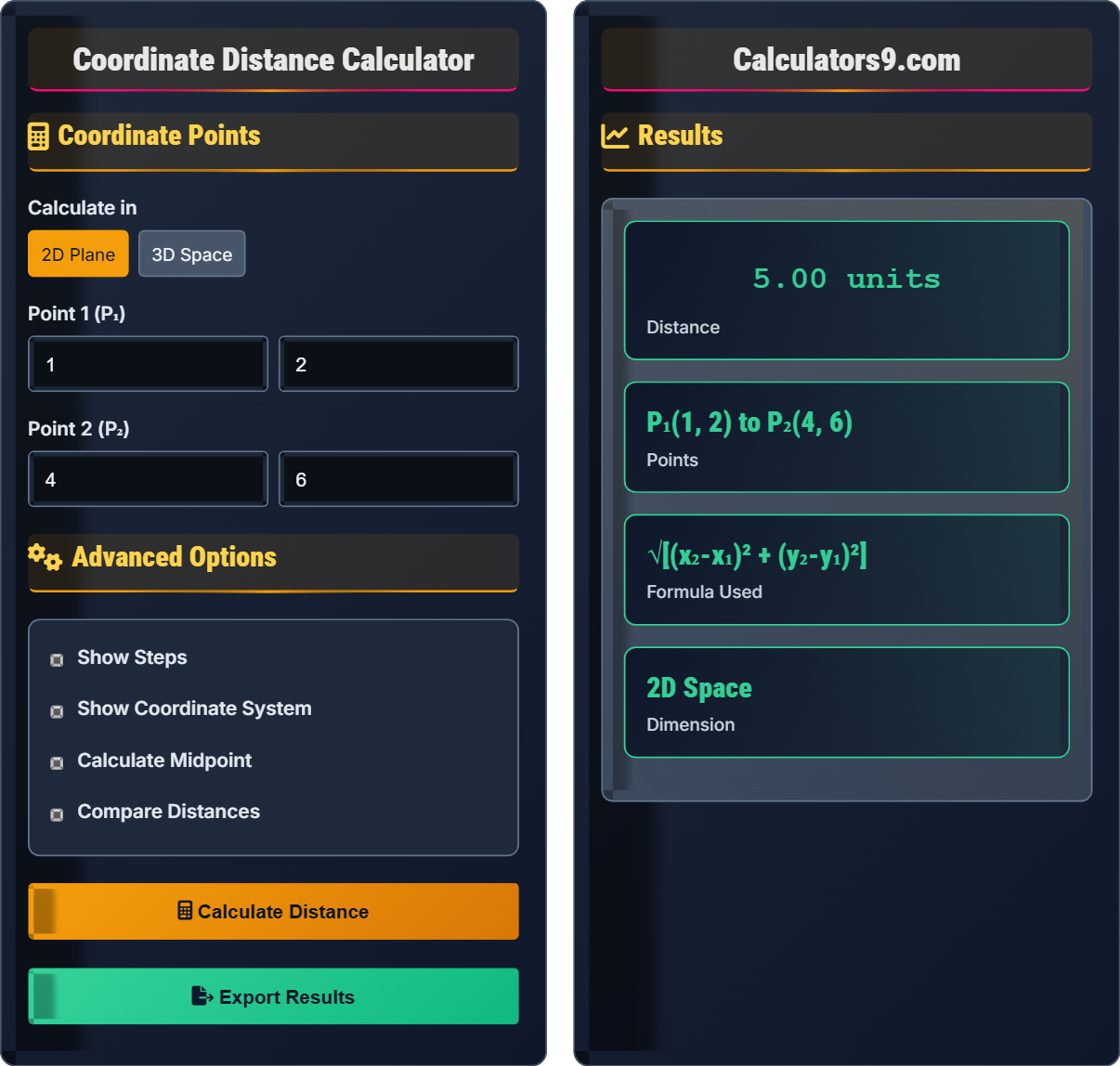
Example: For points (1, 2) and (4, 6):
d = √[(4-1)² + (6-2)²] = √[3² + 4²] = √[9 + 16] = √25 = 5 units
Coordinate Points
Advanced Options
Results
Comprehensive Coordinate Geometry Guide
The distance between two points in a coordinate system is calculated using the Euclidean distance formula. This formula is derived from the Pythagorean theorem and represents the shortest straight-line distance between two points in space.
The distance formula comes from the Pythagorean theorem:
- Create a right triangle with the two points
- Horizontal leg: |x₂ - x₁|
- Vertical leg: |y₂ - y₁|
- Hypotenuse (distance): d = √[(x₂-x₁)² + (y₂-y₁)²]
This extends to 3D: d = √[(x₂-x₁)² + (y₂-y₁)² + (z₂-z₁)²]
Distance calculations in special situations:
- Horizontal line: Points with same y-coordinates: d = |x₂ - x₁|
- Vertical line: Points with same x-coordinates: d = |y₂ - y₁|
- Origin to point: d = √(x² + y²)
- 3D extension: Add z-coordinate differences
- Navigation: GPS and map distance calculations
- Computer Graphics: Object positioning and collision detection
- Physics: Calculating displacement between positions
- Engineering: Surveying and construction measurements
- Robotics: Path planning and movement calculations
Coordinate Geometry Fundamentals
The distance between two points is the length of the straight line segment connecting them, calculated using the Euclidean distance formula.
Distance formula: d² = (x₂-x₁)² + (y₂-y₁)², which is the Pythagorean theorem applied to coordinate geometry.
- Distance is always positive
- Distance is symmetric: d(P₁,P₂) = d(P₂,P₁)
- Distance from a point to itself is 0
- Coordinates must be in the same system
Advanced Concepts
The midpoint is the point exactly halfway between two points: M = ((x₁+x₂)/2, (y₁+y₂)/2).
- Calculate x-differences: (x₂-x₁)
- Calculate y-differences: (y₂-y₁)
- Calculate z-differences: (z₂-z₁)
- Sum of squares: (x₂-x₁)² + (y₂-y₁)² + (z₂-z₁)²
- Take square root: d = √[sum]
- Order of points doesn't matter for distance
- Squaring eliminates sign differences
- Distance is preserved under translation
- Distance scales linearly under uniform scaling
Coordinate Geometry Learning Quiz
Find the distance between points A(3, 4) and B(7, 1). Show all steps and explain the geometric reasoning behind the formula.
Step 1: Identify the coordinates: A(3, 4) means x₁=3, y₁=4; B(7, 1) means x₂=7, y₂=1
Step 2: Identify the distance formula: d = √[(x₂-x₁)² + (y₂-y₁)²]
Geometric Reasoning: The distance formula comes from the Pythagorean theorem. If we draw a right triangle with the two points, the horizontal leg has length |x₂-x₁| and the vertical leg has length |y₂-y₁|. The distance is the hypotenuse.
Step 3: Substitute values into the formula:
d = √[(7-3)² + (1-4)²]
d = √[4² + (-3)²]
d = √[16 + 9]
d = √25
d = 5 units
Therefore, the distance between A(3, 4) and B(7, 1) is 5 units.
This problem demonstrates the connection between coordinate geometry and the Pythagorean theorem. The distance formula is essentially the Pythagorean theorem applied to coordinate points. By finding the horizontal and vertical differences between the points, we create the legs of a right triangle, with the distance being the hypotenuse. Understanding this geometric foundation helps in remembering and applying the formula correctly.
The squaring operation ensures that distance is always positive.
Distance: The length of the shortest path between two points
Coordinate: A value that specifies the position of a point in spacePythagorean Theorem: In a right triangle, a² + b² = c²
• Always subtract coordinates in the same order
• Distance is always positive regardless of order
• Coordinates must be in the same system
• Draw a right triangle to visualize the problem
• Remember: distance = √(change in x² + change in y²)
• Check that your answer makes sense geometrically
• Subtracting coordinates in the wrong order
• Forgetting to square the differences
• Taking the square root of a negative number (impossible)
A city planner needs to find the straight-line distance between two locations: City Hall at coordinates (2, 5) and the Library at coordinates (8, 9). The city uses a grid system where each unit represents 100 meters. What is the actual distance in kilometers between the two buildings?
Step 1: Identify the coordinates: City Hall (2, 5), Library (8, 9)
Step 2: Apply the distance formula:
d = √[(x₂-x₁)² + (y₂-y₁)²]
d = √[(8-2)² + (9-5)²]
d = √[6² + 4²]
d = √[36 + 16]
d = √52 ≈ 7.21 units
Step 3: Convert to real-world distance:
Each unit = 100 meters
Distance = 7.21 units × 100 meters/unit = 721 meters
Distance in kilometers = 721 ÷ 1000 = 0.721 km
Therefore, the straight-line distance between City Hall and the Library is approximately 0.721 kilometers.
This application problem connects coordinate geometry to real-world scenarios. The key steps involve first calculating the distance in coordinate units using the distance formula, then converting to actual distance using the given scale factor. This demonstrates how mathematical concepts apply to practical problems like urban planning, navigation, and logistics.
Unit conversion is often necessary in real-world applications.
Grid System: A coordinate system used to locate places
Scale Factor: A multiplier to convert between units
Real-world Distance: Actual physical distance between locations
• Always include unit conversions when needed
• Check that units are consistent throughout the problem
• Round appropriately for practical applications
• Draw a diagram to visualize the problem
• Keep track of units during calculations
• Estimate the answer to check reasonableness
• Forgetting to convert units
• Not applying the distance formula correctly
• Mixing different units in the same calculation
FAQ
Q: How does the distance formula extend to 3D space?
A: The 3D distance formula adds the z-coordinate differences:
2D Distance: d = √[(x₂-x₁)² + (y₂-y₁)²]
3D Distance: d = √[(x₂-x₁)² + (y₂-y₁)² + (z₂-z₁)²]
This follows from extending the Pythagorean theorem to three dimensions. Instead of a right triangle, we now have a right rectangular prism where the distance is the space diagonal. The principle remains the same: sum the squares of the coordinate differences and take the square root.
Q: What's the relationship between distance and midpoint formulas?
A: The distance and midpoint formulas are complementary in coordinate geometry:
Distance Formula: d = √[(x₂-x₁)² + (y₂-y₁)²] (measures separation)
Midpoint Formula: M = ((x₁+x₂)/2, (y₁+y₂)/2) (finds center point)
They are related in that:
- Both use the same coordinate pairs
- Midpoint divides the line segment into two equal distances
- Distance from midpoint to each endpoint is d/2
- Together they describe both the length and center of a line segment
These formulas together completely characterize a line segment in coordinate space.