Polygon Angle Sum Calculator
Geometry tool • 2026 edition
$$\text{Interior Angle Sum} = (n - 2) \times 180°$$
The sum of interior angles of a polygon with n sides is equal to (n-2) times 180 degrees.
Components:
- n = number of sides in the polygon
- Each triangle contributes 180° to the total
- Any polygon can be divided into (n-2) triangles
Exterior Angle Sum:
$$\text{Exterior Angle Sum} = 360°$$
Individual Interior Angle (Regular Polygon):
$$\text{Each Interior Angle} = \frac{(n - 2) \times 180°}{n}$$
Individual Exterior Angle (Regular Polygon):
$$\text{Each Exterior Angle} = \frac{360°}{n}$$
Examples:
- Triangle (n=3): (3-2) × 180° = 180°
- Square (n=4): (4-2) × 180° = 360°
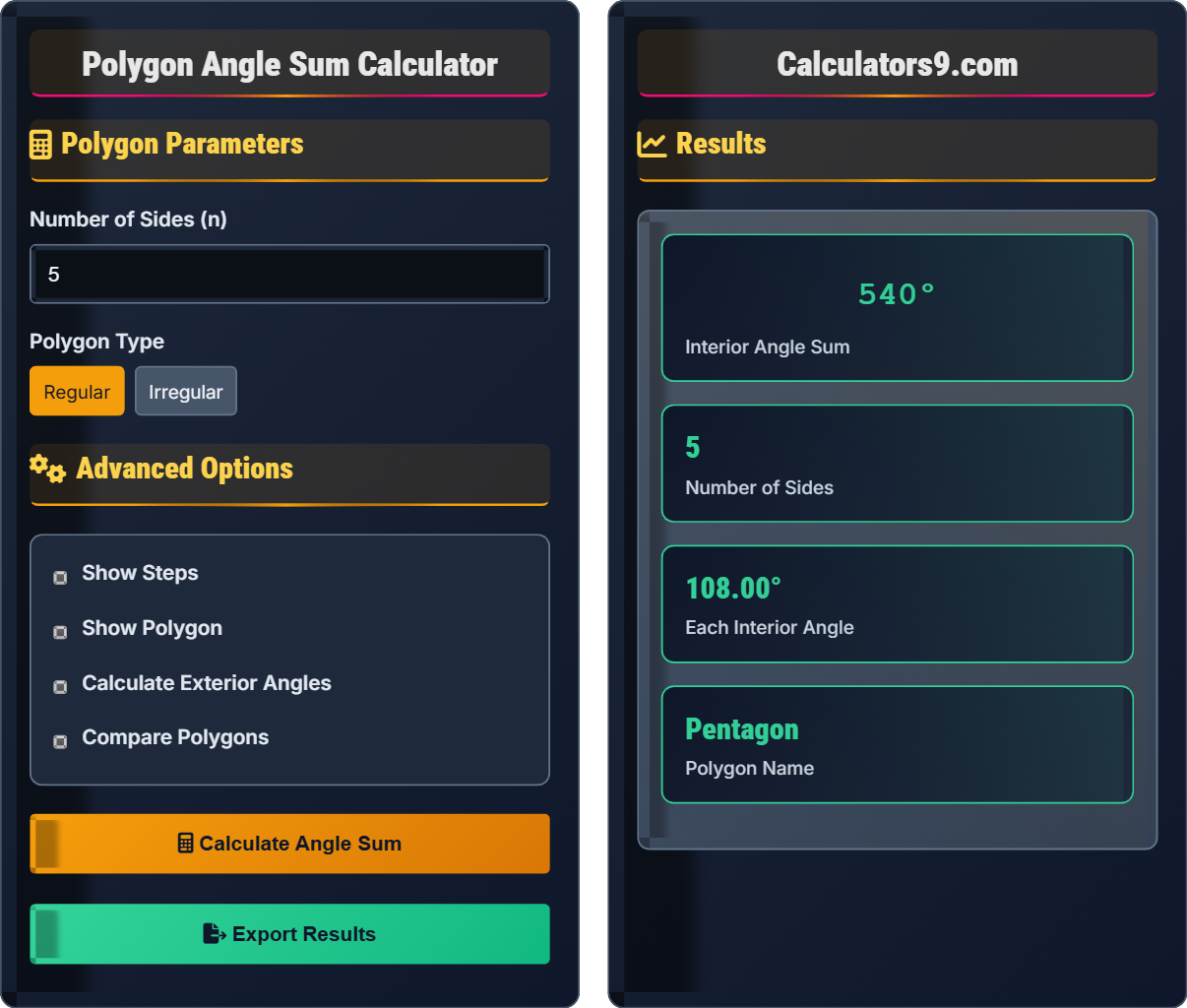
- Pentagon (n=5): (5-2) × 180° = 540°
Polygon Parameters
Advanced Options
Results
Comprehensive Polygon Angle Guide
A polygon is a closed plane figure with straight sides. The sum of interior angles of a polygon depends only on the number of sides. This relationship is fundamental to polygon geometry.
Key formulas for polygon angles:
- Interior Angle Sum: (n-2) × 180°
- Exterior Angle Sum: 360° (constant for all polygons)
- Regular Polygon Interior Angle: [(n-2) × 180°]/n
- Regular Polygon Exterior Angle: 360°/n
Polygon angle calculations in special situations:
- Triangle (n=3): Interior sum = 180°
- Quadrilateral (n=4): Interior sum = 360°
- Regular Polygon: All angles equal
- Star Polygon: More complex angle relationships
- Architecture: Design of polygonal structures and tiling
- Engineering: Stress analysis in polygonal frames
- Computer Graphics: Rendering polygonal meshes
- Art & Design: Symmetrical patterns and tessellations
- Surveying: Land measurement and mapping
Polygon Angle Fundamentals
The sum of interior angles of a polygon with n sides is (n-2) × 180°, derived from dividing the polygon into (n-2) triangles.
Any polygon can be divided into (n-2) triangles by drawing diagonals from one vertex, with each triangle contributing 180°.
- Interior angle sum increases by 180° for each additional side
- Exterior angle sum is always 360° regardless of number of sides
- Regular polygon angles are all equal
- Minimum number of sides is 3 (triangle)
Advanced Concepts
Exterior angles are supplementary to interior angles and always sum to 360° in any polygon.
- Number of diagonals from one vertex: n-3
- Total number of diagonals: n(n-3)/2
- Number of triangles formed: n-2
- Sum of interior angles: (n-2) × 180°
- Interior + Exterior angle = 180°
- Exterior angles always sum to 360°
- As n increases, individual interior angles approach 180°
- As n increases, polygon approaches a circle
Polygon Angle Learning Quiz
Find the sum of interior angles and the measure of each interior angle in a regular octagon (8-sided polygon). Show all steps and explain the geometric reasoning behind the formula.
Step 1: Identify the number of sides: n = 8 (octagon)
Step 2: Apply the interior angle sum formula: Sum = (n-2) × 180°
Geometric Reasoning: Any polygon can be divided into triangles by drawing diagonals from one vertex. For an n-sided polygon, this creates (n-2) triangles. Since each triangle has interior angles that sum to 180°, the total sum is (n-2) × 180°.
Step 3: Calculate the sum of interior angles:
Sum = (8-2) × 180° = 6 × 180° = 1080°
Step 4: For a regular polygon, all angles are equal. Calculate each interior angle:
Each angle = Sum ÷ n = 1080° ÷ 8 = 135°
Step 5: Calculate each exterior angle:
Each exterior angle = 360° ÷ 8 = 45°
Therefore, the sum of interior angles in a regular octagon is 1080°, and each interior angle measures 135°.
This problem demonstrates the fundamental relationship between the number of sides and angle sums in polygons. The key insight is that any polygon can be triangulated, meaning it can be divided into triangles. This triangulation is the basis for the formula (n-2) × 180°. For regular polygons, where all sides and angles are equal, we can easily find the measure of each individual angle by dividing the total sum by the number of angles.
The triangulation method provides geometric intuition for the formula.
Octagon: A polygon with 8 sides
Regular Polygon: A polygon with equal sides and equal anglesTriangulation: Dividing a polygon into triangles
• Interior angle sum = (n-2) × 180°
• Exterior angle sum = 360° for any polygon
• For regular polygons, divide sum by n to get individual angles
• Remember: n-2 triangles in any n-gon
• Interior + exterior angle = 180°
• Regular polygons have equal angles
• Forgetting to subtract 2 from n in the formula
• Confusing interior and exterior angles
• Not dividing by n for individual angles in regular polygons
A stop sign is a regular octagon. What is the measure of each interior angle of the stop sign? If a construction company needs to cut wooden beams to create a regular decagon (10-sided) picture frame, what angle should each beam be cut at to ensure proper fit?
Part 1 - Stop Sign (Octagon):
For a regular octagon (n=8), each interior angle = [(n-2) × 180°]/n
Each angle = [(8-2) × 180°]/8 = [6 × 180°]/8 = 1080°/8 = 135°
Part 2 - Decagon Picture Frame:
For a regular decagon (n=10), each interior angle = [(n-2) × 180°]/n
Each angle = [(10-2) × 180°]/10 = [8 × 180°]/10 = 1440°/10 = 144°
For the wooden beams to fit properly, each beam should be cut at an angle that allows the pieces to join at 144°. Since the angle of the joint is 144°, each beam needs to be cut at half the supplement of this angle: (180° - 144°)/2 = 36°/2 = 18° from the perpendicular.
Therefore, each interior angle of the stop sign is 135°, and the wooden beams should be cut at 18° from perpendicular to each side.
This application problem connects polygon angle calculations to real-world scenarios. The stop sign example shows how the mathematical concept applies to traffic signs, which are designed with regular polygons for visibility and recognition. The construction problem demonstrates how carpenters and builders use polygon angle knowledge to create precise joints in furniture and architectural elements. Understanding polygon angles is essential for proper fitting of joined pieces.
Mathematical concepts have practical applications in everyday life.
Octagon: An 8-sided polygon
Decagon: A 10-sided polygon
Regular Polygon: A polygon with equal sides and angles
• Apply the angle sum formula correctly
• For construction, consider how angles affect joining pieces
• Each regular polygon angle = (n-2)×180°/n
• Draw a diagram to visualize the problem
• Remember that interior angles of regular polygons are all equal
• Consider practical applications when solving
• Forgetting to divide by n for individual angles
• Not considering practical implications for construction
• Confusing the angle of the joint with the cutting angle
FAQ
Q: Why does the exterior angle sum always equal 360° regardless of the number of sides?
A: The exterior angle sum is always 360° because it represents one complete rotation around the polygon:
- Imagine walking around the perimeter of any polygon
- At each vertex, you turn through the exterior angle
- After visiting all vertices, you've made one complete 360° turn
- This is true regardless of the number of sides or shape
This is a fundamental property of closed planar figures and explains why the exterior angle sum is constant.
Q: How does the number of diagonals relate to the number of sides in a polygon?
A: The number of diagonals in a polygon with n sides is given by the formula: n(n-3)/2
Reasoning:
- From each vertex, you can draw diagonals to (n-3) other vertices
- You subtract 3 because you can't connect to itself or to adjacent vertices
- Since each diagonal connects two vertices, we count each diagonal twice
- Therefore, the total number of diagonals is n(n-3)/2
For example, a hexagon (n=6) has 6(6-3)/2 = 6×3/2 = 9 diagonals.