Pythagorean Theorem Solver
Advanced geometry tool • Right triangle calculator
Pythagorean Theorem:
Show the calculator\(c^2 = a^2 + b^2\)
Where:
- \(c\) is the hypotenuse (longest side, opposite the right angle)
- \(a\) and \(b\) are the legs (sides forming the right angle)
Applications: Finding unknown side lengths, verifying right triangles, distance calculations, trigonometric ratios, special triangles (30-60-90, 45-45-90), Pythagorean triples (3-4-5, 5-12-13, etc.).
Trigonometric Connections: \(\sin = \frac{\text{opposite}}{\text{hypotenuse}}\), \(\cos = \frac{\text{adjacent}}{\text{hypotenuse}}\), \(\tan = \frac{\text{opposite}}{\text{adjacent}}\).
Special Cases: Isosceles right triangle (45-45-90): legs equal, hypotenuse = leg × √2. 30-60-90 triangle: sides in ratio 1:√3:2.
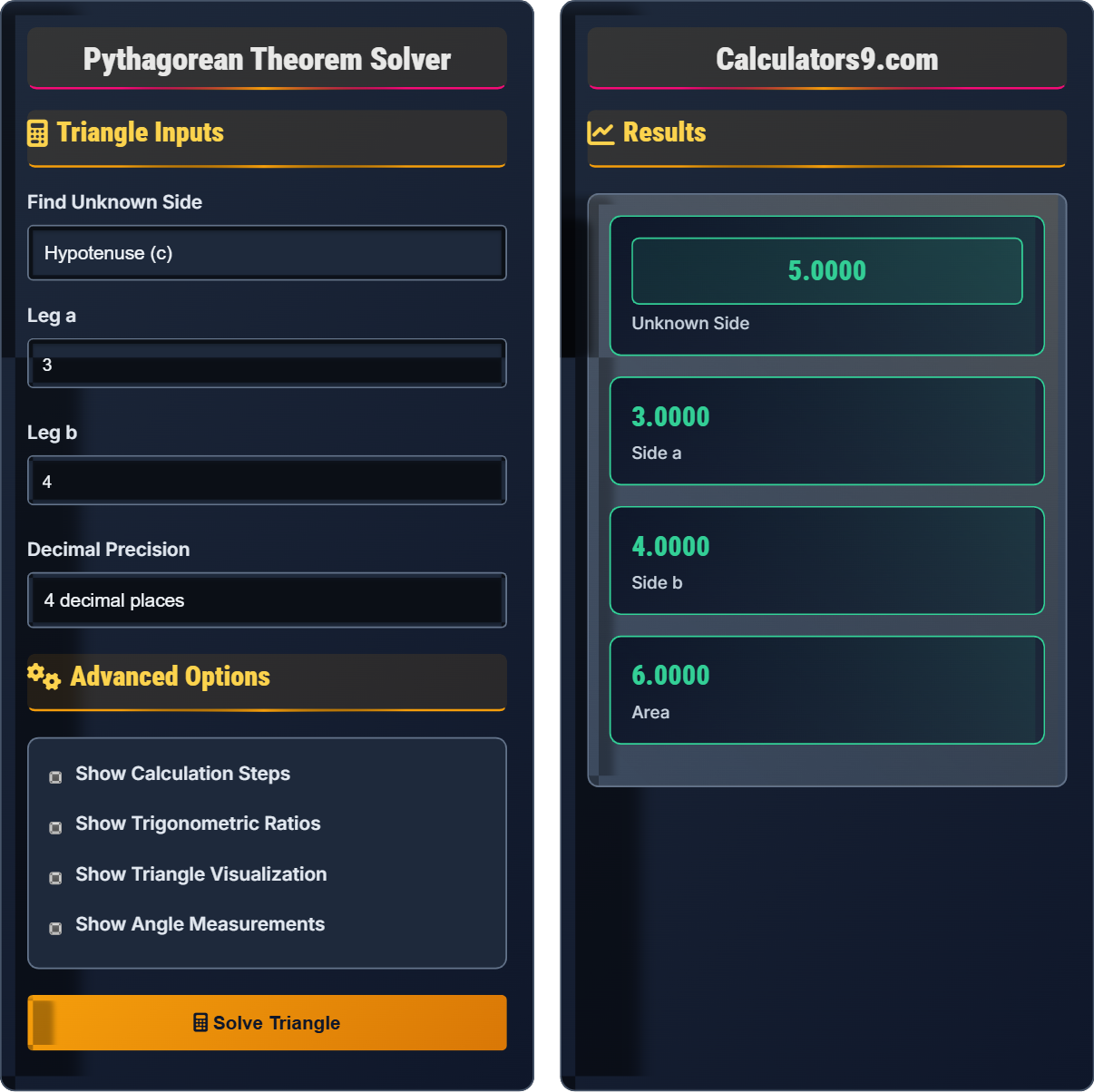
Triangle Inputs
Advanced Options
Results
Pythagorean Theorem Fundamentals
The Pythagorean theorem states that in a right triangle, the square of the hypotenuse (the side opposite the right angle) is equal to the sum of the squares of the other two sides. This fundamental theorem of geometry has been known for thousands of years and is essential for understanding right triangles and their properties.
-
1Standard Form: c² = a² + b²
-
2Solving for Hypotenuse: c = √(a² + b²)
-
Solving for Leg a: a = √(c² - b²)
-
Solving for Leg b: b = √(c² - a²)
-
Converse: If c² = a² + b², then triangle is right triangle
- Applies only to right triangles
- Hypotenuse is always the longest side
- Hypotenuse is opposite the 90° angle
- Can be used to verify if a triangle is right
Special Triangles & Triples
There are several special right triangles that appear frequently in geometry and trigonometry. These triangles have specific angle measures and side length ratios that make calculations easier.
- 45-45-90 Triangle: Isosceles right triangle, sides in ratio 1:1:√2
- 30-60-90 Triangle: Sides in ratio 1:√3:2
- Pythagorean Triples: Integer side lengths (3-4-5, 5-12-13, etc.)
- Similar Triangles: Proportional side lengths
- 45-45-90: Equal legs, hypotenuse = leg × √2
- 30-60-90: Short leg : Long leg : Hypotenuse = 1 : √3 : 2
- Common triples: (3,4,5), (5,12,13), (7,24,25), (8,15,17)
- Scaling maintains ratios: (6,8,10) is 2×(3,4,5)
Pythagorean Theorem Learning Quiz
In a right triangle, if the legs measure 6 units and 8 units, what is the length of the hypotenuse?
The answer is A) 10 units. Using the Pythagorean theorem: c² = a² + b², where a = 6 and b = 8. c² = 6² + 8² = 36 + 64 = 100. Therefore, c = √100 = 10 units. This is the famous 6-8-10 Pythagorean triple, which is a scaled version of the 3-4-5 triple (multiplied by 2).
This problem demonstrates the most basic application of the Pythagorean theorem. The key insight is recognizing that we're solving for the hypotenuse when both legs are known. The calculation is straightforward: square the legs, add them, then take the square root. Notice that 6-8-10 is a Pythagorean triple, which means all sides are integers.
Pythagorean Theorem: c² = a² + b² for right triangles
Hypotenuse: Longest side of right triangle, opposite right angle
Legs: Two shorter sides forming the right angle
• Always identify which side is the hypotenuse
• Square both legs, then add them
• Take the square root of the sum
• Remember: hypotenuse is always longest side
• Check if it's a known Pythagorean triple
• Verify: 6² + 8² = 36 + 64 = 100 = 10²
• Forgetting to take the square root
• Adding the legs before squaring them
• Confusing hypotenuse with a leg
A ladder leans against a wall, reaching a height of 12 feet on the wall. If the base of the ladder is 5 feet away from the wall, how long is the ladder? Show your work.
Step 1: Identify the right triangle
The ladder, wall, and ground form a right triangle where:
- Wall height = 12 feet (one leg)
- Ground distance = 5 feet (other leg)
- Ladder length = unknown hypotenuse
Step 2: Apply the Pythagorean theorem
c² = a² + b²
c² = 5² + 12²
c² = 25 + 144
c² = 169
Step 3: Solve for c
c = √169 = 13 feet
Step 4: Verification
5² + 12² = 25 + 144 = 169 = 13²
Therefore, the ladder is 13 feet long.
This practical problem shows how the Pythagorean theorem applies to real-world situations. The key is recognizing that the ladder, wall, and ground form a right triangle. The ladder acts as the hypotenuse, the wall height is one leg, and the ground distance is the other leg. This is a common application in construction and physics problems.
Right Triangle Formation: Wall ⊥ ground creates 90° angle
Practical Application: Real-world use of geometric principles
Verification: Checking that solution satisfies original equation
• Identify the right angle first
• Determine which side is the hypotenuse
• Apply theorem with correct values
• Draw a diagram to visualize the problem
• Label all known sides
• Check if it matches a Pythagorean triple (5-12-13)
• Misidentifying which sides are legs vs hypotenuse
• Not recognizing the right angle in real-world scenarios
• Arithmetic errors in squaring numbers
A person walks 3 miles east, then turns north and walks 4 miles. How far is the person from the starting point? Express your answer in simplest radical form and as a decimal approximation.
Step 1: Visualize the path
The person walks east, then north, forming a right angle. The direct distance from start to finish forms the hypotenuse of a right triangle.
Step 2: Identify the legs
- Eastward distance = 3 miles (one leg)
- Northward distance = 4 miles (other leg)
Step 3: Apply the Pythagorean theorem
c² = 3² + 4²
c² = 9 + 16
c² = 25
Step 4: Solve for c
c = √25 = 5 miles
Step 5: Decimal approximation
Since √25 = 5, the decimal approximation is exactly 5.0000 miles.
Step 6: Verification
3² + 4² = 9 + 16 = 25 = 5² ✓
Therefore, the person is 5 miles from the starting point.
This problem demonstrates how the Pythagorean theorem calculates direct distances when movements are perpendicular. The key insight is that east-west and north-south directions are perpendicular, forming a right triangle. This principle is used in navigation, mapping, and coordinate geometry.
Direct Distance: Shortest path between two points
Perpendicular Directions: East and north are perpendicular
Coordinate Movement: Movement along perpendicular axes
• Perpendicular movements form right triangles
• Direct distance is the hypotenuse
• Always check if answer makes sense
• Draw a compass rose to visualize directions
• Recognize that north-east movement forms right triangle
• This is a 3-4-5 Pythagorean triple
• Adding distances instead of using Pythagorean theorem
• Not recognizing that directions are perpendicular
• Forgetting that the direct path is the hypotenuse
In a 30-60-90 triangle, the shortest side (opposite the 30° angle) measures 6 inches. Find the lengths of the other two sides using the Pythagorean theorem and verify with special triangle ratios.
Step 1: Understand the 30-60-90 triangle ratios
In a 30-60-90 triangle, the sides are in the ratio 1 : √3 : 2
- Side opposite 30° = shortest side
- Side opposite 60° = shortest side × √3
- Side opposite 90° (hypotenuse) = shortest side × 2
Step 2: Find the other sides using ratios
Given: shortest side = 6 inches
Side opposite 60° = 6√3 ≈ 10.39 inches
Hypotenuse = 6 × 2 = 12 inches
Step 3: Verify using Pythagorean theorem
c² = a² + b²
12² = 6² + (6√3)²
144 = 36 + (36 × 3)
144 = 36 + 108
144 = 144 ✓
Step 4: Alternative verification using Pythagorean theorem directly
Let's say we only knew the shortest side (6) and wanted to find the hypotenuse
Let the side opposite 60° = x, and hypotenuse = y
From the angle relationships, we know x² + 6² = y² (Pythagorean)
Also, from special triangle ratios: x = 6√3 and y = 12
Verification: (6√3)² + 6² = 108 + 36 = 144 = 12² ✓
Therefore, the sides are 6 inches, 6√3 ≈ 10.39 inches, and 12 inches.
This problem demonstrates how special right triangles follow both the Pythagorean theorem and specific ratios. The 30-60-90 triangle ratios (1 : √3 : 2) are derived from the Pythagorean theorem applied to the fundamental 30-60-90 triangle. This shows how general theorems can lead to specialized shortcuts.
30-60-90 Triangle: Right triangle with angles 30°, 60°, 90°
Special Triangle Ratio: 1 : √3 : 2 for sides opposite 30° : 60° : 90°
Derived Ratios: Ratios that follow from Pythagorean theorem
• 30-60-90: shortest : medium : hypotenuse = 1 : √3 : 2
• Always verify special ratios with Pythagorean theorem
• These ratios are shortcuts derived from the theorem
• Memorize 30-60-90 and 45-45-90 ratios
• Use them to check your work
• Remember: hypotenuse is always twice the shortest side in 30-60-90
• Confusing which angle corresponds to which side
• Forgetting that ratios only apply to specific triangles
• Not verifying special ratios with the theorem
Which of the following sets of numbers could represent the sides of a right triangle?
The answer is B) 5, 12, 13. To determine if a set of numbers can represent the sides of a right triangle, we check if they satisfy the Pythagorean theorem (a² + b² = c², where c is the largest number).
A) 2, 3, 4: 2² + 3² = 4 + 9 = 13 ≠ 16 = 4² ❌
B) 5, 12, 13: 5² + 12² = 25 + 144 = 169 = 13² ✓
C) 7, 8, 9: 7² + 8² = 49 + 64 = 113 ≠ 81 = 9² ❌
D) 10, 15, 20: 10² + 15² = 100 + 225 = 325 ≠ 400 = 20² ❌
The set 5, 12, 13 is a famous Pythagorean triple, meaning all three numbers are integers that satisfy the Pythagorean theorem.
This question tests the converse of the Pythagorean theorem: if three numbers satisfy a² + b² = c², then they form a right triangle. Pythagorean triples like (5,12,13) are important because they provide integer solutions to the theorem, making them useful for construction problems and avoiding irrational numbers.
Pythagorean Triple: Three positive integers that satisfy a² + b² = c²
Converse of Pythagorean Theorem: If a² + b² = c², then triangle is right triangle
Integer Solutions: All sides are whole numbers
• Always test the largest number as the potential hypotenuse
• Verify: sum of squares of smaller sides = square of largest side
• Common triples: (3,4,5), (5,12,13), (7,24,25), (8,15,17)
• Check that the largest number is the hypotenuse
• Memorize common Pythagorean triples
• Scaled versions of triples also work (e.g., 6-8-10)
• Not identifying the largest number as potential hypotenuse
• Arithmetic errors when squaring numbers
• Forgetting to verify the largest number is indeed the hypotenuse
FAQ
Q: Does the Pythagorean theorem work for all triangles?
A: No, the Pythagorean theorem only applies to right triangles. The theorem states that in a right triangle, the square of the hypotenuse equals the sum of the squares of the other two sides. For other types of triangles:
Acute triangles: c² < a² + b² (where c is the longest side)
Obtuse triangles: c² > a² + b² (where c is the longest side)
There are generalized versions of the theorem for other triangles, such as the Law of Cosines: c² = a² + b² - 2ab cos(C), which reduces to the Pythagorean theorem when C = 90° (since cos(90°) = 0).
Q: How can I use the Pythagorean theorem in 3D space?
A: The Pythagorean theorem can be extended to 3D space. For a rectangular prism with dimensions length (l), width (w), and height (h), the space diagonal d can be found using:
d² = l² + w² + h²
Distance between two points in 3D: For points (x₁, y₁, z₁) and (x₂, y₂, z₂), the distance is:
d = √[(x₂-x₁)² + (y₂-y₁)² + (z₂-z₁)²]
This is derived by applying the 2D Pythagorean theorem twice: first to find the diagonal of the base, then to find the space diagonal using that base diagonal and the height.
Example: For a box with dimensions 3×4×5, the space diagonal is √(3² + 4² + 5²) = √(9 + 16 + 25) = √50 = 5√2 ≈ 7.07 units.