Sector Area Finder
Circle sector calculator • 2026 standards
Sector Area Formulas:
Show the calculatorFor sector area: \( A = \frac{1}{2} r^2 \theta \) (where θ is in radians)
Alternative: \( A = \frac{\theta}{360°} \times \pi r^2 \) (where θ is in degrees)
Arc length: \( s = r\theta \) (where θ is in radians)
Chord length: \( c = 2r\sin\left(\frac{\theta}{2}\right) \)
Where:
- \( r \) = radius of the circle
- \( \theta \) = central angle in radians
A sector is the region of a circle bounded by two radii and the included arc. The area is proportional to the central angle. When θ = 2π (full circle), the sector area equals the full circle area πr².
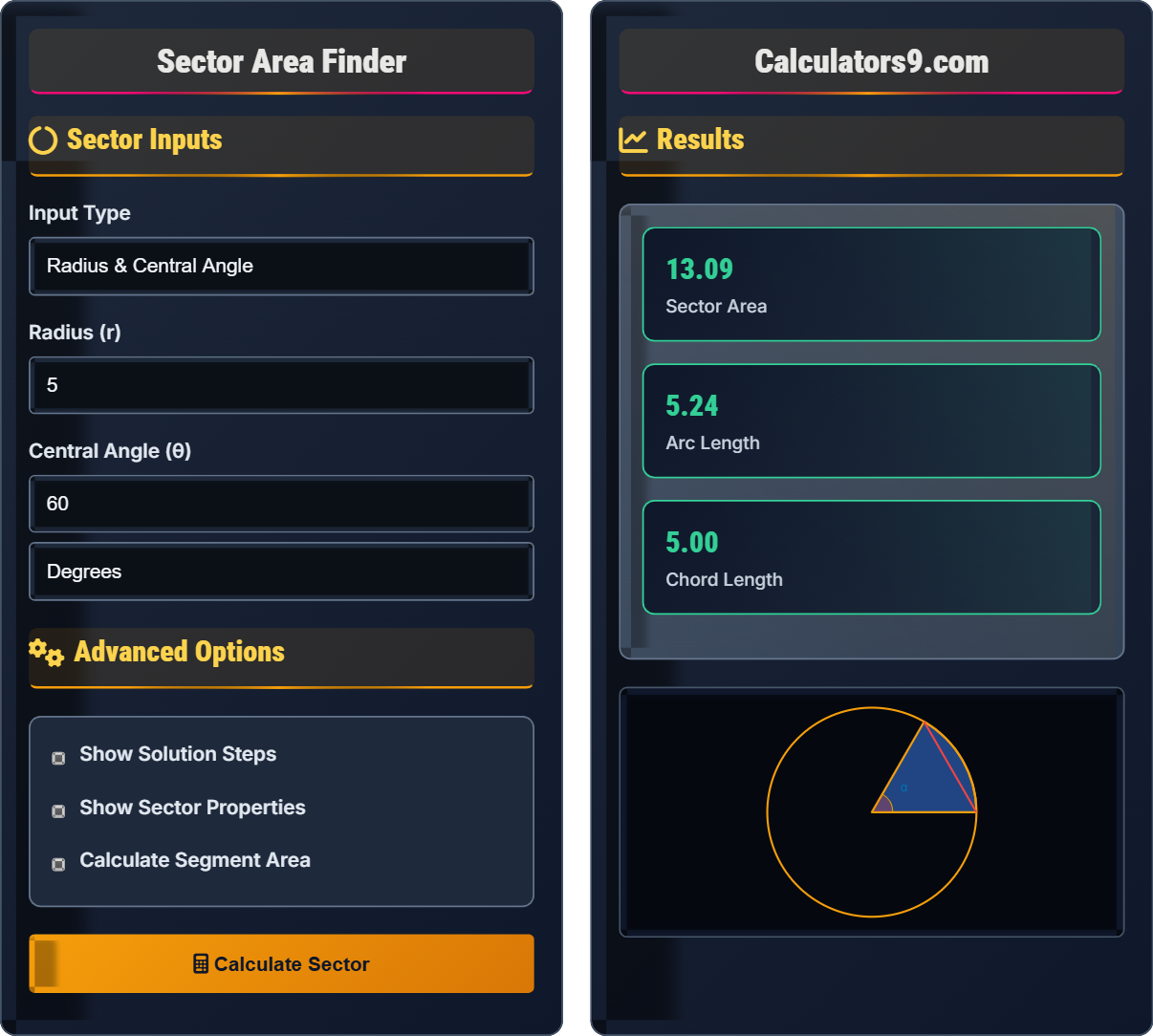
Example: For a circle with radius 5 and central angle 60° (π/3 radians):
\( A = \frac{1}{2} \times 5^2 \times \frac{\pi}{3} = \frac{25\pi}{6} \approx 13.09 \) square units
Arc length: \( s = 5 \times \frac{\pi}{3} = \frac{5\pi}{3} \approx 5.24 \) units
Sector Inputs
Advanced Options
Results
Comprehensive Circle Sector Guide
A circle sector is the portion of a circle enclosed by two radii and the arc between them. It's essentially a "pie slice" of the circle. The angle formed by the two radii at the center of the circle is called the central angle.
For a sector with radius r and central angle θ (in radians):
Alternative formula using degrees:
Additional formulas:
Important related concepts:
- Circular Segment: The region between a chord and its arc (Area = Sector Area - Triangle Area)
- Annulus Sector: A sector of an annulus (ring-shaped region)
- Quadrant: A sector with 90° central angle
- Central Angle: The angle subtended at the center of the circle
- Always convert to radians: For most formulas, use radians for θ
- Proportional reasoning: Sector area is proportional to central angle
- Check angle units: Ensure consistency between angle and formula
- Verify results: Minor sectors should have area less than half the circle
Sector Fundamentals
Region bounded by two radii and an arc.
\( A = \frac{1}{2} r^2 \theta \)
Where r=radius and θ=central angle (in radians).
- Central angle must be in radians for formula
- Area increases with square of radius
- Area is proportional to central angle
Applications
Find area, arc length, chord length.
- Find area given radius and angle
- Find arc length given radius and angle
- Find chord length given radius and angle
- Find segment area (sector minus triangle)
- Convert degrees to radians if needed
- Check angle range (0° to 360°)
- Verify solution makes sense
- Units must be consistent
Sector Area Learning Quiz
What is the area of a sector with radius 8 and central angle 45°? Which of the following is correct?
The answer is B) 8π square units. Using the sector area formula: A = (θ/360°) × πr². For r=8 and θ=45°: A = (45°/360°) × π × 8² = (1/8) × π × 64 = 8π square units.
This problem demonstrates the application of the sector area formula when the angle is given in degrees. The key is recognizing that the area is proportional to the central angle. Since 45° is 1/8 of a full circle (360°), the sector area is 1/8 of the full circle area. This proportional thinking is often more intuitive than working with the formula directly.
Circle Sector: Region bounded by two radii and an arc
Central Angle: Angle subtended at the center of the circle
Proportional Reasoning: Using ratios to solve geometric problems
• Use the appropriate formula based on angle units
• The area is proportional to the central angle• A full circle is 360° or 2π radians
• Remember: 45° = π/4 radians
• Use proportional reasoning: 45°/360° = 1/8
• The full circle area is πr²
• Forgetting to convert between degrees and radians
• Using the wrong formula for the given units
• Making arithmetic errors with fractions
Find the arc length of a sector with radius 10 cm and central angle π/3 radians. Then find the area of the sector. Show your complete work.
Step 1: Calculate the arc length using s = rθ: Given: r = 10 cm, θ = π/3 radians s = rθ = 10 × (π/3) = 10π/3 cm s ≈ 10.47 cm
Step 2: Calculate the sector area using A = (1/2)r²θ: A = (1/2) × r² × θ A = (1/2) × 10² × (π/3) A = (1/2) × 100 × (π/3) A = 50π/3 cm² A ≈ 52.36 cm²
Therefore, the arc length is 10π/3 cm (≈10.47 cm) and the area is 50π/3 cm² (≈52.36 cm²).
This problem demonstrates the use of the radian-based formulas for both arc length and sector area. When the angle is already in radians, the calculations are straightforward. The arc length formula s = rθ shows that arc length is directly proportional to both radius and central angle. The sector area formula A = (1/2)r²θ is derived from the proportion of the sector to the full circle.
Arc Length: The distance along the curved line of the arc
Radians: A unit of angular measure where the arc length equals the radius
Proportionality: Direct relationship between two quantities
• When θ is in radians, use s = rθ for arc length
• When θ is in radians, use A = (1/2)r²θ for area
• Always check that units are consistent
• Remember: 1 radian ≈ 57.3°
• π/3 radians = 60°
• When θ is in radians, the formulas are simpler
• Using the degree formula when angle is in radians
• Forgetting the 1/2 factor in the area formula
• Mixing up units between radians and degrees
A pizza has a diameter of 16 inches. If a slice has a central angle of 72°, what is the area of the slice? If the pizza costs $20, what is the cost per square inch of this slice?
First, find the radius of the pizza: r = diameter/2 = 16/2 = 8 inches
Now calculate the area of the slice using the sector area formula: A = (θ/360°) × πr² A = (72°/360°) × π × 8² A = (1/5) × π × 64 A = 64π/5 square inches A ≈ 40.21 square inches
To find the cost per square inch of the slice: The slice represents 72°/360° = 1/5 of the whole pizza Cost of slice = (1/5) × $20 = $4 Cost per square inch = $4 / 40.21 square inches ≈ $0.10 per square inch
Therefore, the area of the slice is approximately 40.21 square inches, and the cost per square inch is about $0.10.
This real-world application combines geometric calculations with proportional reasoning. The problem demonstrates how sectors appear in everyday life (pizza slices) and how to calculate both area and cost per unit area. The key insight is that the slice represents 1/5 of the whole pizza, so both the area and the cost of the slice are 1/5 of the total.
Radius: Distance from center to edge of circle
Diameter: Distance across circle through center
Cost per Unit Area: Price divided by area covered• Area of sector is proportional to central angle
• Cost is distributed proportionally to area
• Convert diameter to radius for formulas
• 72° = 1/5 of full circle (360°)
• Convert diameter to radius immediately
• Always check that your answer makes sense
• Using diameter instead of radius in formulas
• Forgetting to convert diameter to radius
• Not accounting for proportional cost distribution
Find the area of the circular segment (the region between a chord and its arc) for a circle with radius 10 units and a central angle of 60°. Hint: Segment Area = Sector Area - Triangle Area.
Step 1: Calculate the sector area: A_sector = (θ/360°) × πr² A_sector = (60°/360°) × π × 10² A_sector = (1/6) × π × 100 A_sector = 100π/6 = 50π/3 square units
Step 2: Calculate the triangle area (formed by the two radii and the chord): The triangle is isosceles with two sides of length r=10 and included angle θ=60° A_triangle = (1/2) × r² × sin(θ) A_triangle = (1/2) × 10² × sin(60°) A_triangle = (1/2) × 100 × (√3/2) A_triangle = 25√3 square units
Step 3: Calculate the segment area: A_segment = A_sector - A_triangle A_segment = 50π/3 - 25√3 A_segment ≈ 52.36 - 43.30 ≈ 9.06 square units
Therefore, the area of the circular segment is approximately 9.06 square units.
This problem introduces the concept of a circular segment, which is the region between a chord and its arc. The solution requires calculating both the sector area and the triangle area formed by the two radii and the chord. The triangle area formula (1/2)ab sin(C) is particularly useful here since we know two sides and the included angle. This demonstrates how complex geometric regions can be broken down into simpler components.
Circular Segment: Region between a chord and its arc
Isosceles Triangle: Triangle with two equal sides
Triangle Area Formula: (1/2)ab sin(C) for two sides and included angle
• Segment Area = Sector Area - Triangle Area
• Use the triangle area formula when two sides and included angle are known
• sin(60°) = √3/2
• Remember: sin(60°) = √3/2 ≈ 0.866
• π ≈ 3.14159
• Break complex shapes into simpler components
• Forgetting to subtract the triangle area from sector area
• Using the wrong triangle area formula
• Confusing segment area with sector area
Which of the following statements about circle sectors is TRUE?
The answer is B) The area of a sector is proportional to the central angle. Looking at the formula A = (θ/360°) × πr², the area is directly proportional to the central angle θ. Statement A is incorrect because area is proportional to θ, not θ². Statement C is incorrect because area is proportional to r². Statement D is true but B is more fundamental to the nature of sectors.
This question tests understanding of the fundamental relationship between sector area and central angle. The key insight is that when the radius is fixed, doubling the central angle doubles the area. This linear relationship is crucial for understanding how sectors behave. The area depends linearly on the central angle and quadratically on the radius, which is why a sector with twice the angle has twice the area, but a sector with twice the radius has four times the area.
Proportionality: Direct relationship between two quantities
Semicircle: Half of a circle (180° central angle)
Linear Relationship: One quantity changes directly with another
• Sector area ∝ central angle (linear relationship)
• Sector area ∝ radius² (quadratic relationship)
• 180° sector = semicircle
• Area changes linearly with angle (for fixed radius)
• Area changes quadratically with radius (for fixed angle)
• A 90° sector is 1/4 of the full circle
• Confusing linear and quadratic relationships
• Thinking area depends on angle squared
• Forgetting the role of radius in the formula
FAQ
Q: What's the difference between a sector and a segment of a circle?
A: A circle sector is the region bounded by two radii and the included arc, like a "pie slice." A circle segment is the region bounded by a chord and the arc subtended by that chord.
Mathematically:
- Sector Area: \( A_{\text{sector}} = \frac{1}{2} r^2 \theta \) (where θ is in radians)
- Segment Area: \( A_{\text{segment}} = A_{\text{sector}} - A_{\text{triangle}} \)
The segment is what remains when you "cut off" the triangular portion from the sector.
Q: How do I calculate sector properties in real-world applications?
A: In real-world applications, sectors appear in many contexts:
- Architecture: Designing arches, domes, and curved structures
- Engineering: Calculating material needs for curved surfaces
- Agriculture: Irrigation sectors in circular sprinkler systems
- Manufacturing: Creating pie-shaped components
For practical measurements:
- Measure the radius and central angle directly
- Use the arc length formula: \( s = r\theta \)
- Calculate area with: \( A = \frac{1}{2} r^2 \theta \)
Ensure your angle measurements are in radians for these formulas.