Surface Area Calculator
3D geometry tool • 2026 edition
Common Surface Area Formulas:
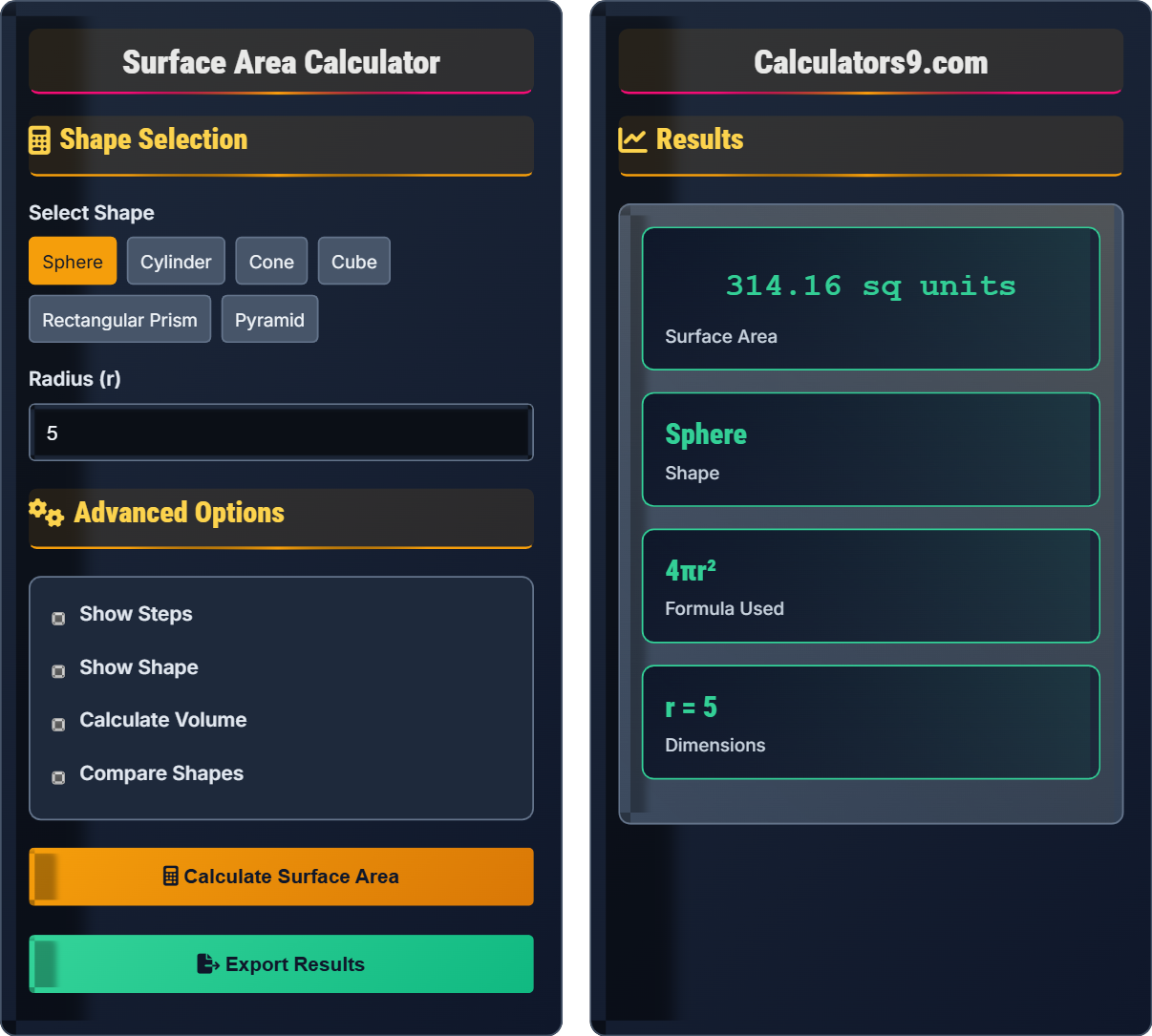
- Sphere: SA = 4πr²
- Cylinder: SA = 2πr² + 2πrh = 2πr(r + h)
- Cone: SA = πr² + πrl = πr(r + l), where l is slant height
- Rectangular Prism: SA = 2(lw + lh + wh)
- Square Pyramid: SA = b² + 2bs, where b is base side and s is slant height
- Cube: SA = 6s², where s is side length
Volume Formulas (for reference):
- Sphere: V = (4/3)πr³
- Cylinder: V = πr²h
- Cone: V = (1/3)πr²h
- Rectangular Prism: V = lwh
Example: For a cylinder with radius r = 3 and height h = 5:
SA = 2πr(r + h) = 2π(3)(3 + 5) = 6π(8) = 48π ≈ 150.80 square units
Shape Selection
Advanced Options
Results
Comprehensive 3D Geometry Guide
Surface area is the total area of all the faces or surfaces of a three-dimensional shape. It measures the amount of material needed to cover the exterior of a 3D object. Unlike volume, which measures the space inside, surface area measures the outer boundary.
Key surface area formulas for common 3D shapes:
- Sphere: SA = 4πr² - all surface area is curved
- Cylinder: SA = 2πr² + 2πrh - two circular bases plus curved lateral surface
- Cone: SA = πr² + πrl - circular base plus curved lateral surface
- Cube: SA = 6s² - six identical square faces
- Rectangular Prism: SA = 2(lw + lh + wh) - three pairs of rectangular faces
Things to watch out for when calculating surface area:
- Hollow shapes: Subtract inner surface areas for hollow cylinders or spheres
- Missing faces: Adjust formulas for open containers or truncated shapes
- Unit consistency: Ensure all dimensions are in the same units
- Slant heights: For cones/pyramids, use slant height, not vertical height
- Construction: Calculating materials needed for walls, roofs, or containers
- Manufacturing: Determining coating, painting, or wrapping requirements
- Engineering: Heat transfer calculations based on exposed surface area
- Biology: Understanding surface area to volume ratios in cells
- Chemistry: Reaction rates affected by surface area of reactants
3D Geometry Fundamentals
Surface area is the sum of all areas of the faces or surfaces of a 3D object, measured in square units.
Method: Sum the areas of all individual faces of the 3D shape.
- Surface area is always expressed in square units
- Curved surfaces require special formulas (not length × width)
- Different shapes have different surface area formulas
- Account for all surfaces including bases and lateral faces
Advanced Concepts
The ratio of surface area to volume is critical in many scientific applications.
- Exclude base(s) from total surface area
- For cylinder: LSA = 2πrh
- For cone: LSA = πrl
- For prism: LSA = perimeter of base × height
- Linear dimensions scale by factor k
- Surface area scales by factor k²
- Volume scales by factor k³
3D Geometry Learning Quiz
Find the surface area of a cylinder with radius 4 cm and height 7 cm. Show all steps and explain each component of the formula.
Step 1: Identify the given values: radius r = 4 cm, height h = 7 cm
Step 2: Identify the formula for cylinder surface area: SA = 2πr² + 2πrh
Explanation of formula components:
- 2πr² = area of two circular bases (top and bottom)
- 2πrh = area of the curved lateral surface
Step 3: Substitute values into the formula:
SA = 2π(4)² + 2π(4)(7)
SA = 2π(16) + 2π(28)
SA = 32π + 56π
SA = 88π cm²
Step 4: Calculate decimal approximation:
SA = 88π ≈ 88 × 3.14159 ≈ 276.46 cm²
Therefore, the surface area is 88π cm² or approximately 276.46 cm².
This problem demonstrates how the surface area of a cylinder combines the areas of its geometric components. The cylinder has two circular bases (each with area πr²) and one curved lateral surface (which unfolds to form a rectangle with dimensions circumference × height = 2πr × h). Understanding the geometric origin of each term in the formula helps with memorization and problem-solving.
Breaking down the total surface area into its components makes the calculation more intuitive.
Surface Area: The total area of all faces/surfaces of a 3D shape
Lateral Surface: The curved or side surface excluding bases
Cylinder: A 3D shape with two parallel circular bases connected by a curved surface
• Always include both circular bases in the total surface area
• The lateral surface area is 2πrh
• Express surface area in square units
• Remember: SA = 2(circular base area) + (lateral area)
• Visualize unfolding the curved surface to form a rectangle
• Check that all dimensions use the same unit
• Forgetting to include both circular bases
• Confusing lateral surface area with total surface area
• Using diameter instead of radius in formulas
A cylindrical water tank has a diameter of 6 feet and a height of 10 feet. The tank needs to be painted on the outside. How much surface area needs to be painted? If paint covers 200 square feet per gallon, how many gallons of paint are needed?
Step 1: Find the radius from diameter: r = diameter/2 = 6/2 = 3 feet
Step 2: Identify the given values: r = 3 ft, h = 10 ft
Step 3: Calculate surface area (assuming closed cylinder):
SA = 2πr² + 2πrh
SA = 2π(3)² + 2π(3)(10)
SA = 2π(9) + 2π(30)
SA = 18π + 60π = 78π
SA ≈ 78 × 3.14159 ≈ 245.04 square feet
Step 4: Calculate paint needed:
Gallons needed = Surface area ÷ Coverage per gallon
Gallons needed = 245.04 ÷ 200 = 1.225 gallons
Since paint is sold in whole gallons, round up to 2 gallons.
Therefore, approximately 245.04 square feet need to be painted, requiring 2 gallons of paint.
This application problem connects surface area calculations to a practical scenario. The key insight is that painting the tank requires covering all external surfaces, which is the total surface area of the cylinder. The problem also demonstrates the importance of rounding up in practical applications since partial gallons of paint aren't typically available.
Converting between diameter and radius is a common step in real-world problems.
Application Problem: A math problem set in a real-world context
Coverage Rate: The area that can be covered by a unit amount of material
Practical Rounding: Adjusting calculated values to meet real-world constraints
• Convert diameter to radius before using formulas
• Always round up when calculating materials needed
• Check that units are consistent throughout the problem
• Draw a diagram to visualize the problem
• Identify what surfaces need to be measured
• Consider practical constraints in real-world applications
• Forgetting to convert diameter to radius
• Not accounting for all surfaces that need coverage
• Forgetting to round up for practical applications
FAQ
Q: How do I find the surface area of a cone, and what's the difference between slant height and vertical height?
A: The surface area of a cone is: SA = πr² + πrl
Where:
- r = radius of the base
- l = slant height (distance along the surface from apex to base edge)
- πr² = area of the circular base
- πrl = area of the curved lateral surface
Slant Height vs Vertical Height:
Vertical Height (h): The perpendicular distance from the apex to the center of the base
Slant Height (l): The distance along the curved surface from apex to any point on the base edge
The relationship between them is: l² = r² + h² (by the Pythagorean theorem)
For surface area calculations, you need the slant height, not the vertical height!
Q: What is the surface area to volume ratio and why is it important in science?
A: The surface area to volume ratio (SA:V) is calculated as Surface Area ÷ Volume.
Importance in Science:
Biology: Cells with high SA:V ratios (like thin, flat cells) can exchange materials more efficiently with their environment. As cells grow larger, their SA:V decreases, which limits their ability to exchange nutrients and waste.
Chemistry: Reactions occur at surfaces, so materials with high SA:V (like powders) react faster than bulk materials.
Physics: Heat loss/gain is proportional to surface area, while heat capacity is proportional to volume. Small objects lose heat faster relative to their mass than large objects.
For a cube with side length s: SA = 6s², V = s³, so SA:V = 6s²/s³ = 6/s. As s increases, SA:V decreases.