Acceleration Timer
Physics & Engineering Tool • Motion Analysis
Acceleration Formula:
Show the calculator\( a = \frac{v_f - v_i}{t} \)
\( v_f = v_i + at \)
\( s = v_i t + \frac{1}{2}at^2 \)
Where:
- \( a \) = acceleration (m/s²)
- \( v_i \) = initial velocity (m/s)
- \( v_f \) = final velocity (m/s)
- \( t \) = time (s)
- \( s \) = displacement (m)
These fundamental equations describe the relationship between acceleration, velocity, time, and displacement for objects moving with constant acceleration.
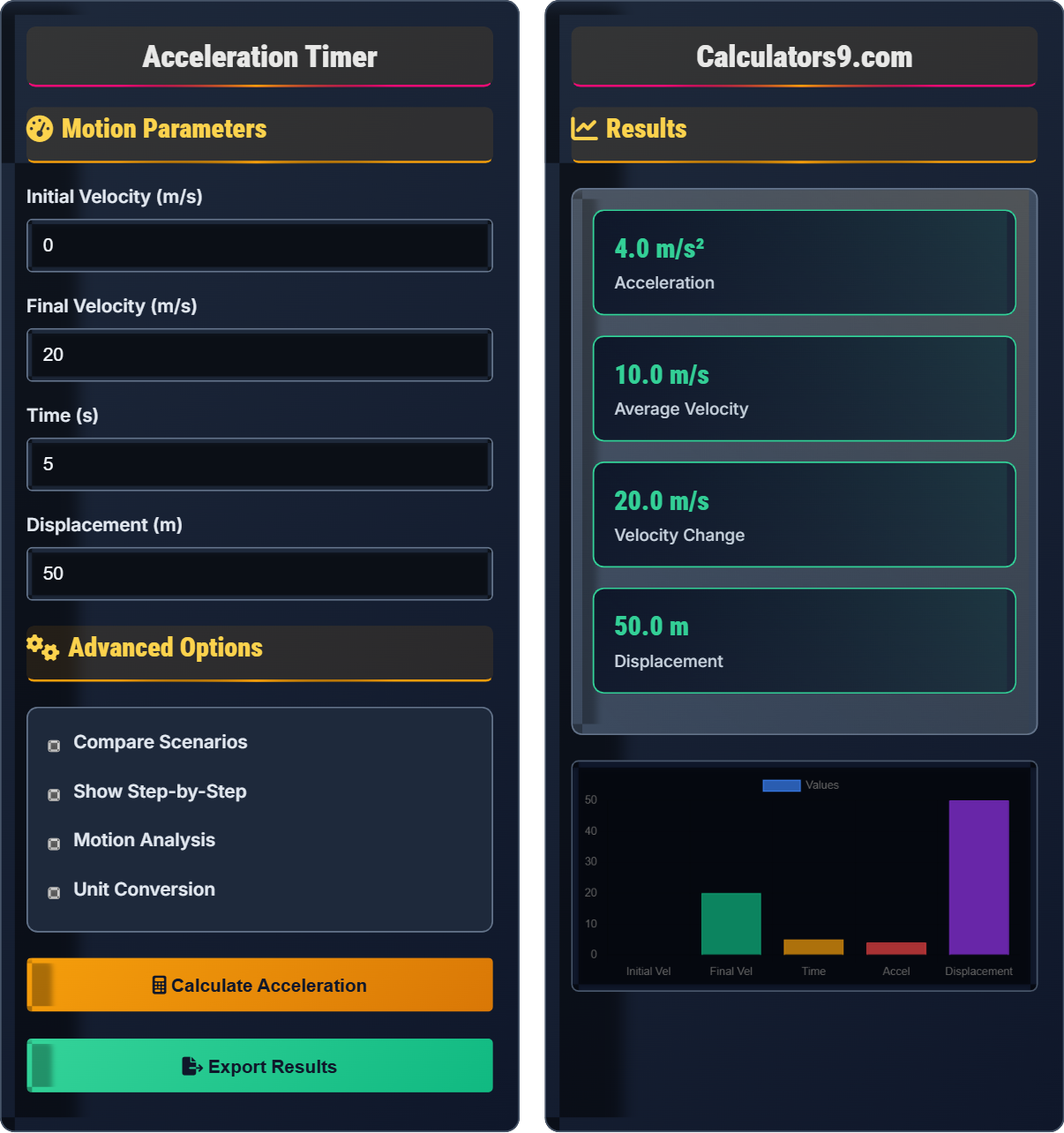
Example: A car accelerates from 0 m/s to 20 m/s in 5 seconds:
\( a = \frac{20 - 0}{5} = 4 \) m/s²
\( s = 0 \times 5 + \frac{1}{2} \times 4 \times 5^2 = 50 \) m
Thus, the car accelerates at 4 m/s² and travels 50 meters.
Motion Parameters
Advanced Options
Results
| Parameter | Value | Unit |
|---|---|---|
| Initial Velocity | 0.0 | m/s |
| Final Velocity | 20.0 | m/s |
| Acceleration | 4.0 | m/s² |
| Time | 5.0 | s |
| Displacement | 50.0 | m |
| Scenario | Initial Vel. (m/s) | Final Vel. (m/s) | Time (s) | Accel. (m/s²) | Displacement (m) |
|---|---|---|---|---|---|
| Scenario 1 | 0.0 | 20.0 | 5.0 | 4.0 | 50.0 |
| Scenario 2 | 5.0 | 15.0 | 10.0 | 1.0 | 100.0 |
Based on the calculated acceleration of 4.0 m/s², this represents a moderate acceleration suitable for automotive applications. The displacement of 50 meters occurs over 5 seconds, indicating efficient acceleration from rest.
Key insights:
- Acceleration rate: Moderate (4.0 m/s²)
- Velocity gain: 20 m/s over 5 seconds
- Average velocity: 10 m/s
- Distance covered: 50 meters
Acceleration Fundamentals
Acceleration is the rate of change of velocity with respect to time. It is a vector quantity that describes how quickly an object's velocity changes. Acceleration can be positive (speeding up) or negative (slowing down, also called deceleration). The SI unit for acceleration is meters per second squared (m/s²).
The fundamental acceleration formula is:
Where:
- \(a\) = acceleration (m/s²)
- \(v_f\) = final velocity (m/s)
- \(v_i\) = initial velocity (m/s)
- \(t\) = time (s)
Acceleration calculations are essential in numerous fields:
- Automotive: Car performance metrics, braking systems, safety
- Aerospace: Rocket launches, spacecraft maneuvers, g-force analysis
- Engineering: Machinery design, vibration analysis, control systems
- Sports: Performance analysis, training optimization, biomechanics
- Car accelerating from 0 to 60 mph in 6 seconds
- Aircraft taking off with constant acceleration
- Ball thrown vertically experiencing gravitational acceleration
- Train decelerating to stop at a station
Acceleration Concepts
Acceleration is the rate of change of velocity per unit time.
\(a = \frac{v_f - v_i}{t}\)
Where a=acceleration, v_f=final velocity, v_i=initial velocity, t=time.
- Acceleration = change in velocity ÷ time
- Positive = speeding up
- Negative = slowing down
Applications
Average acceleration = total change in velocity ÷ total time
- Measure initial and final velocities
- Record time interval
- Calculate acceleration
- Interpret results
- Gravitational acceleration: g = 9.8 m/s²
- Standard human tolerance: ~5g
- Vehicle acceleration: 2-5 m/s²
- Formula 1 cars: up to 6g
Acceleration Learning Quiz
When a car is moving forward and slowing down, what is the direction of its acceleration?
The answer is B) Backward (opposite to motion). When a car is moving forward and slowing down, the acceleration is in the backward direction (opposite to the direction of motion). This is called negative acceleration or deceleration. The acceleration vector points in the direction of the change in velocity, which in this case is opposite to the forward motion.
This question tests the understanding that acceleration is the direction of the change in velocity, not necessarily the direction of motion. Even when moving forward, if the velocity is decreasing, the acceleration points in the opposite direction. This concept is crucial for understanding motion dynamics.
Acceleration: Rate of change of velocity
Deceleration: Negative acceleration (slowing down)
Vector: Quantity with magnitude and direction
• Acceleration direction = direction of velocity change
• Slowing down = acceleration opposite to motion
• Acceleration can be positive or negative
• Think: "What direction is velocity changing?"
• Remember: acceleration ≠ direction of motion
• Confusing acceleration direction with motion direction
• Assuming acceleration always matches motion direction
A sports car accelerates from rest to 30 m/s in 6 seconds, then maintains that speed for 10 seconds. Calculate the car's acceleration during the first phase and the total distance traveled during both phases.
Phase 1: Acceleration Phase
Initial velocity (v_i) = 0 m/s
Final velocity (v_f) = 30 m/s
Time (t) = 6 s
Step 1: Calculate acceleration
a = (v_f - v_i) / t
a = (30 - 0) / 6 = 5 m/s²
Step 2: Calculate distance during acceleration
s = v_i*t + ½*a*t²
s = 0*6 + ½*5*6²
s = 0 + ½*5*36 = 90 m
Phase 2: Constant Velocity Phase
Velocity (v) = 30 m/s
Time (t) = 10 s
Distance (s) = v*t = 30*10 = 300 m
Total Distance:
Total distance = 90 + 300 = 390 m
The car accelerates at 5 m/s² during the first phase and travels a total distance of 390 meters.
This problem demonstrates motion in two distinct phases: acceleration followed by constant velocity. It's important to analyze each phase separately using the appropriate kinematic equations. During constant velocity, acceleration is zero, so we use the simpler distance = velocity × time formula.
Constant Velocity: Zero acceleration, uniform motion
Uniform Acceleration: Constant rate of velocity changeRest: Zero initial velocity
• For uniform acceleration: a = (v_f - v_i) / t
• For constant velocity: s = v*t
• Total distance = sum of distances in each phase
• Break multi-phase problems into separate parts
• Use appropriate equations for each phase
• Always check if acceleration is constant
• Applying acceleration formulas to constant velocity phases
• Forgetting to account for both phases of motion
• Mixing up kinematic equations
FAQ
Q: What's the difference between acceleration and velocity, and how are they related?
A: Velocity is the rate of change of displacement (how fast an object is moving and in what direction), while acceleration is the rate of change of velocity (how quickly the velocity is changing).
Mathematically, acceleration is the derivative of velocity with respect to time: \(a = \frac{dv}{dt}\). If velocity is constant, acceleration is zero. If velocity is changing, there is non-zero acceleration.
For example, a car traveling at a constant 60 km/h has velocity but zero acceleration. When the driver presses the accelerator, the car gains velocity, creating positive acceleration. When braking, the car experiences negative acceleration (deceleration).
Q: How do acceleration calculations apply to real-world engineering problems?
Can you provide examples of how these concepts are used in practice?
A: Acceleration calculations are fundamental in engineering applications:
- Automotive: Crash test analysis, airbag deployment timing, brake system design
- Aerospace: Launch vehicle staging, reentry g-forces, satellite orbit adjustments
- Structural: Earthquake-resistant building design, vibration analysis
- Manufacturing: Conveyor system design, robotic arm motion planning
For example, when designing a car's suspension system, engineers calculate expected accelerations during various driving conditions to ensure passenger comfort and vehicle stability. They also consider maximum tolerable accelerations for safety systems.