Capacitance Combiner
Physics & Engineering Tool • Electrical Calculations
Capacitor Combination Formulas:
Show the calculatorSeries: \( \frac{1}{C_{eq}} = \frac{1}{C_1} + \frac{1}{C_2} + \frac{1}{C_3} + ... + \frac{1}{C_n} \)
Parallel: \( C_{eq} = C_1 + C_2 + C_3 + ... + C_n \)
Charge: \( Q = C \times V \)
Energy: \( E = \frac{1}{2}CV^2 \)
Where:
- \( C_{eq} \) = equivalent capacitance (F)
- \( C_i \) = individual capacitance (F)
- \( Q \) = charge stored (Coulombs)
- \( V \) = voltage across capacitor (V)
- \( E \) = energy stored (Joules)
These formulas describe how capacitors combine in series and parallel configurations. In series, the equivalent capacitance is less than any individual capacitor, while in parallel, it's the sum of all capacitances.
Example: Two capacitors in series: C₁=10μF, C₂=20μF
\( \frac{1}{C_{eq}} = \frac{1}{10} + \frac{1}{20} = \frac{2+1}{20} = \frac{3}{20} \)
\( C_{eq} = \frac{20}{3} = 6.67 \) μF
If V = 12V, then Q = 6.67μF × 12V = 80μC
Thus, equivalent capacitance is 6.67μF and total charge is 80μC.
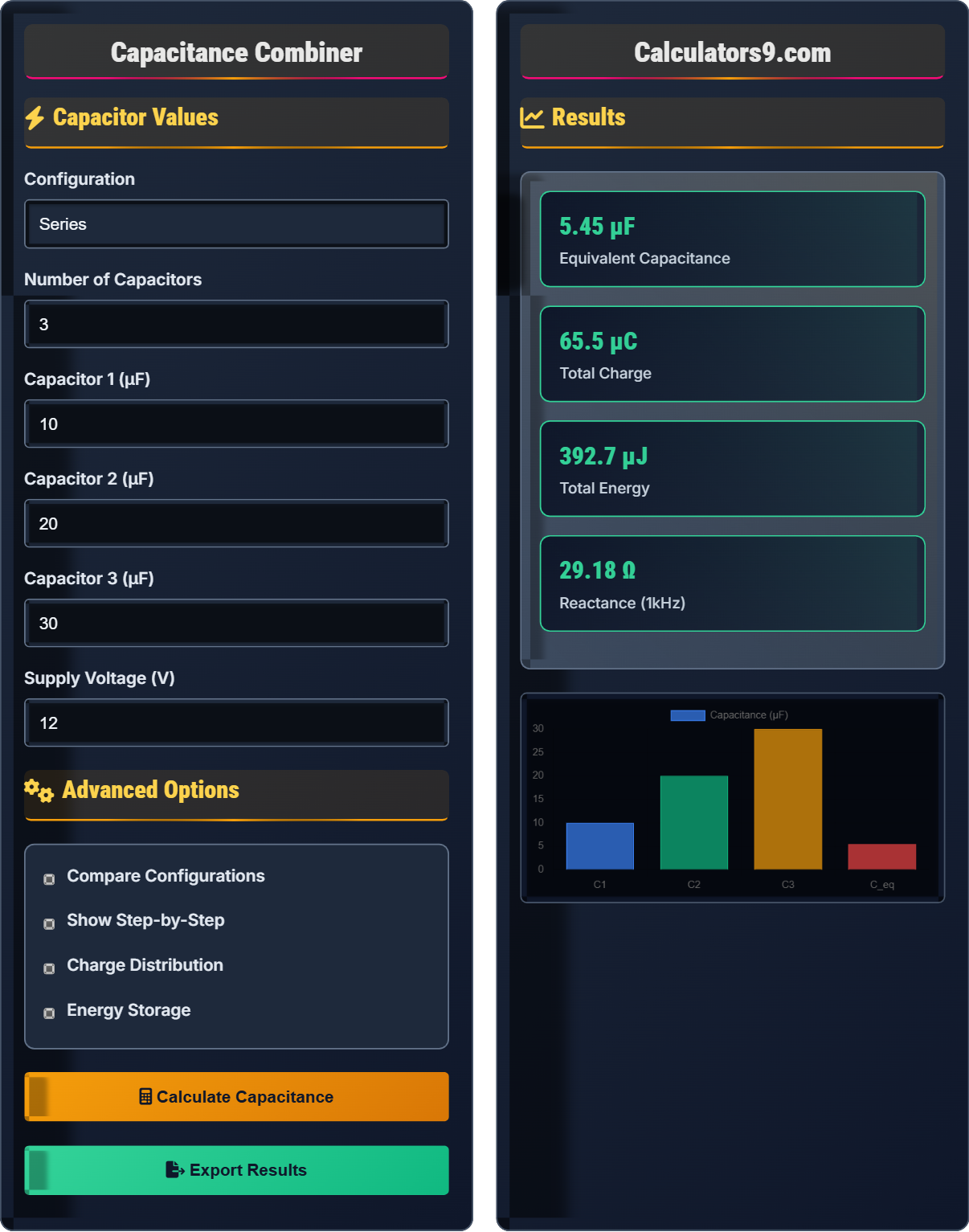
Capacitor Values
Advanced Options
Results
| Parameter | Value | Unit |
|---|---|---|
| Equivalent Capacitance | 6.67 | μF |
| Total Charge | 80.0 | μC |
| Total Energy | 480.0 | μJ |
| Supply Voltage | 12.0 | V |
| Configuration | Series | - |
| Capacitor | Capacitance (μF) | Voltage (V) | Charge (μC) | Energy (μJ) |
|---|---|---|---|---|
| C₁ | 10.0 | 6.0 | 60.0 | 180.0 |
| C₂ | 20.0 | 3.0 | 60.0 | 90.0 |
| C₃ | 30.0 | 2.0 | 60.0 | 60.0 |
Based on the calculated capacitance of 6.67 μF at 12V:
- Total Energy: 480.0 μJ
- Energy Density: 480.0 μJ/μF
- Time Constant: RC (depends on circuit resistance)
- Power Rating: Based on charging/discharging rate
Energy is stored in the electric field between capacitor plates and can be released when needed.
Capacitance Fundamentals
Capacitance is the ability of a component to store electrical charge. A capacitor consists of two conductive plates separated by an insulating material (dielectric). When voltage is applied, charges accumulate on the plates, creating an electric field between them.
The fundamental formulas for combining capacitors are:
Parallel: \(C_{eq} = C_1 + C_2 + C_3 + ... + C_n\)
Charge: \(Q = C \times V\)
Energy: \(E = \frac{1}{2}CV^2\)
Where:
- \(C_{eq}\) = equivalent capacitance (F)
- \(C_i\) = individual capacitance (F)
- \(Q\) = charge stored (Coulombs)
- \(V\) = voltage across capacitor (V)
- \(E\) = energy stored (Joules)
Capacitor combinations are essential in numerous fields:
- Electronics: Filtering, coupling, decoupling, timing circuits
- Power Systems: Power factor correction, energy storage
- Signal Processing: Filters, oscillators, integrators
- Energy Storage: Supercapacitors, pulse power systems
- Audio crossover networks using series/parallel combinations
- Power supply filter circuits
- Timing circuits in digital systems
- Energy storage in camera flash circuits
Capacitance Concepts
Capacitance: Ability to store electric charge per unit voltage.
\(C_{eq} = \sum C_i\) (parallel)
\(\frac{1}{C_{eq}} = \sum \frac{1}{C_i}\) (series)
Where C_eq = equivalent capacitance of combination.
- Series: C_eq < any individual C
- Parallel: C_eq > any individual C
- Charge conserved in series
Applications
Energy stored: E = ½CV²
- Identify series and parallel sections
- Combine capacitors step by step
- Calculate total charge and energy
- Determine individual values
- Voltage rating affects safety
- Dielectric affects performance
- Frequency affects reactance
- Temperature affects capacitance
Capacitance Learning Quiz
How does the equivalent capacitance of two identical capacitors compare when connected in series versus parallel?
The answer is B) Series is half of Parallel. For two identical capacitors C:
Series: C_eq = C/2
Parallel: C_eq = 2C
So series capacitance is half of parallel capacitance.
This question tests the fundamental understanding of how capacitors combine differently in series and parallel. In series, the equivalent capacitance decreases (less than smallest), while in parallel, it increases (sum of all). This is opposite to how resistors behave, which often confuses students.
Capacitance: Charge storage ability
Series: Connected end-to-end
Parallel: Connected side-by-side
• Series: C_eq = (1/C₁ + 1/C₂)⁻¹
• Parallel: C_eq = C₁ + C₂
• Capacitors behave oppositely to resistors
• Remember: Capacitors add in parallel
• Series is like resistors in parallel
• Using resistor formulas for capacitors
• Forgetting that series decreases capacitance
Two capacitors (C₁=6μF, C₂=12μF) are connected in series to a 18V battery. Calculate the equivalent capacitance, total charge, and voltage across each capacitor.
Step 1: Calculate equivalent capacitance
1/C_eq = 1/C₁ + 1/C₂ = 1/6 + 1/12 = 2/12 + 1/12 = 3/12 = 1/4
C_eq = 4μF
Step 2: Calculate total charge
Q_total = C_eq × V = 4μF × 18V = 72μC
Step 3: Calculate voltage across each capacitor
In series, charge is the same on each capacitor:
V₁ = Q/C₁ = 72μC / 6μF = 12V
V₂ = Q/C₂ = 72μC / 12μF = 6V
Step 4: Verify voltage division
V_total = V₁ + V₂ = 12V + 6V = 18V ✓
Verification: The smaller capacitor (6μF) has more voltage drop (12V) than the larger one (12μF) which has 6V, demonstrating that voltage divides inversely proportional to capacitance in series circuits.
The equivalent capacitance is 4μF, total charge is 72μC, with 12V across C₁ and 6V across C₂.
This problem demonstrates the inverse relationship between capacitance and voltage in series circuits. The 6μF capacitor has half the capacitance of the 12μF capacitor, so it develops twice the voltage (12V vs 6V). This is because in series, charge is constant across all capacitors, so V = Q/C, meaning voltage is inversely proportional to capacitance.
Series Capacitors: Same charge on each
Voltage Division: Inversely proportional to capacitance
Charge Conservation: Charge same in series
• Q_total = Q₁ = Q₂ = ... = Q_n (in series)
• V_total = V₁ + V₂ + ... + V_n (in series)
• C_eq < any individual C (in series)
• In series: Charge same, voltage divides
• In parallel: Voltage same, charge divides
• Always verify: V_total = sum of voltage drops
• Forgetting that charge is constant in series
• Using parallel formulas for series connections
• Not verifying that voltage drops sum to total voltage
FAQ
Q: What happens when capacitors are connected in series? How does this differ from parallel?
A: When capacitors are connected in series:
- Equivalent capacitance is less than the smallest individual capacitor
- Charge is the same on all capacitors (Q₁ = Q₂ = Q₃)
- Voltage divides among capacitors inversely proportional to their capacitance
- Each capacitor experiences a fraction of the total voltage
When connected in parallel:
- Equivalent capacitance is the sum of all individual capacitances
- Voltage is the same across all capacitors
- Charge divides among capacitors proportional to their capacitance
- Each capacitor experiences the full voltage
This is opposite to how resistors behave - series capacitors decrease total capacitance while series resistors increase total resistance.
Q: How do capacitor combination calculations apply to real-world engineering problems?
Can you provide examples of how these concepts are used in practice?
A: Capacitor combinations are fundamental in electrical engineering applications:
- Filter Design: RC circuits for signal processing and noise reduction
- Power Supply: Bulk capacitors in parallel for ripple filtering
- Timing Circuits: RC combinations for oscillator and delay circuits
- Energy Storage: Series capacitors for high-voltage applications
For example, in a switching power supply, engineers use parallel capacitors to achieve the required bulk capacitance for smoothing output ripple. If a design needs 1000μF but only 470μF capacitors are available, they might connect two in parallel to get 940μF. In high-voltage applications, capacitors are connected in series to distribute voltage stress and prevent breakdown, though balancing resistors are often added to ensure equal voltage distribution.