Doppler Shift Calculator
Wave frequency analysis • 2026 physics
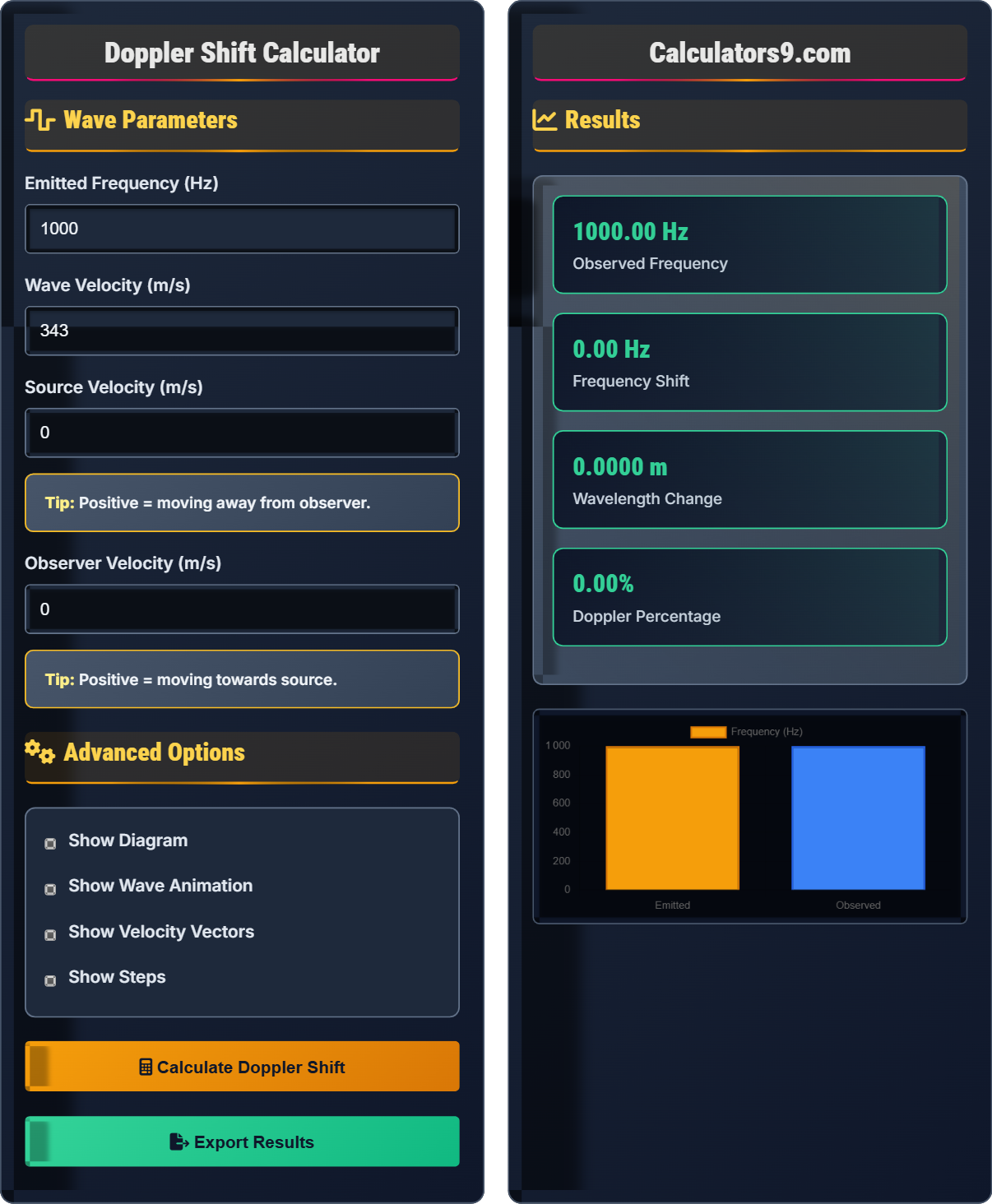
Doppler Effect Formula:
Show the calculator\( f' = f \frac{v + v_o}{v - v_s} \)
Where:
- \( f' \) = observed frequency
- \( f \) = emitted frequency
- \( v \) = wave velocity in medium
- \( v_o \) = observer velocity (positive if moving towards source)
- \( v_s \) = source velocity (positive if moving away from observer)
This formula describes how the frequency of a wave changes when there is relative motion between the source and observer. When the source moves towards the observer, the frequency increases (blue shift), and when it moves away, the frequency decreases (red shift).
Example: For a sound wave with \( f = 1000 \) Hz, wave velocity \( v = 343 \) m/s, observer velocity \( v_o = 0 \) m/s, and source velocity \( v_s = 20 \) m/s (moving towards observer):
\( f' = 1000 \times \frac{343 + 0}{343 - 20} = 1000 \times \frac{343}{323} \approx 1061.9 \) Hz
Thus, the observed frequency is approximately 1061.9 Hz.
Wave Parameters
Advanced Options
Results
| Parameter | Value | Description |
|---|
| Parameter | Value | Description |
|---|
Comprehensive Doppler Effect Guide
The Doppler effect is the change in frequency or wavelength of a wave in relation to an observer who is moving relative to the wave source. Named after Austrian physicist Christian Doppler, it explains phenomena such as the changing pitch of a siren as it approaches and then recedes from an observer.
The general Doppler effect formula is:
Where:
- \(f'\) = observed frequency
- \(f\) = emitted frequency
- \(v\) = wave velocity in medium
- \(v_o\) = observer velocity (positive if moving towards source)
- \(v_s\) = source velocity (positive if moving away from observer)
Different scenarios produce distinct Doppler effects:
- Source Approaching Observer: Observed frequency increases (blueshift)
- Source Receding from Observer: Observed frequency decreases (redshift)
- Transverse Motion: Minimal frequency shift when motion is perpendicular to the line of sight
- Relativistic Effects: At high velocities, special relativity modifies the classical Doppler formula
- Medium Dependence: Wave velocity varies with the medium (air, water, vacuum)
- Direction Matters: Only the component of velocity along the line of sight affects frequency
- Accuracy Requirements: High-precision measurements need relativistic corrections
- Environmental Factors: Temperature and pressure affect wave propagation speed
Doppler Effect Fundamentals
Change in frequency due to relative motion between source and observer.
\(f' = f\frac{v + v_o}{v - v_s}\)
Where f'=observed freq, f=emitted freq, v=wave speed, vo=observer vel, vs=source vel.
- Approach = higher frequency
- Recession = lower frequency
- Speed affects magnitude
Applications
Police radar guns measure vehicle speeds using microwave Doppler shifts.
- Doppler ultrasound
- Blood flow measurement
- Cardiac monitoring
- Vascular diagnostics
- Temperature affects wave speed
- Direction matters
- Medium dependent
- Relativistic effects at high speeds
Doppler Effect Learning Quiz
When a sound source moves towards a stationary observer, what happens to the observed frequency?
The answer is B) It increases. When a sound source moves towards a stationary observer, the observed frequency increases. This is because the waves are compressed as the source moves closer to the observer, resulting in a higher frequency. This phenomenon is known as blueshift in the context of light waves.
Think of a person throwing balls at regular intervals. If the thrower moves towards the catcher, the balls arrive more frequently because each ball has less distance to travel than the previous one. Similarly, when a sound source moves towards an observer, the wavefronts reach the observer more frequently, resulting in a higher perceived frequency.
Doppler Effect: Change in frequency due to relative motion between source and observer
Blueshift: Increase in frequency when source moves towards observer
Redshift: Decrease in frequency when source moves away from observer
• Moving towards observer = higher frequency
• Moving away from observer = lower frequency
• Stationary source and observer = no frequency change
• Remember: Approach = higher pitch, recession = lower pitch
• Think of the ambulance siren example
• Confusing the direction of frequency change
• Thinking that the source's actual frequency changes
A police car emits a siren at 1200 Hz while traveling at 25 m/s towards a stationary pedestrian. Calculate the frequency heard by the pedestrian. (Use speed of sound = 343 m/s)
Using the Doppler formula: \(f' = f\frac{v + v_o}{v - v_s}\)
Given:
- f = 1200 Hz (emitted frequency)
- v = 343 m/s (speed of sound)
- v_o = 0 m/s (observer is stationary)
- v_s = 25 m/s (source moving towards observer, positive direction)
Substituting values:
Step 1: Calculate numerator: v + v_o = 343 + 0 = 343
Step 2: Calculate denominator: v - v_s = 343 - 25 = 318
Step 3: Calculate ratio: 343/318 = 1.0786
Step 4: Calculate observed frequency: f' = 1200 × 1.0786 = 1294.3 Hz
This calculation shows how the motion of the source affects the perceived frequency. The positive sign for source velocity indicates movement toward the observer, which compresses the waves and increases the frequency. The result is that the pedestrian hears a higher pitch than the actual siren frequency.
Wave Compression: Waves become closer together when source moves toward observer
Wave Expansion: Waves spread apart when source moves away from observer
Relative Motion: Only the component of motion along the line of sight matters
• Always consider direction of motion relative to line of sight
• Positive velocity means moving away from observer
• Negative velocity means moving toward observer
• Draw a diagram showing source, observer, and directions
• Remember: approaching = higher frequency
• Use consistent units throughout
• Using wrong sign convention for velocities
• Forgetting to convert units
• Mixing up numerator and denominator
A radar gun operating at 2.45 GHz detects a frequency shift of 1.2 kHz when measuring a car's speed. If the radar gun is stationary and the speed of light is 3×10⁸ m/s, calculate the car's speed assuming it's moving directly towards the radar.
For electromagnetic waves with small velocity approximations, the Doppler shift formula simplifies to: Δf = 2f(v/c), where Δf is the frequency shift, v is the target velocity, and c is the speed of light.
Step 1: Rearrange to solve for velocity: v = (Δf × c) / (2f)
Step 2: Convert frequencies to Hz: f = 2.45 × 10⁹ Hz, Δf = 1.2 × 10³ Hz
Step 3: Calculate: v = (1.2 × 10³ × 3 × 10⁸) / (2 × 2.45 × 10⁹)
Step 4: Simplify: v = (3.6 × 10¹¹) / (4.9 × 10⁹) = 73.5 m/s
Step 5: Convert to km/h: 73.5 × 3.6 = 264.6 km/h
Therefore, the car is traveling at approximately 73.5 m/s (264.6 km/h).
This example demonstrates how radar systems use the Doppler effect to measure speed. The factor of 2 appears because the wave travels to the target and back, experiencing Doppler shift twice. This is why radar systems are highly sensitive to velocity changes.
Radar Doppler: Double Doppler shift in radar systems (to target and back)
Frequency Shift: Difference between emitted and received frequencies
Electromagnetic Waves: Light, radio, microwaves (travel at speed of light)
• Radar: Δf = 2f(v/c) for round trip
• Sound waves: Use classical Doppler formula
• Electromagnetic waves: Use relativistic formula at high speeds
• Remember the factor of 2 for radar systems
• Use scientific notation for large numbers
• Convert units consistently
• Forgetting the factor of 2 in radar Doppler
• Using wrong wave velocity (sound vs light)
• Unit conversion errors
An astronomer observes a hydrogen emission line at 656.3 nm in the laboratory, but detects it at 660.0 nm from a distant galaxy. Calculate the galaxy's recessional velocity using the Doppler formula for electromagnetic waves. (Use speed of light = 3×10⁸ m/s)
For electromagnetic waves, we use the Doppler formula: λ_obs = λ_emit √[(c+v)/(c-v)], where λ is wavelength, v is velocity, and positive v means moving away.
Step 1: Convert wavelengths to meters: λ_emit = 656.3 × 10⁻⁹ m, λ_obs = 660.0 × 10⁻⁹ m
Step 2: Calculate wavelength ratio: λ_obs/λ_emit = 660.0/656.3 = 1.00564
Step 3: Square both sides: (λ_obs/λ_emit)² = (c+v)/(c-v) = (1.00564)² = 1.01131
Step 4: Solve for v: (λ_obs/λ_emit)²(c-v) = c+v
Step 5: Expand: (λ_obs/λ_emit)²c - (λ_obs/λ_emit)²v = c + v
Step 6: Collect terms: (λ_obs/λ_emit)²c - c = v + (λ_obs/λ_emit)²v
Step 7: Factor: c[(λ_obs/λ_emit)² - 1] = v[1 + (λ_obs/λ_emit)²]
Step 8: Solve: v = c[(λ_obs/λ_emit)² - 1] / [1 + (λ_obs/λ_emit)²]
Step 9: Calculate: v = 3×10⁸ × [1.01131 - 1] / [1 + 1.01131] = 3×10⁸ × 0.01131 / 2.01131 = 1.69×10⁶ m/s
Therefore, the galaxy is receding at approximately 1.69×10⁶ m/s (1,690 km/s).
This demonstrates how astronomers use redshift to measure cosmic distances and velocities. The redshift (longer wavelength) indicates the galaxy is moving away from us. This principle underlies Hubble's law and our understanding of cosmic expansion. The relativistic nature of light requires a more complex formula than for sound waves.
Redshift: Increase in wavelength indicating recession
Blueshift: Decrease in wavelength indicating approach
Hubble's Law: Relationship between galaxy distance and recession velocity
• Longer wavelengths = redshift = moving away
• Shorter wavelengths = blueshift = moving towards
• Need relativistic formula for light waves
• Redshift = longer wavelengths = moving away
• Blueshift = shorter wavelengths = moving towards
• Use approximation for small velocities: v/c = (λ_obs - λ_emit)/λ_emit
• Using classical Doppler for electromagnetic waves
• Confusing redshift and blueshift directions
• Sign errors in velocity calculations
Which of the following statements about the Doppler effect is TRUE for objects moving at relativistic speeds?
The answer is B) Time dilation affects the observed frequency. At relativistic speeds (approaching the speed of light), special relativity must be taken into account. The relativistic Doppler effect includes time dilation effects, which cause additional frequency shifts beyond those predicted by the classical formula. The relativistic formula is: \(f' = f\sqrt{\frac{1+\beta}{1-\beta}}\) where β = v/c.
At high velocities, classical physics breaks down and relativistic effects become significant. Time dilation means that clocks in moving frames run slower from the perspective of a stationary observer, affecting the frequency of oscillations. This adds another layer to the Doppler effect beyond simple wave compression or expansion.
Relativistic Doppler: Doppler effect incorporating special relativity
Time Dilation: Slowing of time in moving reference framesLorentz Factor: γ = 1/√(1-v²/c²) in special relativity
• Use relativistic formula for v > 0.1c
• Time dilation affects frequency measurements
• Relativistic effects become dominant near light speed
• Apply relativistic corrections for high-speed objects
• Remember that electromagnetic waves always travel at c
• Use β = v/c to simplify relativistic calculations
• Applying classical Doppler to relativistic speeds
• Ignoring time dilation effects
• Forgetting that c is constant in all reference frames
FAQ
Q: Why does the Doppler effect occur differently for sound waves versus light waves?
A: The fundamental difference lies in the medium of propagation and relativistic effects:
- Sound Waves: Require a medium (air, water, etc.) and follow classical mechanics. The Doppler effect depends on the velocities of source and observer relative to the medium.
- Light Waves: Do not require a medium and always travel at speed \( c \) in vacuum. They follow special relativity, which introduces time dilation and length contraction effects.
For sound waves, the classical Doppler formula is: \( f' = f\frac{v + v_o}{v - v_s} \)
For electromagnetic waves at relativistic speeds, the formula incorporates Lorentz transformations: \( f' = f\sqrt{\frac{1+\beta}{1-\beta}} \) where \( \beta = v/c \).
This is why astronomical observations of distant galaxies require relativistic corrections, while everyday sound phenomena use classical formulas.
Q: How do radar speed guns calculate vehicle speed using the Doppler effect?
A: Radar speed guns use the Doppler effect with electromagnetic waves:
- Transmission: The radar gun emits microwaves at frequency \( f_0 \) (typically 24.125 GHz or 35.5 GHz).
- Reflection: Microwaves reflect off the moving vehicle, which acts as a moving source.
- Return Signal: The reflected signal experiences Doppler shift due to the vehicle's motion.
- Calculation: The radar system measures the frequency difference (Doppler shift) between transmitted and received signals.
The formula for radar speed detection is: \( \Delta f = \frac{2v \cdot f_0}{c} \)
Where \( \Delta f \) is the frequency shift, \( v \) is vehicle speed, \( f_0 \) is transmitted frequency, and \( c \) is the speed of light.
With \( \Delta f \) measured and \( f_0 \) known, the radar system calculates \( v \) using: \( v = \frac{\Delta f \cdot c}{2f_0} \).