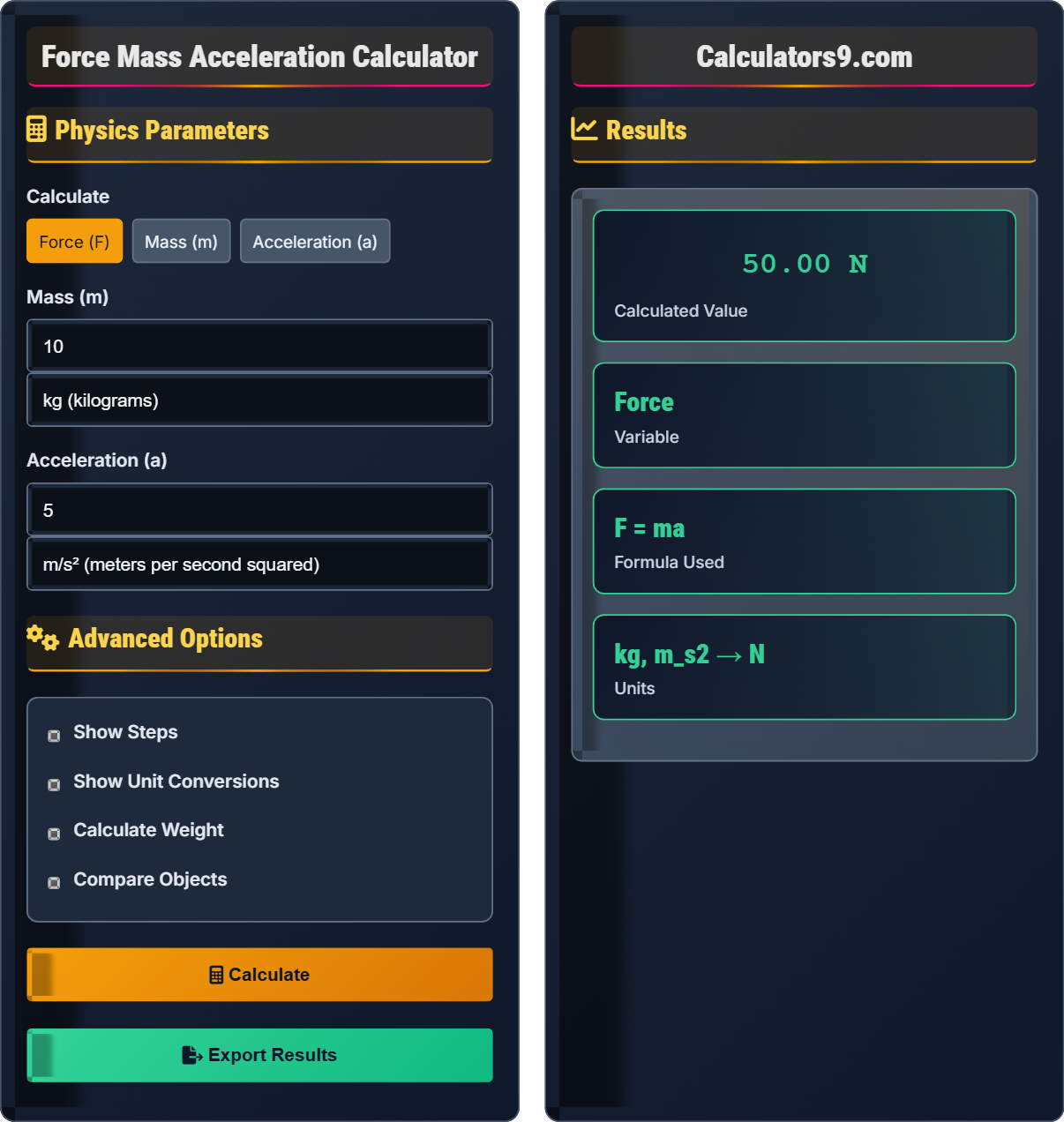
Force Mass Acceleration Calculator
Newton's laws tool • 2026 edition
$$F = ma$$
Newton's second law of motion states that the force acting on an object is equal to the mass of the object multiplied by its acceleration.
Components:
- F = net force (Newtons, N)
- m = mass (kilograms, kg)
- a = acceleration (meters per second squared, m/s²)
Derived Formulas:
- m = F/a (mass from force and acceleration)
- a = F/m (acceleration from force and mass)
SI Units:
- Force: Newtons (N) = kg·m/s²
- Mass: Kilograms (kg)
- Acceleration: m/s²
Example: For a 10 kg object accelerating at 5 m/s²:
F = ma = 10 kg × 5 m/s² = 50 N
Physics Parameters
Advanced Options
Results
Comprehensive Physics Guide
Newton's second law states that the acceleration of an object is directly proportional to the net force acting on it and inversely proportional to its mass. The equation F = ma quantifies this relationship.
Three equivalent forms of Newton's second law:
- F = ma: Force equals mass times acceleration
- m = F/a: Mass equals force divided by acceleration
- a = F/m: Acceleration equals force divided by mass
Newton's second law in practical situations:
- Transportation: Car acceleration, braking, turning
- Sports: Ballistics, throwing, jumping
- Engineering: Structural loads, rocket propulsion
- Space Exploration: Orbital mechanics, thrust calculations
- Everyday Life: Lifting objects, pushing, pulling
- Mass: 1 kg = 1000 g = 2.205 lb
- Force: 1 N = 0.225 lbf = 10⁵ dyn
- Acceleration: 1 g = 9.807 m/s²
- Weight: W = mg (weight equals mass times gravity)
Physics Fundamentals
F = ma, where force is directly proportional to acceleration and inversely proportional to mass.
Weight = Mass × Gravitational Acceleration (W = mg), where g = 9.807 m/s² on Earth.
- Force and acceleration are vector quantities (direction matters)
- Mass is a scalar quantity (magnitude only)
- Force and acceleration are in the same direction
- Greater mass requires greater force for same acceleration
Advanced Concepts
Resistance to acceleration; the m in F = ma represents inertial mass.
- Identify all forces acting on object
- Resolve forces into components
- Sum forces in each direction
- Apply F = ma to net force
- Double force → double acceleration (same mass)
- Double mass → half acceleration (same force)
- Force and acceleration are directly proportional
- Mass and acceleration are inversely proportional
Physics Learning Quiz
A 20 kg object is accelerated at 3 m/s². What force is required? Show all steps and explain the physical meaning of the result.
Step 1: Identify known values: mass m = 20 kg, acceleration a = 3 m/s²
Step 2: Identify the formula: F = ma
Physical Meaning: Newton's second law tells us that to accelerate an object, we must apply a force. The amount of force needed is proportional to both the mass of the object and the desired acceleration.
Step 3: Substitute values into the formula:
F = ma = 20 kg × 3 m/s²
Step 4: Calculate:
F = 60 kg·m/s² = 60 N
Step 5: Physical interpretation: A force of 60 Newtons is required to accelerate a 20 kg object at 3 m/s². This means that if you apply 60 N of force to the object, its velocity will increase by 3 m/s every second.
Therefore, the required force is 60 N.
This problem demonstrates the direct relationship between force, mass, and acceleration. The larger the mass, the more force is needed to achieve the same acceleration. Similarly, to achieve greater acceleration, more force is required. Understanding this relationship is fundamental to mechanics and helps predict how objects will move when forces act upon them.
The units (kg·m/s² = N) confirm that we're working with consistent SI units.
Force: A push or pull that changes an object's state of motion
Mass: The measure of an object's resistance to accelerationAcceleration: Rate of change of velocity (m/s²)
• Always use consistent units (SI preferred)
• Force and acceleration are in the same direction
• Greater mass requires greater force for same acceleration
• Remember: F = ma is the foundation of classical mechanics
• The direction of force determines direction of acceleration
• Check that your answer has reasonable units
• Using inconsistent units (mixing kg with lb, etc.)
• Forgetting to specify direction for vectors
• Confusing mass with weight
A car with a mass of 1500 kg accelerates from rest to 20 m/s in 10 seconds. What average force must the engine apply? If the car encounters a headwind that exerts a retarding force of 500 N, what force must the engine now provide to maintain the same acceleration?
Part 1 - Initial Acceleration:
First, calculate the acceleration:
a = (final velocity - initial velocity) / time = (20 - 0) / 10 = 2 m/s²
Now apply Newton's second law:
F = ma = 1500 kg × 2 m/s² = 3000 N
Part 2 - With Headwind:
When the headwind opposes motion, the net force needed is:
F_net = ma = 3000 N (still needed for same acceleration)
Since the headwind opposes motion (retarding force = 500 N), the engine must overcome this:
F_engine = F_net + F_headwind = 3000 N + 500 N = 3500 N
Therefore, initially the engine must apply 3000 N, but with the headwind it must apply 3500 N.
This problem demonstrates how Newton's second law applies to real-world transportation scenarios. The first part shows the basic calculation of force needed for acceleration. The second part introduces the concept of net force, where multiple forces act on an object. When external forces oppose motion, the driving force must be increased to maintain the same acceleration. This principle is crucial in automotive engineering and aerodynamics.
Real-world physics often involves multiple interacting forces.
Headwind: Wind blowing against the direction of motion
Retarding Force: A force that opposes motion
Net Force: The vector sum of all forces acting on an object
• Net force determines acceleration, not individual forces
• Opposing forces must be overcome to maintain acceleration
• Acceleration depends on net force, not applied force alone
• Always identify all forces acting on an object
• Consider the direction of each force
• Calculate net force before applying F = ma
• Forgetting to account for opposing forces
• Not distinguishing between applied force and net force
• Ignoring the direction of forces
FAQ
Q: What's the difference between mass and weight?
A: Mass and weight are different physical quantities:
Mass:
- Measure of amount of matter in an object
- Scalar quantity (magnitude only)
- Constant regardless of location
- Measured in kilograms (kg)
Weight:
- Gravitational force acting on an object
- Vector quantity (magnitude and direction)
- Changes with gravitational field strength
- W = mg (where g = 9.807 m/s² on Earth)
For example, a 10 kg object has the same mass on Earth and Moon, but weighs 98.1 N on Earth and only 16.3 N on the Moon.
Q: How does Newton's second law relate to momentum?
A: Newton's second law can be expressed in terms of momentum:
Original form: F = ma
Momentum form: F = dp/dt = d(mv)/dt
When mass is constant: F = m(dv/dt) = ma
Relationship:
- Momentum (p) = mass × velocity = mv
- Force is the rate of change of momentum
- This form is more general and applies when mass changes
- Conservation of momentum is fundamental in collisions
This formulation is essential in rocket science where mass changes as fuel is consumed.