Frequency Period Converter
Physics oscillation calculator • Wave cycle time converter
Frequency-Period Relationship:
Show the calculator\( f = \frac{1}{T} \) and \( T = \frac{1}{f} \)
Where:
- \( f \) = frequency (Hz)
- \( T \) = period (seconds)
This fundamental relationship shows that frequency and period are inversely proportional. As one increases, the other decreases proportionally. This relationship is essential in understanding oscillatory motion, wave phenomena, and periodic systems.
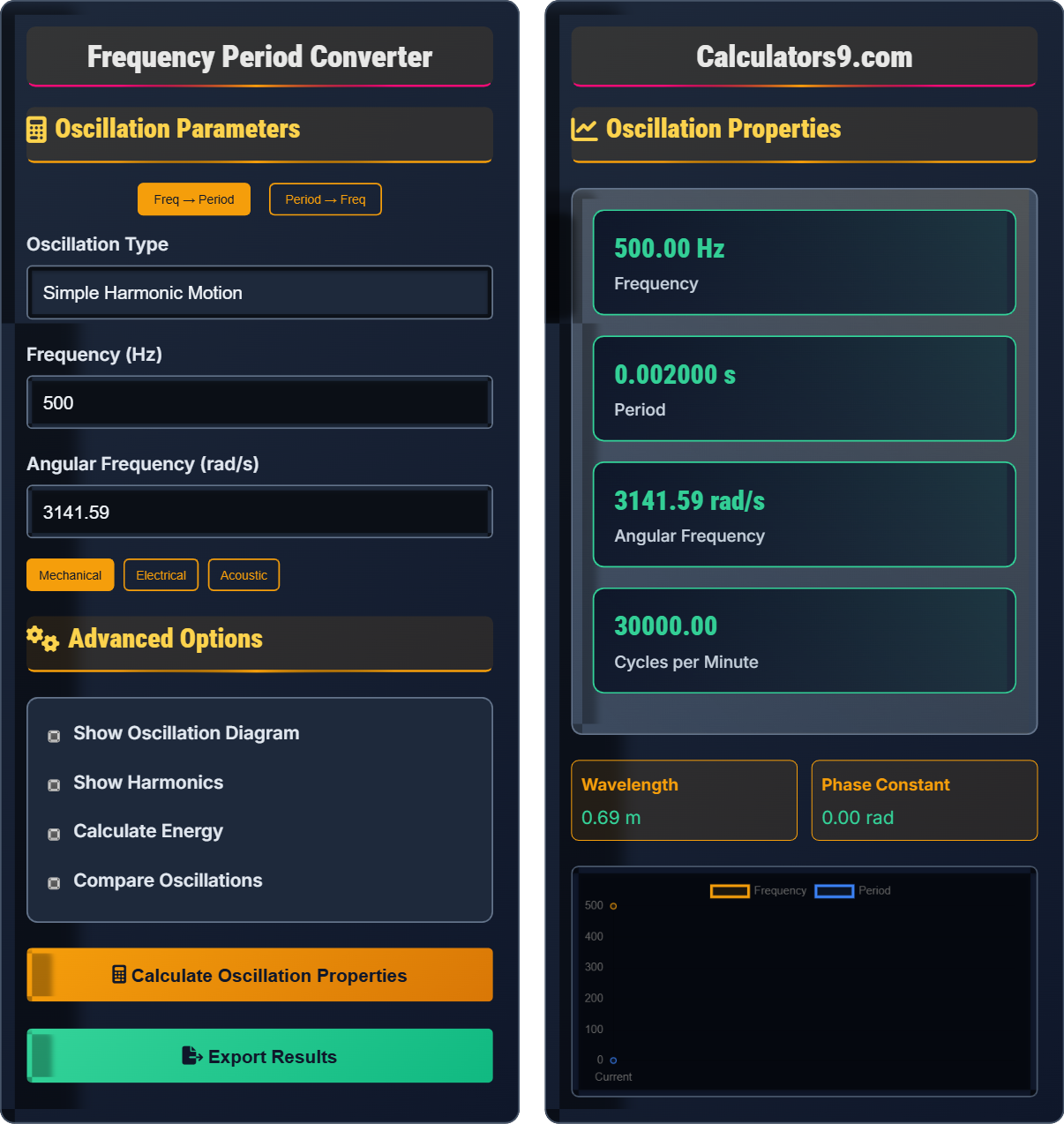
Example: For a wave with period \( T = 0.002 \) s:
\( f = \frac{1}{0.002} = 500 \) Hz
And conversely, for a frequency of 500 Hz:
\( T = \frac{1}{500} = 0.002 \) s
Thus, the wave has a frequency of 500 Hz and a period of 0.002 seconds.
Oscillation Parameters
Advanced Options
Oscillation Properties
Oscillation Physics Fundamentals
Oscillation is the repetitive variation of a quantity around a central value or between two or more different states. It's a fundamental concept in physics describing periodic motion found in mechanical systems, electrical circuits, and wave phenomena. Oscillations are characterized by their frequency, period, amplitude, and phase.
The fundamental relationship between frequency and period is:
Where:
- \(f\) = frequency (Hz)
- \(T\) = period (s)
Key properties that characterize oscillations:
- Amplitude: Maximum displacement from equilibrium position
- Frequency: Number of oscillations per unit time
- Period: Time for one complete oscillation
- Phase: Position within the oscillation cycle
- Angular Frequency: Rate of change of phase angle
- Clocks: Pendulum and quartz oscillators provide timekeeping
- Electronics: Oscillators generate signals in radio and communication
- Music: Sound waves produced by vibrating strings and air columns
- Seismology: Earthquake detection through ground oscillations
- Medical: Ultrasound and heart rhythm monitoring
Frequency-Period Concepts
Number of oscillations per unit time (measured in Hertz).
\(f = 1/T\)
Where f=frequency, T=period.
- Frequency and period are inversely proportional
- Higher frequency = shorter period
- Lower frequency = longer period
Oscillation Relationships
\(\omega = 2\pi f\)
- Angular frequency: \(\omega = 2\pi f\)
- Period: \(T = 1/f\)
- Frequency: \(f = 1/T\)
- Cycles per minute: \(CPM = 60f\)
- Angular frequency in radians per second
- Phase affects waveform timing
- Amplitude affects energy content
Oscillation Physics Learning Quiz
If an oscillator has a period of 0.004 seconds, what is its frequency?
Using the frequency-period relationship: \(f = \frac{1}{T}\)
Given:
- Period (T) = 0.004 s
Calculation: f = 1/0.004 = 250 Hz
The answer is A) 250 Hz
This is a direct application of the fundamental relationship between frequency and period. Frequency and period are inversely proportional, meaning that as one increases, the other decreases. This relationship is fundamental to understanding all oscillatory phenomena, from simple pendulums to electronic oscillators.
Frequency: Number of oscillations per second (measured in Hertz)
Period: Time taken for one complete oscillation (measured in seconds)
Hertz (Hz): Unit of frequency equal to one cycle per second
• f = 1/T (frequency equals one divided by period)
• Units must be consistent (Hz = 1/s)
• Frequency and period are inversely related
• Remember: f = 1/T and T = 1/f
• High frequency = short period
• Low frequency = long period
• Forgetting to take the reciprocal of the period
• Mixing up units without proper conversion
An oscillator completes 1200 cycles in 4 minutes. Calculate its frequency, period, and angular frequency.
First, convert time to seconds: 4 minutes = 4 × 60 = 240 seconds
Frequency calculation:
f = Number of cycles / Time = 1200 / 240 = 5 Hz
Period calculation:
T = 1/f = 1/5 = 0.2 seconds
Angular frequency calculation:
ω = 2πf = 2π × 5 = 10π ≈ 31.42 rad/s
The oscillator has a frequency of 5 Hz, a period of 0.2 seconds, and an angular frequency of approximately 31.42 rad/s.
This problem demonstrates how to derive oscillation parameters from basic measurements. The frequency is simply the count of oscillations divided by the time interval. Once we have frequency, we can easily calculate period using the inverse relationship. Angular frequency is then calculated using the relationship ω = 2πf, which connects the temporal frequency to the rate of phase change.
Cycle: One complete oscillation from starting point back to starting point
Angular Frequency: Rate of change of phase angle in radians per second
Radians: Unit of angular measurement where 2π radians = 360°
• Frequency = cycles per unit time
• Period = 1/frequency
• Angular frequency = 2π × frequency
• Always convert time to seconds for consistency
• Use π ≈ 3.14159 for angular frequency calculations
• Remember: 1 Hz = 1 cycle/second
• Forgetting to convert time units to seconds
• Confusing angular frequency with regular frequency
• Arithmetic errors with π multiplication
A simple pendulum makes 30 complete swings in 1 minute. Calculate its period and frequency. If the length of the pendulum were doubled, how would the frequency change? (Note: For small angles, the period of a simple pendulum is T = 2π√(L/g) where L is length and g is acceleration due to gravity)
Part 1: Calculate frequency and period
Time = 1 minute = 60 seconds
Frequency = 30 swings / 60 s = 0.5 Hz
Period = 1/frequency = 1/0.5 = 2.0 seconds
Part 2: Effect of doubling length
Original: T₁ = 2π√(L/g)
After doubling: T₂ = 2π√(2L/g) = 2π√(2)√(L/g) = √2 × T₁
New period = √2 × 2.0 ≈ 2.83 seconds
New frequency = 1/2.83 ≈ 0.35 Hz
When the length is doubled, the frequency decreases by a factor of √2.
This problem connects the mathematical relationships of oscillation to a physical system. The first part uses the basic definition of frequency. The second part demonstrates how physical parameters affect oscillation characteristics. For a simple pendulum, the period is proportional to the square root of the length, which means frequency is inversely proportional to the square root of the length.
Simple Pendulum: Idealized pendulum with point mass suspended from frictionless pivot
Swing: One complete oscillation from one extreme to the other and back
Acceleration due to Gravity: g ≈ 9.8 m/s² near Earth's surface
• Pendulum period T = 2π√(L/g) for small angles
• Period increases with square root of length
• Frequency decreases with square root of length
• Remember: T ∝ √L for pendulums
• f ∝ 1/√L since f = 1/T
• Always consider the square root relationship
• Forgetting the 2π factor in the pendulum formula
• Not accounting for the inverse relationship between f and T
A mass-spring system has a natural frequency of 10 Hz. If an external force oscillates at 10 Hz, what phenomenon occurs? What happens to the amplitude of oscillation? If the driving frequency changes to 15 Hz, how does the amplitude change? (Consider resonance and forced oscillation principles)
When the driving frequency (10 Hz) matches the natural frequency (10 Hz), resonance occurs.
At resonance:
- The amplitude of oscillation becomes maximum
- Energy transfer from the driving force to the system is most efficient
- Even a small driving force can produce large oscillations
When the driving frequency changes to 15 Hz (away from the natural frequency of 10 Hz):
- The amplitude of oscillation decreases significantly
- Energy transfer becomes less efficient
- The system oscillates at the driving frequency (15 Hz)
Resonance occurs when driving frequency equals natural frequency, producing maximum amplitude.
Resonance is a critical concept in oscillatory systems. It occurs when the frequency of an external driving force matches the natural frequency of the system. At resonance, the system absorbs maximum energy from the driving force, resulting in large amplitude oscillations. This principle is utilized in many applications (musical instruments, radio tuners) but can also be destructive (bridge collapses, shattering glass).
Natural Frequency: Frequency at which a system oscillates when disturbed
Resonance: Large amplitude oscillations when driving frequency matches natural frequency
Forced Oscillation: Oscillation caused by an external periodic force
• Resonance occurs when driving frequency = natural frequency
• Maximum amplitude occurs at resonance
• Away from resonance, amplitude decreases
• Think of pushing a swing at the right moment for maximum height
• Resonance can be beneficial or harmful depending on context
• Damping reduces resonance peak amplitude
• Thinking resonance occurs at any frequency
• Confusing natural frequency with driving frequency
• Not understanding that amplitude peaks at resonance
Which of the following statements about angular frequency is TRUE?
The answer is B) Angular frequency equals 2π times the frequency. Angular frequency (ω) is related to regular frequency (f) by the equation: ω = 2πf. Angular frequency is measured in radians per second, not Hertz. It represents the rate of change of the phase angle in oscillatory motion.
Angular frequency is a measure of how fast the phase of an oscillation changes over time. While regular frequency counts the number of complete cycles per second (measured in Hertz), angular frequency measures the rate of phase change in radians per second. The factor of 2π comes from the fact that one complete cycle corresponds to 2π radians of phase change.
Angular Frequency: Rate of change of phase angle (ω = 2πf)
Phase Angle: Angular position in the oscillation cycle
Radians per Second: Unit of angular frequency
• ω = 2πf (angular frequency = 2π × frequency)
• Angular frequency in radians per second
• Regular frequency in Hertz
• Remember: ω = 2πf
• Angular frequency is always larger than regular frequency by factor of 2π
• Use radians when working with angular frequency
• Confusing angular frequency with regular frequency
• Using the same units for both quantities
• Forgetting the 2π factor in conversions
FAQ
Q: What's the difference between frequency and angular frequency?
A: Frequency and angular frequency describe the same oscillatory behavior but in different ways:
Regular frequency (f) measures the number of complete cycles per unit time:
\( f = \frac{1}{T} \) (measured in Hertz = cycles/second)
Angular frequency (ω) measures the rate of change of phase angle:
\( \omega = 2\pi f = \frac{2\pi}{T} \) (measured in radians/second)
Since one complete cycle corresponds to 2π radians, angular frequency is larger than regular frequency by a factor of 2π. Angular frequency is particularly useful in calculus-based descriptions of oscillations and wave equations.
Q: How does damping affect oscillation frequency?
A: Damping affects both the amplitude and frequency of oscillations:
For a damped harmonic oscillator, the angular frequency is modified from the undamped value:
\( \omega_d = \sqrt{\omega_0^2 - \gamma^2} \)
Where:
- \( \omega_0 \) = undamped angular frequency
- \( \gamma \) = damping coefficient
- \( \omega_d \) = damped angular frequency
For light damping (\( \gamma < \omega_0 \)), the frequency decreases slightly. For critical damping (\( \gamma = \omega_0 \)) or heavy damping (\( \gamma > \omega_0 \)), oscillations cease entirely.