Gravitational Force Calculator
Newton's law analysis • 2026 physics
Newton's Law of Gravitation:
Show the calculator\( F = G \frac{m_1 m_2}{r^2} \)
Where:
- \( F \) = gravitational force (Newtons)
- \( G \) = gravitational constant (6.674×10⁻¹¹ N⋅m²/kg²)
- \( m_1, m_2 \) = masses of the two objects (kg)
- \( r \) = distance between centers of mass (m)
This fundamental law describes the attractive force between any two masses in the universe. The force is directly proportional to the product of the masses and inversely proportional to the square of the distance between them. This inverse-square relationship means that doubling the distance reduces the force to one-fourth its original value.
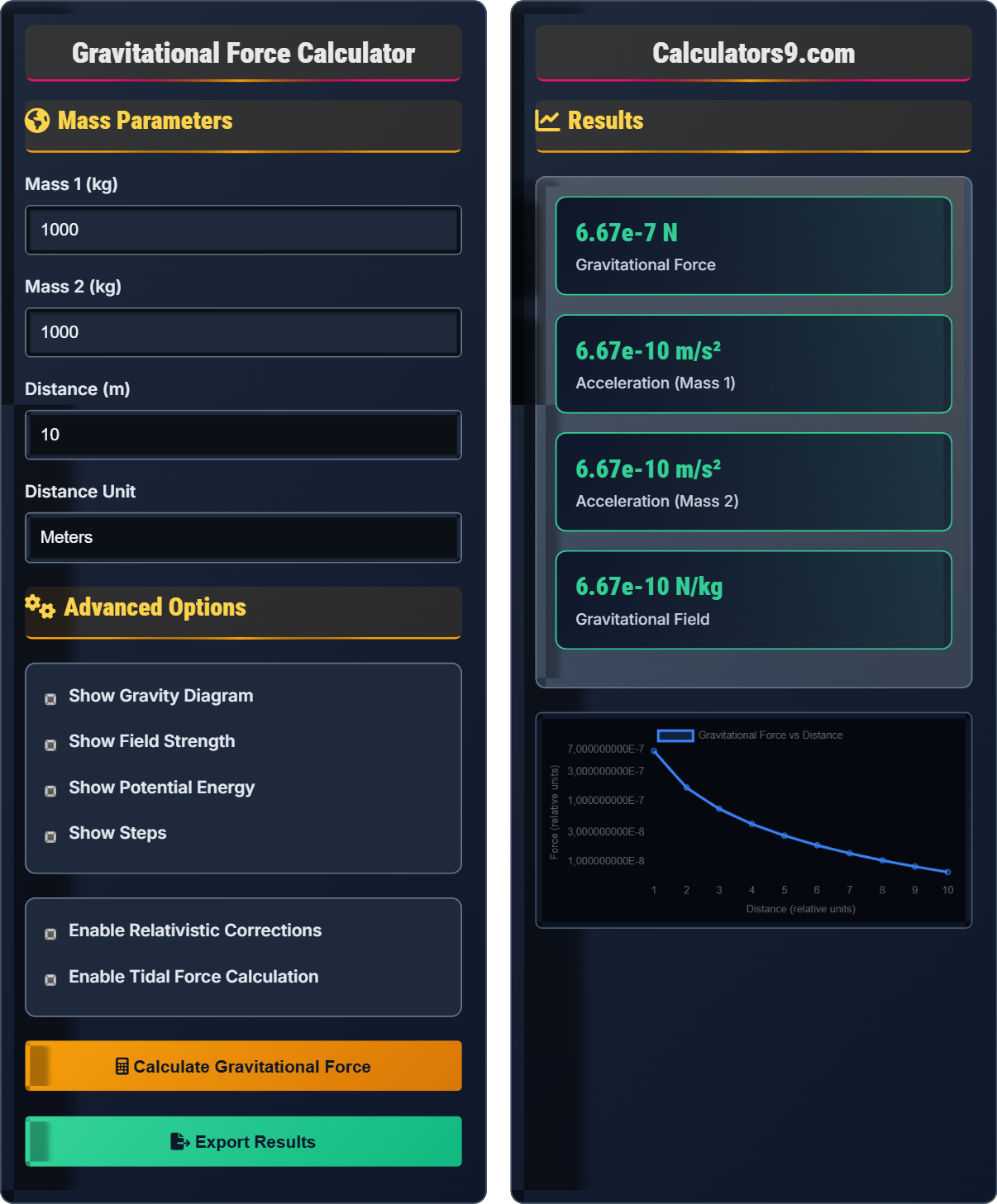
Example: For two masses of 1000 kg each separated by 10 meters:
\( F = 6.674 \times 10^{-11} \times \frac{1000 \times 1000}{10^2} = 6.674 \times 10^{-11} \times \frac{1,000,000}{100} = 6.674 \times 10^{-7} \) N
Thus, the gravitational force is approximately 6.674×10⁻⁷ N.
Mass Parameters
Advanced Options
Results
| Parameter | Value | Description |
|---|
| Energy Type | Value | Significance |
|---|
| Field Property | Value | Units |
|---|
Comprehensive Gravity Guide
Gravitational force is the attractive force between any two objects with mass, described by Sir Isaac Newton in his law of universal gravitation. It governs everything from falling apples to planetary orbits. The force is always attractive and acts along the line connecting the centers of mass of the two objects.
The fundamental equation is:
Where:
- \(F\) = gravitational force (Newtons)
- \(G\) = gravitational constant (6.674×10⁻¹¹ N⋅m²/kg²)
- \(m_1, m_2\) = masses of the two objects (kg)
- \(r\) = distance between centers of mass (m)
The gravitational potential energy between two masses is:
Note the negative sign, indicating that work is done by the gravitational field to bring masses together from infinity.
- Inverse Square Law: Force decreases quadratically with distance
- Universal Constant: G is the same everywhere in the universe
- Weak Force: Gravity is the weakest of fundamental forces
- Additive: Forces from multiple masses sum vectorially
Gravity Fundamentals
Attractive force between any two masses in the universe.
\(F = G\frac{m_1 m_2}{r^2}\)
Where F=force, G=gravitational constant, m₁,m₂=masses, r=distance.
- Always attractive
- Inverse square law
- Proportional to mass product
Applications
Planetary motion and satellite trajectories governed by gravity.
- Planetary orbit calculations
- Satellite positioning
- Space mission planning
- GPS system operation
- Distance affects force significantly
- Large masses create strong fields
- Relativistic effects at high speeds
- Quantum effects at small scales
Gravity Learning Quiz
According to Newton's law of gravitation, if the distance between two masses is doubled, what happens to the gravitational force between them?
The answer is C) It quarters. According to Newton's law of gravitation: F = G(m₁m₂)/r², the force is inversely proportional to the square of the distance. When distance doubles (r → 2r), the force becomes: F_new = G(m₁m₂)/(2r)² = G(m₁m₂)/(4r²) = F_original/4. So the force becomes one-fourth of the original value.
This is an example of an inverse-square law. Many physical quantities follow this pattern, including light intensity, sound intensity, and electrostatic force. When distance doubles, the effect spreads over four times the area (since area scales with the square of distance), reducing the intensity by a factor of four.
Inverse Square Law: Force varies as 1/r² with distance
Gravitational Constant: G = 6.674×10⁻¹¹ N⋅m²/kg²
Newton's Law: F = G(m₁m₂)/r²
• Force ∝ 1/r² (inverse square law)
• Force ∝ m₁m₂ (directly proportional to masses)
• Force is always attractive
• Remember: double distance = quarter force
• Triple distance = ninth force
• Halve distance = quadruple force
• Thinking force changes linearly with distance
• Forgetting the squared relationship
• Confusing with linear relationships
Calculate the gravitational force between Earth (mass = 5.97×10²⁴ kg) and the Moon (mass = 7.35×10²² kg) when they are separated by 3.84×10⁸ m. Show your work.
Using Newton's law: F = G(m₁m₂)/r²
Given:
- G = 6.674×10⁻¹¹ N⋅m²/kg²
- m₁ = 5.97×10²⁴ kg (Earth)
- m₂ = 7.35×10²² kg (Moon)
- r = 3.84×10⁸ m
Step 1: Calculate m₁m₂ = (5.97×10²⁴)(7.35×10²²) = 4.39×10⁴⁷ kg²
Step 2: Calculate r² = (3.84×10⁸)² = 1.47×10¹⁷ m²
Step 3: Calculate F = (6.674×10⁻¹¹)(4.39×10⁴⁷)/(1.47×10¹⁷)
Step 4: F = (2.93×10³⁷)/(1.47×10¹⁷) = 1.99×10²⁰ N
Therefore, the gravitational force is approximately 1.99×10²⁰ N.
This calculation demonstrates the enormous scale of gravitational forces between celestial bodies. Despite the vast distance between Earth and Moon, the massive sizes of these bodies result in a tremendous gravitational force that keeps the Moon in orbit. The force is what we commonly call "weight" on a cosmic scale.
Gravitational Force: Attractive force between masses
Center of Mass: Point where mass can be considered concentrated
Orbital Motion: Result of gravitational force and inertia
• Use consistent units (SI units preferred)
• Distance is center-to-center separation
• Force acts along line connecting centers
• Use scientific notation for large numbers
• Keep track of units throughout calculation
• Verify order of magnitude makes sense
• Forgetting to square the distance
• Using radius instead of center-to-center distance
• Arithmetic errors with scientific notation
A person with mass 70 kg weighs 686 N on Earth. Calculate their weight on Mars, which has a mass of 6.39×10²³ kg and a radius of 3.39×10⁶ m. (Use G = 6.674×10⁻¹¹ N⋅m²/kg²)
Weight is the gravitational force between the person and the planet. We can calculate the acceleration due to gravity on Mars using: g = GM/R²
Step 1: Calculate g on Mars
g_Mars = G × M_Mars / R_Mars²
g_Mars = (6.674×10⁻¹¹) × (6.39×10²³) / (3.39×10⁶)²
g_Mars = (4.26×10¹³) / (1.15×10¹³) = 3.71 m/s²
Step 2: Calculate weight on Mars
Weight = mass × g_Mars = 70 × 3.71 = 259.7 N
Therefore, the person would weigh approximately 260 N on Mars.
This problem demonstrates the difference between mass and weight. Mass is an intrinsic property (70 kg remains constant), but weight depends on the local gravitational field. Mars has about 11% the mass of Earth but a similar radius, resulting in about 38% of Earth's surface gravity.
Weight: Gravitational force on an object (W = mg)
Mass: Amount of matter in an object (invariant)
Surface Gravity: Acceleration due to gravity at planet's surface
• Mass is constant, weight varies with gravity
• g = GM/R² for spherical objects
• Weight = mass × surface gravity
• Remember: g = GM/R² for planets
• Surface gravity depends on mass and radius
• Weight is a force measured in Newtons
• Confusing mass with weight
• Forgetting to use radius squared
• Using diameter instead of radius
Derive the formula for orbital velocity around a central mass M at distance r, assuming circular motion. Then calculate the orbital velocity of the Moon around Earth (M_Earth = 5.97×10²⁴ kg, r = 3.84×10⁸ m).
For circular orbital motion, gravitational force provides centripetal force:
Gravitational force: F_gravity = GMm/r²
Centripetal force: F_centripetal = mv²/r
Setting them equal: GMm/r² = mv²/r
Simplifying: GM/r² = v²/r
Therefore: v² = GM/r
Orbital velocity: v = √(GM/r)
Now calculating for Moon:
v = √(GM_Earth/r) = √[(6.674×10⁻¹¹)(5.97×10²⁴)/(3.84×10⁸)]
v = √[3.98×10¹⁴/3.84×10⁸] = √[1.04×10⁶] = 1,020 m/s
Therefore, the Moon's orbital velocity is approximately 1,020 m/s.
This derivation shows how gravity provides the necessary centripetal force for orbital motion. The orbital velocity is independent of the orbiting object's mass, which explains why all objects at the same distance from a central mass have the same orbital velocity. This principle is fundamental to satellite technology.
Orbital Velocity: Speed required for stable circular orbit
Centripetal Force: Force directed toward center of circular motion
Geostationary Orbit: Orbit with same period as Earth's rotation
• v = √(GM/r) for circular orbits
• Orbital velocity independent of satellite mass
• Closer orbits = faster velocities
• Remember: gravity provides centripetal force
• Equal forces for stable orbit
• Square root relationship with distance
• Forgetting to equate gravitational and centripetal forces
• Including satellite mass in orbital velocity formula
• Using diameter instead of radius
Which statement about gravitational potential energy is CORRECT?
The answer is C) It is defined as U = -Gm₁m₂/r. Gravitational potential energy is defined as the work done against gravity to bring a mass from infinity to a distance r from another mass. By convention, potential energy is zero at infinity, making it negative as masses come together. The negative sign indicates that work is done BY the gravitational field, not against it.
The negative sign in gravitational potential energy is crucial for understanding bound systems. When U < 0, the system is bound (like Earth-Moon). When U ≥ 0, the system is unbound (objects can separate to infinity). This convention makes energy conservation work properly in gravitational systems.
Gravitational Potential Energy: U = -Gm₁m₂/r
Bound System: Total energy < 0, objects remain together
Escape Condition: Total energy ≥ 0, objects can separate
• U = -Gm₁m₂/r (negative sign important)
• Zero potential energy at infinite separation
<• Bound systems have negative total energy• Remember: negative potential energy for attractive forces
• Think of it as "energy debt" to separate masses
• Closer = more negative (more bound)
• Forgetting the negative sign
• Thinking potential energy is positive
• Misunderstanding the zero-point convention
FAQ
Q: How does Einstein's theory of general relativity modify Newton's law of gravitation?
A: Einstein's general relativity fundamentally reimagines gravity not as a force but as the curvature of spacetime caused by mass and energy. The key modifications to Newton's law include:
Field Equations: Instead of F = Gm₁m₂/r², Einstein proposed: \( G_{\mu\nu} = \frac{8\pi G}{c^4} T_{\mu\nu} \)
Where \( G_{\mu\nu} \) is the Einstein tensor describing spacetime curvature and \( T_{\mu\nu} \) is the stress-energy tensor.
Key Predictions:
- Gravitational Time Dilation: Time runs slower in stronger gravitational fields
- Gravitational Redshift: Light loses energy climbing out of gravitational wells
- Precession of Orbits: Mercury's perihelion precesses 43" per century beyond Newtonian prediction
- Gravitational Waves: Ripples in spacetime propagating at light speed
- Black Holes: Regions where spacetime curvature becomes infinite
Newton's law remains accurate for weak fields and low velocities but breaks down in extreme conditions like near black holes or in cosmological contexts.
Q: What are tidal forces and how do they relate to gravitational gradients?
A: Tidal forces arise from the gradient in the gravitational field across an extended object. While Newton's law gives the gravitational force at a point, tidal forces result from the difference in gravitational pull across the object.
For a spherical object of radius R near a mass M at distance r, the tidal force per unit mass is approximately:
\( F_{tidal} \approx 2G\frac{MR}{r^3} \)
This explains phenomena like:
- Earth's Tides: Moon's gravitational gradient creates bulges on opposite sides of Earth
- Roche Limit: Distance within which tidal forces exceed an object's self-gravity
- Spaghettification: Near black holes, tidal forces stretch objects longitudinally
- Orbital Circularization: Tidal friction gradually circularizes orbits
Tidal forces scale as 1/r³ (gradient of 1/r² force), making them particularly significant for close encounters with massive objects.