Kinetic Energy Calculator
Physics & Engineering Tool • Energy Calculations
Kinetic Energy Formula:
Show the calculator\( KE = \frac{1}{2}mv^2 \)
Where:
- \( KE \) = kinetic energy (joules)
- \( m \) = mass of the object (kg)
- \( v \) = velocity of the object (m/s)
This fundamental physics formula calculates the energy possessed by an object due to its motion. The kinetic energy is directly proportional to the mass and proportional to the square of the velocity.
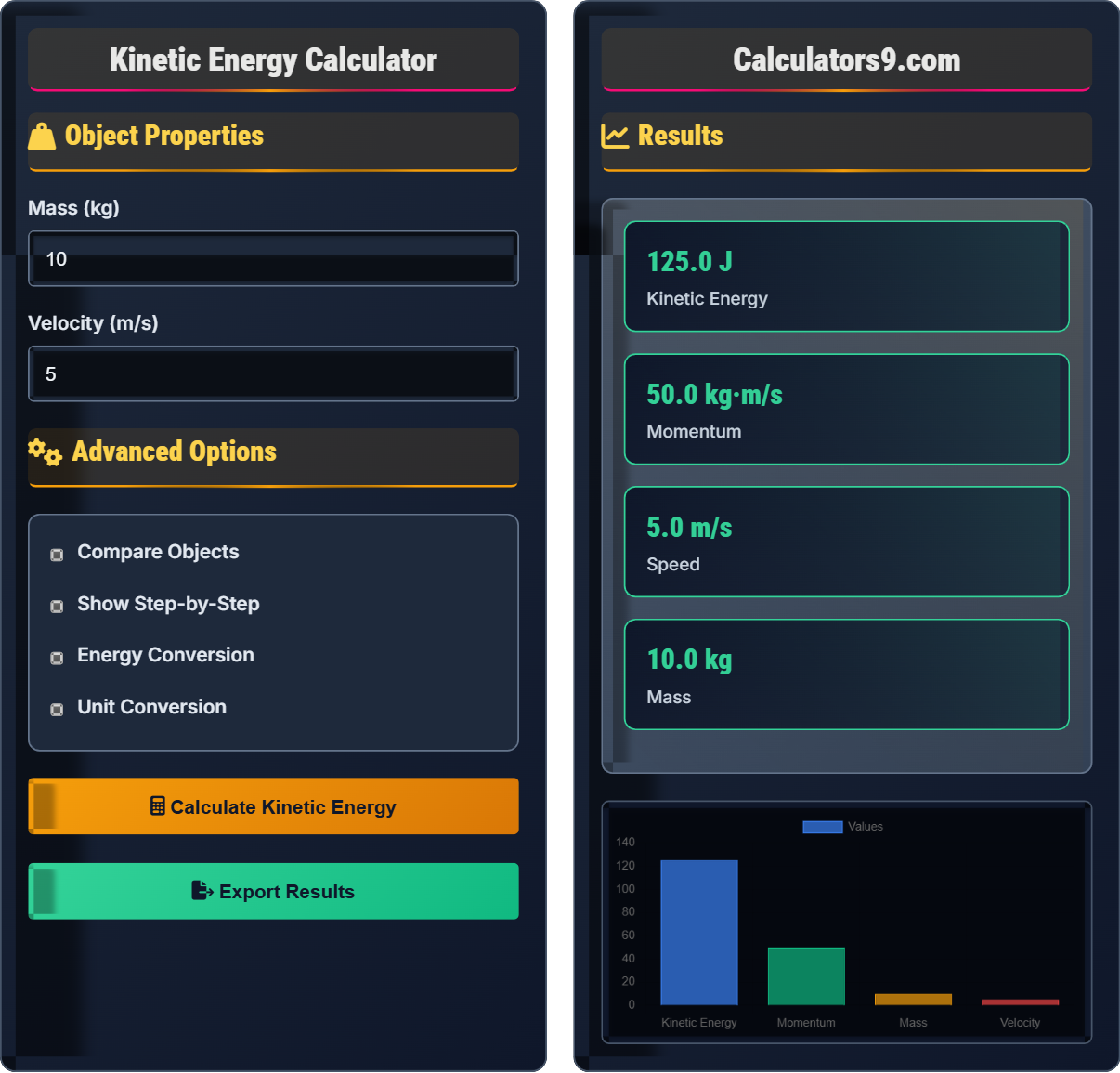
Example: For an object with mass \( m = 10 \) kg moving at velocity \( v = 5 \) m/s:
\( KE = \frac{1}{2} \times 10 \times 5^2 = \frac{1}{2} \times 10 \times 25 = 125 \) joules
Thus, the object has 125 joules of kinetic energy.
Object Properties
Advanced Options
Results
| Property | Value | Unit |
|---|---|---|
| Kinetic Energy | 125.0 | J |
| Momentum | 50.0 | kg·m/s |
| Mass | 10.0 | kg |
| Velocity | 5.0 | m/s |
| Object | Mass (kg) | Velocity (m/s) | KE (J) | Ratio |
|---|---|---|---|---|
| Object 1 | 10.0 | 5.0 | 125.0 | 1.0 |
| Object 2 | 15.0 | 3.0 | 67.5 | 0.54 |
| Unit | Value |
|---|---|
| Joules (J) | 125.0 |
| Kilojoules (kJ) | 0.125 |
| Calories (cal) | 29.9 |
| Kilocalories (kcal) | 0.030 |
| Foot-pounds (ft-lb) | 92.2 |
Kinetic Energy Fundamentals
Kinetic energy is the energy possessed by an object due to its motion. It's one of the fundamental forms of mechanical energy and plays a crucial role in physics, engineering, and everyday applications. The faster an object moves or the more massive it is, the greater its kinetic energy.
The classical kinetic energy formula is derived from Newtonian mechanics:
Where:
- \(KE\) = kinetic energy (joules)
- \(m\) = mass of the object (kilograms)
- \(v\) = velocity of the object (meters per second)
Kinetic energy calculations are essential in numerous fields:
- Transportation: Vehicle crash analysis, braking distance calculations
- Sports: Ballistics, impact analysis, performance optimization
- Engineering: Turbine design, collision safety, energy storage
- Physics: Particle accelerators, molecular motion studies
- A car traveling at 60 mph has significantly more kinetic energy than at 30 mph
- A bullet's high velocity gives it enormous kinetic energy despite small mass
- Wind turbines capture kinetic energy from moving air
- Roller coasters convert potential energy to kinetic energy and back
Kinetic Energy Concepts
Energy of motion - the work needed to accelerate an object from rest to its current velocity.
\(KE = \frac{1}{2}mv^2\)
Where KE=kinetic energy, m=mass, v=velocity.
- KE increases with the square of velocity
- Doubling velocity quadruples KE
- KE is always positive
Applications
Momentum (p=mv) is linear with velocity, while KE is quadratic (v²).
- PE → KE (falling objects)
- KE → Heat (friction)
- KE → Sound (impacts)
- KE → Other forms
- Relativistic effects at high speeds
- Rotational kinetic energy
- Quantum mechanical effects
- Frame of reference dependency
Kinetic Energy Learning Quiz
If the velocity of an object is doubled, how does its kinetic energy change?
The answer is B) It quadruples. Since kinetic energy is calculated as KE = ½mv², when velocity doubles, the kinetic energy becomes KE = ½m(2v)² = ½m(4v²) = 4(½mv²). This means the kinetic energy increases by a factor of four, or quadruples.
This demonstrates the fundamental relationship between velocity and kinetic energy. The squared relationship (v²) means that small changes in velocity result in disproportionately large changes in kinetic energy. This is why even modest increases in vehicle speed dramatically increase the energy involved in potential collisions.
Kinetic Energy: Energy of motion, calculated as KE = ½mv²
Quadratic Relationship: When one quantity is proportional to the square of another
Velocity: Speed in a given direction
• KE ∝ v² (kinetic energy is proportional to velocity squared)
• Doubling velocity increases KE by factor of 4
• Tripling velocity increases KE by factor of 9
• Remember: KE depends on velocity squared, not just velocity
• Use the relationship (v₂/v₁)² to find KE ratios
• Assuming KE doubles when velocity doubles (it quadruples)
• Forgetting the ½ in the formula
A 2000 kg car is traveling at 20 m/s. Calculate its kinetic energy. Then determine what speed it would need to travel to have twice the kinetic energy.
Step 1: Calculate initial kinetic energy
KE₁ = ½mv² = ½ × 2000 × (20)² = ½ × 2000 × 400 = 400,000 J = 400 kJ
Step 2: Find velocity for double KE
KE₂ = 2 × KE₁ = 2 × 400,000 = 800,000 J
800,000 = ½ × 2000 × v₂²
800,000 = 1000 × v₂²
v₂² = 800,000/1000 = 800
v₂ = √800 ≈ 28.28 m/s
Therefore, the car needs to travel at approximately 28.28 m/s to have twice the kinetic energy.
This problem demonstrates the inverse application of the kinetic energy formula. We're finding velocity given kinetic energy, which requires algebraic manipulation. Notice that to double the kinetic energy, we don't need to double the velocity—instead, we multiply by √2 (approximately 1.414). This reinforces the quadratic relationship between velocity and kinetic energy.
Kinetic Energy: Energy possessed by an object due to its motion
Mass: Measure of matter in an object (kg)
Velocity: Rate of change of displacement (m/s)
• KE = ½mv² (kinetic energy formula)
• To double KE, multiply velocity by √2
• KE is always positive regardless of direction
• When solving for velocity, take the square root of both sides
• Always check units: mass in kg, velocity in m/s
• Remember that KE is scalar (no direction)
• Forgetting to square the velocity in calculations
• Misapplying the relationship between KE and velocity
• Incorrectly assuming linear relationship
FAQ
Q: Why is kinetic energy proportional to the square of velocity rather than just velocity?
A: The quadratic relationship between kinetic energy and velocity arises from the work-energy principle. When a force accelerates an object over a distance, the work done (W = Fd) translates to kinetic energy. Since acceleration (and thus velocity change) occurs over time, and distance traveled during acceleration is proportional to time squared, the energy gained ends up being proportional to velocity squared.
Mathematically, starting from Newton's second law (F = ma) and kinematic equations, we derive that the work needed to accelerate an object from rest to velocity v is W = ½mv². This quadratic relationship reflects how much harder it is to achieve higher velocities—the energy needed grows rapidly as speed increases.
Consider this practical example: if a car going 30 mph needs a certain distance to stop, a car going 60 mph (double the speed) needs four times the stopping distance because it has four times the kinetic energy to dissipate.
Q: How does kinetic energy apply to rotating objects like wheels or turbines?
Is the formula still KE = ½mv² for rotating systems?
A: For rotating objects, we use rotational kinetic energy, which follows a similar quadratic pattern but uses angular velocity and moment of inertia:
\( KE_{rot} = \frac{1}{2}I\omega^2 \)
Where I is the moment of inertia (analogous to mass) and ω is the angular velocity (radians per second).
For a wheel or cylinder rotating about its axis, the moment of inertia depends on the mass distribution. For example, a solid cylinder has I = ½mr², where r is the radius. So the rotational kinetic energy would be:
\( KE_{rot} = \frac{1}{2} \times \frac{1}{2}mr^2 \times \omega^2 = \frac{1}{4}mr^2\omega^2 \)
This is particularly important in engineering applications like flywheels for energy storage, turbine design, and vehicle dynamics. The quadratic relationship still applies—doubling angular velocity quadruples the rotational kinetic energy.