Moment of Inertia Calculator
Rotational dynamics analysis • 2026 physics
Moment of Inertia Formula:
Show the calculator\( I = \sum m_i r_i^2 \) or \( I = \int r^2 dm \)
Where:
- \( I \) = moment of inertia (kg⋅m²)
- \( m_i \) = mass of each particle (kg)
- \( r_i \) = distance from rotation axis to each particle (m)
This fundamental quantity measures an object's resistance to angular acceleration about a specific axis. It depends on both the mass distribution and the location of the rotation axis. The moment of inertia plays the same role in rotational motion as mass does in linear motion. For continuous bodies, integration replaces summation.
Common Shapes:
- Point mass: \( I = mr^2 \)
- Ring: \( I = mr^2 \)
- Solid cylinder: \( I = \frac{1}{2}mr^2 \)
- Hollow cylinder: \( I = \frac{1}{2}m(r_1^2 + r_2^2) \)
- Solid sphere: \( I = \frac{2}{5}mr^2 \)
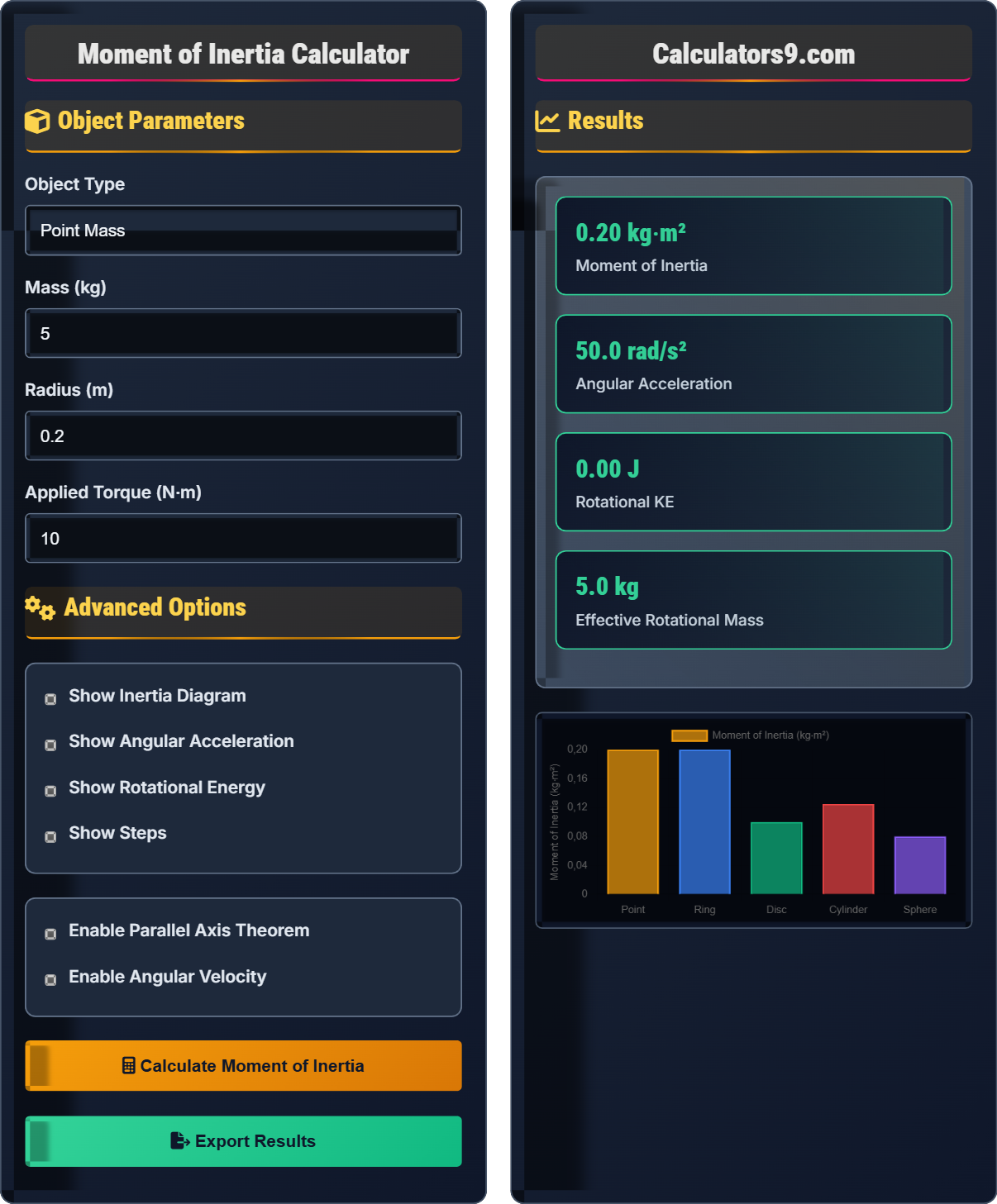
Object Parameters
Advanced Options
Results
| Parameter | Value | Description |
|---|
| Acceleration Type | Value | Significance |
|---|
| Energy Property | Value | Units |
|---|
Comprehensive Moment of Inertia Guide
Moment of inertia is a measure of an object's resistance to changes in its rotational motion about a specific axis. It is the rotational analog of mass in linear motion. The moment of inertia depends on both the mass of an object and how that mass is distributed relative to the rotation axis. Objects with more mass distributed farther from the axis have greater moments of inertia.
The fundamental definition is:
For discrete particles or continuous bodies respectively, where \(m_i\) is the mass of each particle and \(r_i\) is its distance from the rotation axis.
When the rotation axis is not through the center of mass:
Where \(I_{cm}\) is the moment of inertia about the center of mass, m is the total mass, and d is the distance to the new axis.
- Rotating Machinery: Design of flywheels, turbines, and motors
- Vehicle Dynamics: Wheel and engine rotation considerations
- Sports: Golf clubs, baseball bats, and diving rotations
- Structural Engineering: Beam deflection and stability
- Astronomy: Planetary rotation and satellite stabilization
Inertia Fundamentals
Resistance to angular acceleration about a rotation axis.
\(I = \sum m_i r_i^2\)
Where I=inertia, m=mass, r=distance from axis.
- Depends on mass distribution
- Farther mass = higher inertia
- Axis location matters
Applications
Flywheels, motors, and rotating machinery rely on inertia principles.
- Motor design
- Vehicle dynamics
- Sports equipment
- Structural analysis
- Mass distribution affects inertia
- Axis location critical
- Parallel axis theorem applies
- Angular momentum conservation
Moment of Inertia Learning Quiz
Two identical spheres have the same mass, but one has twice the radius of the other. How does the moment of inertia of the larger sphere compare to the smaller one about an axis through their centers?
The answer is C) Four times as large. For a solid sphere, the moment of inertia is I = (2/5)mr². If the radius doubles (r → 2r), the moment of inertia becomes I_new = (2/5)m(2r)² = (2/5)m(4r²) = 4 × (2/5)mr² = 4I_original. Since I ∝ r², doubling the radius quadruples the moment of inertia.
This demonstrates the quadratic dependence of moment of inertia on radius. Even though the spheres have the same mass, the larger sphere has more mass distributed farther from the rotation axis, significantly increasing its resistance to angular acceleration. This is why flywheels are designed with mass concentrated at the outer edges.
Moment of Inertia: Resistance to angular acceleration
Mass Distribution: How mass is arranged relative to rotation axis
Quadratic Dependence: I ∝ r² for radial dimensions
• I ∝ r² for radial dimensions
• More distant mass contributes disproportionately
• Same mass can have different inertias
• Think of figure skater pulling arms in
• Concentrate mass at edges for high inertia
• Distribute mass near axis for low inertia
• Thinking inertia only depends on mass
• Forgetting quadratic dependence on radius
• Confusing with linear mass properties
Calculate the moment of inertia of a solid cylinder with mass 8 kg and radius 0.3 m rotating about its central axis. Then find the angular acceleration if a torque of 12 N⋅m is applied.
Step 1: Calculate moment of inertia
For a solid cylinder rotating about its central axis: I = (1/2)mr²
I = (1/2) × 8 × (0.3)² = (1/2) × 8 × 0.09 = 0.36 kg⋅m²
Step 2: Calculate angular acceleration
Using Newton's second law for rotation: τ = Iα
Rearranging: α = τ/I = 12/0.36 = 33.33 rad/s²
Therefore, the moment of inertia is 0.36 kg⋅m² and the angular acceleration is 33.3 rad/s².
This connects moment of inertia to angular acceleration through the rotational equivalent of Newton's second law. The moment of inertia acts as the "rotational mass," determining how much angular acceleration results from a given torque. Just as F = ma in linear motion, τ = Iα in rotational motion.
Rotational Equivalent: τ = Iα (analogous to F = ma)
Angular Acceleration: Rate of change of angular velocity
Central Axis: Axis through the center of the object
• τ = Iα for rotational motion
• Larger I means smaller α for same τ
• Formula depends on object shape and axis
• Remember: I = ½mr² for solid cylinders
• Torque causes angular acceleration
• Inertia resists angular acceleration
• Using wrong formula for object shape
• Confusing rotational with linear equations
• Forgetting axis dependence
A uniform rod of mass 2 kg and length 1.2 m rotates about an axis perpendicular to the rod and passing through one end. Calculate its moment of inertia using the parallel axis theorem. (The moment of inertia about the center is I_cm = (1/12)ML²)
Step 1: Find moment of inertia about center of mass
I_cm = (1/12)ML² = (1/12) × 2 × (1.2)² = (1/12) × 2 × 1.44 = 0.24 kg⋅m²
Step 2: Apply parallel axis theorem
I = I_cm + Md²
The distance from center to end is d = L/2 = 1.2/2 = 0.6 m
I = 0.24 + 2 × (0.6)² = 0.24 + 2 × 0.36 = 0.24 + 0.72 = 0.96 kg⋅m²
Therefore, the moment of inertia about the end is 0.96 kg⋅m².
This demonstrates how the parallel axis theorem allows calculation of moment of inertia about any axis parallel to one through the center of mass. Moving the rotation axis away from the center significantly increases the moment of inertia, making the rod harder to rotate about its end than about its center.
Parallel Axis Theorem: I = I_cm + Md²
Center of Mass: Point where mass is balanced
Arbitrary Axis: Any axis parallel to CM axis• I = I_cm + Md² always
• d is distance between axes
• I increases with distance from CM
• CM formula is usually simpler
• Always add Md² for parallel axis
• Distance is from CM to new axis
• Forgetting to add Md²
• Calculating distance incorrectly
• Confusing axis locations
A solid disk of mass 3 kg and radius 0.4 m rotates at 10 rad/s. Calculate its rotational kinetic energy. If the disk suddenly expands to double its radius while conserving angular momentum, what happens to its rotational kinetic energy?
Step 1: Calculate initial moment of inertia
I_initial = (1/2)mr² = (1/2) × 3 × (0.4)² = 0.24 kg⋅m²
Step 2: Calculate initial rotational kinetic energy
KE_initial = (1/2)Iω² = (1/2) × 0.24 × (10)² = 12 J
Step 3: Apply angular momentum conservation
L = Iω = constant
I_final = (1/2)m(2r)² = (1/2) × 3 × (0.8)² = 0.96 kg⋅m²
Since L_initial = L_final: I₁ω₁ = I₂ω₂
0.24 × 10 = 0.96 × ω₂
ω₂ = 2.4 rad/s
Step 4: Calculate final kinetic energy
KE_final = (1/2)I₂ω₂² = (1/2) × 0.96 × (2.4)² = 2.76 J
The rotational kinetic energy decreases from 12 J to 2.76 J.
This demonstrates the conservation of angular momentum versus energy. When the disk expands, its moment of inertia increases, causing its angular velocity to decrease to conserve angular momentum. Since KE = (1/2)Iω² and ω decreases more significantly than I increases, the total kinetic energy decreases.
Rotational KE: KE = (1/2)Iω²
Angular Momentum: L = Iω (conserved)
Energy Conservation: Does not apply to KE in this case
• L = Iω conserved in isolated systems
• KE = (1/2)Iω² not necessarily conserved
• Expanding I decreases ω
• Angular momentum often conserved
• KE changes with I and ω differently
• Think of ice skater expanding arms
• Confusing momentum and energy conservation
• Thinking KE is always conserved
• Forgetting ω changes with I
Compare a hollow cylinder and a solid cylinder with the same mass and outer radius. Which statement is TRUE?
The answer is D) The hollow cylinder has higher moment of inertia. For a solid cylinder: I_solid = (1/2)mr². For a hollow cylinder: I_hollow = mr² (assuming thin walls). Since all the mass of the hollow cylinder is concentrated at the outer radius, it has more mass farther from the rotation axis, resulting in a higher moment of inertia than the solid cylinder where mass is distributed from center to outer edge.
This illustrates how mass distribution affects moment of inertia. Even with the same total mass and outer dimensions, the hollow cylinder has all its mass concentrated at the maximum distance from the axis, maximizing the contribution to moment of inertia. This is why hollow shapes generally have higher moments of inertia than solid ones of the same mass and size.
Mass Distribution: How mass is arranged relative to axis
Hollow Cylinder: I = mr² (thin wall)
Solid Cylinder: I = ½mr²
• Farther mass contributes more to I
• Hollow shapes typically have higher I
• Same mass can have different I values
• Concentrate mass at edges for high I
• Distribute mass near axis for low I
• Hollow objects have higher I than solid
• Thinking mass is the only factor
• Forgetting distribution matters more
• Confusing with linear mass properties
FAQ
Q: How does the perpendicular axis theorem differ from the parallel axis theorem in moment of inertia calculations?
A: These theorems apply to different geometric situations:
Parallel Axis Theorem: Applies when moving the rotation axis parallel to an axis through the center of mass:
\( I = I_{cm} + md^2 \)
Used for any 3D object when the new axis is parallel to the CM axis.
Perpendicular Axis Theorem: Applies only to planar objects (laminae) and relates moments of inertia about three mutually perpendicular axes:
\( I_z = I_x + I_y \)
Where the z-axis is perpendicular to the plane containing the x and y axes.
For example, for a flat rectangular plate: if you know \( I_x \) and \( I_y \) (axes in the plane), you can find \( I_z \) (axis perpendicular to the plane).
Q: What is the significance of the radius of gyration in moment of inertia applications?
A: The radius of gyration, k, is defined as the distance from the rotation axis at which the entire mass of an object could be concentrated without changing its moment of inertia:
\( I = mk^2 \) therefore \( k = \sqrt{\frac{I}{m}} \)
Its significance includes:
- Structural Engineering: Determines buckling behavior of columns
- Design Optimization: Helps optimize mass distribution
- Comparative Analysis: Allows comparing inertial properties of different shapes
- Scaling Laws: Predicts how inertia changes with size
For example, a solid sphere has \( k = r\sqrt{\frac{2}{5}} = 0.632r \), meaning all its mass could be concentrated at 63.2% of its radius to achieve the same moment of inertia.