Potential Energy Calculator
Physics & Engineering Tool • Energy Calculations
Gravitational Potential Energy Formula:
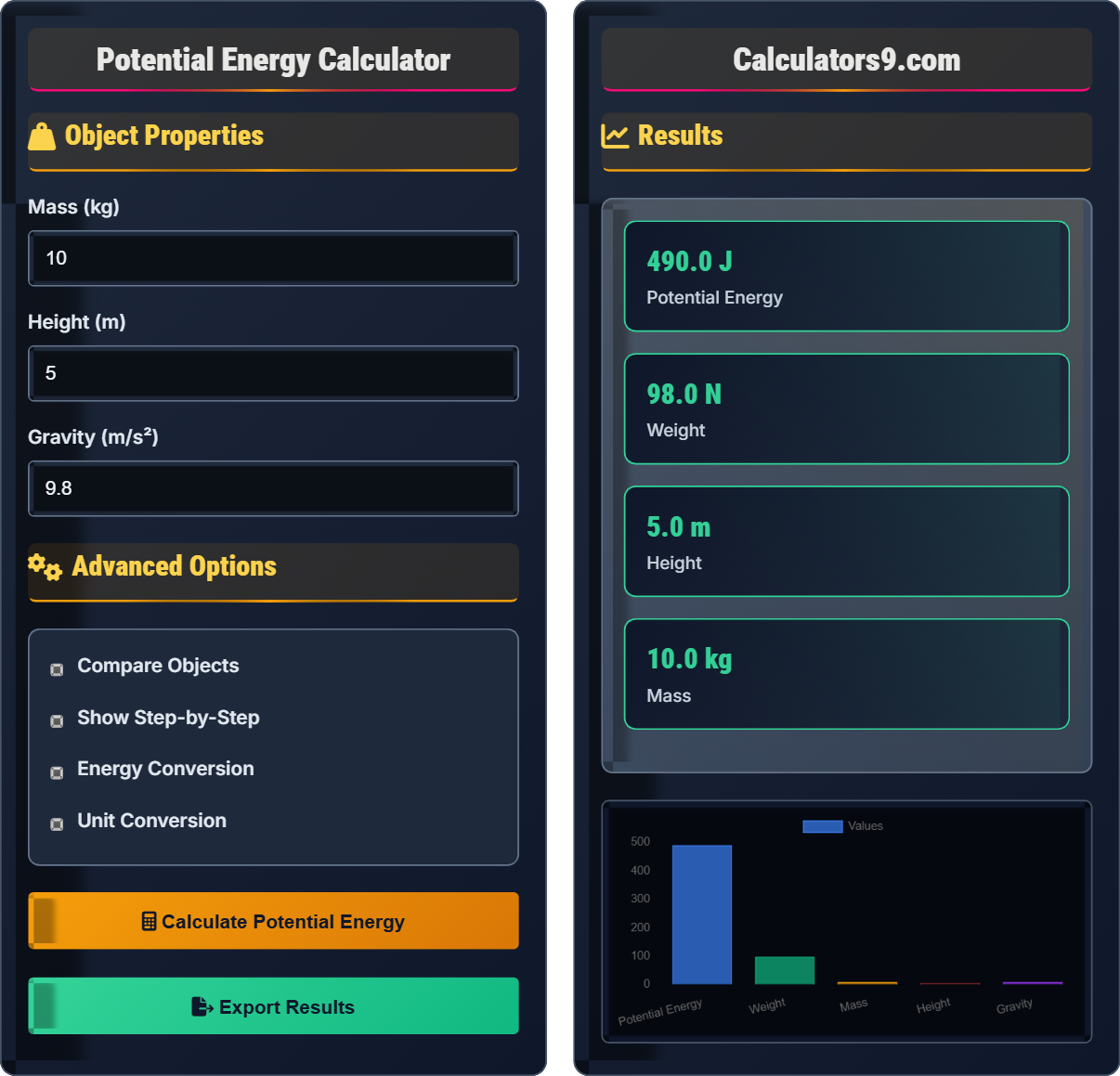
Show the calculator\( PE = mgh \)
Where:
- \( PE \) = potential energy (joules)
- \( m \) = mass of the object (kg)
- \( g \) = acceleration due to gravity (m/s²)
- \( h \) = height above reference point (m)
This fundamental physics formula calculates the energy stored in an object due to its position in a gravitational field. The potential energy increases with mass, gravitational acceleration, and height.
Example: For an object with mass \( m = 10 \) kg at height \( h = 5 \) m on Earth (\( g = 9.8 \) m/s²):
\( PE = 10 \times 9.8 \times 5 = 490 \) joules
Thus, the object has 490 joules of potential energy.
Object Properties
Advanced Options
Results
| Property | Value | Unit |
|---|---|---|
| Potential Energy | 490.0 | J |
| Weight | 98.0 | N |
| Mass | 10.0 | kg |
| Height | 5.0 | m |
| Gravity | 9.8 | m/s² |
| Object | Mass (kg) | Height (m) | PE (J) | Ratio |
|---|---|---|---|---|
| Object 1 | 10.0 | 5.0 | 490.0 | 1.0 |
| Object 2 | 15.0 | 3.0 | 441.0 | 0.90 |
| Unit | Value |
|---|---|
| Joules (J) | 490.0 |
| Kilojoules (kJ) | 0.490 |
| Calories (cal) | 117.1 |
| Kilocalories (kcal) | 0.117 |
| Foot-pounds (ft-lb) | 361.4 |
Potential Energy Fundamentals
Potential energy is the energy stored in an object due to its position in a force field, most commonly gravitational. It represents the capacity to do work based on an object's position relative to other objects. The higher an object is positioned, the more potential energy it possesses.
The gravitational potential energy formula is derived from the work done against gravity:
Where:
- \(PE\) = potential energy (joules)
- \(m\) = mass of the object (kilograms)
- \(g\) = acceleration due to gravity (m/s²)
- \(h\) = height above reference point (meters)
Potential energy calculations are essential in numerous fields:
- Hydroelectric Power: Water stored in reservoirs has potential energy
- Transportation: Fuel efficiency calculations for hills and mountains
- Engineering: Structural stability, dam design, elevator systems
- Physics: Pendulum motion, roller coasters, projectile motion
- Water behind a dam stores potential energy waiting to be released
- A book on a shelf has more potential energy than one on the floor
- Rubber bands store elastic potential energy when stretched
- Roller coasters convert PE to KE and back throughout the ride
Potential Energy Concepts
Stored energy due to position - the work needed to move an object to its current position against gravity.
\(PE = mgh\)
Where PE=potential energy, m=mass, g=gravity, h=height.
- PE increases linearly with height
- Doubling height doubles PE
- PE is zero at reference level
Applications
PE converts to KE when objects fall, following conservation of energy.
- PE → KE (falling objects)
- PE → Elastic PE (compression)
- PE → Electrical (hydroelectric)
- PE → Other forms
- Gravity varies by location
- Reference point affects calculations
- Other PE types exist (elastic, chemical)
- Energy losses in real systems
Potential Energy Learning Quiz
If the height of an object is tripled while its mass remains constant, how does its potential energy change?
The answer is B) It triples. Since potential energy is calculated as PE = mgh, when height is tripled, the potential energy becomes PE = mg(3h) = 3(mgh). This means the potential energy increases by a factor of three, or triples. This is a direct linear relationship.
This demonstrates the linear relationship between height and potential energy. Unlike kinetic energy which has a quadratic relationship with velocity, potential energy has a direct linear relationship with height. This means that doubling the height doubles the potential energy, tripling the height triples the potential energy, and so on.
Potential Energy: Stored energy due to position in a gravitational field
Linear Relationship: When one quantity changes proportionally to another
Reference Level: Zero point for measuring height
• PE ∝ h (potential energy is proportional to height)
• Tripling height triples PE
• PE is zero at reference level
• Remember: PE = mgh is a linear relationship
• Changes in height cause proportional changes in PE
• Confusing with KE which has quadratic relationship
• Forgetting the linear nature of PE-height relationship
A 50 kg rock is sitting on a cliff 20 meters above the ground. Calculate its potential energy. Then determine what height it would need to be raised to in order to have twice the potential energy. (Use g = 9.8 m/s²)
Step 1: Calculate initial potential energy
PE₁ = mgh = 50 × 9.8 × 20 = 9,800 J
Step 2: Find height for double PE
PE₂ = 2 × PE₁ = 2 × 9,800 = 19,600 J
19,600 = 50 × 9.8 × h₂
19,600 = 490 × h₂
h₂ = 19,600/490 = 40 m
Therefore, the rock needs to be raised to a height of 40 meters to have twice the potential energy.
This problem demonstrates the inverse application of the potential energy formula. We're finding height given potential energy, which requires algebraic manipulation. Since PE is linearly related to height, doubling the potential energy requires exactly doubling the height. This is different from kinetic energy where velocity has a quadratic relationship with KE.
Potential Energy: Energy stored due to position in gravitational field
Mass: Measure of matter in an object (kg)Gravity: Acceleration due to gravitational field (m/s²)
• PE = mgh (potential energy formula)
• To double PE, double the height
• PE is always positive when above reference level
• When solving for height, divide both sides by mg
• Always check units: mass in kg, height in m, g in m/s²
• Remember that PE = 0 at reference level
• Forgetting the reference level for height measurement
• Confusing linear PE-height relationship with quadratic KE-velocity
• Incorrectly assuming PE changes quadratically
FAQ
Q: Why is potential energy calculated relative to a reference point rather than absolutely?
A: Potential energy is defined relative to a reference point because only differences in potential energy are physically meaningful. There's no absolute "zero" point for potential energy in space. We can choose any convenient reference level (like ground level, sea level, or the bottom of a well) as our zero point. What matters is the change in potential energy when an object moves from one position to another.
For example, if you lift a book from the floor to a shelf, the work you do depends only on the difference in height between the floor and the shelf, not on the absolute height above sea level. This is why we say "potential energy at height h" rather than "absolute potential energy."
Mathematically, if we change our reference point, we add a constant to all potential energies, but differences remain unchanged: ΔPE = PE₂ - PE₁ stays the same regardless of the reference level.
Q: How does potential energy apply to renewable energy systems like hydroelectric power?
How do engineers calculate the energy potential of water reservoirs?
A: Hydroelectric power plants rely entirely on gravitational potential energy. Water stored in reservoirs at elevated positions contains potential energy that can be converted to electrical energy as it flows downhill through turbines.
The potential energy of a water reservoir is calculated using PE = mgh, where:
- m = mass of water (volume × density)
- g = gravitational acceleration (≈9.8 m/s²)
- h = height difference between reservoir and turbine (head)
For a reservoir containing 1 million cubic meters of water (mass = 1 billion kg) at a height of 100 meters above the turbines:
PE = 1×10⁹ × 9.8 × 100 = 9.8×10¹¹ Joules
This energy can be converted to electricity with efficiencies typically ranging from 80-90%. Engineers also consider factors like flow rate, turbine efficiency, and seasonal water availability when designing these systems.