Refractive Index Calculator
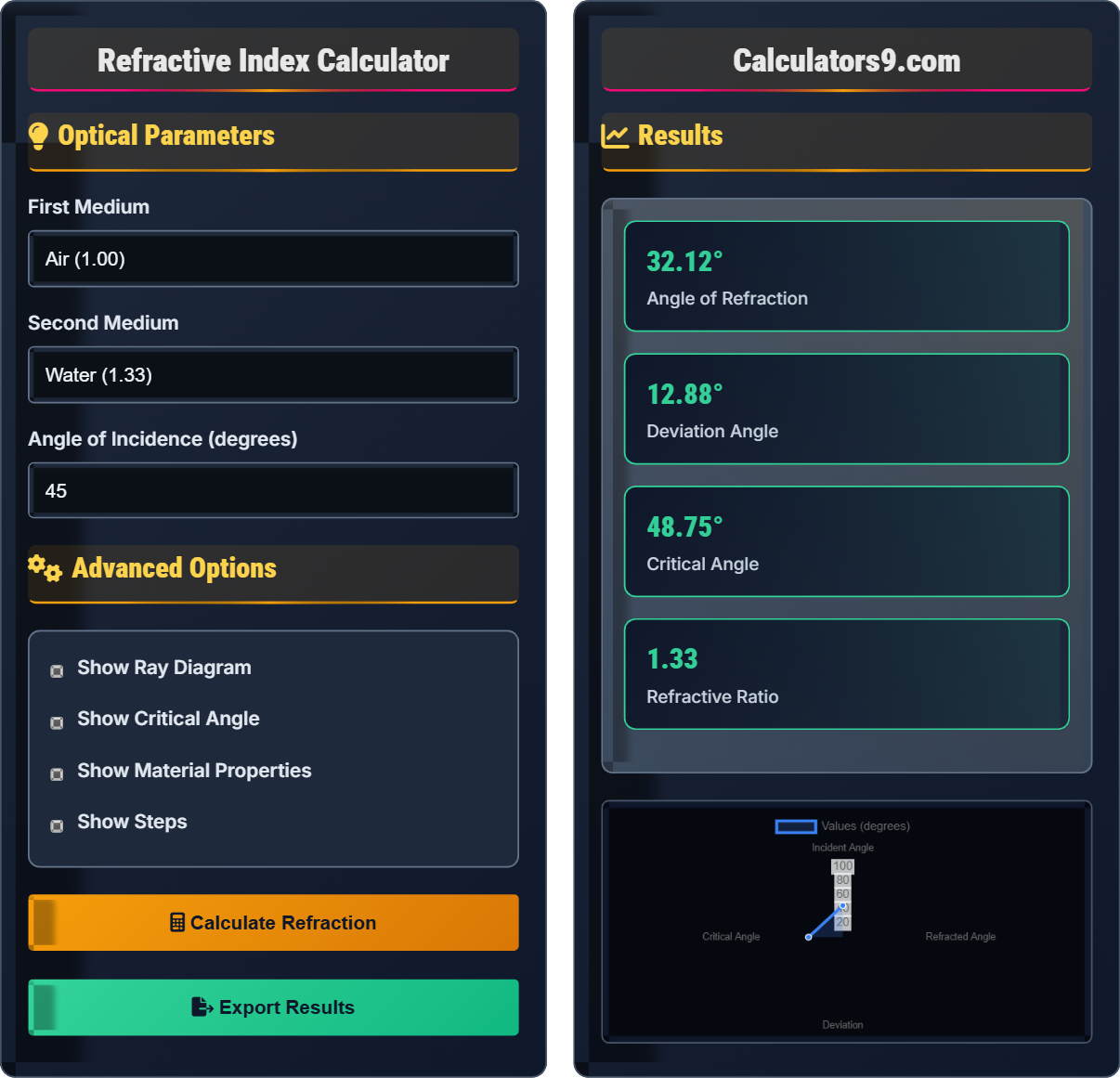
Snell's law analysis • 2026 optics
Snell's Law Formula:
Show the calculator\( n_1 \sin(\theta_1) = n_2 \sin(\theta_2) \)
Where:
- \( n_1 \) = refractive index of first medium
- \( n_2 \) = refractive index of second medium
- \( \theta_1 \) = angle of incidence (in degrees)
- \( \theta_2 \) = angle of refraction (in degrees)
This formula describes how light bends when passing from one medium to another. The refractive index indicates how much light slows down in a medium compared to vacuum. When light enters a denser medium, it bends towards the normal; when entering a less dense medium, it bends away from the normal.
Example: Light traveling from air (\( n_1 = 1.00 \)) into water (\( n_2 = 1.33 \)) at an angle of incidence of 45°:
\( \sin(\theta_2) = \frac{n_1 \sin(\theta_1)}{n_2} = \frac{1.00 \times \sin(45°)}{1.33} = \frac{0.707}{1.33} = 0.532 \)
\( \theta_2 = \arcsin(0.532) = 32.1° \)
Thus, the angle of refraction is approximately 32.1°.
Optical Parameters
Advanced Options
Results
| Parameter | Value | Description |
|---|
| Material | Index | Properties |
|---|
Comprehensive Refraction Guide
Refraction is the bending of light as it passes from one medium to another with different optical densities. This occurs because light travels at different speeds in different materials, characterized by their refractive index. Named after Dutch mathematician Willebrord Snell, Snell's law quantifies this phenomenon.
The fundamental equation governing refraction is Snell's law:
Where:
- \(n_1\) = refractive index of first medium
- \(n_2\) = refractive index of second medium
- \(\theta_1\) = angle of incidence (measured from normal)
- \(\theta_2\) = angle of refraction (measured from normal)
When light travels from a denser to a less dense medium, there's a critical angle beyond which total internal reflection occurs:
Where \(n_1 > n_2\). If the angle of incidence exceeds \(\theta_c\), all light is reflected internally.
- Dispersion: Different wavelengths have slightly different refractive indices
- Temperature Effects: Refractive index varies with temperature
- Wavelength Dependence: Index typically decreases with increasing wavelength
- Material Purity: Impurities can alter refractive properties
Refraction Fundamentals
Bending of light when passing between media with different optical densities.
\(n_1 \sin(\theta_1) = n_2 \sin(\theta_2)\)
Where n₁,n₂=refractive indices, θ₁,θ₂=incident/refracted angles.
- Denser medium = bending toward normal
- Less dense medium = bending away from normal
- Perpendicular incidence = no bending
Applications
Lenses, prisms, and fiber optics rely on refraction principles.
- Corrective eyewear
- Camera lenses
- Telescopes
- Fiber optic cables
- Temperature affects refractive index
- Wavelength dependence (dispersion)
- Material purity matters
- Critical angle for TIR
Refraction Learning Quiz
When light travels from air into glass, how does it behave?
The answer is B) It slows down and bends towards the normal. When light travels from a less dense medium (air, n≈1.00) to a denser medium (glass, n≈1.52), it slows down and bends toward the normal. This is because the refractive index of glass is higher than that of air, causing the light to change direction according to Snell's law.
Think of a car driving from asphalt onto sand at an angle. The wheel hitting the sand first slows down while the other wheel continues at the original speed, causing the car to turn. Similarly, when light enters a denser medium, the part of the wavefront entering first slows down, causing the entire beam to bend toward the normal.
Refractive Index: Measure of how much light slows down in a medium
Normal: Imaginary line perpendicular to the surface interface
Denser Medium: Material with higher refractive index
• Light slows down in denser media
• Bends toward normal when entering denser medium
• Bends away from normal when entering less dense medium
• Remember: Denser = slower and bends toward normal
• Use the car analogy for direction of bending
• Confusing the direction of bending
• Thinking light speeds up in denser media
A ray of light travels from air (n=1.00) into water (n=1.33) at an angle of incidence of 30°. Calculate the angle of refraction.
Using Snell's law: \(n_1 \sin(\theta_1) = n_2 \sin(\theta_2)\)
Given:
- n₁ = 1.00 (air)
- n₂ = 1.33 (water)
- θ₁ = 30°
Step 1: Calculate sin(θ₁) = sin(30°) = 0.5
Step 2: Substitute into Snell's law: 1.00 × 0.5 = 1.33 × sin(θ₂)
Step 3: Solve for sin(θ₂): sin(θ₂) = (1.00 × 0.5) / 1.33 = 0.376
Step 4: Calculate θ₂: θ₂ = arcsin(0.376) = 22.1°
Therefore, the angle of refraction is 22.1°.
This calculation confirms that light bends toward the normal when entering a denser medium. The smaller angle of refraction (22.1°) compared to the angle of incidence (30°) demonstrates this principle. The ratio of sines equals the inverse ratio of refractive indices.
Angle of Incidence: Angle between incident ray and normal
Angle of Refraction: Angle between refracted ray and normal
Snell's Law: Relationship between angles and refractive indices
• Always measure angles from the normal
• Use sine function for Snell's law
• Verify direction of bending matches result
• Draw a clear diagram with normal line
• Remember: denser medium = smaller angle
• Always verify your answer makes physical sense
• Measuring angles from the surface instead of normal
• Using cosine instead of sine
• Forgetting to take arcsine to find angle
A light ray travels from diamond (n=2.42) into air (n=1.00). Calculate the critical angle for total internal reflection. What happens if the angle of incidence is greater than this critical angle?
The critical angle formula is: \(\theta_c = \arcsin\left(\frac{n_2}{n_1}\right)\)
Where n₁ > n₂ (light travels from denser to less dense medium).
Step 1: Identify n₁ = 2.42 (diamond), n₂ = 1.00 (air)
Step 2: Calculate ratio: n₂/n₁ = 1.00/2.42 = 0.413
Step 3: Calculate critical angle: θc = arcsin(0.413) = 24.4°
Step 4: If angle of incidence > 24.4°, total internal reflection occurs.
Therefore, the critical angle is 24.4°, and total internal reflection occurs for angles greater than this.
At the critical angle, the refracted ray travels along the boundary between the two media. Beyond this angle, refraction cannot occur, and all light is reflected back into the denser medium. This principle is essential for fiber optic technology.
Critical Angle: Angle of incidence where refraction grazes the surface
Total Internal Reflection: Complete reflection when angle exceeds critical
Optical Fiber: Uses TIR to guide light through flexible cables
• TIR only occurs when light travels from denser to less dense medium
• Critical angle exists only when n₁ > n₂
• Incident angle must exceed critical angle for TIR
• Remember: TIR = no refraction, only reflection
• Critical angle always occurs at the boundary condition
• Use the formula only when n₁ > n₂
• Applying critical angle formula when n₁ < n₂
• Forgetting the physical condition for TIR
• Confusing critical angle with Brewster's angle
An optical fiber has a core with refractive index 1.48 and cladding with refractive index 1.46. Calculate the critical angle for light traveling within the core. If the fiber is immersed in water (n=1.33), how does this affect the acceptance angle?
Step 1: Calculate critical angle at core-cladding interface:
θc = arcsin(n_cladding/n_core) = arcsin(1.46/1.48) = arcsin(0.986) = 80.6°
Step 2: Calculate acceptance angle (numerical aperture):
NA = √(n_core² - n_cladding²) = √(1.48² - 1.46²) = √(2.1904 - 2.1316) = √0.0588 = 0.242
Step 3: Acceptance angle in air: θ_accept = arcsin(NA) = arcsin(0.242) = 14.0°
Step 4: When immersed in water (n_water = 1.33):
θ_accept_water = arcsin(NA/n_water) = arcsin(0.242/1.33) = arcsin(0.182) = 10.5°
Therefore, the critical angle is 80.6°, and the acceptance angle decreases from 14.0° to 10.5° when immersed in water.
This demonstrates how the surrounding medium affects fiber optic performance. The numerical aperture determines how much light can be captured by the fiber. When immersed in a higher-index medium, the acceptance angle decreases, reducing the fiber's light-gathering capability.
Numerical Aperture: Measure of light-gathering ability of an optical fiber
Acceptance Angle: Maximum angle for light to enter fiber and propagate
Optical Fiber: Waveguide that transmits light by total internal reflection
• NA = √(n₁² - n₂²) for fiber optic systems
• Acceptance angle depends on surrounding medium
• Higher NA = wider acceptance angle
• NA is dimensionless and always < 1
• Acceptance angle in water = arcsin(NA/n_medium)
• Higher contrast between core and cladding = higher NA
• Forgetting to adjust acceptance angle for surrounding medium
• Confusing critical angle with acceptance angle
• Incorrectly identifying core vs cladding indices
Which of the following statements about dispersion is TRUE?
The answer is B) Blue light typically has a higher refractive index than red light. Dispersion is the phenomenon where the refractive index of a material varies with wavelength. Typically, blue light (shorter wavelength) has a higher refractive index than red light (longer wavelength), causing white light to separate into its component colors when passing through a prism.
This wavelength dependence of refractive index explains why prisms create rainbows and why chromatic aberration occurs in lenses. The relationship is often described by Cauchy's equation: n(λ) = A + B/λ² + C/λ⁴, where λ is wavelength. Shorter wavelengths interact more strongly with the atomic structure of materials.
Dispersion: Variation of refractive index with wavelength
Chromatic Aberration: Focal length variation with wavelength in lenses
Cauchy's Equation: Mathematical description of dispersion
• Blue light usually has higher n than red light
• Dispersion occurs in all transparent materials
• Vacuum has no dispersion (n=1 for all wavelengths)
• Remember: Blue bends more than red in a prism
• Dispersion causes chromatic aberration in lenses
• Achromatic lenses correct for dispersion
• Assuming all wavelengths have same refractive index
• Thinking dispersion only occurs in specific materials
• Confusing dispersion with absorption
FAQ
Q: How does temperature affect refractive index and why is this important?
A: Temperature affects refractive index primarily through two mechanisms:
- Density Changes: As temperature increases, most materials expand and become less dense, typically decreasing the refractive index.
- Polarizability: Higher temperatures can affect molecular polarizability, further altering the refractive index.
The relationship is often expressed as: \( \frac{dn}{dT} \approx -2 \times 10^{-4} \) K⁻¹ for glasses.
This temperature dependence is crucial in applications like:
- High-precision optical instruments that must account for thermal drift
- Fiber optic communications where temperature variations affect signal transmission
- Thermal lensing in high-power laser systems
- Optical sensors that measure temperature based on refractive index changes
Q: What is the difference between phase velocity and group velocity in dispersive media?
A: In dispersive media, phase velocity and group velocity differ significantly:
- Phase Velocity: \( v_p = \frac{\omega}{k} = \frac{c}{n(\lambda)} \) - the speed at which individual wave crests propagate
- Group Velocity: \( v_g = \frac{d\omega}{dk} = \frac{c}{n(\lambda) + \lambda \frac{dn}{d\lambda}} \) - the speed at which energy and information propagate
In non-dispersive media (constant n), both velocities equal c/n. However, in dispersive media, they differ:
\( v_g = \frac{c}{n - \lambda \frac{dn}{d\lambda}} \)
This difference is critical for:
- Pulse broadening in optical fibers
- Design of ultrafast laser systems
- Quantum information processing
- Superluminal effects (group velocity can exceed c, but no information travels faster than c)