Snell's Law Solver
Optical refraction analysis • 2026 optics
Snell's Law Formula:
Show the calculator\( n_1 \sin(\theta_1) = n_2 \sin(\theta_2) \)
Where:
- \( n_1 \) = refractive index of first medium
- \( n_2 \) = refractive index of second medium
- \( \theta_1 \) = angle of incidence (in degrees)
- \( \theta_2 \) = angle of refraction (in degrees)
This fundamental law of optics describes how light bends when transitioning between media with different refractive indices. The law states that the product of the refractive index and sine of the angle remains constant across the interface. When light enters a denser medium, it bends toward the normal; when entering a less dense medium, it bends away from the normal.
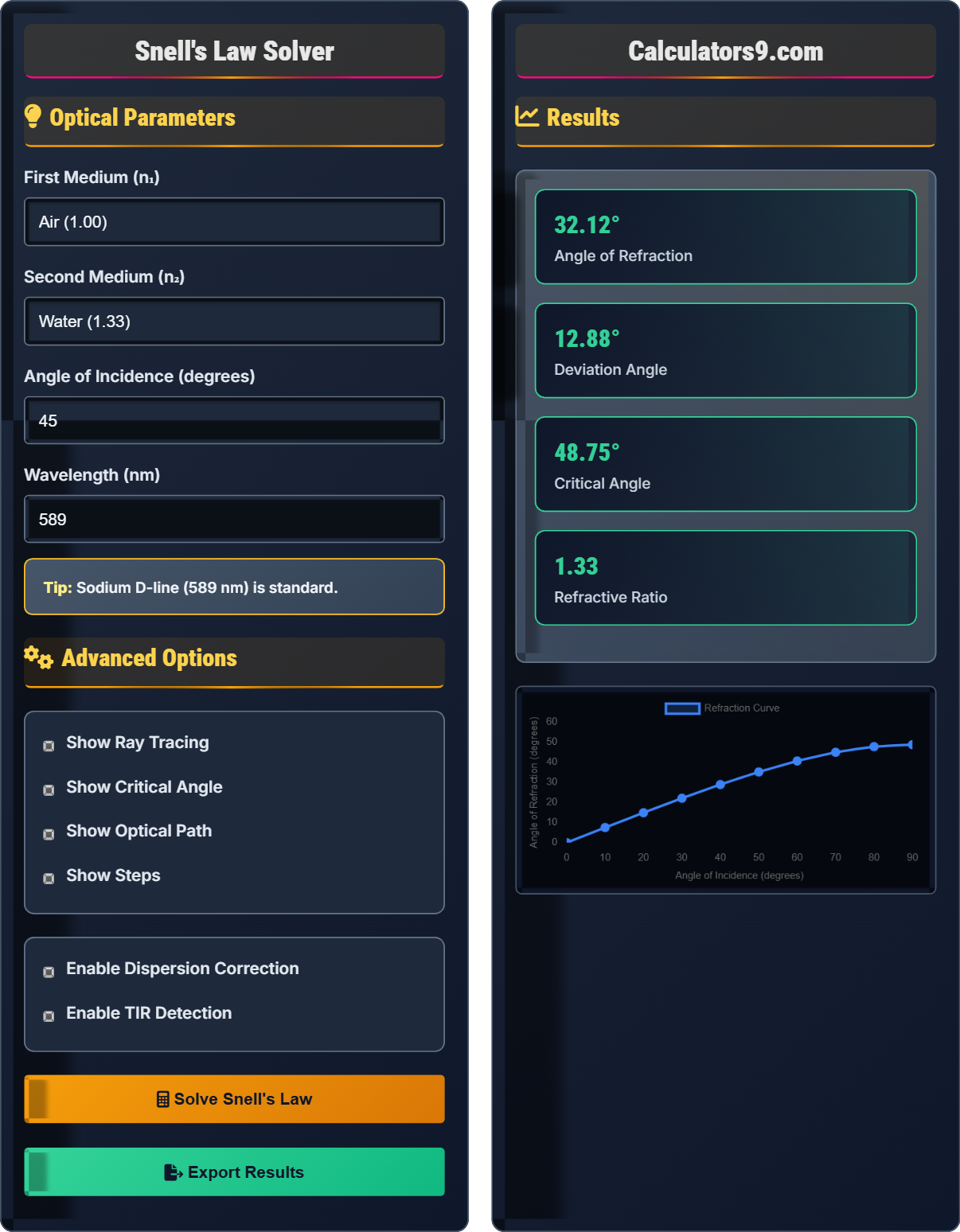
Example: Light traveling from air (\( n_1 = 1.00 \)) into water (\( n_2 = 1.33 \)) at an angle of incidence of 45°:
\( \sin(\theta_2) = \frac{n_1 \sin(\theta_1)}{n_2} = \frac{1.00 \times \sin(45°)}{1.33} = \frac{0.707}{1.33} = 0.532 \)
\( \theta_2 = \arcsin(0.532) = 32.1° \)
Thus, the angle of refraction is approximately 32.1°.
Optical Parameters
Advanced Options
Results
| Parameter | Value | Description |
|---|
| Material | Index | Properties |
|---|
| Property | Value | Significance |
|---|
Comprehensive Snell's Law Guide
Snell's law, discovered by Dutch mathematician Willebrord Snell in 1621, describes the relationship between the angles of incidence and refraction when light passes through the interface between two different isotropic media. It forms the foundation of geometric optics and explains how light bends at boundaries.
The fundamental equation governing refraction is Snell's law:
Where:
- \(n_1\) = refractive index of first medium
- \(n_2\) = refractive index of second medium
- \(\theta_1\) = angle of incidence (measured from normal)
- \(\theta_2\) = angle of refraction (measured from normal)
When light travels from a denser to a less dense medium, there's a critical angle beyond which total internal reflection occurs:
Where \(n_1 > n_2\). If the angle of incidence exceeds \(\theta_c\), all light is reflected internally.
- Dispersion: Different wavelengths have slightly different refractive indices
- Temperature Effects: Refractive index varies with temperature
- Wavelength Dependence: Index typically decreases with increasing wavelength
- Material Purity: Impurities can alter refractive properties
Snell's Law Fundamentals
Relationship between angles of incidence and refraction at media interfaces.
\(n_1 \sin(\theta_1) = n_2 \sin(\theta_2)\)
Where n₁,n₂=refractive indices, θ₁,θ₂=incident/refracted angles.
- Denser medium = bending toward normal
- Less dense medium = bending away from normal
- Perpendicular incidence = no bending
Applications
Lenses, prisms, and fiber optics rely on Snell's law principles.
- Corrective eyewear design
- Camera lens systems
- Telescope construction
- Fiber optic networks
- Temperature affects refractive index
- Wavelength dependence (dispersion)
- Material purity matters
- Critical angle for TIR
Snell's Law Learning Quiz
According to Snell's law, if light travels from air into a medium with a higher refractive index, what happens to the light ray?
The answer is B) It slows down and bends towards the normal. When light travels from air (n≈1.00) into a medium with higher refractive index (like water, n≈1.33), it slows down and bends toward the normal. According to Snell's law: n₁sin(θ₁) = n₂sin(θ₂), when n₂ > n₁, sin(θ₂) < sin(θ₁), which means θ₂ < θ₁.
Imagine a line of soldiers marching from asphalt onto sand at an angle. The soldiers entering the sand first slow down while others continue at the original speed, causing the line to turn. Similarly, when light enters a denser medium, the wavefront changes direction, causing the ray to bend toward the normal.
Refractive Index: Measure of how much light slows down in a medium
Normal: Imaginary line perpendicular to the surface interface
Snell's Law: n₁sin(θ₁) = n₂sin(θ₂) at interface
• Light slows down in denser media
• Bends toward normal when entering denser medium
• Bends away from normal when entering less dense medium
• Remember: Denser = slower and bends toward normal
• Use the soldier analogy for direction of bending
• Confusing the direction of bending
• Thinking light speeds up in denser media
A light ray travels from air (n₁=1.00) into glass (n₂=1.52) at an angle of incidence of 30°. Calculate the angle of refraction and explain the process.
Using Snell's law: n₁sin(θ₁) = n₂sin(θ₂)
Given:
- n₁ = 1.00 (air)
- n₂ = 1.52 (glass)
- θ₁ = 30°
Step 1: Calculate sin(θ₁) = sin(30°) = 0.5
Step 2: Substitute into Snell's law: 1.00 × 0.5 = 1.52 × sin(θ₂)
Step 3: Solve for sin(θ₂): sin(θ₂) = (1.00 × 0.5) / 1.52 = 0.329
Step 4: Calculate θ₂: θ₂ = arcsin(0.329) = 19.2°
Therefore, the angle of refraction is 19.2°.
This calculation confirms that light bends toward the normal when entering a denser medium. The smaller angle of refraction (19.2°) compared to the angle of incidence (30°) demonstrates this principle. The ratio of sines equals the inverse ratio of refractive indices: sin(θ₂)/sin(θ₁) = n₁/n₂.
Angle of Incidence: Angle between incident ray and normal
Angle of Refraction: Angle between refracted ray and normal
Snell's Law: Relationship between angles and refractive indices
• Always measure angles from the normal
• Use sine function for Snell's law
• Verify direction of bending matches result
• Draw a clear diagram with normal line
• Remember: denser medium = smaller angle
• Always verify your answer makes physical sense
• Measuring angles from the surface instead of normal
• Using cosine instead of sine
• Forgetting to take arcsine to find angle
A light ray travels from diamond (n₁=2.42) into air (n₂=1.00). Calculate the critical angle for total internal reflection. Explain what happens when the angle of incidence exceeds this value.
The critical angle formula is: θc = arcsin(n₂/n₁)
Where n₁ > n₂ (light travels from denser to less dense medium).
Step 1: Identify n₁ = 2.42 (diamond), n₂ = 1.00 (air)
Step 2: Calculate ratio: n₂/n₁ = 1.00/2.42 = 0.413
Step 3: Calculate critical angle: θc = arcsin(0.413) = 24.4°
Step 4: If angle of incidence > 24.4°, total internal reflection occurs.
Therefore, the critical angle is 24.4°, and total internal reflection occurs for angles greater than this.
At the critical angle, the refracted ray travels along the boundary between the two media. Beyond this angle, refraction cannot occur, and all light is reflected back into the denser medium. This principle is essential for fiber optic technology and explains phenomena like the "silver" appearance of air bubbles in water.
Critical Angle: Angle of incidence where refraction grazes the surface
Total Internal Reflection: Complete reflection when angle exceeds critical
Optical Fiber: Uses TIR to guide light through flexible cables
• TIR only occurs when light travels from denser to less dense medium
• Critical angle exists only when n₁ > n₂
• Incident angle must exceed critical angle for TIR
• Remember: TIR = no refraction, only reflection
• Critical angle always occurs at the boundary condition
• Use the formula only when n₁ > n₂
• Applying critical angle formula when n₁ < n₂
• Forgetting the physical condition for TIR
• Confusing critical angle with Brewster's angle
An optical fiber has a core with refractive index 1.48 and cladding with refractive index 1.46. Calculate the critical angle for light traveling within the core. Then calculate the numerical aperture and acceptance angle of the fiber.
Step 1: Calculate critical angle at core-cladding interface:
θc = arcsin(n_cladding/n_core) = arcsin(1.46/1.48) = arcsin(0.986) = 80.6°
Step 2: Calculate numerical aperture (NA):
NA = √(n_core² - n_cladding²) = √(1.48² - 1.46²) = √(2.1904 - 2.1316) = √0.0588 = 0.242
Step 3: Calculate acceptance angle:
θ_accept = arcsin(NA) = arcsin(0.242) = 14.0°
Therefore, the critical angle is 80.6°, the numerical aperture is 0.242, and the acceptance angle is 14.0°.
This demonstrates how Snell's law applies to practical optical devices. The numerical aperture determines how much light can be captured by the fiber. A higher NA allows for greater light collection but also results in more modal dispersion. The critical angle ensures light remains trapped in the core by total internal reflection.
Numerical Aperture: Measure of light-gathering ability of an optical fiber
Acceptance Angle: Maximum angle for light to enter fiber and propagate
Optical Fiber: Waveguide that transmits light by total internal reflection
• NA = √(n₁² - n₂²) for fiber optic systems
• Acceptance angle = arcsin(NA)
• Higher NA = wider acceptance angle
• NA is dimensionless and always < 1
• Acceptance angle in water = arcsin(NA/n_medium)
• Higher contrast between core and cladding = higher NA
• Forgetting to adjust acceptance angle for surrounding medium
• Confusing critical angle with acceptance angle
• Incorrectly identifying core vs cladding indices
Which statement about dispersion in Snell's law is CORRECT?
The answer is B) Blue light typically has a higher refractive index than red light. Dispersion is the phenomenon where the refractive index of a material varies with wavelength. Typically, blue light (shorter wavelength) has a higher refractive index than red light (longer wavelength), causing white light to separate into its component colors when passing through a prism according to Snell's law.
This wavelength dependence of refractive index explains why prisms create rainbows and why chromatic aberration occurs in lenses. The relationship is often described by Cauchy's equation: n(λ) = A + B/λ² + C/λ⁴, where λ is wavelength. Shorter wavelengths interact more strongly with the atomic structure of materials.
Dispersion: Variation of refractive index with wavelength
Chromatic Aberration: Focal length variation with wavelength in lenses
Cauchy's Equation: Mathematical description of dispersion
• Blue light usually has higher n than red light
• Dispersion occurs in all transparent materials
• Vacuum has no dispersion (n=1 for all wavelengths)
• Remember: Blue bends more than red in a prism
• Dispersion causes chromatic aberration in lenses
• Achromatic lenses correct for dispersion
• Assuming all wavelengths have same refractive index
• Thinking dispersion only occurs in specific materials
• Confusing dispersion with absorption
FAQ
Q: How does Snell's law relate to Fermat's principle of least time?
A: Snell's law is a direct consequence of Fermat's principle of least time, which states that light travels between two points along the path that takes the least time. Consider light traveling from point A in medium 1 to point B in medium 2:
The time taken is: \( t = \frac{d_1}{v_1} + \frac{d_2}{v_2} = \frac{n_1 d_1}{c} + \frac{n_2 d_2}{c} \)
Where \( v_1 = c/n_1 \) and \( v_2 = c/n_2 \) are the speeds in each medium.
By minimizing the time with respect to the path parameter and using calculus of variations, we arrive at Snell's law: \( n_1 \sin(\theta_1) = n_2 \sin(\theta_2) \).
This elegant connection shows that Snell's law emerges from the deeper principle that nature follows paths of extremal time, linking geometric optics to variational principles.
Q: What are the limitations of Snell's law and when do we need more advanced theories?
A: Snell's law, as a ray optics approximation, has several important limitations:
- Wave Nature: Fails when object dimensions approach wavelength (diffraction effects)
- Polarization: Doesn't account for Fresnel equations which describe reflection/transmission coefficients
- Non-isotropic Media: In crystals with birefringence, light splits into ordinary and extraordinary rays
- Non-linear Media: High-intensity lasers create non-linear effects not described by Snell's law
- Quantum Effects: At very small scales, quantum electrodynamics provides more accurate descriptions
More advanced theories include:
- Wave Optics: For diffraction and interference
- Electromagnetic Theory: Maxwell's equations for polarization effects
- Quantum Optics: For single-photon behavior and quantum phenomena