Velocity & Displacement Calculator
Physics & Engineering Tool • Kinematics Calculations
Key Kinematic Equations:
Show the calculator\( v = u + at \)
\( s = ut + \frac{1}{2}at^2 \)
\( v^2 = u^2 + 2as \)
Where:
- \( v \) = final velocity (m/s)
- \( u \) = initial velocity (m/s)
- \( a \) = acceleration (m/s²)
- \( t \) = time (s)
- \( s \) = displacement (m)
These fundamental kinematic equations describe the motion of objects under constant acceleration. They form the basis for analyzing motion in physics and engineering applications.
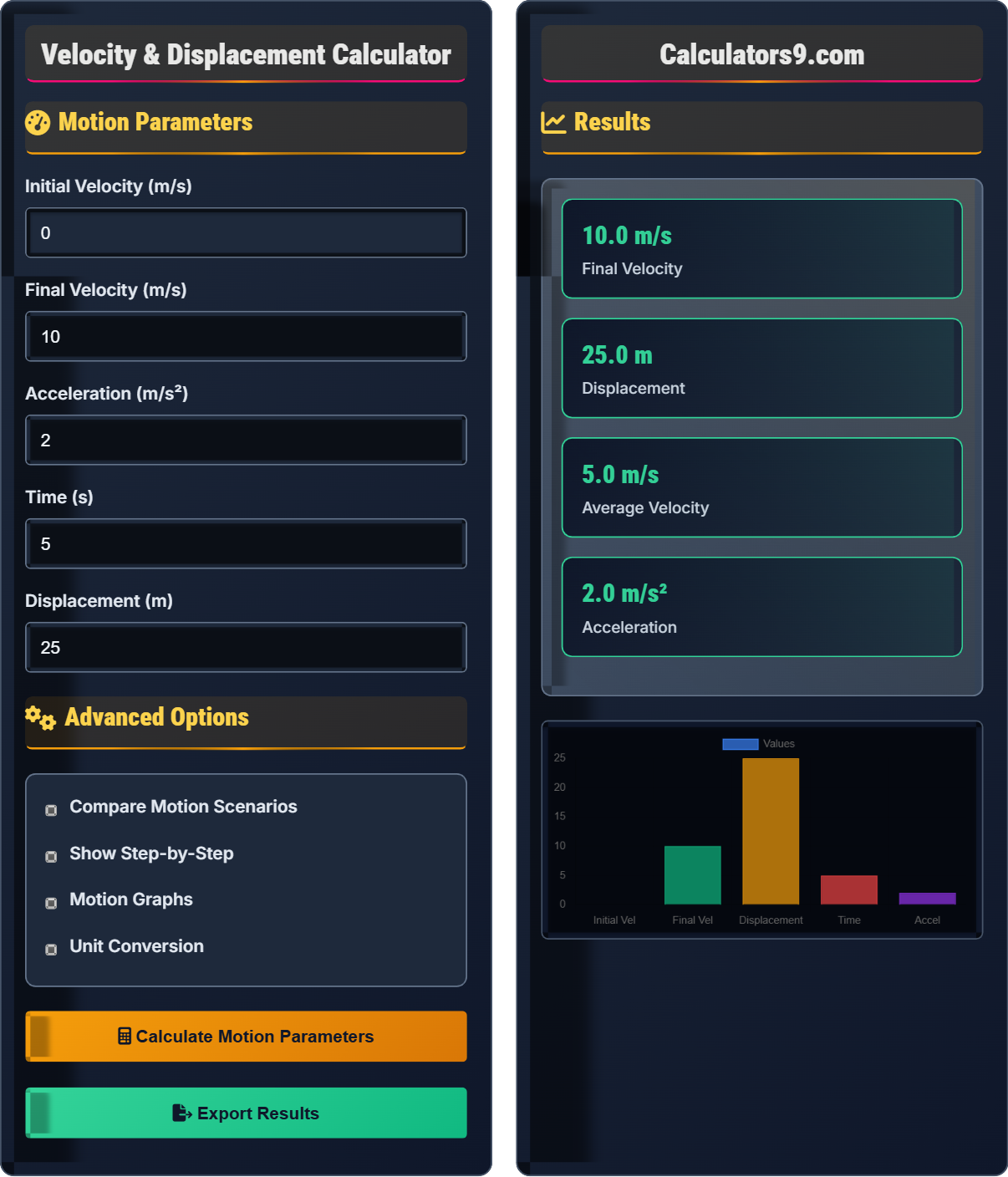
Example: An object starts from rest (u=0) and accelerates at 2 m/s² for 5 seconds:
\( v = 0 + 2 \times 5 = 10 \) m/s
\( s = 0 \times 5 + \frac{1}{2} \times 2 \times 5^2 = 25 \) m
Thus, the object reaches 10 m/s and travels 25 meters.
Motion Parameters
Advanced Options
Results
| Parameter | Value | Unit |
|---|---|---|
| Initial Velocity | 0.0 | m/s |
| Final Velocity | 10.0 | m/s |
| Acceleration | 2.0 | m/s² |
| Time | 5.0 | s |
| Displacement | 25.0 | m |
| Scenario | Initial Vel. (m/s) | Final Vel. (m/s) | Accel. (m/s²) | Time (s) | Displacement (m) |
|---|---|---|---|---|---|
| Scenario 1 | 0.0 | 10.0 | 2.0 | 5.0 | 25.0 |
| Scenario 2 | 5.0 | 15.0 | 1.0 | 10.0 | 100.0 |
Velocity & Displacement Fundamentals
Velocity is a vector quantity that describes the rate of change of displacement with respect to time. Unlike speed, velocity includes direction. It is measured in meters per second (m/s) and is calculated as displacement divided by time. Positive velocity indicates motion in the positive direction, while negative velocity indicates motion in the opposite direction.
Displacement is the change in position of an object from its initial to final location. It is a vector quantity that considers both the distance and direction from the starting point. Unlike distance, which is always positive, displacement can be positive, negative, or zero depending on the direction of movement relative to the reference point.
The fundamental kinematic equations for uniformly accelerated motion are:
\(s = ut + \frac{1}{2}at^2\)
\(v^2 = u^2 + 2as\)
Where:
- \(v\) = final velocity (m/s)
- \(u\) = initial velocity (m/s)
- \(a\) = acceleration (m/s²)
- \(t\) = time (s)
- \(s\) = displacement (m)
Velocity and displacement calculations are essential in numerous fields:
- Transportation: Vehicle dynamics, braking distances, collision analysis
- Engineering: Machinery design, robotics, automation systems
- Physics: Projectile motion, orbital mechanics, wave propagation
- Sports: Performance analysis, trajectory prediction, biomechanics
- A car accelerating from 0 to 60 mph in 6 seconds
- A ball thrown vertically reaching maximum height
- An airplane taking off and reaching cruising altitude
- A train decelerating to stop at a station
Kinematic Concepts
Velocity is displacement per unit time; displacement is change in position with direction.
\(v = u + at\)
\(s = ut + \frac{1}{2}at^2\)
\(v^2 = u^2 + 2as\)
Where v=final vel, u=initial vel, a=acceleration, t=time, s=displacement.
- Acceleration must be constant
- Direction matters (sign convention)
- Units must be consistent
Applications
Average velocity = total displacement ÷ total time
- Identify known variables
- Select appropriate equation
- Substitute values
- Solve for unknown
- Free fall acceleration: g = 9.8 m/s²
- Deceleration is negative acceleration
- Velocity-time graphs show acceleration
- Area under curve = displacement
Kinematics Learning Quiz
Which of the following statements about velocity and speed is correct?
The answer is B) Speed is a scalar, velocity is a vector. Speed is the magnitude of velocity without directional information, making it a scalar quantity. Velocity, however, includes both magnitude and direction, making it a vector quantity. This is a fundamental distinction in physics.
This question tests understanding of vector vs scalar quantities. Scalars have only magnitude (like speed, temperature, mass), while vectors have both magnitude and direction (like velocity, force, displacement). This distinction is crucial for solving kinematic problems correctly.
Scalar: Quantity with magnitude only (no direction)
Vector: Quantity with magnitude and direction
Speed: Scalar measure of how fast an object moves
• Velocity can be negative, speed cannot
• Speed = |velocity| (magnitude of velocity)
• Direction matters in velocity calculations
• Remember: Vector = Magnitude + Direction
• Use sign convention consistently
• Confusing velocity and speed
• Ignoring direction in vector problems
A car traveling at 20 m/s applies brakes and comes to a complete stop in 4 seconds. Calculate the car's acceleration and the distance traveled during braking. Also determine the average velocity during this period.
Given:
Initial velocity (u) = 20 m/s
Final velocity (v) = 0 m/s
Time (t) = 4 s
Step 1: Calculate acceleration using v = u + at
0 = 20 + a(4)
-20 = 4a
a = -5 m/s²
Step 2: Calculate displacement using s = ut + ½at²
s = 20(4) + ½(-5)(4)²
s = 80 + ½(-5)(16)
s = 80 - 40 = 40 m
Step 3: Calculate average velocity
Average velocity = total displacement ÷ total time
Average velocity = 40 ÷ 4 = 10 m/s
The car has an acceleration of -5 m/s² (deceleration), travels 40 meters during braking, and has an average velocity of 10 m/s during the braking period.
This problem demonstrates the application of kinematic equations to a real-world scenario. The negative acceleration indicates deceleration. The average velocity (10 m/s) is the midpoint between initial (20 m/s) and final (0 m/s) velocities, which is always true for uniform acceleration. This makes sense because the car spends equal time at speeds above and below the average.
Deceleration: Negative acceleration (slowing down)
Average Velocity: Total displacement ÷ Total time
Uniform Acceleration: Constant acceleration
• For uniform acceleration: avg vel = (u+v)/2
• Negative acceleration means slowing down
• Always check units and direction
• List all known variables first
• Choose equation with only one unknown
• Check if answer makes physical sense
• Forgetting sign conventions for direction
• Using distance instead of displacement
• Mixing up velocity and acceleration
FAQ
Q: What's the difference between distance and displacement, and why does it matter in kinematics?
A: Distance is the total length of the path traveled by an object, while displacement is the straight-line distance from the starting point to the ending point with direction. Distance is always positive and scalar, while displacement can be positive, negative, or zero and is a vector.
For example, if you walk 5 meters east and then 3 meters west, your total distance is 8 meters, but your displacement is 2 meters east. This matters because velocity is based on displacement (not distance), so average velocity would be 2 meters divided by total time, not 8 meters divided by time.
In kinematic equations, we use displacement (s) rather than distance because these equations describe the change in position with direction, which is essential for accurate motion analysis.
Q: How do velocity and displacement calculations apply to real-world engineering problems?
Can you give examples of how these concepts are used in practice?
A: Velocity and displacement calculations are fundamental in engineering applications:
- Automotive: Braking systems are designed using deceleration calculations to ensure safe stopping distances
- Aerospace: Rocket trajectories require precise velocity and displacement calculations for successful missions
- Robotics: Robot arms use kinematic equations to move precisely to target locations
- Construction: Crane operations require understanding of load motion and positioning
For example, when designing a roller coaster, engineers calculate the velocity at various points to ensure riders experience safe g-forces while maintaining excitement. They also calculate displacement to plan the track layout and ensure smooth transitions between elements.