Work & Power Calculator
Physics & Engineering Tool • Mechanics Calculations
Work and Power Formulas:
Show the calculator\( W = F \cdot d \cdot \cos(\theta) \)
\( P = \frac{W}{t} \)
Where:
- \( W \) = work (joules)
- \( F \) = applied force (newtons)
- \( d \) = distance moved (meters)
- \( \theta \) = angle between force and direction of motion
- \( P \) = power (watts)
- \( t \) = time taken (seconds)
These fundamental physics formulas calculate the work done by a force and the rate at which work is performed (power). Work is energy transferred to an object when a force causes displacement.
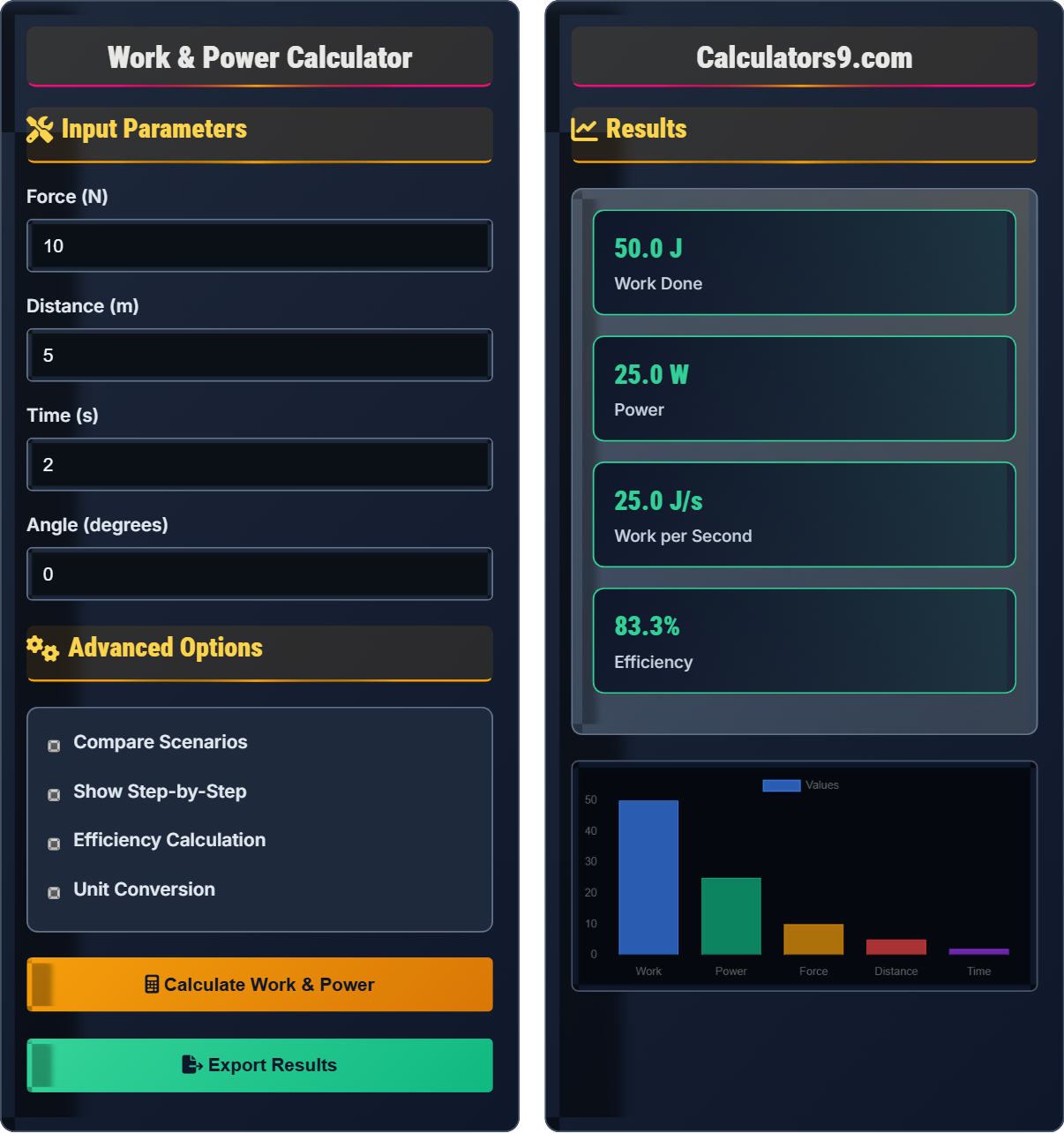
Example: A force of 10 N applied parallel to the direction of motion (θ = 0°) moves an object 5 m in 2 seconds:
\( W = 10 \times 5 \times \cos(0°) = 50 \) joules
\( P = \frac{50}{2} = 25 \) watts
Thus, 50 joules of work is done at a rate of 25 watts.
Input Parameters
Advanced Options
Results
| Property | Value | Unit |
|---|---|---|
| Work | 50.0 | J |
| Power | 25.0 | W |
| Force | 10.0 | N |
| Distance | 5.0 | m |
| Time | 2.0 | s |
| Scenario | Force (N) | Distance (m) | Time (s) | Work (J) | Power (W) |
|---|---|---|---|---|---|
| Scenario 1 | 10.0 | 5.0 | 2.0 | 50.0 | 25.0 |
| Scenario 2 | 15.0 | 3.0 | 1.0 | 45.0 | 45.0 |
| Unit | Value |
|---|---|
| Joules (J) | 50.0 |
| Kilojoules (kJ) | 0.050 |
| Calories (cal) | 11.96 |
| Kilocalories (kcal) | 0.012 |
| Foot-pounds (ft-lb) | 36.88 |
Work & Power Fundamentals
Work is the transfer of energy that occurs when a force causes an object to move. In physics, work is defined as the product of the force applied to an object and the distance the object moves in the direction of the force. Work is only done when there is displacement in the direction of the applied force.
Power measures the rate at which work is done or energy is transferred. It quantifies how quickly work can be accomplished. Higher power means more work can be done in less time, making it a crucial concept in engineering and everyday applications.
The fundamental formulas for work and power are:
\(P = \frac{W}{t}\)
Where:
- \(W\) = work (joules)
- \(F\) = applied force (newtons)
- \(d\) = distance moved (meters)
- \(\theta\) = angle between force and direction of motion
- \(P\) = power (watts)
- \(t\) = time taken (seconds)
Work and power calculations are essential in numerous fields:
- Engineering: Machine design, motor sizing, efficiency calculations
- Transportation: Vehicle performance, fuel efficiency
- Construction: Lifting operations, crane specifications
- Physics: Motion analysis, energy conservation
- Lifting a weight vertically does work against gravity
- A car engine performs work to overcome friction and air resistance
- A crane's power rating determines how quickly it can lift loads
- A person climbing stairs performs work against gravity
Work & Power Concepts
Work is energy transferred when a force causes displacement. Power is the rate of doing work.
\(W = F \cdot d \cdot \cos(\theta)\)
\(P = \frac{W}{t}\)
Where W=work, F=force, d=displacement, θ=angle, P=power, t=time.
- Work is maximized when θ=0°
- No work when θ=90°
- Power increases with work rate
Applications
Efficiency = (useful power out / total power in) × 100%
- Chemical → Mechanical (engines)
- Electrical → Mechanical (motors)
- Potential → Kinetic → Work
- Work → Heat (friction)
- Friction affects actual work
- Angle affects effective work
- Efficiency losses in real systems
- Units must be consistent
Work & Power Learning Quiz
If a force is applied perpendicular to the direction of motion (90° angle), what happens to the work done?
The answer is C) No work is done. According to the work formula W = F·d·cos(θ), when the angle θ is 90°, cos(90°) = 0. Therefore, W = F·d·0 = 0. This means that when a force is applied perpendicular to the direction of motion, no work is done on the object. This is why the normal force exerted by a surface on an object sliding across it does no work.
This demonstrates the critical role of the angle in work calculations. The cosine function in the work formula accounts for the component of force that acts in the direction of motion. When force is perpendicular to motion, there is no component in the direction of motion, so no work is done. This is why carrying a heavy object horizontally at constant speed does no work against gravity.
Work: Energy transferred by a force causing displacement
Cosine Function: Trigonometric function used to find force component
Perpendicular: At a 90° angle
• W = F·d·cos(θ) - work formula with angle dependency
• When θ = 0°, work is maximum
• When θ = 90°, work is zero
• Remember: Only force component parallel to motion does work
• Cos(0°)=1, Cos(90°)=0, Cos(180°)=-1
• Forgetting the angle in work calculations
• Assuming perpendicular forces do work
A construction worker pulls a 50 kg crate 10 meters along a horizontal surface with a force of 100 N at an angle of 30° above the horizontal. The coefficient of friction between the crate and surface is 0.2. Calculate the work done by the pulling force and the net power if the motion takes 5 seconds.
Step 1: Calculate work done by pulling force
W_pull = F_pull × d × cos(θ)
W_pull = 100 × 10 × cos(30°)
W_pull = 1000 × 0.866 = 866 J
Step 2: Calculate normal force
N = mg - F_pull × sin(θ)
N = 50 × 9.8 - 100 × sin(30°)
N = 490 - 100 × 0.5 = 440 N
Step 3: Calculate frictional force
f = μN = 0.2 × 440 = 88 N
Step 4: Calculate work done against friction
W_friction = f × d × cos(180°)
W_friction = 88 × 10 × (-1) = -880 J
Step 5: Calculate net work
W_net = W_pull + W_friction = 866 + (-880) = -14 J
Step 6: Calculate net power
P_net = W_net ÷ t = -14 ÷ 5 = -2.8 W
The pulling force does 866 J of work, but the net work is -14 J (negative because friction does more work than the pulling force). The net power is -2.8 W.
This problem demonstrates the importance of considering all forces when calculating net work. The pulling force does positive work, but friction does negative work. Since the frictional force (88 N) is greater than the horizontal component of the pulling force (100 × cos(30°) = 86.6 N), the net effect is negative work. This shows that the crate would actually slow down under these conditions.
Normal Force: Perpendicular contact force from a surface
Friction: Force opposing relative motion between surfaces
Net Work: Total work done by all forces
• Work = F·d·cos(θ) for each individual force
• Net work = sum of all individual works
• Friction opposes motion, so θ = 180°, cos(180°) = -1
• Always identify all forces acting on the object
• Calculate work for each force separately
• Remember that friction always opposes motion
• Forgetting to account for friction in work calculations
• Using wrong angle for friction (should be 180°)
• Adding works with different signs incorrectly
FAQ
Q: Why is the angle important in the work formula, and what happens when force and displacement are not aligned?
A: The angle is crucial because work is only done by the component of force that acts in the direction of displacement. When force and displacement are not aligned, we use the cosine of the angle between them to find the effective component of force: F_eff = F × cos(θ).
When θ = 0°, cos(0°) = 1, so all the force contributes to work. When θ = 90°, cos(90°) = 0, so no work is done regardless of the force magnitude. When θ = 180°, cos(180°) = -1, indicating that the force opposes the motion and does negative work.
For example, when you carry a heavy backpack horizontally, the upward force you apply doesn't do work on the pack because it's perpendicular to the horizontal displacement. However, if you carry it up stairs, the vertical component of motion means some work is done against gravity.
Q: How do work and power calculations apply to electric motors and mechanical systems?
How do engineers use these concepts in real-world applications?
A: Electric motors convert electrical energy to mechanical work. The power rating of a motor indicates the rate at which it can perform work. For example, a 1 kW motor can do 1000 joules of work per second.
Engineers use work and power calculations to:
- Size motors appropriately for specific loads
- Determine how quickly equipment can perform tasks
- Calculate energy consumption and efficiency
- Design transmission systems (gears, pulleys, etc.)
For instance, if a conveyor belt needs to move 1000 kg of material 10 meters vertically in 30 seconds, engineers calculate: W = mgh = 1000 × 9.8 × 10 = 98,000 J, P = 98,000 ÷ 30 = 3,267 W. They would then select a motor with sufficient power, accounting for efficiency losses.