Logarithm Calculator
Log solver • 2026 edition
Logarithm Definition:
Show the calculator\( \log_b(x) = y \iff b^y = x \)
Where:
- \( b \) = Base of the logarithm
- \( x \) = Argument (positive number)
- \( y \) = Result (logarithm value)
This definition states that the logarithm of x with base b is the exponent to which b must be raised to obtain x.
Example: \( \log_2(8) = 3 \) because \( 2^3 = 8 \)
Common logarithms:
• Natural log: \( \ln(x) = \log_e(x) \) where \( e \approx 2.718 \)
• Common log: \( \log(x) = \log_{10}(x) \)
• Binary log: \( \log_2(x) \)
Logarithm Values
Advanced Options
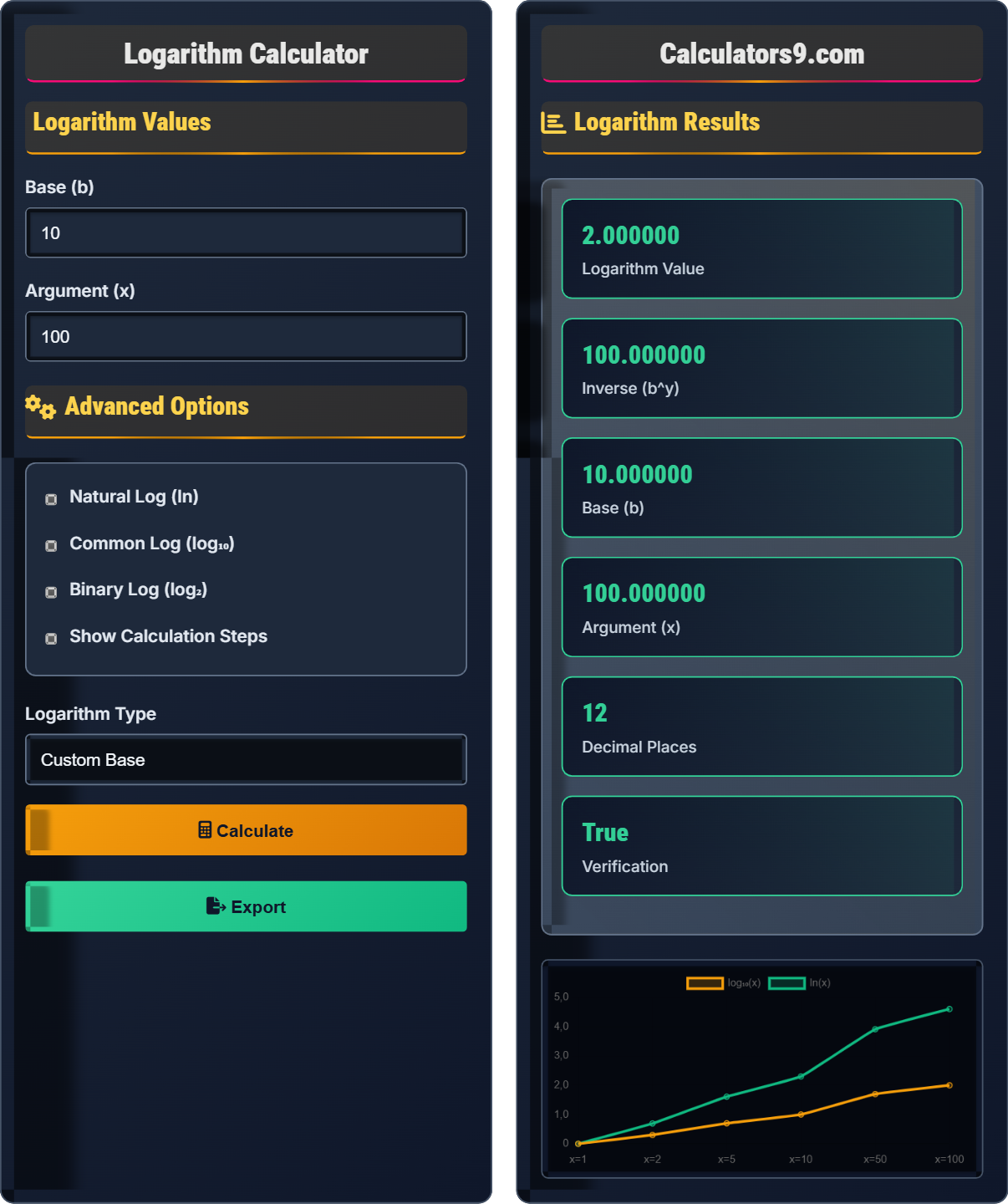
Logarithm Results
| Operation | Expression | Result |
|---|---|---|
| Logarithm | log₁₀(100) | 2.000000 |
| Inverse | 10² | 100.000000 |
| Verification | 10² ≟ 100 | True |
| Natural Log | ln(100) | 4.605170 |
| Common Log | log₁₀(100) | 2.000000 |
| Binary Log | log₂(100) | 6.643856 |
| Property | Formula | Application |
|---|---|---|
| Product Rule | logₐ(xy) = logₐ(x) + logₐ(y) | log₁₀(10×10) = log₁₀(10) + log₁₀(10) |
| Quotient Rule | logₐ(x/y) = logₐ(x) - logₐ(y) | log₁₀(100/10) = log₁₀(100) - log₁₀(10) |
| Power Rule | logₐ(xⁿ) = n·logₐ(x) | log₁₀(10²) = 2·log₁₀(10) |
| Change of Base | logₐ(b) = ln(b)/ln(a) | log₂(100) = ln(100)/ln(2) |
| Identity | logₐ(a) = 1 | log₁₀(10) = 1 |
| Zero Property | logₐ(1) = 0 | log₁₀(1) = 0 |
Comprehensive Logarithm Guide
A logarithm is the inverse operation to exponentiation. Just as subtraction undoes addition, logarithms undo exponentiation. The logarithm of a number x with respect to a base b is the exponent to which b must be raised to yield x. In mathematical notation: logb(x) = y means by = x.
The basic logarithm definition:
Where:
- \(b\) is the base (positive, not equal to 1)
- \(x\) is the argument (positive number)
- \(y\) is the logarithm value
Key properties that make logarithms useful:
- Product Rule: loga(xy) = loga(x) + loga(y)
- Quotient Rule: loga(x/y) = loga(x) - loga(y)
- Power Rule: loga(xn) = n·loga(x)
- Change of Base: loga(b) = ln(b)/ln(a)
- Identity: loga(a) = 1
- Exponential Growth/Decay: Population growth, radioactive decay
- Sound Intensity: Decibel scale for measuring sound
- Earthquake Magnitude: Richter scale for measuring earthquakes
- Chemistry: pH scale for acidity measurement
- Computer Science: Algorithm complexity analysis
Logarithm Basics
The exponent to which a base must be raised to produce a given number.
\( \log_b(x) = y \iff b^y = x \)
Where b is base, x is argument, y is result.
- Base must be positive and ≠ 1
- Argument must be positive
- loga(1) = 0
- loga(a) = 1
Properties
Rules that govern logarithmic operations.
- Product Rule: loga(xy) = loga(x) + loga(y)
- Quotient Rule: loga(x/y) = loga(x) - loga(y)
- Power Rule: loga(xn) = n·loga(x)
- Change of Base: loga(b) = ln(b)/ln(a)
- Only positive numbers have real logarithms
- Base cannot be 0 or 1
- Logarithms of negative numbers are complex
- ln(e) = 1, log₁₀(10) = 1
Logarithm Learning Quiz
What is the value of log₂(8)?
The answer is B) 3. To find log₂(8), we ask: "To what power must 2 be raised to get 8?" Since 2³ = 8, then log₂(8) = 3. This follows the definition that if logb(x) = y, then by = x.
Understanding the definition of logarithms is crucial. The logarithm asks for the exponent, not the result of the exponentiation. When evaluating logb(x), think: "What power do I raise b to, to get x?" This reverses the process of exponentiation. In this case, 2¹ = 2, 2² = 4, 2³ = 8, so the exponent is 3.
Logarithm: The exponent to which a base must be raised to produce a given number
Base: The number that is raised to a power in logarithmic expressions
Argument: The number for which we want to find the logarithm
• logb(x) = y means by = x
• Base must be positive and not equal to 1
• Argument must be positive
• Remember: log asks for the exponent
• Think of logarithms as reverse exponentiation
• Confusing the logarithm value with the argument
• Forgetting that the base cannot be 1 or negative
Using the product rule of logarithms, express log₃(18) in terms of simpler logarithms and calculate its approximate value.
1. Factor 18: 18 = 2 × 9 = 2 × 3²
2. Apply product rule: log₃(18) = log₃(2 × 3²) = log₃(2) + log₃(3²)
3. Apply power rule: log₃(3²) = 2 × log₃(3) = 2 × 1 = 2
4. So: log₃(18) = log₃(2) + 2
5. Using change of base: log₃(2) = ln(2)/ln(3) ≈ 0.693/1.099 ≈ 0.631
6. Therefore: log₃(18) ≈ 0.631 + 2 = 2.631
This problem demonstrates how logarithm properties help simplify complex calculations. The product rule allows us to break down the logarithm of a composite number into the sum of logarithms of its factors. This is particularly useful when we know the logarithms of the factors or can calculate them more easily. The power rule further simplifies logarithms of powers by bringing the exponent out as a multiplier.
Product Rule: loga(xy) = loga(x) + loga(y)
Power Rule: loga(xn) = n·loga(x)
Change of Base: loga(b) = ln(b)/ln(a)
• Product rule: Break down multiplication inside log
• Power rule: Bring exponents out as multipliers
• loga(a) = 1 for any valid base
• Factor numbers to use product rule effectively
• Look for perfect powers when applying power rule
• Applying product rule to addition instead of multiplication
• Forgetting to apply power rule correctly
FAQ
Q: Why can't we take the logarithm of a negative number?
A: The logarithm of a negative number is undefined in the real number system because there is no real number that you can raise a positive base to in order to get a negative result.
By definition: \( \log_b(x) = y \) means \( b^y = x \)
For any positive base \( b \) and real exponent \( y \), the result \( b^y \) is always positive. Therefore, there is no real value of \( y \) such that \( b^y = x \) when \( x \) is negative.
In the complex number system, logarithms of negative numbers are defined, but they result in complex numbers with imaginary components.
Q: What's the difference between ln(x) and log(x)?
A: The difference lies in the base of the logarithm:
• Natural logarithm: \( \ln(x) = \log_e(x) \) where \( e \approx 2.718 \)
• Common logarithm: \( \log(x) = \log_{10}(x) \) (when base is omitted)
The natural logarithm uses Euler's number \( e \) as the base, which appears naturally in many mathematical contexts, especially in calculus. The common logarithm uses base 10, which aligns with our decimal number system.
They are related by the change of base formula: \( \ln(x) = \log(x) \times \ln(10) \approx 2.303 \times \log(x) \)