Proportion Calculator
Ratio & proportion solver • 2026 edition
Proportion Formula:
Show the calculator\( \frac{a}{b} = \frac{c}{d} \)
Where:
- \( a \) = First numerator
- \( b \) = First denominator
- \( c \) = Second numerator
- \( d \) = Second denominator
This formula states that two ratios are equal when their cross products are equal: \( a \times d = b \times c \)
Example: If \( \frac{2}{3} = \frac{x}{6} \), then:
Cross multiply: \( 2 \times 6 = 3 \times x \)
So: \( 12 = 3x \), therefore \( x = 4 \)
Thus, \( \frac{2}{3} = \frac{4}{6} \) is a true proportion.
Proportion Values
Advanced Options
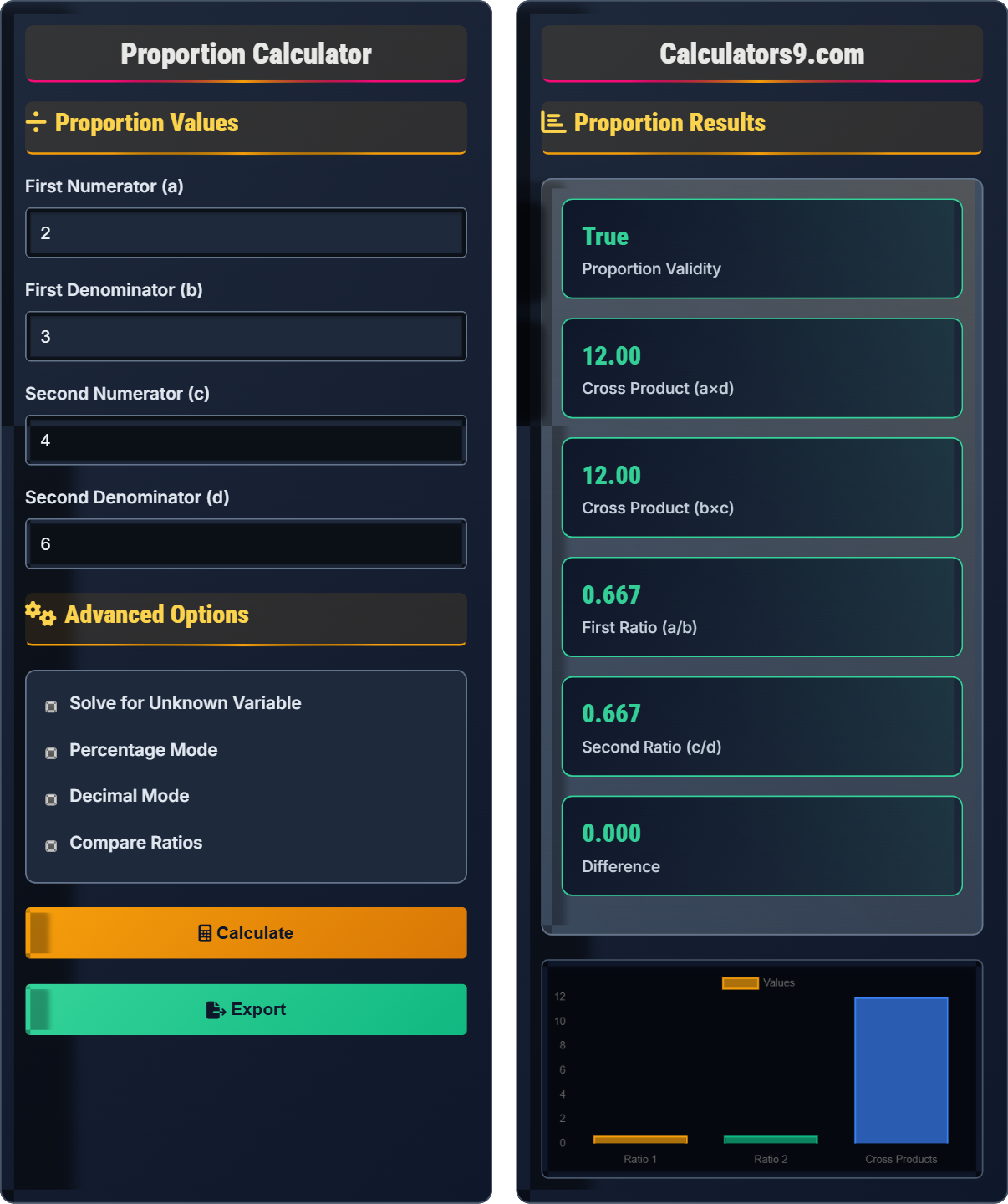
Proportion Results
| Component | Value | Formula |
|---|---|---|
| First Ratio | 2/3 | a/b |
| Second Ratio | 4/6 | c/d |
| Cross Product 1 | 12.00 | a×d |
| Cross Product 2 | 12.00 | b×c |
| Decimal Form | 0.667 | a/b |
| Percentage | 66.67% | (a/b)×100 |
| Verification | Check | Result |
|---|---|---|
| Proportion Validity | a/b = c/d | True |
| Cross Products Equal | a×d = b×c | True |
| Ratios Equal | 0.667 = 0.667 | True |
| Proportion Simplified | 2/3 = 4/6 | 2/3 = 2/3 |
| Error Margin | |a/b - c/d| | 0.000 |
Comprehensive Proportion Guide
A proportion is an equation stating that two ratios are equal. If we have two ratios a:b and c:d, they form a proportion if a/b = c/d. This means that the relationship between the first pair of numbers is the same as the relationship between the second pair of numbers.
The basic proportion formula:
This can be verified using cross multiplication: \( a \times d = b \times c \)
- \(a, b, c, d\) are the terms of the proportion
- \(a\) and \(d\) are called extremes
- \(b\) and \(c\) are called means
- In any proportion, the product of the extremes equals the product of the means
Proportions are used in many real-world situations:
- Scaling: Maps, blueprints, and models
- Recipes: Adjusting ingredient quantities
- Percentages: Converting between fractions and percents
- Geometry: Similar triangles and figures
- Unit Conversion: Converting between measurement systems
- Identify the unknown: Determine which variable needs to be found
- Set up the proportion: Place known values in the correct positions
- Cross multiply: Multiply the extremes and means
- Solve for the variable: Use algebra to isolate the unknown
- Verify: Check that the cross products are equal
Proportion Basics
An equation stating that two ratios are equal.
\( \frac{a}{b} = \frac{c}{d} \)
Where a/b and c/d are equivalent ratios.
- Cross products are equal: a×d = b×c
- Means and extremes: b and c are means, a and d are extremes
- Denominators cannot be zero
Methods
Multiply diagonals to verify or solve proportions.
- Set up the proportion equation
- Cross multiply
- Solve for the unknown variable
- Verify the solution
- Always check for division by zero
- Verify solutions by substituting back
- Round appropriately for context
- Consider units when applicable
Proportion Learning Quiz
Which of the following is TRUE about the proportion 3/4 = 6/8?
The answer is A) The cross products are 24 and 24. In the proportion 3/4 = 6/8, the cross products are calculated as follows: 3 × 8 = 24 and 4 × 6 = 24. Since both cross products are equal, the ratios form a valid proportion. This verifies that 3/4 = 6/8 is a true statement.
The cross multiplication property is fundamental to understanding proportions. When we have a proportion a/b = c/d, multiplying the extremes (a and d) gives the same result as multiplying the means (b and c). This property not only helps verify whether two ratios form a proportion but also provides the method for solving proportions with unknown values.
Proportion: An equation stating that two ratios are equal
Cross Products: The products obtained by multiplying the numerator of one ratio by the denominator of the other
Extremes: The first and last terms of a proportion (a and d in a/b = c/d)
Means: The middle terms of a proportion (b and c in a/b = c/d)
• In a proportion, the product of the extremes equals the product of the means
• Cross multiplication: a/b = c/d implies a×d = b×c
• Both ratios must be defined (denominators ≠ 0)
• Always verify proportions by checking cross products
• Remember: extremes × extremes = means × means
• Confusing which terms to multiply when cross multiplying
• Forgetting to check if denominators are zero
If 5 apples cost $3, how much would 8 apples cost at the same rate? Set up and solve the proportion.
1. Set up the proportion: 5 apples / $3 = 8 apples / $x
2. Write as ratios: 5/3 = 8/x
3. Cross multiply: 5 × x = 3 × 8
4. Simplify: 5x = 24
5. Solve for x: x = 24/5 = 4.8
Therefore, 8 apples would cost $4.80.
This problem demonstrates the practical application of proportions in real-world scenarios. We establish a relationship between the number of apples and their cost, maintaining the same unit rate. The key is identifying the consistent relationship (unit price) and setting up the proportion with corresponding terms in the same positions. This approach works for any direct proportion problem.
Direct Proportion: As one quantity increases, the other increases at the same rate
Unit Rate: The rate per single unit (cost per apple in this case)
Corresponding Terms: Terms that represent the same type of quantity in each ratio
• Keep corresponding quantities in the same positions in each ratio
• Always define what each variable represents
• Verify the solution makes sense in context
• Organize information: 5 apples → $3, 8 apples → $x
• Check: Does $4.80 for 8 apples seem reasonable?
• Mixing up corresponding terms in the proportion
• Forgetting to verify the solution makes contextual sense
FAQ
Q: How do I know if two ratios form a proportion?
A: Two ratios form a proportion if they are equivalent, meaning they simplify to the same value. The most reliable way to check this is by using cross multiplication.
For ratios a/b and c/d, they form a proportion if: \( \frac{a}{b} = \frac{c}{d} \)
This can be verified by checking if: \( a \times d = b \times c \)
For example, to check if 2/3 and 4/6 form a proportion:
Cross multiply: 2 × 6 = 12 and 3 × 4 = 12
Since both products are equal (12 = 12), the ratios form a proportion.
Q: What is the difference between a ratio and a proportion?
A: A ratio is a comparison of two quantities, typically expressed as a:b or a/b. A proportion is an equation that states two ratios are equal.
Mathematically:
Ratio: \( a : b \) or \( \frac{a}{b} \) (a single comparison)
Proportion: \( \frac{a}{b} = \frac{c}{d} \) (an equation of two ratios)
Think of it this way: a ratio is like a fraction (3/4), while a proportion is like an equation (3/4 = 6/8). The proportion asserts that the two ratios are equivalent. Every proportion contains two ratios, but a ratio by itself is not an equation.