Square Root Calculator
Fast & accurate square root calculator • 2026 edition
Square Root Formula:
Show the calculator\( \sqrt{x} = x^{1/2} \)
Where:
- \( \sqrt{x} \) = square root of x
- \( x \) = the number we want to find the square root of
- \( x^{1/2} \) = x raised to the power of 1/2
The square root of a number is a value that, when multiplied by itself, gives the original number. For example, √16 = 4 because 4 × 4 = 16.
Example: For a number \( x = 25 \):
\( \sqrt{25} = 25^{1/2} = 5 \)
Because 5 × 5 = 25, the square root of 25 is 5.
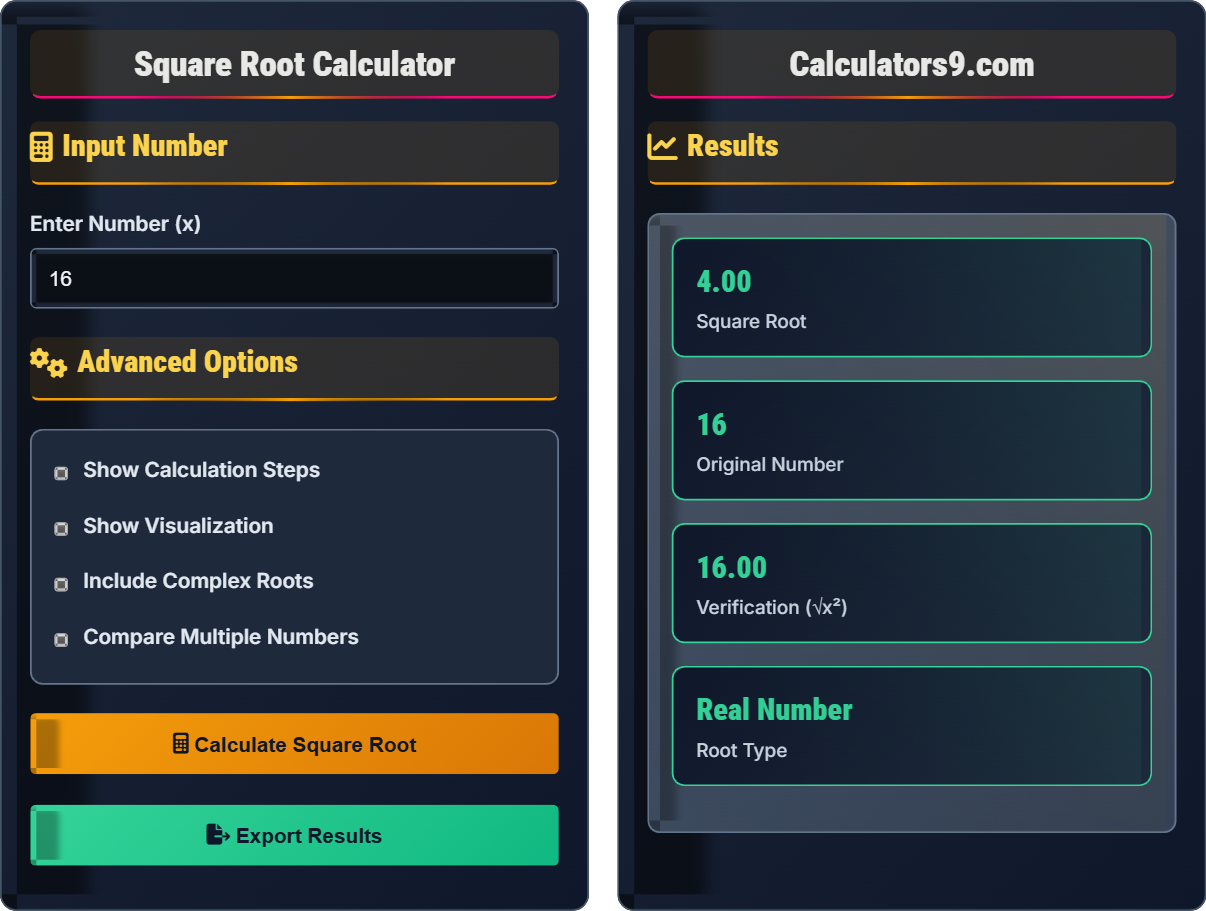
Input Number
Advanced Options
Results
Comprehensive Square Root Guide
A square root of a number x is a number y such that y² = x. In other words, it's a value that, when multiplied by itself, gives the original number. The square root is denoted by the radical symbol √. For example, √9 = 3 because 3 × 3 = 9.
The mathematical definition of a square root is:
Alternative representation using exponents:
Where:
- \(y\) = the square root of x
- \(x\) = the radicand (number under the radical)
- \(y^2\) = y squared (y multiplied by itself)
- Prime Factorization: Factor the number and take square root of perfect squares
- Long Division Method: Traditional algorithm for finding square roots manually
- Newton's Method: Iterative approach for approximating square roots
- Using Calculators: Built-in functions for quick calculations
- Estimation: Finding nearby perfect squares for approximation
- Perfect Squares: Numbers whose square roots are integers (1, 4, 9, 16, 25...)
- Irrational Roots: Square roots of non-perfect squares (like √2, √3)
- Complex Roots: Square roots of negative numbers (involves imaginary unit i)
- Zero Root: √0 = 0
- One Root: √1 = 1
Square Root Basics
A square root of a number x is a number y such that y² = x.
\(y = \sqrt{x} \text{ where } y^2 = x\)
Alternative: \(\sqrt{x} = x^{1/2}\)
- √(ab) = √a × √b
- √(a/b) = √a / √b
- √(x²) = |x|
- √x ≥ 0 for real numbers
Applications
Used in distance formulas, area calculations, and the Pythagorean theorem.
- Calculating velocity and acceleration
- Determining standard deviation
- Signal processing applications
- Waveform analysis
- Negative numbers have complex square roots
- Most square roots are irrational numbers
- Approximations are often used in practical applications
- Sign matters in real-world applications
Square Root Learning Quiz
Which of the following is NOT a perfect square?
The answer is C) 30. A perfect square is a number that can be expressed as the product of an integer with itself. Let's check each option:
- 16 = 4² (4 × 4 = 16)
- 25 = 5² (5 × 5 = 25) ✓
- 30 = not a perfect square (there's no integer n such that n² = 30) ✗
- 49 = 7² (7 × 7 = 49) ✓
Since there's no integer that when multiplied by itself equals 30, it is not a perfect square.
Perfect squares are fundamental in mathematics and have special properties. They are important because their square roots are integers, making calculations simpler. To identify a perfect square, you need to determine if there exists an integer n such that n² equals the given number. This concept is crucial for simplifying radical expressions and solving quadratic equations.
Perfect Square: A number that can be expressed as the square of an integer (n² where n is an integer)
Square Root: A value that, when multiplied by itself, gives the original number
Integer: A whole number (positive, negative, or zero)
• Perfect squares are always non-negative
• The square root of a perfect square is always an integer
• Between consecutive perfect squares, there are no other perfect squares
• Memorize the first 15 perfect squares: 1, 4, 9, 16, 25, 36, 49, 64, 81, 100, 121, 144, 169, 196, 225
• To check if a number is a perfect square, find its square root and verify if it's a whole number
• Confusing perfect squares with other special number types
• Forgetting that negative numbers don't have real square roots
• Assuming all numbers ending in 0, 1, 4, 5, 6, or 9 are perfect squares
Calculate the square root of 144 using prime factorization method and explain each step.
To find √144 using prime factorization:
- Step 1: Find the prime factors of 144
144 ÷ 2 = 72
72 ÷ 2 = 36
36 ÷ 2 = 18
18 ÷ 2 = 9
9 ÷ 3 = 3
3 ÷ 3 = 1
So, 144 = 2⁴ × 3² - Step 2: Group the prime factors in pairs
144 = (2²) × (2²) × (3²)
144 = (2×2) × (2×2) × (3×3) - Step 3: Take one factor from each pair for the square root
√144 = 2 × 2 × 3 = 12 - Step 4: Verify the result
12 × 12 = 144 ✓
Therefore, √144 = 12.
The prime factorization method works because when you take the square root of a number, you're essentially looking for a value that appears twice in the multiplication. By factoring the number completely and pairing up identical factors, you can easily identify what value, when doubled in the multiplication, gives the original number. This method is particularly useful for large numbers and helps reinforce understanding of factors and multiples.
Prime Factorization: Breaking down a composite number into a product of prime numbers
Prime Number: A number greater than 1 that has no positive divisors other than 1 and itself
Factor Pair: Two numbers that multiply together to give the original number
• Every composite number has a unique prime factorization
• For a perfect square, all prime factors must appear an even number of times
• The square root of a number is the product of one factor from each prime factor pair
• Always start dividing by the smallest prime number (2) and work upward
• Organize your work in a tree diagram to keep track of factors
• Practice with smaller numbers first before moving to larger ones
• Forgetting to group factors in pairs when calculating the square root
• Incorrectly identifying prime numbers
• Missing some prime factors during the division process
FAQ
Q: Why do we sometimes get two answers for square roots?
A: When solving the equation \( x^2 = a \), where \( a > 0 \), there are actually two solutions: \( x = +\sqrt{a} \) and \( x = -\sqrt{a} \).
For example, if \( x^2 = 9 \), then \( x = 3 \) or \( x = -3 \), because both \( 3^2 = 9 \) and \( (-3)^2 = 9 \).
However, by mathematical convention, the symbol \( \sqrt{a} \) (called the "principal square root") refers to the non-negative solution only. So \( \sqrt{9} = 3 \), not \( ±3 \).
When solving equations, we write \( x = ±\sqrt{a} \) to indicate both solutions. But when just evaluating \( \sqrt{a} \), it represents only the positive value.
Q: How do calculators compute square roots so quickly?
A: Modern calculators and computers typically use iterative algorithms to compute square roots efficiently. One common method is the Newton-Raphson method, which finds successively better approximations to the roots (or zeroes) of a real-valued function.
For square roots, the Newton-Raphson iteration is:
\( x_{n+1} = \frac{1}{2}\left(x_n + \frac{a}{x_n}\right) \)
Starting with an initial guess \( x_0 \), this formula rapidly converges to \( \sqrt{a} \). Each iteration roughly doubles the number of correct digits.
For example, to find \( \sqrt{25} \) starting with \( x_0 = 5 \):
- Iteration 1: \( x_1 = \frac{1}{2}(5 + \frac{25}{5}) = \frac{1}{2}(5 + 5) = 5 \)
- Already converged! In practice, less accurate initial guesses would require more iterations.