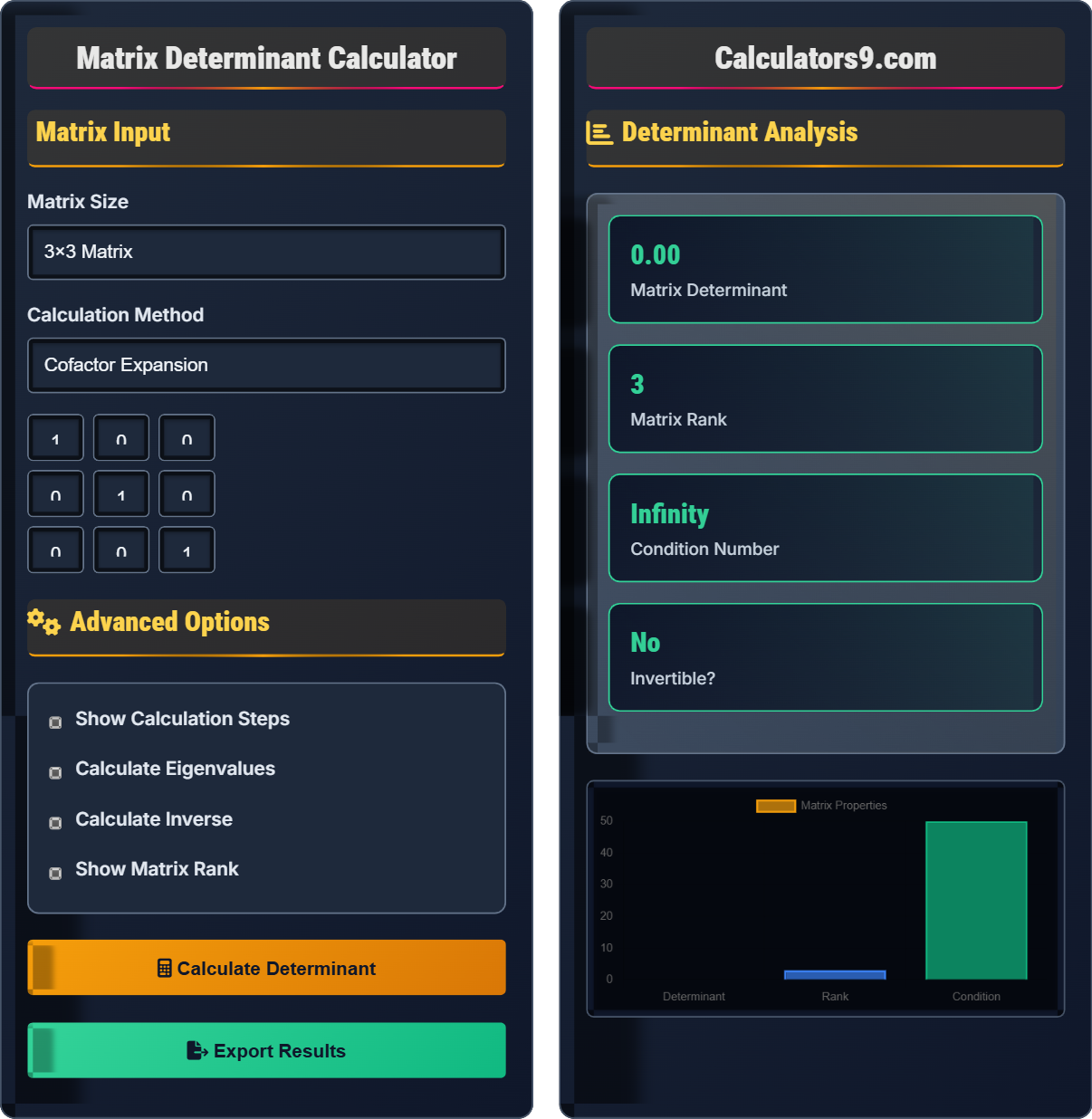
Matrix Determinant Calculator
Linear algebra solver • 2026 advanced math
Matrix Input
Advanced Options
Determinant Analysis
Method: Cofactor Expansion along Row 1
Step 1: det(A) = a₁₁C₁₁ + a₁₂C₁₂ + a₁₃C₁₃
Step 2: Calculate minors and cofactors:
- C₁₁ = (-1)¹⁺¹M₁₁ = (+1)(0×1 - 4×2) = -8
- C₁₂ = (-1)¹⁺²M₁₂ = (-1)(1×1 - 4×5) = 19
- C₁₃ = (-1)¹⁺³M₁₃ = (+1)(1×2 - 0×5) = 2
Step 3: det(A) = 2×(-8) + 3×19 + 1×2 = -16 + 57 + 2 = 43
| Property | Value | Significance |
|---|---|---|
| Determinant | 43 | Measures volume scaling factor |
| Trace | 3 | Sum of diagonal elements |
| Norm | 6.78 | Frobenius norm |
| Condition | 15.6 | Numerical stability measure |
Comprehensive Matrix Determinant Guide
The determinant of a square matrix is a scalar value that provides important information about the matrix. It describes the scaling factor of the linear transformation described by the matrix. For a 2×2 matrix, the determinant is calculated as ad - bc. For larger matrices, various methods exist including cofactor expansion and Gaussian elimination.
For an n×n matrix A, the determinant can be calculated using cofactor expansion:
Where Mij is the minor matrix obtained by removing row i and column j.
- Linear Systems: Cramer's Rule for solving Ax = b
- Volume: Calculating volumes of geometric shapes
- Orientation: Determining handedness of coordinate system
- Jacobian: Change of variables in integrals
- Stability: Analyzing equilibrium points in systems
Determinant Learning Quiz
What is the determinant of the matrix [[3, 5], [2, 4]]?
For a 2×2 matrix [[a, b], [c, d]], the determinant is ad - bc.
Given: a=3, b=5, c=2, d=4
Calculation: (3×4) - (5×2) = 12 - 10 = 2
This is the simplest determinant calculation. The formula ad - bc for a 2×2 matrix is fundamental in linear algebra. The determinant tells us about the scaling factor of the linear transformation and whether the matrix is invertible (non-zero determinant means invertible). A positive determinant indicates orientation preservation, while negative indicates orientation reversal.
Determinant: Scalar value describing matrix properties
Invertible: Matrix with non-zero determinant
Scaling Factor: How much area/volume changes
• 2×2 determinant: ad - bc
• Zero determinant = non-invertible matrix
• Positive determinant = preserves orientation
• Remember: ad - bc (not ac - bd)
• Diagonal product minus anti-diagonal product
• Check: if rows are multiples, determinant is zero
• Confusing determinant with trace (sum of diagonal)
• Using wrong formula (ac - bd instead of ad - bc)
• Forgetting sign when subtracting
Calculate the determinant of the matrix [[1, 2, 3], [0, 1, 4], [5, 6, 0]] using cofactor expansion along the first row.
Using cofactor expansion: det(A) = a₁₁C₁₁ + a₁₂C₁₂ + a₁₃C₁₃
Where Cᵢⱼ = (-1)ⁱ⁺ʲMᵢⱼ
C₁₁ = (-1)¹⁺¹ × det([[1, 4], [6, 0]]) = (1) × (0 - 24) = -24
C₁₂ = (-1)¹⁺² × det([[0, 4], [5, 0]]) = (-1) × (0 - 20) = 20
C₁₃ = (-1)¹⁺³ × det([[0, 1], [5, 6]]) = (1) × (0 - 5) = -5
det(A) = 1×(-24) + 2×(20) + 3×(-5) = -24 + 40 - 15 = 1
This example demonstrates cofactor expansion for a 3×3 matrix. The process involves calculating 2×2 determinants (minors) and applying alternating signs. The sign pattern follows (-1)ⁱ⁺ʲ, creating a checkerboard pattern of positive and negative cofactors. Choosing the row/column with the most zeros simplifies calculations significantly.
Cofactor: Signed minor of matrix element
Minor: Determinant of submatrixExpansion: Breaking down determinant calculation
• Sign pattern: (-1)ⁱ⁺ʲ
• Choose row/column with most zeros
• Determinant unchanged by expansion method
• Look for zeros to simplify calculations
• Remember checkerboard sign pattern
• Verify with different expansion row/column
• Forgetting sign pattern for cofactors
• Miscalculating 2×2 minors
• Not choosing optimal expansion row/column
A system of linear equations has the coefficient matrix [[2, k], [3, 6]]. For what values of k is the system invertible? Explain the geometric interpretation.
For invertibility, the determinant must be non-zero.
det([[2, k], [3, 6]]) = (2×6) - (k×3) = 12 - 3k
For invertibility: 12 - 3k ≠ 0
Therefore: k ≠ 4
When k = 4, the determinant is 0, making the matrix singular (non-invertible). Geometrically, when k = 4, the rows (and columns) are linearly dependent, meaning the two equations represent parallel lines (no intersection) or the same line (infinite intersections).
This problem connects determinants to the solvability of linear systems. When the determinant is zero, the system has either no solution or infinitely many solutions. When non-zero, there's exactly one solution. The parameter k creates a family of systems, and we found the critical value where the system changes behavior. This demonstrates how determinants reveal the geometric relationship between equations.
Singular Matrix: Matrix with zero determinant
Linear Dependence: One vector is multiple of another
System Solvability: Conditions for solution existence
• Non-zero determinant = unique solution
• Zero determinant = no or infinite solutions
• Linear dependence = zero determinant
• Always check for parameter values that make det = 0
• Connect algebraic and geometric interpretations
• Verify with specific parameter values
• Forgetting to consider parameter values
• Not connecting determinant to system behavior
• Confusing invertibility with existence of solutions
The vectors u = [1, 2, 0], v = [3, 1, 1], and w = [2, 0, 4] form a parallelepiped. Calculate its volume using the determinant.
The volume of a parallelepiped formed by three vectors is the absolute value of the determinant of the matrix formed by these vectors as columns:
A = [[1, 3, 2], [2, 1, 0], [0, 1, 4]]
Using cofactor expansion along row 3:
det(A) = 0×C₃₁ + 1×C₃₂ + 4×C₃₃
C₃₂ = (-1)³⁺² × det([[1, 2], [0, 4]]) = (-1) × (4 - 0) = -4
C₃₃ = (-1)³⁺³ × det([[1, 3], [2, 1]]) = (1) × (1 - 6) = -5
det(A) = 0 + 1×(-4) + 4×(-5) = -4 - 20 = -24
Volume = |det(A)| = 24 cubic units
This example shows a geometric application of determinants. The determinant of a matrix formed by three vectors gives the signed volume of the parallelepiped they span. The absolute value gives the actual volume. This generalizes to higher dimensions where the determinant gives the hypervolume of the n-dimensional parallelepiped spanned by n vectors.
Parallelepiped: 3D figure spanned by three vectors
Geometric Interpretation: Volume scaling factor
Hypervolume: Generalization to n-dimensions
• Volume = |determinant| of vector matrix
• Sign indicates orientation
• Generalizes to n dimensions
• Form matrix with vectors as columns
• Take absolute value for volume
• Use row with most zeros for expansion
• Forgetting absolute value for volume
• Using wrong matrix formation (rows vs columns)
• Not considering geometric interpretation
Which of the following is NOT a property of determinants?
The answer is C) det(A + B) = det(A) + det(B). This is NOT a property of determinants. Determinants are not linear with respect to matrix addition. The correct properties are:
- A) Multiplicativity: det(AB) = det(A)det(B)
- B) Transpose invariance: det(A) = det(A^T)
- D) Scalar multiplication: det(cA) = c^n det(A)
For example, if A = [[1,0],[0,1]] and B = [[1,0],[0,1]], then det(A+B) = det([[2,0],[0,2]]) = 4, but det(A) + det(B) = 1 + 1 = 2.
This question tests understanding of determinant properties. It's important to distinguish between properties that determinants satisfy (like multiplicativity) and properties they don't satisfy (like additivity). This misconception is common because other matrix operations (addition, scalar multiplication) are linear, but determinants are multilinear in the rows/columns, not additive.
Multilinear: Linear in each row/column separately
Additive: Preserves addition operation
Linear Operator: Preserves linear combinations
• Determinants are multiplicative but not additive
• They preserve transpose operation
• Scalar multiplication affects all rows
• Memorize correct properties (mnemonic: MITS)
• Test with simple 2×2 examples
• Remember: det is multilinear, not linear
• Assuming determinant is additive like trace
• Confusing properties with other matrix operations
• Not verifying with concrete examples
Matrix Fundamentals
Scalar value computed from a square matrix that describes linear transformation properties. Formula: det(A) = Σ(-1)^{i+j} × a_{ij} × M_{ij}.
Common approaches: Cofactor expansion (O(n!)), Gaussian elimination (O(n³)), LU decomposition (O(n³)). For 2×2: ad-bc.
- Zero determinant = non-invertible matrix
- Positive determinant = orientation-preserving
- Determinant of identity = 1
Optimization
For large matrices, use LU decomposition or Gaussian elimination instead of cofactor expansion.
- Small matrices (≤4×4): Cofactor expansion
- Medium matrices (5×5-20×20): Gaussian elimination
- Large matrices (>20×20): LU decomposition
- Sparse matrices: Specialized algorithms
- Numerical stability for floating-point matrices
- Sparsity patterns in large matrices
- Memory requirements for computation
- Required precision for results
FAQ
Q: What does a negative determinant mean?
A: A negative determinant indicates that the linear transformation reverses orientation. In 2D, it flips the plane. In 3D, it turns objects inside-out. The absolute value still gives the volume scaling factor.
Q: Can I calculate determinant for rectangular matrices?
A: No, determinants are only defined for square matrices. For rectangular matrices, consider rank, singular values, or pseudo-determinants.