Anxiety Score Estimator
GAD-7 assessment • 2026 guidelines
Anxiety Score Formula (GAD-7):
Show the calculator\( \text{Anxiety Score} = \sum_{i=1}^{7} R_i \)
Where:
- \( R_i \) = Response to each of the 7 GAD-7 questions
- Response scale: 0 (Not at all) to 3 (Nearly every day)
- Questions assess anxiety symptoms over the past 2 weeks
This formula calculates the total anxiety score based on the Generalized Anxiety Disorder 7-item scale, a validated screening tool developed by Spitzer et al. (2006).
Score Interpretation:
- 0-4: Minimal anxiety
- 5-9: Mild anxiety
- 10-14: Moderate anxiety
- 15-21: Severe anxiety
Example: If responses to the 7 questions are [0, 1, 2, 1, 3, 2, 1], the anxiety score would be:
\( 0 + 1 + 2 + 1 + 3 + 2 + 1 = 10 \)
Thus, the result indicates Moderate anxiety.
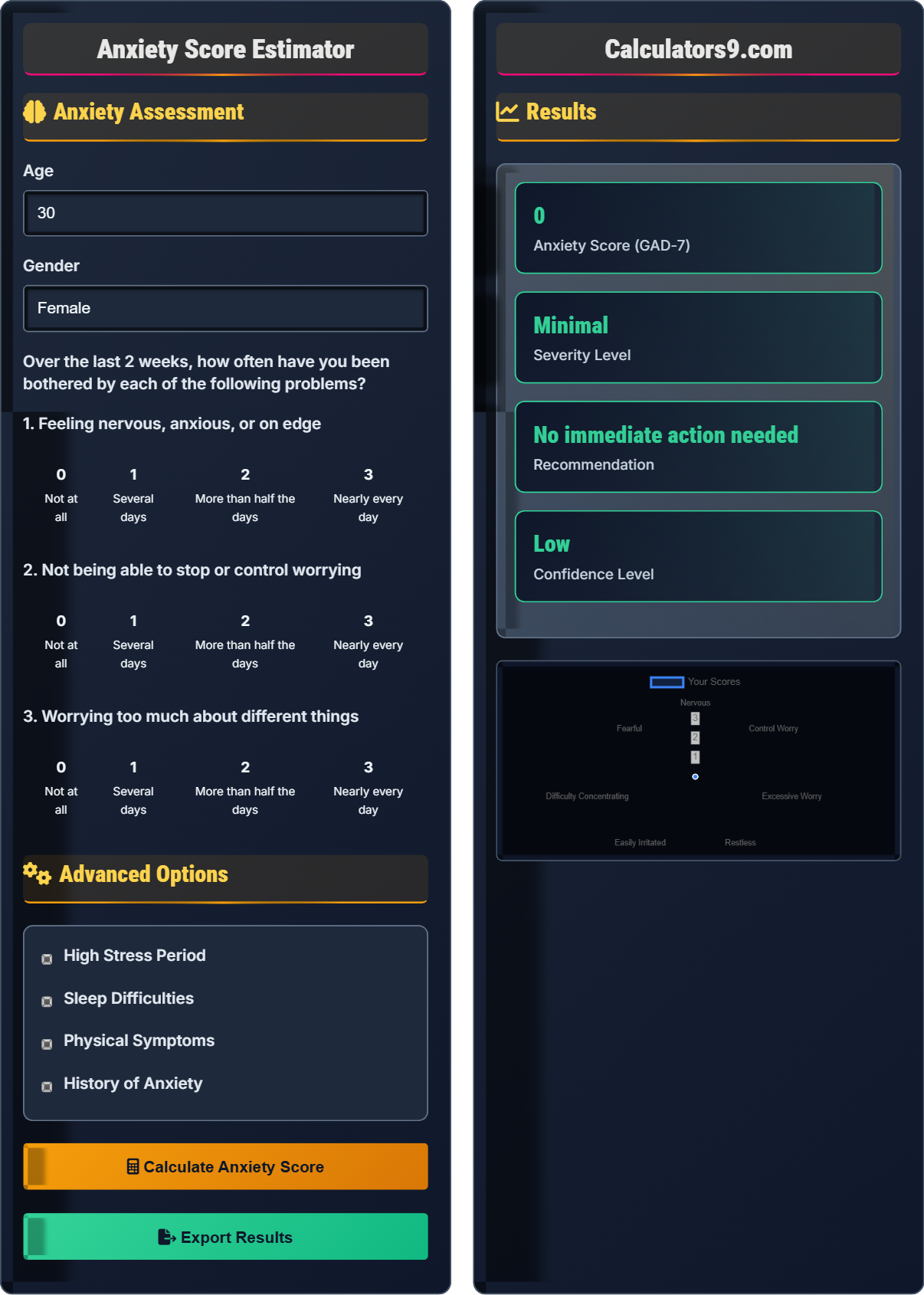
Anxiety Assessment
Advanced Options
Results
| Question | Score | Severity | Impact |
|---|
| Resource | Type | Access |
|---|
Comprehensive Anxiety Guide
Anxiety is a natural stress response characterized by feelings of worry, nervousness, or unease about something with an uncertain outcome. While occasional anxiety is normal, persistent and excessive anxiety that interferes with daily activities may indicate an anxiety disorder. The GAD-7 is a validated screening tool for generalized anxiety disorder.
The Generalized Anxiety Disorder 7-item scale (GAD-7) scores each of the 7 questions on a scale from 0 to 3:
Scoring:
- 0-4: Minimal anxiety
- 5-9: Mild anxiety
- 10-14: Moderate anxiety
- 15-21: Severe anxiety
Common anxiety symptoms include:
- Physical: Rapid heartbeat, sweating, trembling, fatigue
- Cognitive: Excessive worry, racing thoughts, difficulty concentrating
- Emotional: Restlessness, irritability, feeling overwhelmed
- Behavioral: Avoidance behaviors, sleep disturbances
- Mindfulness: Meditation and breathing exercises
- Lifestyle: Regular exercise and balanced diet
- Social: Support from friends and family
- Professional: Therapy and medication when needed
Anxiety Basics
Validated screening tool for generalized anxiety disorder.
\( \text{Score} = \sum_{i=1}^{7} R_i \)
Where Ri = response to question i (0-3 scale).
- Higher scores indicate greater anxiety severity
- Score reflects symptoms over past 2 weeks
- Professional consultation recommended for moderate+ scores
Management
0-4: Minimal, 5-9: Mild, 10-14: Moderate, 15-21: Severe.
- Self-care and lifestyle changes
- Mindfulness and relaxation
- Professional therapy
- Medication when appropriate
- Screening tools are not diagnostic
- Individual factors affect scores
- Follow up with healthcare providers
Anxiety Assessment Learning Quiz
According to the GAD-7 scoring system, what anxiety severity level corresponds to a total score of 12?
The answer is C) Moderate anxiety. According to the GAD-7 scoring system, anxiety severity levels are defined as follows: 0-4 (Minimal), 5-9 (Mild), 10-14 (Moderate), and 15-21 (Severe). A score of 12 falls within the 10-14 range, indicating moderate anxiety severity.
Understanding the GAD-7 scoring system is crucial for interpreting anxiety assessments. The scale is designed to provide a standardized measure of anxiety symptoms over the past two weeks. Each of the seven questions is scored from 0 (not at all) to 3 (nearly every day), and the total score determines the severity level. This standardization allows for consistent assessment across different populations and settings.
GAD-7: Generalized Anxiety Disorder 7-item scale, a validated screening tool
Anxiety Severity: Classification based on total score indicating symptom impact
Screening Tool: Assessment instrument used to identify potential disorders
• Scores range from 0 to 21 (7 questions × 3 maximum points each)
• Higher scores indicate greater anxiety severity
• Professional consultation recommended for moderate+ scores
• Remember the ranges: 0-4, 5-9, 10-14, 15-21
• Use the acronym MINMS (Minimal, Mild, Moderate, Severe)
• Moderate scores (10-14) typically warrant professional attention
• Confusing the scoring ranges for different severity levels
• Misunderstanding that each question scores 0-3, not 1-4
• Assuming the tool is diagnostic rather than screening
A patient responds to the GAD-7 questions as follows: [1, 2, 0, 3, 2, 1, 0]. Calculate the total anxiety score, determine the severity level, and explain what this means for intervention recommendations.
Step 1: Calculate the total anxiety score
Sum of responses: 1 + 2 + 0 + 3 + 2 + 1 + 0 = 9
Step 2: Determine severity level
According to GAD-7 scoring:
0-4 = Minimal
5-9 = Mild
10-14 = Moderate
15-21 = Severe
A score of 9 falls in the mild anxiety range.
Step 3: Intervention recommendations
For mild anxiety (score 5-9), recommended interventions include:
- Self-care strategies and lifestyle modifications
- Mindfulness and relaxation techniques
- Regular exercise and good sleep hygiene
- Consideration of counseling or therapy
- Monitoring for changes in symptoms
While professional help may be beneficial, mild anxiety can often be managed with self-directed interventions and support systems.
This problem demonstrates the complete process of interpreting GAD-7 results. It involves mathematical calculation (addition), classification based on established criteria, and clinical decision-making based on the severity level. The approach shows how quantitative scores translate into qualitative recommendations for care. Understanding this connection between numbers and clinical significance is essential for proper interpretation of screening tools.
Screening Tool: Assessment used to identify individuals who may have a condition
Intervention: Action taken to address or manage a health issue
Severity Level: Classification indicating the degree of symptoms
• Screening tools are not definitive diagnoses
• Clinical judgment is needed alongside scores
• Individual circumstances affect interpretation
• Always verify calculations by double-checking addition
• Memorize the specific ranges for quick reference
• Consider the context of the individual's situation
• Arithmetic errors in calculating the total score
• Misremembering the severity ranges
• Treating screening results as definitive diagnoses
FAQ
Q: I got a GAD-7 score of 13, which puts me in the moderate range. What should I do next?
A: A GAD-7 score of 13 indicates moderate anxiety, which suggests significant symptoms that are impacting your daily functioning. This is the threshold where professional intervention becomes strongly recommended.
Mathematically, your score of 13 falls within the moderate range (10-14), which indicates that anxiety symptoms are occurring more than half the days or nearly every day across multiple domains. Research shows that individuals in this range often benefit significantly from treatment interventions.
Recommended next steps include:
1. Consult a mental health professional - A therapist can provide a comprehensive assessment and develop a personalized treatment plan
2. Consider therapy options - Cognitive Behavioral Therapy (CBT) is particularly effective for anxiety
3. Implement self-care strategies - Regular exercise, mindfulness practices, and good sleep hygiene
4. Build support systems - Connect with trusted friends, family, or support groups
While a score of 13 isn't in the severe range (15-21), it does indicate that anxiety is significantly affecting your quality of life and professional support would be beneficial.
Q: How accurate is the GAD-7 compared to clinical diagnosis for anxiety disorders?
A: The GAD-7 demonstrates excellent psychometric properties as a screening tool. Research studies have shown that the GAD-7 has:
• Sensitivity: 89% (correctly identifies 89% of people with GAD)
• Specificity: 82% (correctly identifies 82% of people without GAD)
• Reliability: High internal consistency (α = 0.92)
Mathematically, if we consider a population where 10% have GAD:
True positives: 89% of 10% = 8.9%
False negatives: 11% of 10% = 1.1%
True negatives: 82% of 90% = 73.8%
False positives: 18% of 90% = 16.2%
This means that while the GAD-7 is highly accurate as a screening tool, it's not perfect and requires clinical follow-up for definitive diagnosis. The positive predictive value depends on the prevalence of anxiety in the tested population. In clinical settings where anxiety disorders are more prevalent, the GAD-7 performs even better.