Digital Detox Planner
Fast technology wellness tool • 2026 standards
Digital Detox Formula:
Show the calculator\( \text{Detox Duration} = \frac{\text{Screen Time} \times \text{Device Dependency}}{\text{Recovery Factor}} \)
Where:
- Screen Time = Average daily hours spent on devices
- Device Dependency = Score reflecting digital dependency (1-10)
- Recovery Factor = Individual recovery capacity (0.5-2.0)
This formula provides personalized digital detox recommendations based on individual technology usage patterns. Research shows that reducing screen time can improve sleep, reduce anxiety, and enhance real-world social connections.
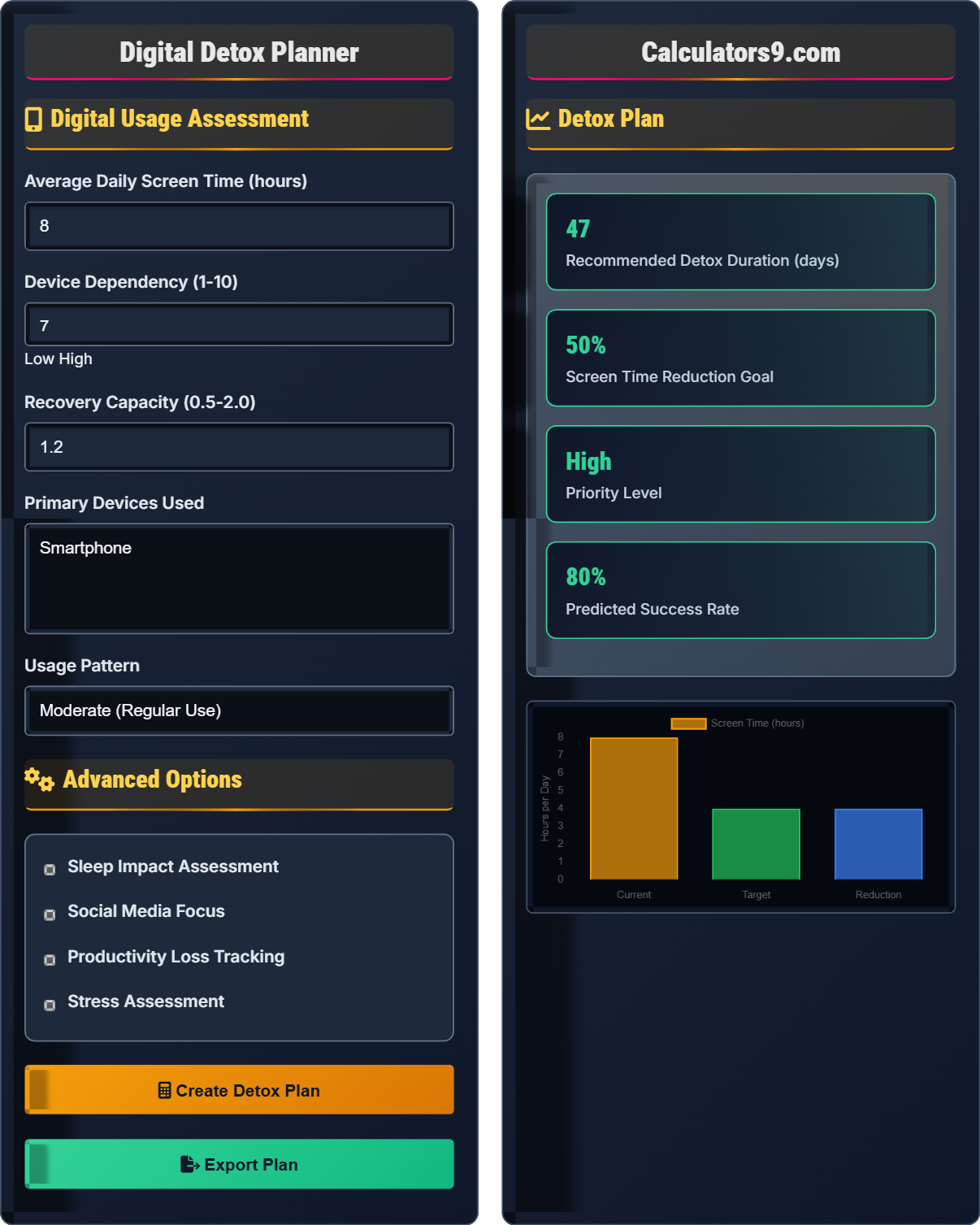
Example: For 8 hours of daily screen time, with device dependency score of 7, and recovery factor of 1.2:
\( \text{Detox Duration} = \frac{8 \times 7}{1.2} = 46.7 \) days
This suggests a 47-day digital detox program would be appropriate.
Digital Usage Assessment
Advanced Options
Detox Plan
| Factor | Value | Impact |
|---|---|---|
| Current Screen Time | 8 hours/day | High |
| Device Dependency | 7/10 | High |
| Recovery Capacity | 1.2 | Moderate |
| Primary Device | Smartphone | Highest |
| Phase | Duration | Goal |
|---|---|---|
| Assessment | Days 1-3 | Track current usage |
| Reduction | Days 4-14 | Reduce by 25% |
| Stabilization | Days 15-28 | Maintain new habits |
| Integration | Days 29-47 | Build healthy routines |
Comprehensive Digital Wellness Guide
Digital wellness refers to maintaining a healthy relationship with technology that supports overall well-being. It involves conscious, intentional, and balanced use of digital devices and platforms. Regular assessment of digital habits helps maintain mental health and productivity while avoiding technology-related stress.
The standard digital detox calculation uses:
Where:
- \(D\) = Detox Duration (days)
- \(S\) = Screen Time (hours/day)
- \(D\) = Device Dependency Score (1-10)
- \(R\) = Recovery Factor (0.5-2.0)
Signs of problematic digital habits include:
- Sleep Disruption: Blue light exposure affecting circadian rhythms
- Eye Strain: Digital eye strain from prolonged screen use
- Reduced Focus: Constant notifications disrupting concentration
- Social Isolation: Online interactions replacing real-world connections
- Anxiety: Fear of missing out or online stress
- Productivity Loss: Excessive browsing and distraction
- Time Limits: Set boundaries for daily device usage
- Blue Light Filters: Use filters during evening hours
- Notification Management: Turn off non-essential alerts
- Digital Curfew: Establish device-free periods before sleep
- Real-World Activities: Balance screen time with offline activities
- Regular Breaks: Follow 20-20-20 rule (every 20 min, look at 20 ft for 20 sec)
Digital Wellness Basics
Conscious and balanced use of technology to support overall well-being.
\(D = \frac{S \times D}{R}\)
Where D=detox, S=screen time, D=dependency, R=recovery.
- Gradual reduction is more sustainable than cold turkey
- Identify and address underlying reasons for device dependency
- Replace digital activities with healthy alternatives
Self-Care Strategies
Establishing limits and healthy relationships with technology.
- Morning without devices
- Designated phone-free zones
- Regular digital sabbaths
- Notification audits
- Work requirements may limit detox options
- Gradual changes are more sustainable
- Support systems improve success rates
- Technology can be used positively
Digital Wellness Learning Quiz
According to research, which of the following is NOT a documented benefit of digital detox?
The answer is D) Increased screen addiction. Research consistently shows that digital detox reduces screen dependency and addiction behaviors. All other options (improved sleep, reduced anxiety, enhanced creativity) are well-documented benefits of reducing digital device usage.
Understanding the science behind digital wellness is crucial for motivation. Research demonstrates that excessive screen time disrupts natural circadian rhythms, increases cortisol levels, and fragments attention spans. Detoxing from digital devices allows the brain to recover these natural functions.
Digital Addiction: Compulsive use of digital devices despite negative consequences
Circadian Rhythm: Natural biological cycle regulating sleep-wake patterns
Attention Fragmentation: Splitting focus across multiple digital tasks
• Digital detox is not about eliminating all technology
• Benefits typically emerge after 1-2 weeks of consistent practice
• Gradual reduction is more sustainable than abrupt cessation
• Start with one device-free hour daily
• Replace scrolling with reading or walking
• Use analog alarm clocks to reduce phone checking
• Expecting immediate results
• Not having alternative activities planned
A person spends 10 hours daily on screens, has a device dependency score of 8, and a recovery factor of 1.0. Calculate their recommended detox duration and explain the phased approach for implementing this plan.
Using the formula: Detox Duration = (Screen Time × Device Dependency) ÷ Recovery Factor
Calculation: (10 × 8) ÷ 1.0 = 80 days
For an 80-day detox plan, implement these phases:
- Assessment (Days 1-5): Track current usage and identify triggers
- Reduction (Days 6-25): Gradually reduce screen time by 1-2 hours per week
- Stabilization (Days 26-50): Maintain new limits and resist temptation
- Integration (Days 51-70): Build healthy routines and alternatives
- Transition (Days 71-80): Prepare for returning to some technology with boundaries
Extended detox periods require careful planning and gradual progression. The phased approach allows the brain to adjust to reduced stimulation while building new neural pathways. Each phase serves a specific purpose in rewiring digital habits and establishing sustainable practices.
Neural Plasticity: Brain's ability to form new neural connections
Dopamine Detox: Reducing stimulation to reset reward pathways
Behavioral Conditioning: Linking actions to rewards/substances
• Longer detox periods require more structured planning
• Each phase should have specific, measurable goals
• Support systems improve adherence and success
• Prepare alternative activities in advance
• Enlist accountability partners
• Celebrate milestones during the process
• Not having a structured plan for long detoxes
• Underestimating the challenge of extended periods
• Failing to prepare for setbacks and challenges
FAQ
Q: How can I do a digital detox if I work remotely and depend on technology?
A: For remote workers, focus on boundaries rather than elimination:
- Work-Life Separation: Set strict start/end times for work devices
- Notification Management: Disable non-urgent notifications during personal time
- Device-Free Zones: Keep bedrooms and dining areas device-free
- Batch Communication: Check emails/messages at designated intervals
- Alternative Activities: Replace recreational screen time with other hobbies
Remember, digital detox doesn't mean eliminating all technology—it means using it intentionally and with boundaries. Focus on reducing recreational screen time while maintaining work-related technology use.
Q: How can families participate in digital detox together?
A: Family digital detox requires collaborative planning:
- Family Meeting: Discuss goals and agree on boundaries together
- Shared Activities: Plan offline activities everyone enjoys
- Device-Free Times: Establish meal times and evenings without devices
- Accountability: Support each other through the transition
- Gradual Approach: Start with shorter periods and extend gradually
- Rewards System: Celebrate collective achievements
Family participation increases success rates and strengthens relationships. Children especially benefit from seeing parents model healthy digital behaviors. The key is making it a shared experience rather than a punishment.