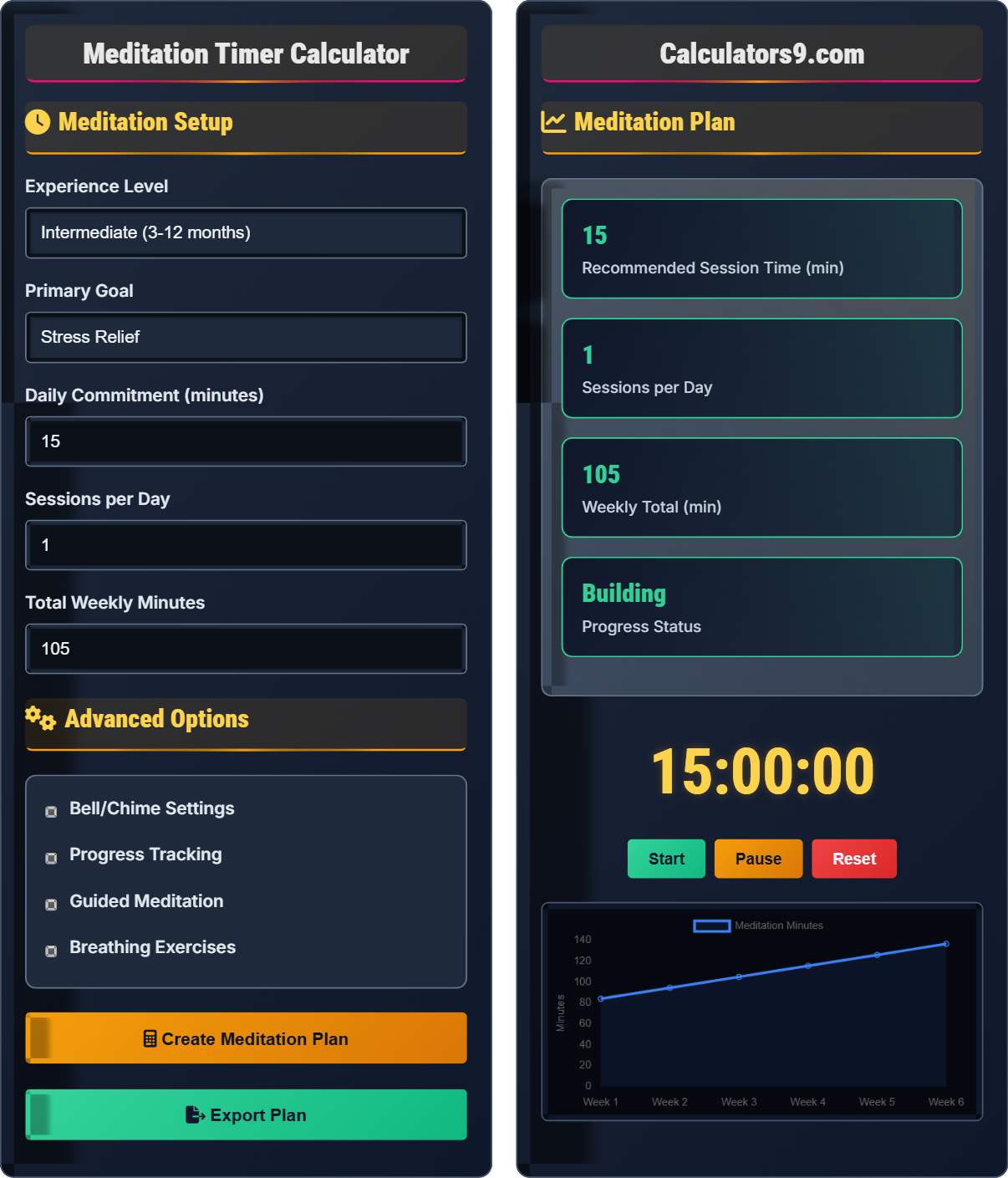
Meditation Timer Calculator
Fast mindfulness tool • 2026 standards
Meditation Duration Formula:
Show the calculator\( \text{Session Time} = \text{Beginner Level} \times \text{Experience Factor} \times \text{Goal Multiplier} \times \text{Progressive Increase} \)
Where:
- Beginner Level = Starting duration (typically 5-10 minutes)
- Experience Factor = Based on meditation experience
- Goal Multiplier = Based on desired outcomes
- Progressive Increase = Gradual increment factor
This formula provides personalized meditation session recommendations based on individual characteristics and goals. Regular meditation practice offers numerous benefits for mental health and well-being.
Example: For a beginner with moderate goals:
\( \text{Session Time} = 10 \times 1.0 \times 1.2 \times 1.0 = 12 \) minutes
This person should start with 10-12 minute sessions.
Meditation Setup
Advanced Options
Meditation Plan
| Aspect | Details |
|---|---|
| Experience Level | Intermediate |
| Primary Goal | Focus Improvement |
| Recommended Duration | 15 minutes |
| Best Practice Times | Morning, Evening |
| Day | Time | Duration |
|---|---|---|
| Monday | 07:00 AM | 15 min |
| Tuesday | 07:00 AM | 15 min |
| Wednesday | 07:00 AM | 15 min |
| Thursday | 07:00 AM | 15 min |
| Friday | 07:00 AM | 15 min |
Comprehensive Meditation Guide
Meditation is a practice that involves focusing the mind to achieve a state of calm and awareness. Regular meditation offers numerous benefits including stress reduction, improved focus, emotional regulation, and enhanced overall well-being. Scientific research supports meditation's positive effects on both mental and physical health.
Recommended meditation durations based on experience level:
Where:
- \(T\) = Total Time Recommended
- \(B\) = Base Time (5-20 minutes)
- \(E\) = Experience Factor (0.5-2.0)
- \(G\) = Goal Factor (0.8-1.5)
Research-backed benefits of regular meditation practice:
- Stress Reduction: Decreases cortisol levels by 14-25%
- Improved Focus: Enhances attention span and concentration
- Emotional Regulation: Better control over emotions and reactions
- Brain Health: Increases gray matter density in areas linked to learning
- Physical Health: Lowers blood pressure and improves immune function
- Start Small: Begin with 5-10 minute sessions
- Consistency: Practice at the same time daily
- Comfortable Space: Find a quiet, comfortable location
- Posture: Sit upright with spine straight
- Patience: Expect mind wandering, gently return focus
Meditation Fundamentals
Practice of focusing the mind to achieve calm awareness and inner peace.
\(T = B \times E \times G\)
Where T=time, B=base, E=experience, G=goal.
- Consistency beats duration
- Start with achievable goals
- Focus on breath as anchor
Self-Care Strategies
Present-moment consciousness without judgment.
- Set realistic expectations
- Create a dedicated space
- Use guided resources
- Track your progress
- Progress is gradual
- Mind wandering is normal
- Benefits accumulate over time
- Choose suitable meditation type
Meditation Learning Quiz
According to research, what is the minimum daily meditation time needed to see significant benefits?
The answer is B) 5-10 minutes. Research shows that even short daily meditation sessions of 5-10 minutes can produce measurable benefits in stress reduction, focus, and emotional regulation. Consistency is more important than duration for beginners.
Understanding that meditation benefits don't require lengthy sessions is crucial for establishing a sustainable practice. The key insight is that regular, consistent practice—even in small doses—yields significant benefits. This knowledge helps overcome the common barrier of "not having enough time" to meditate.
Mindfulness: Present-moment awareness without judgment
Neuroplasticity: Brain's ability to form new neural pathways
Default Mode Network: Brain network active during rest and self-reflection
• Consistency is more important than duration
• Even 5-10 minutes daily can provide benefits
• Progress is gradual and cumulative
• Start with just 5 minutes daily
• Use meditation apps for guidance
• Track your sessions to build consistency
• Expecting immediate results
• Trying to meditate for too long initially
• Being frustrated by mind wandering
Explain how meditation goals should influence session duration and frequency. Describe the relationship between goal type and optimal meditation practice parameters.
Meditation goals significantly influence optimal practice parameters:
- Stress Relief: 10-20 minutes, 1-2 sessions daily focusing on breath awareness
- Improved Focus: 15-30 minutes, daily practice with concentration techniques
- Emotional Regulation: 15-25 minutes, incorporating loving-kindness meditation
- Spiritual Growth: 20-45 minutes, combining various techniques and longer sessions
- Sleep Improvement: 15-20 minutes before bed, body scan or progressive relaxation
The relationship between goals and practice parameters is based on neuroplasticity research showing that specific meditation techniques target different brain networks and produce distinct benefits.
Understanding the goal-practice relationship is crucial for effective meditation. Different goals require different approaches because meditation affects various neural networks differently. For example, stress relief primarily benefits from parasympathetic activation, while focus enhancement requires strengthening attention networks.
Attention Networks: Brain circuits responsible for focus and concentration
Parasympathetic Activation: Rest and digest nervous system response
Metacognition: Awareness of one's own thought processes
• Align practice duration with your specific goals
• Adjust technique based on desired outcome
• Consider both duration and frequency
• Match meditation type to your primary goal
• Start with shorter durations and gradually increase
• Combine techniques for comprehensive benefits
• Using the same approach for all goals
• Not adjusting practice based on outcomes
• Ignoring the relationship between technique and goal
FAQ
Q: How often should I meditate as a complete beginner?
A: As a beginner, start with 5-10 minutes once daily. Consistency is far more important than duration:
- Frequency: Every day if possible, but at least 4-5 days per week
- Duration: 5-10 minutes for the first 2-4 weeks
- Timing: Choose a consistent time that fits your schedule
- Environment: Find a quiet, comfortable space
Research shows that daily practice, even if brief, is more beneficial than longer, infrequent sessions. Once you establish the habit, gradually increase to 15-20 minutes. The key is building a sustainable routine rather than achieving perfect meditation sessions.
Q: What's the difference between mindfulness and concentration meditation?
A: Mindfulness and concentration meditation engage different cognitive processes:
- Mindfulness Meditation: Open awareness of present moment experiences, observing thoughts/feelings without attachment
- Concentration Meditation: Focused attention on a single object (breath, mantra, visualization)
- Brain Networks: Mindfulness activates the default mode network, concentration strengthens executive attention
- Benefits: Mindfulness enhances emotional regulation, concentration improves focus
Both practices complement each other and can be combined. Beginners often start with concentration techniques to develop focus, then incorporate mindfulness awareness. The choice depends on your goals: concentration for focus, mindfulness for emotional balance.