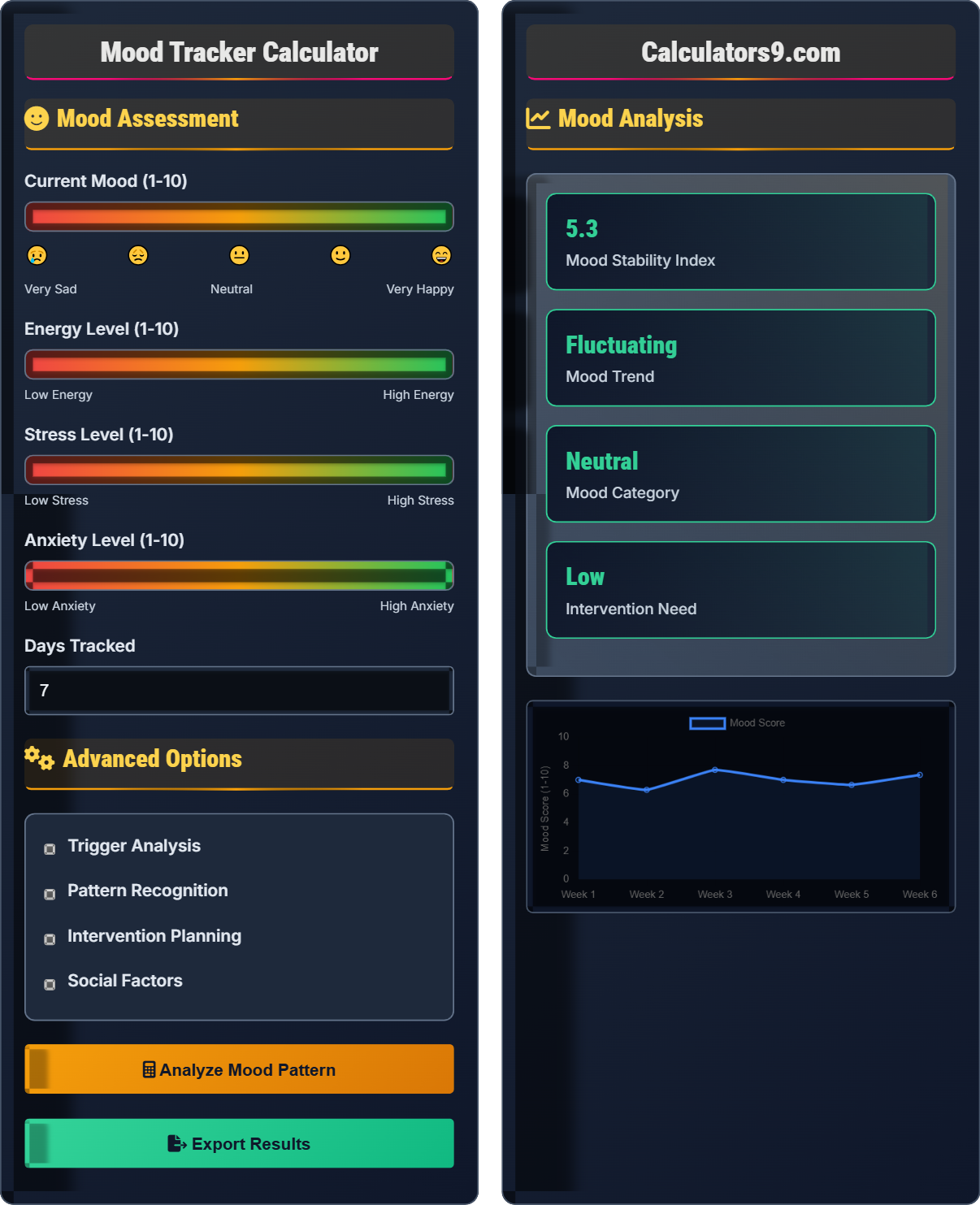
Mood Tracker Calculator
Fast emotional wellness tool • 2026 standards
Mood Tracking Formula:
Show the calculator\( \text{Mood Index} = \frac{\text{Sum of Daily Mood Scores} \times \text{Stability Factor}}{\text{Number of Days Tracked}} \)
Where:
- Daily Mood Scores = 1-10 rating of emotional state
- Stability Factor = Based on consistency of ratings
- Number of Days Tracked = Duration of mood tracking
This formula provides insights into emotional patterns and overall mood stability. Regular mood tracking helps identify triggers, patterns, and improvements over time.
Example: For a person who rated their mood as 7, 6, 8, 5, 7 over 5 days with a stability factor of 0.9:
\( \text{Mood Index} = \frac{(7+6+8+5+7) \times 0.9}{5} = \frac{33 \times 0.9}{5} = 5.94 \)
This indicates a generally stable mood pattern with moderate variation.
Mood Assessment
Advanced Options
Mood Analysis
| Metric | Score | Status |
|---|---|---|
| Current Mood | 7 | Good |
| Energy Level | 6 | Normal |
| Stress Level | 4 | Low |
| Anxiety Level | 3 | Low |
| Factor | Impact | Recommendation |
|---|---|---|
| Stress Management | Moderate Impact | Maintain current practices |
| Sleep Quality | High Impact | Focus on sleep hygiene |
| Social Connections | Low Impact | Maintain current level |
| Physical Activity | High Impact | Increase moderate exercise |
Comprehensive Mood Tracking Guide
Mood tracking is the practice of regularly monitoring and recording emotional states to identify patterns, triggers, and overall emotional wellness. Regular mood tracking provides valuable insights into mental health and helps develop emotional regulation strategies.
Standard mood tracking approaches include:
Where:
- \(M\) = Overall Mood Score
- \(m_i\) = Individual mood rating
- \(w_i\) = Weight factor for each day
- \(n\) = Number of days tracked
Factors that commonly affect mood include:
- Sleep: Quality and duration of rest
- Exercise: Physical activity levels
- Nutrition: Dietary habits and hydration
- Social: Interactions and relationships
- Stress: Work, responsibilities, and life events
- Environment: Weather, lighting, surroundings
- Pattern Recognition: Identify recurring mood patterns
- Trigger Identification: Discover what affects your mood
- Progress Monitoring: Track improvements over time
- Communication: Share insights with healthcare providers
- Self-Awareness: Develop emotional intelligence
Mood Tracking Basics
Systematic monitoring of emotional states to identify patterns and triggers.
\(M = \frac{\sum(m_i \times w_i)}{\sum w_i}\)
Where M=mood score, m=ratings, w=weights, i=days.
- Track consistently at same time daily
- Be honest about your feelings
- Note external factors affecting mood
Self-Care Strategies
Techniques to manage and improve emotional well-being.
- Regular mood tracking
- Journaling
- Mindfulness exercises
- Physical activity
- Everyone's mood patterns are unique
- Patterns emerge over time
- Context affects mood interpretation
- Professional help for persistent issues
Mood Tracking Learning Quiz
What is the primary benefit of regular mood tracking?
The answer is B) To identify patterns and triggers. Regular mood tracking helps identify recurring patterns in emotional states and discover what factors influence your mood. This self-awareness is the foundation for emotional regulation and mental wellness.
Mood tracking is fundamentally about developing emotional awareness and self-regulation. By consistently monitoring mood, individuals can recognize patterns that might not be apparent in day-to-day experience. This awareness enables proactive management of emotional states rather than reactive responses to mood changes.
Emotional Regulation: Ability to manage and respond to emotional experiences appropriately
Mood Patterns: Recurring emotional states over time
Triggers: Events, situations, or factors that affect mood
• Track mood consistently for pattern recognition
• Note context along with mood ratings
• Look for trends over weeks/months
• Track at the same time daily for consistency
• Note external factors (sleep, food, events)
• Use tracking apps for convenience
• Inconsistent tracking schedule
• Expecting immediate results from tracking
A person tracks their mood for 30 days and notices their mood consistently drops on Mondays and improves over weekends. They also note that their mood is lower on days they skip breakfast. Explain the significance of these patterns and suggest interventions based on the findings.
The identified patterns suggest specific triggers and influences:
- Monday Mood Drop: Likely related to work stress, transition from weekend, or anticipation of upcoming week
- Weekend Improvement: Correlates with reduced work stress and increased leisure time
- Breakfast Correlation: Shows connection between nutrition and mood stability
Recommended interventions include: preparing for Monday mornings on Sunday, implementing stress management techniques for workdays, ensuring consistent breakfast consumption, and developing weekend-to-workday transition rituals.
Effective mood tracking reveals actionable insights. The Monday pattern is common and often related to "Sunday Scaries" or work-related stress. The breakfast correlation demonstrates the mind-body connection in emotional wellness. These patterns allow for targeted interventions that address specific triggers.
Pattern Recognition: Identifying recurring themes in emotional states
Correlation: Statistical relationship between variables
Intervention: Deliberate action to influence mood patterns
• Look for patterns over extended periods
• Consider multiple factors simultaneously
• Implement changes gradually
• Track multiple variables (mood, sleep, food, activity)
• Use calendar integration for consistency
• Review patterns monthly for insights
• Drawing conclusions from short-term data
• Ignoring multiple contributing factors
• Making too many changes at once
FAQ
Q: How often should I track my mood for meaningful insights?
A: For meaningful insights, track your mood daily for at least 2-4 weeks. Consistency is more important than frequency:
- Initial Phase: Daily tracking for 2-4 weeks to establish baseline
- Pattern Recognition: 4-8 weeks to identify weekly patterns
- Long-term Trends: 3-6 months for seasonal or life-event patterns
- Optimal Timing: Same time daily, often evening reflection
Research shows that daily tracking for at least 28 days provides reliable pattern recognition. The key is consistency rather than perfection. Even if you miss a day occasionally, continuing the practice provides valuable insights over time.
Q: When should mood tracking prompt professional help?
A: Seek professional help when mood tracking reveals concerning patterns:
- Persistent Low Mood: Scores consistently below 4 for more than 2 weeks
- Increasing Severity: Progressive decline in mood scores
- Functional Impairment: Mood affecting work, relationships, or daily activities
- Thoughts of Self-Harm: Any suicidal ideation or self-destructive thoughts
- Extreme Variability: Large fluctuations in mood without clear triggers
Mood tracking data provides valuable information for mental health professionals. Share your tracking records with providers as they offer objective insights into your emotional patterns that might not be apparent in clinical interviews alone.