Sleep Need Calculator
Fast sleep requirement assessment • 2026 standards
Sleep Need Formula:
Show the calculator\( \text{Required Sleep} = \text{Age-Based Need} + \text{Activity Adjustment} + \text{Health Factor} + \text{Stress Compensation} \)
Where:
- Age-Based Need = Standard requirement for age group
- Activity Adjustment = Based on physical activity level
- Health Factor = Based on health conditions
- Stress Compensation = Based on stress levels
This formula provides personalized sleep recommendations based on individual characteristics and lifestyle factors. Adequate sleep is essential for physical health, cognitive function, and emotional well-being.
Example: For a 30-year-old adult with moderate activity, good health, and moderate stress:
\( \text{Required Sleep} = 7.5 + 0.5 + 0 + 0.5 = 8.5 \) hours
This person should aim for 8.5 hours of sleep per night.
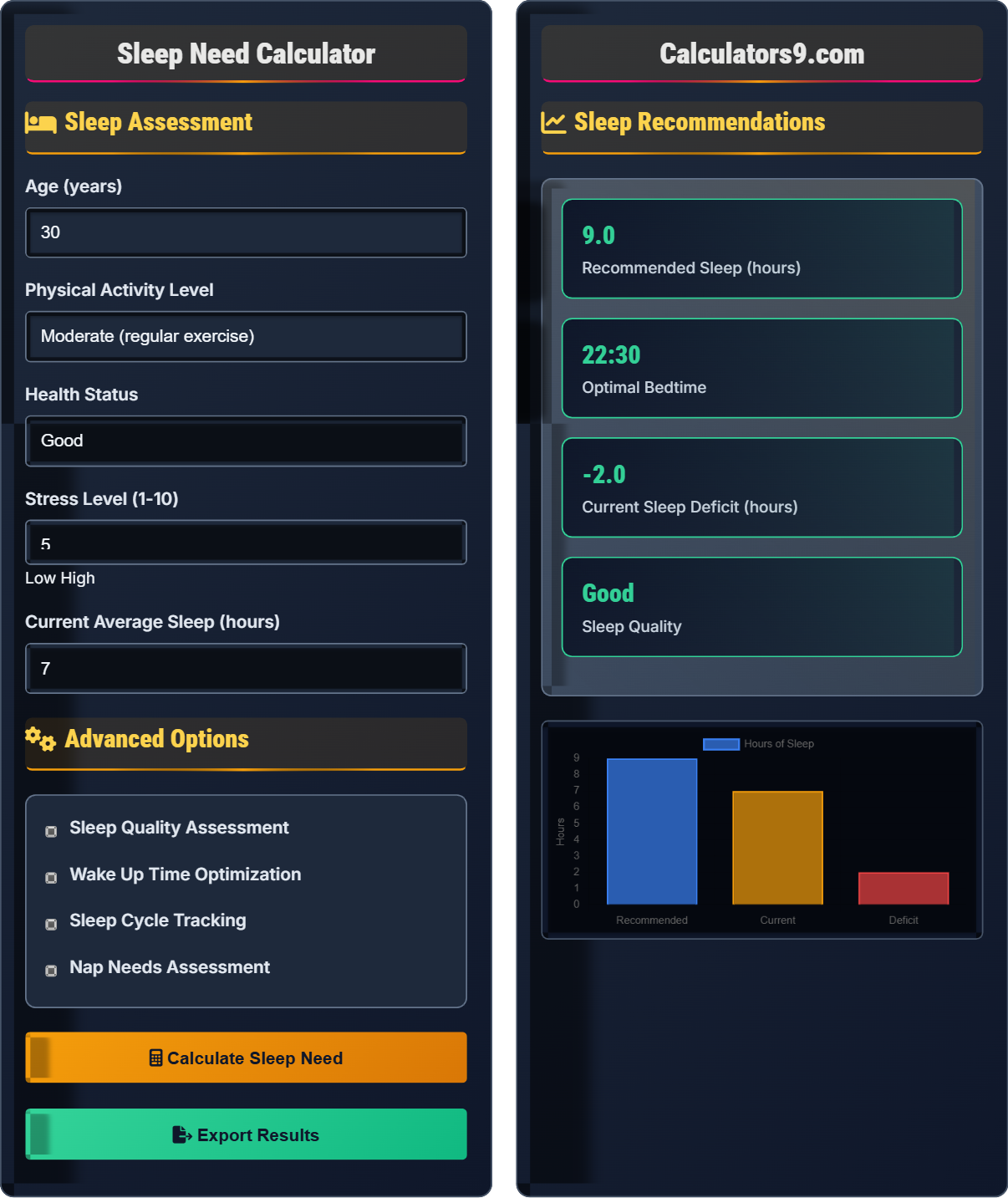
Sleep Assessment
Advanced Options
Sleep Recommendations
| Factor | Value | Impact |
|---|---|---|
| Age-Based Need | 7.5 hours | Baseline requirement |
| Activity Adjustment | +0.5 hours | Increased for activity |
| Health Factor | +0 hours | Based on health status |
| Stress Compensation | +0.5 hours | For stress management |
| Time | Activity | Recommendation |
|---|---|---|
| 22:30 | Bedtime | Prepare for sleep |
| 23:00 | Deep Sleep | First sleep cycle |
| 02:00 | REM Sleep | Cognitive restoration |
| 07:00 | Wake Up | Full rest cycle complete |
Comprehensive Sleep Health Guide
Sleep is essential for physical health, cognitive function, and emotional well-being. Sleep needs vary by age, with adults typically requiring 7-9 hours per night. However, individual factors such as activity level, health status, and stress can modify these requirements.
Personalized sleep needs can be calculated using:
Where:
- \(S\) = Total Sleep Required
- \(A\) = Age-Based Need
- \(E\) = Exercise Adjustment
- \(H\) = Health Factor
- \(C\) = Stress Compensation
A complete sleep cycle lasts 90-110 minutes and includes:
- Stage 1: Light sleep (5-10% of night)
- Stage 2: Onset of true sleep (45-55% of night)
- Stage 3: Deep sleep (15-20% of night)
- REM Sleep: Dreaming phase (20-25% of night)
- Consistent Schedule: Go to bed and wake up at the same time daily
- Comfortable Environment: Cool, dark, quiet bedroom
- Limited Stimulants: Avoid caffeine 6 hours before bedtime
- Screen Time: Limit blue light exposure 1 hour before sleep
- Relaxation: Practice calming activities before bed
Sleep Science Basics
Practices and habits that promote consistent, quality sleep.
\(S = A + E + H + C\)
Where S=sleep, A=age, E=exercise, H=health, C=stress.
- Adults need 7-9 hours of sleep
- Consistency is more important than duration
- Quality matters as much as quantity
Self-Care Strategies
The biological process that regulates sleepiness based on time awake.
- Maintain regular sleep schedule
- Create optimal sleep environment
- Limit evening stimulants
- Practice relaxation techniques
- Individual sleep needs vary
- Quality affects daytime performance
- Consistency improves sleep efficiency
- Physical activity enhances sleep
Sleep Health Learning Quiz
According to the National Sleep Foundation, how many hours of sleep should a healthy adult (18-64 years) aim for?
The answer is B) 7-9 hours. According to the National Sleep Foundation, healthy adults aged 18-64 should aim for 7-9 hours of sleep per night. This range is optimal for maintaining physical health, cognitive function, and emotional well-being.
Sleep requirements vary significantly across the lifespan. Understanding age-appropriate sleep needs is fundamental to maintaining health. The 7-9 hour recommendation for adults is based on extensive research linking adequate sleep to improved immune function, cognitive performance, and reduced risk of chronic diseases.
Circadian Rhythm: Internal body clock that regulates sleep-wake cycles
Homeostatic Sleep Drive: Biological pressure that increases with time awake
REM Sleep: Rapid Eye Movement sleep associated with dreaming and memory consolidation
• Adults need 7-9 hours of sleep nightly
• Consistency is more important than duration
• Individual needs may vary within the range
• Remember: 7-9 hours for adults is the "Gold Standard"
• Consistency beats perfection in sleep timing
• Track your energy levels to find your optimal sleep duration
• Assuming 5-6 hours is sufficient for adults
• Ignoring the importance of sleep consistency
• Compensating for weekday sleep loss with weekend catch-up
Explain how completing full sleep cycles contributes to sleep quality and why someone should aim for 7.5 or 9 hours rather than 8 hours. Include the relationship between sleep cycles and morning grogginess.
A complete sleep cycle lasts 90-110 minutes and includes all stages of sleep: light sleep, deep sleep, and REM sleep. Each stage serves different functions:
- Deep Sleep (Stages 3): Physical restoration, tissue repair, immune function
- REM Sleep: Memory consolidation, emotional processing, cognitive function
- Light Sleep (Stages 1-2): Transition phases, sleep maintenance
Completing full cycles ensures all sleep stages are adequately experienced. Aiming for 7.5 hours (5 cycles) or 9 hours (6 cycles) aligns with natural sleep architecture. Waking up during deep sleep or REM sleep causes grogginess (sleep inertia), while waking up during light sleep feels more refreshing.
Understanding sleep architecture is crucial for optimizing sleep quality. Rather than focusing solely on total hours, timing sleep to align with natural cycles can significantly improve morning alertness. This concept explains why someone who sleeps 7.5 hours often feels more refreshed than someone who sleeps 8 hours, depending on when they wake up in their sleep cycle.
Sleep Architecture: Structure and organization of sleep stages throughout the night
Sleep Inertia: Groggy feeling upon awakening from deep sleep
Polysomnography: Comprehensive recording of biophysiological changes during sleep
• Aim for multiples of 90-minute sleep cycles
• Waking during light sleep feels more refreshing
• Sleep quality is influenced by cycle completion
• Plan sleep in 90-minute increments (7.5, 9, 10.5 hours)
• Use sleep tracking apps to identify optimal wake times
• Allow extra time for falling asleep (15-20 minutes)
• Focusing only on total sleep duration
• Ignoring the importance of sleep timing
• Not accounting for time to fall asleep
FAQ
Q: Is it better to get 7 hours of consistent sleep or 9 hours with an inconsistent schedule?
A: Consistency is more important than duration for sleep quality. A consistent 7-hour sleep schedule is generally better than an inconsistent 9-hour schedule because:
- Circadian Rhythm: Regular timing strengthens your internal body clock
- Hormone Regulation: Consistent sleep schedules optimize melatonin and cortisol production
- Deep Sleep: Regular schedules promote deeper, more restorative sleep
- Daytime Alertness: Consistency improves alertness even with less sleep
However, 7 hours is near the minimum for most adults, so if you're consistently tired, aim for 7.5-8 hours on a regular schedule. The combination of adequate duration AND consistency provides the best outcomes for health and performance.
Q: How can I optimize sleep when dealing with high stress levels?
A: High stress increases sleep needs, and stress management is crucial for quality sleep:
- Extended Sleep: Add 0.5-1 hour to baseline sleep needs during high stress
- Stress Reduction: Practice relaxation techniques before bed (deep breathing, meditation)
- Limit Stimulants: Avoid caffeine after 2 PM and reduce alcohol intake
- Evening Routine: Create a calming pre-sleep routine to signal your body to relax
- Stress Management: Address stressors during the day to reduce nighttime rumination
Stress activates the sympathetic nervous system, making it harder to fall and stay asleep. Managing stress effectively creates better conditions for restorative sleep. Consider that during high-stress periods, you may need more sleep than usual to maintain optimal functioning.