Social Connection Score Calculator
Fast mental health tool • 2026 standards
Social Connection Formula:
Show the calculator\( \text{Connection Score} = \frac{\text{Frequency} \times \text{Quality} \times \text{Diversity}}{\text{Isolation Factor}} \)
Where:
- Frequency = Number of meaningful interactions per week
- Quality = Depth and emotional support of relationships (1-10)
- Diversity = Number of different relationship types (family, friends, colleagues)
- Isolation Factor = Adjusts for physical/social isolation (0.5-2.0)
This formula quantifies social connection quality and helps identify areas for improvement. Strong social connections are linked to better mental health, longevity, and overall wellbeing.
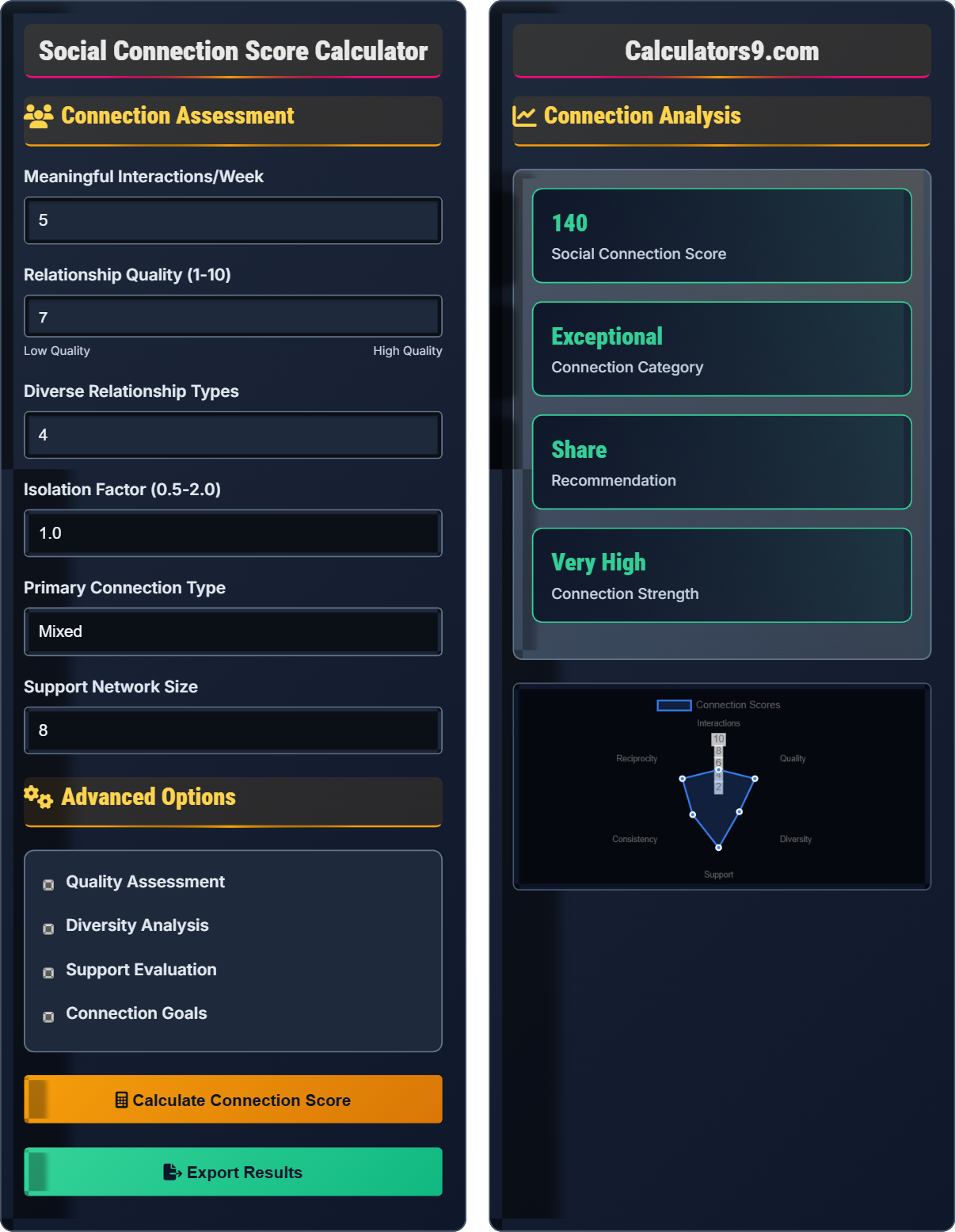
Example: For 5 meaningful interactions per week, with relationship quality of 7, diversity of 4 relationship types, and low isolation factor of 1.0:
\( \text{Connection Score} = \frac{5 \times 7 \times 4}{1.0} = 140 \)
This represents a strong social connection profile.
Connection Assessment
Advanced Options
Connection Analysis
| Factor | Score | Status |
|---|---|---|
| Meaningful Interactions | 5/week | Good |
| Relationship Quality | 7/10 | High |
| Connection Diversity | 4 types | Moderate |
| Isolation Factor | 1.0 | Low |
| Area | Score | Recommendation |
|---|---|---|
| Interaction Frequency | 5 | Maintain current level |
| Quality of Bonds | 7 | Continue nurturing |
| Support Network | 8 | Good support base |
| Connection Diversity | 4 | Consider expanding |
Comprehensive Social Connection Guide
Social connection refers to the quality and quantity of meaningful relationships in our lives. Strong social connections are fundamental to mental health and wellbeing. Research shows that people with robust social networks live longer, experience less stress, and have better overall health outcomes.
The standard social connection calculation uses:
Where:
- \(C\) = Connection Score
- \(F\) = Frequency of meaningful interactions
- \(Q\) = Quality of relationships (1-10)
- \(D\) = Diversity of relationship types
- \(I\) = Isolation factor (0.5-2.0)
Benefits of strong social connections include:
- Mental Health: Reduced depression and anxiety by 20-30%
- Physical Health: Lower blood pressure and stronger immune system
- Longevity: 50% increased likelihood of survival
- Resilience: Better stress management and recovery
- Cognitive Function: Reduced risk of dementia
- Emotional Support: Better coping during difficult times
- Initiative: Take the first step in building relationships
- Consistency: Regular contact maintains connection quality
- Authenticity: Be genuine in interactions
- Reciprocity: Give and receive support equally
- Diversity: Cultivate different types of relationships
- Investment: Prioritize relationship maintenance
Social Connection Fundamentals
Meaningful relationships that provide emotional support and belonging.
\(C = \frac{F \times Q \times D}{I}\)
Where C=connection, F=frequency, Q=quality, D=diversity, I=isolation.
- Quality matters more than quantity
- Consistency builds trust
- Diversity reduces dependency
Self-Care Strategies
Active effort to nurture and sustain meaningful relationships.
- Regular check-ins with loved ones
- Join community groups or clubs
- Practice active listening
- Express gratitude to others
- Introverts may need fewer but deeper connections
- Relationships require mutual investment
- Quality connections are protective against stress
- Virtual connections can be meaningful
Social Connection Learning Quiz
According to research, which of the following is NOT a documented benefit of strong social connections?
The answer is D) Increased loneliness. Strong social connections actually reduce loneliness. All other options are well-documented benefits of robust social relationships: improved immune function, increased longevity (up to 50% higher survival rate), and reduced risk of dementia and cognitive decline.
Understanding the science behind social connections helps motivate relationship building. Social connection is considered a basic human need, similar to food and shelter. The health benefits are so significant that researchers compare strong social ties to the protective effects of exercise and healthy eating.
Social Capital: Networks of relationships that provide mutual benefits
Relational Health: Quality of interpersonal connections
Belongingness: Feeling of being connected and accepted
• Connection quality is more important than quantity
• Relationships require ongoing investment
• Diverse connections provide different benefits
• Start with 1-2 meaningful relationships
• Use technology to maintain long-distance connections
• Join groups aligned with your interests
• Confusing number of contacts with quality of connections
• Only connecting during difficult times
Explain how to build and maintain strong social connections, particularly for introverted individuals. Include specific strategies that align with introversion traits.
Building connections as an introvert requires tailored strategies:
- Small Groups: Focus on 1-on-1 or small group interactions
- Quality Over Quantity: Invest deeply in fewer but meaningful relationships
- Written Communication: Use texts, emails, or notes to stay connected
- Shared Activities: Bond over quiet activities like reading, hiking, or crafts
- Regular Check-ins: Schedule periodic contact rather than spontaneous
- Online Communities: Participate in virtual groups aligned with interests
Maintenance strategies include: sending thoughtful messages, remembering important dates, and being a reliable listener. Introverts often excel at forming deep, authentic connections when they focus on shared interests rather than small talk.
Introverts and extroverts have different social energy needs. Introverts recharge through solitude and may find large group settings draining. Understanding these differences helps create sustainable connection strategies. The key is matching relationship-building methods to personality traits rather than forcing extroverted approaches.
Introversion: Recharging through solitude and reflection
Extroversion: Gaining energy through social interaction
Social Energy: Capacity for social interaction before needing rest
• Respect your social energy limits
• Focus on deep connections rather than broad networks
• Use your listening strengths to build rapport
• Prepare conversation topics in advance
• Attend smaller, interest-based gatherings
• Use follow-up messages to deepen connections
• Forcing yourself into large social settings
• Neglecting to communicate your needs in relationships
FAQ
Q: How many close friends do I need for good social health?
A: Research suggests that 3-5 close, supportive friendships provide the most significant mental health benefits:
- Core Circle: 3-5 people you can rely on for support
- Broader Network: 10-15 additional acquaintances
- Community: Participation in larger groups or communities
- Quality Focus: Deep relationships over many shallow ones
The key is having people you can turn to in times of need. The quantity of casual connections matters less than having a few reliable, supportive relationships. For introverts, fewer but deeper connections are often more fulfilling than large social circles.
Q: Are virtual connections as valuable as in-person ones?
A: Virtual connections can be meaningful but have different characteristics:
- Accessibility: Virtual connections can reach distant loved ones
- Frequency: Easier to maintain regular contact
- Depth: May lack non-verbal cues and intimacy
- Technology: Dependent on platform reliability
- Hybrid Approach: Best when combined with occasional in-person meetings
Research shows that virtual connections provide emotional support and reduce loneliness, especially for isolated populations. However, the strongest social bonds typically combine both virtual and in-person interactions. Video calls offer more connection than text-based communication.