Stress Level Calculator
Fast mental health assessment • 2026 standards
Stress Assessment Formula:
Show the calculator\( \text{Stress Level} = \frac{\text{Sum of Stress Factors}}{\text{Coping Resources}} \times 100 \)
Where:
- Stress Factors = Work, Relationships, Finances, Health, etc.
- Coping Resources = Support Systems, Skills, etc.
This formula provides a standardized assessment of stress levels based on various life factors. Higher scores indicate greater stress levels requiring attention and management.
Example: If stress factors total 45 points and coping resources score 30 points:
\( \text{Stress Level} = \frac{45}{30} \times 100 = 150 \)
This would indicate high stress levels requiring immediate intervention.
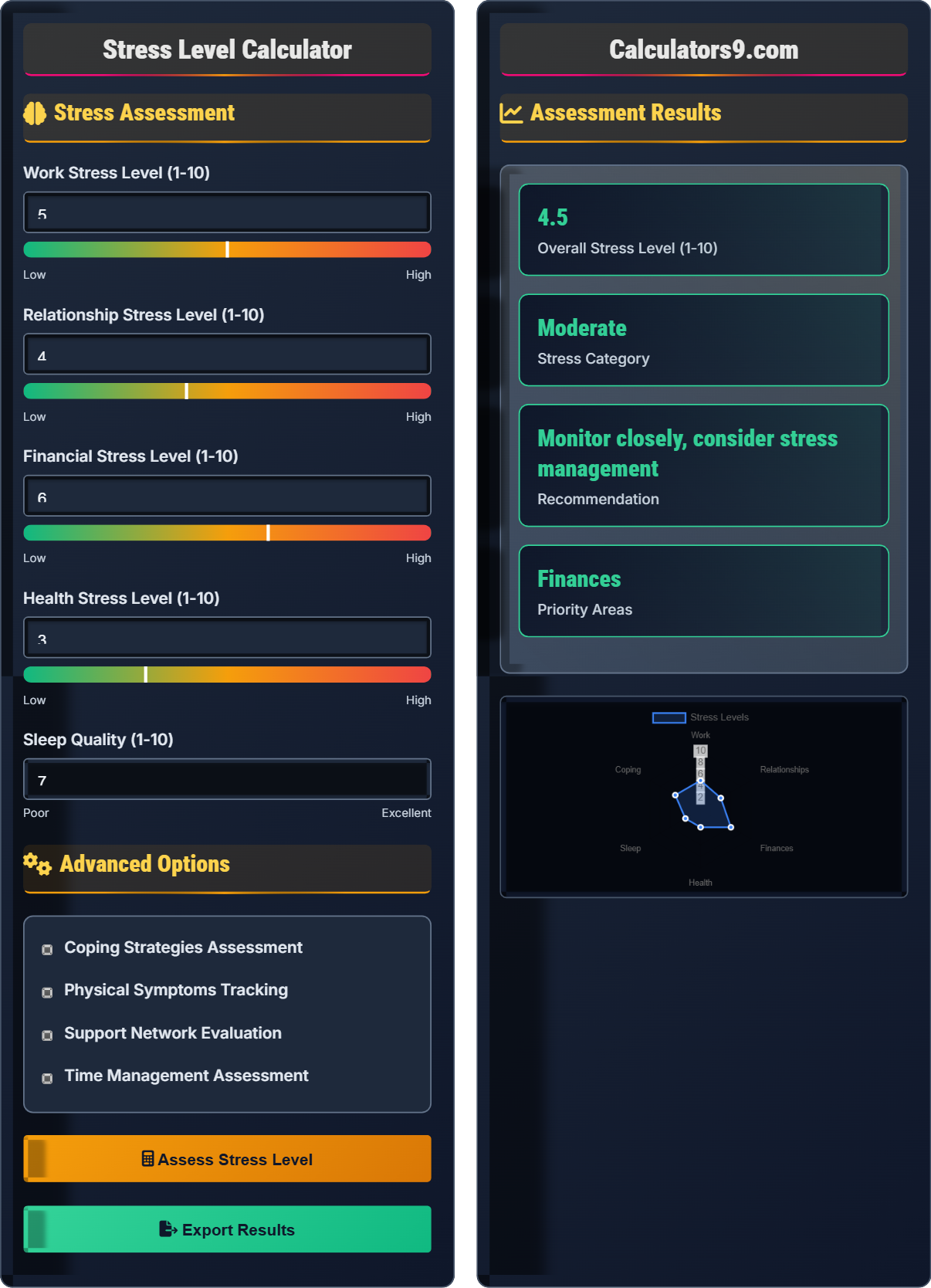
Stress Assessment
Advanced Options
Assessment Results
| Factor | Score | Status |
|---|---|---|
| Work Stress | 5 | Normal |
| Relationship Stress | 4 | Normal |
| Financial Stress | 6 | Elevated |
| Health Stress | 3 | Normal |
| Area | Score |
|---|---|
| Overall Stress Level | 5.0 |
| Sleep Quality | 7 |
| Coping Score | 5 |
| Support Score | 6 |
Comprehensive Stress Management Guide
Stress is the body's natural response to challenges and demands. While some stress can be beneficial (eustress), chronic or excessive stress (distress) can negatively impact physical and mental health. Understanding stress levels helps individuals take proactive steps toward better mental wellness.
Common stress assessment approaches include:
Where:
- \(S\) = Stress Level
- \(F_i\) = Individual stress factors
- \(n\) = Number of factors assessed
Physical and emotional signs of stress include:
- Physical: Headaches, fatigue, muscle tension, sleep problems
- Emotional: Anxiety, irritability, depression, mood swings
- Behavioral: Changes in appetite, social withdrawal, procrastination
- Cognitive: Difficulty concentrating, memory problems, negative thoughts
- Social: Relationship conflicts, decreased productivity, isolation
- Relaxation Techniques: Deep breathing, meditation, progressive muscle relaxation
- Physical Activity: Regular exercise, yoga, walking in nature
- Healthy Habits: Balanced diet, adequate sleep, limited alcohol/caffeine
- Social Support: Connect with friends, family, support groups
- Professional Help: Therapy, counseling, stress management programs
Stress Management Basics
Body's natural response to perceived threats or challenges.
\(S = \sqrt{\sum_{i=1}^{n}(F_i^2)}\)
Where S=stress level, F=factors, n=number of factors.
- Identify stress triggers early
- Develop healthy coping mechanisms
- Seek support when needed
Self-Care Strategies
Regular self-care practices prevent stress accumulation and promote resilience.
- Mindfulness exercises
- Physical activity
- Adequate rest
- Healthy boundaries
- Everyone's stress tolerance varies
- Chronic stress requires professional help
- Prevention is more effective than treatment
- Consistency in self-care matters
Stress Management Learning Quiz
According to standard stress assessment criteria, what stress level category corresponds to a score of 7.5?
The answer is C) High Stress. In standard stress assessment scales, a score of 7.5 falls within the 7-8 range, which is categorized as High Stress. This level indicates significant symptoms and frequent difficulty coping, with professional support recommended.
Understanding stress categorization is essential for appropriate self-care responses. The standard scale ranges from 1-10, with specific thresholds indicating different intervention needs. Scores of 7-8 represent a critical threshold where stress begins to significantly impact daily functioning and may require professional support.
Eustress: Beneficial stress that motivates and energizes
Distress: Harmful stress that overwhelms coping abilities
Allostasis: Body's ability to achieve stability through change
• 1-3 = Low Stress (manageable)
• 4-6 = Moderate Stress (monitor closely)
• 7-8 = High Stress (seek support)
• 9-10 = Severe Stress (professional help needed)
• Remember: 7-8 means "Time for Professional Help"
• Track stress levels weekly for patterns
• Notice early warning signs before reaching high levels
• Ignoring moderate stress levels
• Assuming all stress is harmful
• Waiting until severe levels to seek help
A person has a stress score of 8.2 but reports strong coping strategies (score 8) and robust social support (score 9). How might these protective factors influence their overall stress management approach? Explain the relationship between stressors and protective factors.
Despite the high stress score of 8.2 (indicating severe stress), the strong coping strategies (8/10) and robust social support (9/10) serve as protective factors that can significantly enhance stress management. These protective factors may allow the individual to:
- More effectively process and manage stressors
- Have better emotional regulation during stressful periods
- Access practical help and emotional support when needed
- Recover more quickly from stressful events
The relationship between stressors and protective factors follows the equation: Resilience = Protective Factors - Risk Factors. Even with high stress, strong protective factors can mitigate negative outcomes.
Stress assessment isn't just about stressors; protective factors play a crucial role in determining actual impact. The transactional model of stress emphasizes that stress results from the interaction between environmental demands and personal resources. Someone with high stress but strong protective factors may cope better than someone with moderate stress and weak protective factors.
Protective Factors: Elements that reduce stress impact (coping skills, social support)
Risk Factors: Elements that increase stress vulnerability
Resilience: Ability to adapt and recover from adversity
• High stress doesn't always mean poor outcomes
• Protective factors can buffer stress effects
• Both stressors and resources matter in assessment
• Build protective factors even when stress is low
• Strengthen social connections proactively
• Develop coping skills before crisis hits
• Focusing only on stress reduction without building resilience
• Underestimating the power of social support
• Not developing coping skills until stress is high
FAQ
Q: How often should I assess my stress levels?
A: For optimal mental health management, assess stress levels:
- Weekly: Quick self-assessment to notice patterns and triggers
- Monthly: More detailed evaluation including coping strategies
- During life changes: Major events require immediate assessment
- When symptoms appear: Any new physical or emotional symptoms warrant evaluation
Regular assessment helps identify trends before stress reaches problematic levels. The key is consistency rather than perfection - even brief daily check-ins can be valuable for recognizing early warning signs and implementing preventive strategies.
Q: What are the signs that someone needs professional help for stress management?
A: Professional help should be sought when experiencing:
- Persistent symptoms: Stress lasting more than 2-3 weeks despite self-care
- Functional impairment: Difficulty performing daily activities, work, or relationships
- Physical symptoms: Chronic headaches, sleep disturbances, chest pain, or digestive issues
- Emotional distress: Persistent sadness, anxiety, panic attacks, or hopelessness
- Behavioral changes: Increased substance use, social withdrawal, or self-harm thoughts
Additionally, anyone scoring 7 or above on stress assessments should consider professional consultation. Early intervention prevents minor stress from developing into more serious mental health conditions. Remember, seeking help is a sign of strength, not weakness.