Therapy Cost Calculator
Fast mental health investment tool • 2026 standards
Therapy Cost Formula:
Show the calculator\( \text{Total Cost} = (\text{Session Rate} \times \text{Number of Sessions}) + \text{Additional Fees} - \text{Insurance Coverage} \)
Where:
- Session Rate = Cost per therapy session
- Number of Sessions = Planned therapy sessions
- Additional Fees = Copays, booking fees, etc.
- Insurance Coverage = Amount covered by insurance
This formula helps estimate the total investment for therapy services. Understanding therapy costs enables informed decisions about mental health investments and insurance utilization.
Example: For therapy sessions at $150 each, 20 sessions planned, $50 copay per session, with 80% insurance coverage:
\( \text{Total Cost} = (150 \times 20) + (50 \times 20) - (0.8 \times 150 \times 20) = 3000 + 1000 - 2400 = 1600 \)
The out-of-pocket cost would be $1,600.
Therapy Investment
Advanced Options
Investment Analysis
| Investment Area | Amount | Percentage |
|---|---|---|
| Therapy Sessions | $3,600 | 100% |
| Insurance Savings | -$2,160 | -60% |
| Copay Costs | $600 | 17% |
| Net Investment | $1,440 | 40% |
| Component | Monthly | Duration | Total |
|---|---|---|---|
| Session Fees | $300 | 6 months | $1,800 |
| Copays | $50 | 6 months | $300 |
| Insurance Coverage | $240 | 6 months | $1,440 |
| Out-of-Pocket | $110 | 6 months | $660 |
Comprehensive Therapy Investment Guide
Therapy investment represents a significant commitment to mental health and well-being. Understanding the cost structure helps individuals make informed decisions about their mental health care and financial planning.
The standard therapy cost calculation uses the following formula:
Where:
- \(C\) = Total Cost
- \(R\) = Rate per session
- \(S\) = Number of sessions
- \(F\) = Additional fees
- \(I\) = Insurance coverage
Factors that influence therapy costs include:
- Therapist Credentials: PhD/Licensed Psychologists typically cost more
- Location: Urban areas generally have higher rates
- Specialization: Specialized treatments may command premium rates
- Session Length: Longer sessions cost more
- Insurance Network: In-network providers cost less
- Payment Method: Cash pay vs. insurance affects pricing
- Insurance Utilization: Use in-network providers to maximize coverage
- Flexible Spending: Use FSA/HSA accounts for tax-free payments
- Group Therapy: Join group sessions for reduced individual costs
- Training Clinics: Consider supervised trainee therapists
- Telehealth: Online therapy often costs less
- Payment Plans: Negotiate installment options with providers
Therapy Investment Basics
Financial commitment to mental health and well-being services.
\(C = (R \times S) + F - I\)
Where C=cost, R=rate, S=sessions, F=fees, I=insurance.
- Insurance significantly reduces out-of-pocket costs
- Sliding scale options are available for financial hardship
- Investment in therapy pays dividends in mental health
Self-Care Strategies
Return on investment in mental health services.
- Improved productivity and work performance
- Better relationships and communication
- Reduced medical costs from stress-related conditions
- Enhanced emotional regulation and coping
- Therapy costs are often tax-deductible
- Many employers offer EAP benefits
- Telehealth expands access and reduces costs
- Consistency improves outcomes and cost-effectiveness
Therapy Investment Learning Quiz
If a therapy session costs $150 and your insurance covers 80% with a $25 copay, how much do you pay per session?
The answer is A) $25. With insurance covering 80% of the $150 session ($120), the remaining $30 is subject to your $25 copay. You pay the copay amount, which is less than the remaining uncovered cost.
Understanding how copays work is crucial for therapy cost planning. When insurance covers a percentage of the session cost, you typically pay the copay amount, which is often lower than the remaining uncovered portion. This structure incentivizes seeking therapy services.
Copay: Fixed amount paid per visit regardless of service cost
Coinsurance: Percentage of costs paid after deductible
Deductible: Amount paid before insurance coverage begins
• Copay is usually the lesser of copay amount or uncovered cost
• Insurance coverage percentages apply to negotiated rates
• Verify in-network status before starting therapy
• Contact insurance before starting therapy
• Ask about out-of-pocket maximums
• Understand the difference between copay and coinsurance
• Assuming copay is always applied to full session cost
• Not verifying therapist in-network status
• Forgetting to consider deductible requirements
A person is considering therapy at $150 per session, 2 sessions per month for 6 months. Their insurance covers 80% of costs with a $25 copay. Calculate the total investment and explain the cost-benefit ratio. Show your work and explain the value proposition.
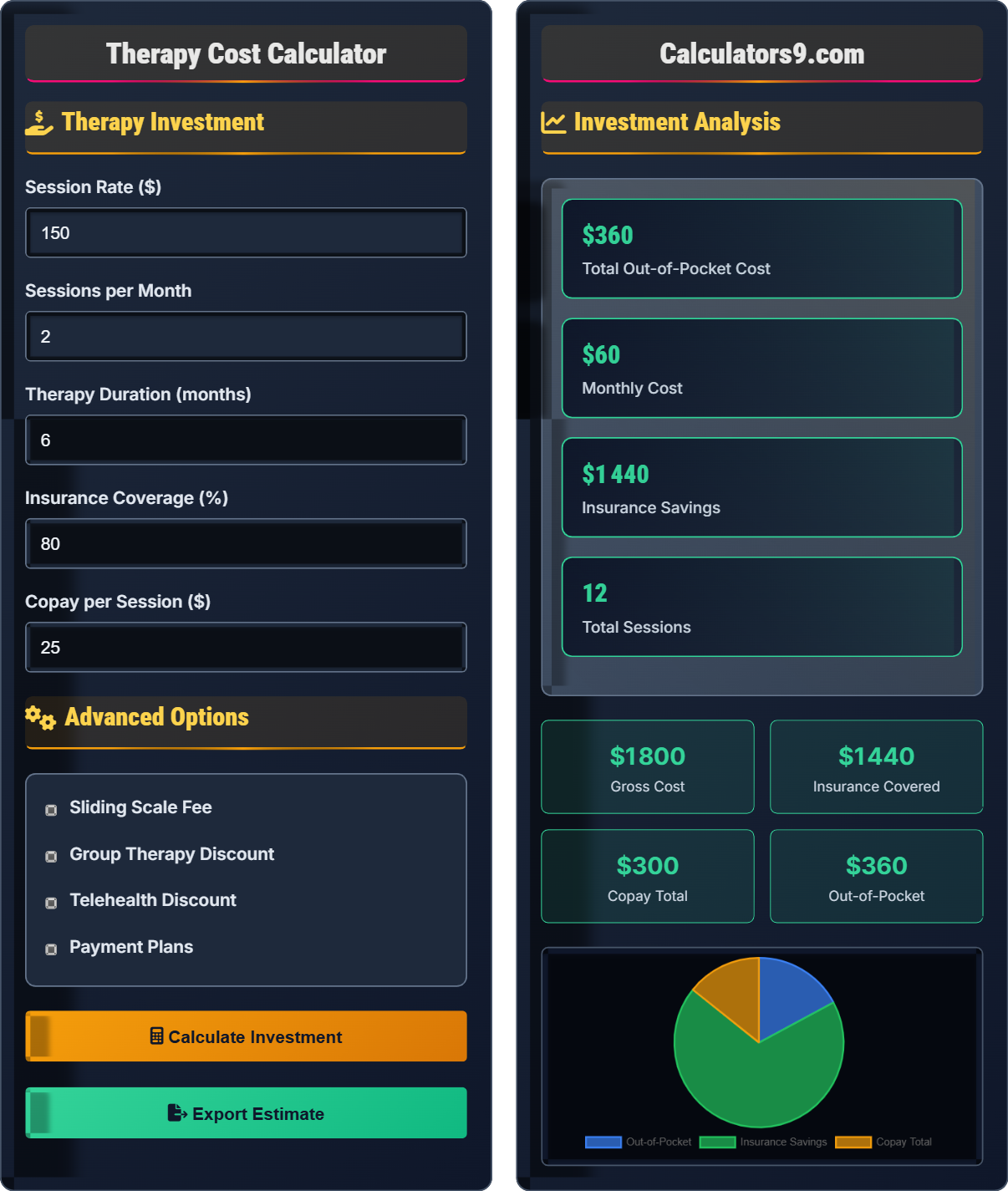
Step 1: Calculate total sessions: 2 sessions/month × 6 months = 12 sessions
Step 2: Calculate gross cost: 12 × $150 = $1,800
Step 3: Calculate insurance coverage: $1,800 × 0.80 = $1,440
Step 4: Calculate copay total: 12 × $25 = $300
Step 5: Calculate out-of-pocket: $1,800 - $1,440 = $360
Step 6: Total investment: $360 (remaining after insurance) + $300 (copays) = $660
The person pays $660 for $1,800 worth of services, receiving $1,440 in insurance savings. This represents a 74% reduction in out-of-pocket costs.
Therapy investment analysis requires understanding multiple components: session rates, frequency, duration, insurance coverage, and copays. The true value emerges from comparing the out-of-pocket investment against the total service value received. Insurance dramatically reduces the financial burden of mental health care.
ROI: Return on investment in mental health services
Cost-Sharing: Division of costs between patient and insurer
Value Proposition: Benefit relative to cost of therapy
• Calculate total investment across entire treatment period
• Consider both direct and indirect benefits of therapy
• Factor in insurance coverage when evaluating affordability
• Use FSA/HSA accounts to pay for therapy
• Consider group therapy for cost reduction
• Negotiate payment plans with providers
• Calculating only per-session costs without considering duration
• Forgetting to account for copays in total calculation
• Not factoring in insurance savings when evaluating affordability
FAQ
Q: Are therapy costs tax-deductible?
A: Yes, therapy costs are often tax-deductible as medical expenses:
- Medical Expense Deduction: Therapy qualifies as a deductible medical expense
- Threshold: Deductible when total medical expenses exceed 7.5% of AGI
- FSA/HSA: Use tax-free accounts to pay for therapy
- Documentation: Keep receipts for all therapy-related expenses
- Insurance Premiums: May include insurance premiums if for medical care
Consult with a tax professional to determine your specific eligibility and the most advantageous way to claim therapy expenses. Many people use Flexible Spending Accounts (FSAs) or Health Savings Accounts (HSAs) to pay for therapy with pre-tax dollars.
Q: What options exist for families with limited income to access therapy?
A: Several options exist for accessing affordable therapy:
- Sliding Scale Programs: Many practices adjust fees based on income
- Community Mental Health Centers: Federally funded centers offering services regardless of ability to pay
- Training Clinics: University programs providing low-cost therapy
- Employee Assistance Programs: Many employers offer free sessions
- Non-Profit Organizations: Charitable organizations providing mental health services
- Online Therapy Platforms: Often more affordable than in-person sessions
Many therapists offer sliding scale fees based on household income and family size. Community health centers often provide services on a pay-what-you-can basis. Don't hesitate to ask about financial assistance options when contacting potential therapists.