Decibel Calculator
dB conversion and level calculator • Audio production tool
Decibel Formulas:
Show Calculator\( \text{dB} = 20 \times \log_{10}(\frac{V}{V_0}) \)
\( \text{dB} = 10 \times \log_{10}(\frac{P}{P_0}) \)
\( \text{SPL (dB)} = 20 \times \log_{10}(\frac{P}{P_{ref}}) \)
Where V is voltage, P is power, and the reference values are typically 1 volt for voltage and 1 milliwatt for power. For SPL, the reference pressure is 20 μPa. These logarithmic scales compress wide ranges of values into manageable numbers.
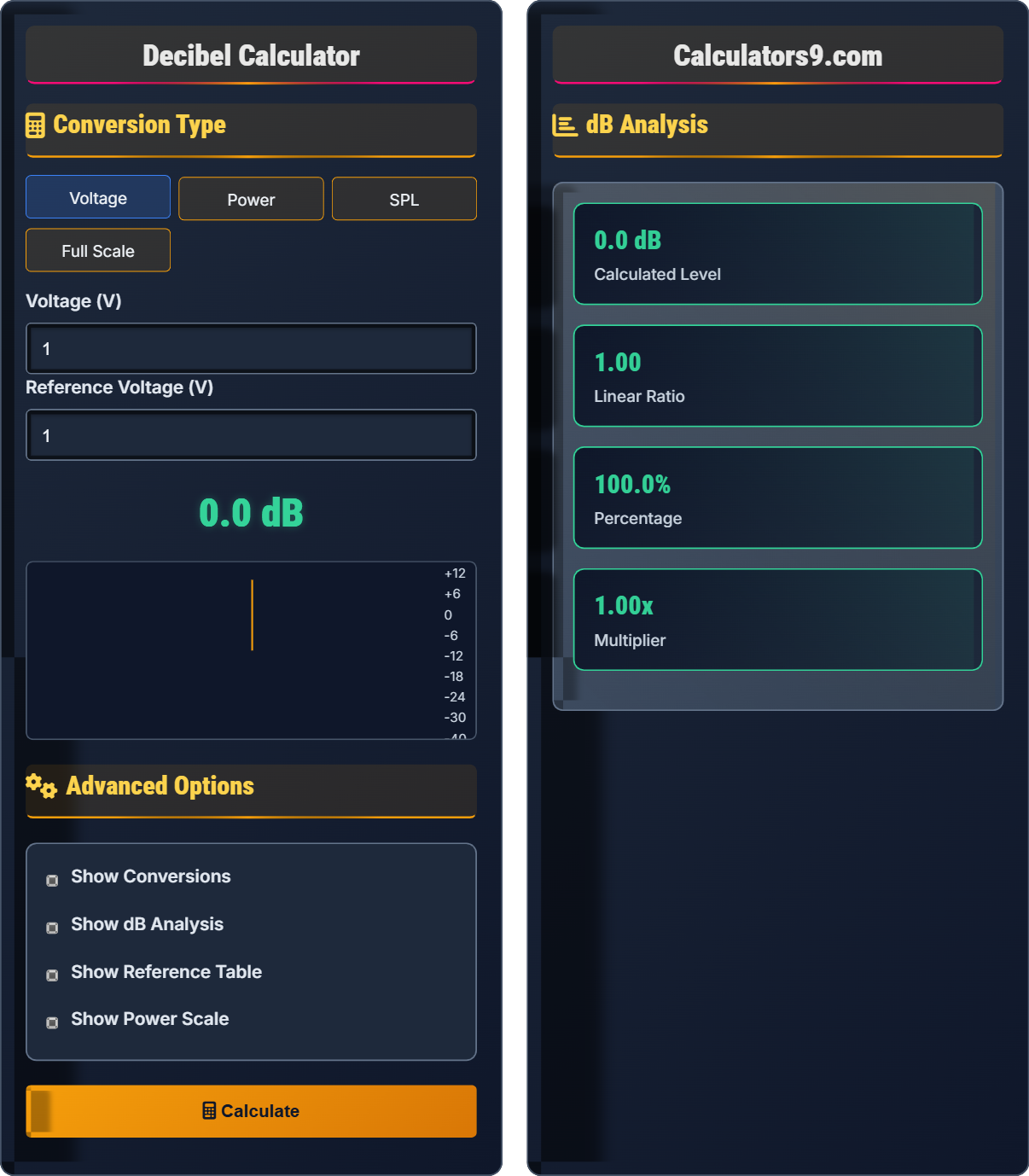
Conversion Type
Advanced Options
dB Analysis
Decibel Fundamentals
The decibel (dB) is a logarithmic unit used to express the ratio between two values of a physical quantity, often power or intensity. In audio, it's used to measure sound pressure levels, voltage, and power ratios.
Voltage: \( \text{dB} = 20 \times \log_{10}(\frac{V}{V_0}) \)
Power: \( \text{dB} = 10 \times \log_{10}(\frac{P}{P_0}) \)
SPL: \( \text{SPL (dB)} = 20 \times \log_{10}(\frac{P}{P_{ref}}) \)
Where V₀, P₀, and P_ref are reference values.
- +3 dB = double power, √2 voltage
- +6 dB = double voltage, quadruple power
- -6 dB = half voltage, quarter power
- -∞ dB = silence
Applications in Audio Production
Decibels are fundamental to audio production for measuring signal levels, setting gain stages, monitoring peak levels, and controlling dynamic range in mixing and mastering.
- Signal level monitoring
- Gain staging
- Dynamic range control
- EQ settings
- Compression ratios
- Always consider reference levels
- Logarithmic scale compresses wide ranges
- 0 dBFS is maximum in digital systems
- Headroom prevents clipping
Decibel Learning Quiz
What is the relationship between a +6 dB change and the corresponding amplitude change?
The answer is A) Amplitude doubles. For voltage/amplitude measurements: +6 dB = 2× amplitude. Using the formula: \( 20 \times \log_{10}(2) = 20 \times 0.301 = 6.02 \) dB. For power: +6 dB = 4× power (since power is proportional to voltage squared).
The key difference between voltage and power calculations is the multiplier: 20 for voltage (amplitude) and 10 for power. This is because power is proportional to the square of voltage. Understanding this relationship is crucial for audio gain calculations and level matching.
Amplitude: Peak value of a signal
Power: Energy delivered over time
Logarithmic Scale: Compresses wide ranges
• +6 dB = 2× amplitude
• +3 dB = 2× power
• Use 20 for voltage, 10 for power
• Remember: 20 for voltage, 10 for power
• +6 dB = double voltage = quadruple power
• -6 dB = half voltage = quarter power
• Using 10 instead of 20 for voltage calculations
• Confusing amplitude and power relationships
• Forgetting the logarithmic nature of dB scale
Convert a voltage of 2.5V to dBV (relative to 1V). Show your work.
Using the voltage formula: \( \text{dB} = 20 \times \log_{10}(\frac{V}{V_0}) \)
Given: V = 2.5V, V₀ = 1V
Step 1: Calculate the ratio: \( \frac{2.5}{1} = 2.5 \)
Step 2: Apply logarithm: \( \log_{10}(2.5) = 0.398 \)
Step 3: Multiply by 20: \( 20 \times 0.398 = 7.96 \) dB
Therefore, 2.5V = 7.96 dBV.
This calculation demonstrates the logarithmic nature of the decibel scale. Rather than expressing voltage as a linear value, dBV expresses it relative to a reference. The logarithmic scale makes it easier to work with the wide range of voltage values encountered in audio systems.
dBV: Decibels relative to 1V
Reference Level: Baseline for comparison
Logarithm: Power to which base is raised
• Use 20 for voltage calculations
• Always specify reference level
• Logarithms compress ratios
• Remember: dBV = 20 × log₁₀(V/1V)
• Use calculator for logarithms
• Check units match reference
• Using 10 instead of 20 for voltage
• Forgetting to specify reference level
• Calculation errors with logarithms
A mixer has a gain control set to +12 dB. If the input signal is 0.5V, what is the output voltage? How much power does this represent compared to the input?
Step 1: Convert +12 dB to voltage ratio
Using: \( \text{dB} = 20 \times \log_{10}(\frac{V_{out}}{V_{in}}) \)
\( 12 = 20 \times \log_{10}(\frac{V_{out}}{0.5}) \)
\( 0.6 = \log_{10}(\frac{V_{out}}{0.5}) \)
\( 10^{0.6} = \frac{V_{out}}{0.5} \)
\( 3.98 = \frac{V_{out}}{0.5} \)
\( V_{out} = 3.98 \times 0.5 = 1.99 \) V ≈ 2.0 V
Step 2: Calculate power ratio
For power: +12 dB = 10^(12/10) = 10^1.2 = 15.85× power
Therefore, the output voltage is 2.0 V, representing 15.85× more power than the input.
This problem demonstrates gain staging, which is critical in audio production. The relationship between voltage gain and power gain is important for understanding how amplifiers affect signal strength. A 12 dB gain significantly increases both voltage and power.
Gain Staging: Setting gain levels throughout signal chain
Amplifier: Device that increases signal level
Power Ratio: Output power to input power
• Voltage gain: 20 × log for dB
• Power gain: 10 × log for dB
• Power ∝ voltage²
• Remember: Power = voltage²
• Use inverse logarithm to find ratios
• Check units consistency
• Confusing voltage and power calculations
• Forgetting the square relationship
• Calculation errors with inverse logs
A microphone has a sensitivity of -40 dBV/Pa. If it's exposed to a sound pressure level of 1 Pa, what is the output voltage? If the quietest detectable sound is 20 μPa, what is the dynamic range?
Step 1: Calculate output voltage for 1 Pa
Using: \( \text{dBV} = 20 \times \log_{10}(\frac{V}{1V}) \)
\( -40 = 20 \times \log_{10}(\frac{V}{1}) \)
\( -2 = \log_{10}(V) \)
\( V = 10^{-2} = 0.01 \) V = 10 mV
Step 2: Calculate dynamic range
Dynamic range = 20 × log₁₀(1 Pa / 20×10⁻⁶ Pa)
= 20 × log₁₀(50,000)
= 20 × 4.7 = 94 dB
Therefore, the output voltage is 10 mV and the dynamic range is 94 dB.
This demonstrates microphone specifications and dynamic range calculations. Microphone sensitivity is typically given in dBV per Pascal (unit of pressure). The dynamic range represents the range from the quietest to loudest sounds the microphone can handle without distortion.
Sensitivity: Output per unit input
Pascal: Unit of pressure
Dynamic Range: Ratio of max to min levels
• Sensitivity in dBV/Pa
• Dynamic range = 20 × log₁₀(max/min)
• Standard reference pressure = 20 μPa
• Remember: 1 Pa = 94 dB SPL
• Convert units to same scale
• Use scientific notation for small values
• Confusing sensitivity units
• Forgetting to convert units
• Using wrong formula for dynamic range
What does 0 dBFS represent in digital audio systems?
The answer is A) Maximum possible level. dBFS (decibels relative to Full Scale) is the reference level in digital audio systems. 0 dBFS represents the maximum level before clipping occurs. All other levels are expressed as negative values relative to this maximum. This is different from analog systems where 0 dB might represent a nominal operating level.
dBFS is unique to digital systems and represents the maximum possible level before digital clipping. Unlike analog systems which have some headroom above 0 dB, digital systems clip immediately at 0 dBFS. This is why digital meters often show negative values, with headroom typically maintained at -6 dBFS or lower.
dBFS: Decibels relative to Full Scale
Clipping: Distortion from exceeding maximum level
Headroom: Safety margin below maximum
• 0 dBFS = maximum in digital systems
• All levels are negative relative to this
• Clipping occurs immediately at 0 dBFS
• Maintain headroom below 0 dBFS
• -6 dBFS is common operating level
• Digital and analog references differ
• Confusing digital and analog reference levels
• Not understanding clipping in digital systems
• Assuming 0 dB is optimal in digital systems
FAQ
Q: What's the difference between dBu and dBV, and when should I use each?
A: The difference lies in their reference voltages:
dBV: Reference voltage is 1.0 VRMS (volts root mean square)
dBu: Reference voltage is 0.775 VRMS (unloaded voltage)
dBV is commonly used in consumer electronics where loads are typically known, while dBu is used in professional audio where equipment often operates unloaded. The 0.775V reference for dBu comes from 1mW of power into a 600Ω load: √(0.001 × 600) = 0.775V.
Q: How do I convert between voltage and power in dB calculations?
A: The key difference is the multiplier in the logarithmic formula:
Voltage (or amplitude): \( \text{dB} = 20 \times \log_{10}(\frac{V}{V_0}) \)
Power: \( \text{dB} = 10 \times \log_{10}(\frac{P}{P_0}) \)
This difference exists because power is proportional to the square of voltage (P = V²/R). So if voltage increases by a factor of 2, power increases by a factor of 4, resulting in +6 dB for voltage but +12 dB for power.
For example: +6 dB voltage = 2× voltage = 4× power = +12 dB power.