Frequency to Note Calculator
Convert audio frequencies to musical notes • Audio production tool
Note Frequency Formula:
Show Calculator\( f(n) = f_0 \times 2^{\frac{n - n_0}{12}} \)
Where:
- \( f(n) \) = frequency of the note
- \( f_0 \) = reference frequency (typically A4 = 440 Hz)
- \( n \) = MIDI note number
- \( n_0 \) = reference MIDI note number (A4 = 69)
To find the note from frequency: \( n = n_0 + 12 \times \log_2(\frac{f}{f_0}) \)
The cents deviation is calculated as: \( \text{cents} = 1200 \times \log_2(\frac{f_{actual}}{f_{nearest}}) \)
This formula allows precise conversion between audio frequencies and musical notes, essential for tuning, pitch detection, and audio production applications.
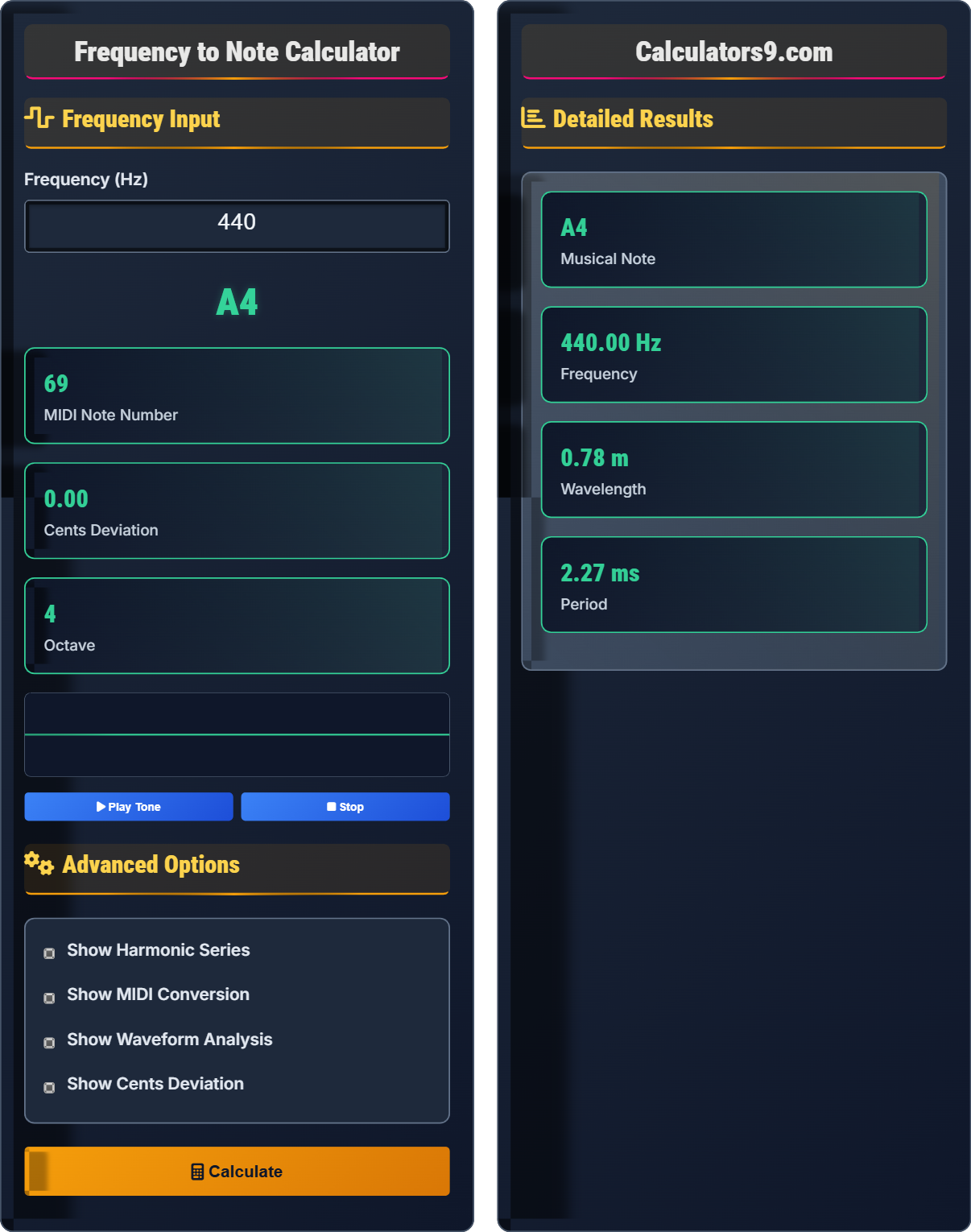
Frequency Input
Advanced Options
Detailed Results
Frequency to Note Conversion
Frequency to note conversion is the mathematical process of mapping an audio frequency (measured in Hertz) to its corresponding musical note. This conversion is fundamental in audio production, instrument tuning, and music theory applications.
\( n = 69 + 12 \times \log_2(\frac{f}{440}) \)
Where n is the MIDI note number and f is the frequency in Hz. The reference point is A4 = 440 Hz (MIDI note 69).
- Each octave doubles the frequency
- 12 semitones make up one octave
- Cents measure microtonal deviations (100 cents = 1 semitone)
- Standard tuning uses A4 = 440 Hz as reference
Applications in Audio Production
This calculator is essential for pitch correction, auto-tuning, spectral analysis, and ensuring instruments are properly tuned within the context of a mix.
- Vocal pitch correction
- Instrument tuning verification
- Spectral analysis
- Auto-tuning setup
- Harmonic analysis
- Consider room acoustics affecting measurements
- Account for instrument intonation variations
- Microtonal adjustments may be needed
- Harmonic content affects perceived pitch
Frequency to Note Learning Quiz
What is the MIDI note number for a frequency of 880 Hz (assuming A4 = 440 Hz)?
The answer is C) 81. Using the formula: \( n = 69 + 12 \times \log_2(\frac{880}{440}) = 69 + 12 \times \log_2(2) = 69 + 12 \times 1 = 81 \). Since 880 Hz is exactly double 440 Hz, it's one octave higher, which corresponds to 12 semitones above A4.
This question tests understanding of the octave relationship in the frequency domain. When frequency doubles, we move up exactly one octave (12 semitones). The logarithmic nature of the formula means that each doubling of frequency adds the same number of semitones regardless of the starting frequency.
Octave: A doubling of frequency that sounds harmonically equivalent
MIDI Note Number: A standardized numbering system for musical notes (A4 = 69)
Logarithmic Scale: A scale where equal ratios correspond to equal intervals
• Each octave doubles the frequency
• 12 semitones = 1 octave = frequency multiplication by 2
• The formula uses log base 2 to account for the doubling relationship
• Remember: Doubling frequency = +12 MIDI notes
• Halving frequency = -12 MIDI notes
• Use the relationship between octaves for quick mental calculations
• Adding instead of multiplying when finding octave relationships
• Forgetting that the formula is logarithmic, not linear
• Miscounting semitones when moving across octaves
Calculate the musical note and MIDI number for a frequency of 330 Hz. Show your work.
Using the formula: \( n = 69 + 12 \times \log_2(\frac{f}{440}) \)
Step 1: Calculate the ratio: \( \frac{330}{440} = 0.75 \)
Step 2: Calculate the logarithm: \( \log_2(0.75) = \log_2(\frac{3}{4}) = \log_2(3) - \log_2(4) \approx 1.585 - 2 = -0.415 \)
Step 3: Apply to formula: \( n = 69 + 12 \times (-0.415) = 69 - 4.98 \approx 64 \)
Step 4: MIDI note 64 corresponds to E4 (since A4 is 69, going back 5 semitones gives E4)
Therefore, 330 Hz is approximately E4 with MIDI note number 64.
This problem demonstrates the use of logarithms in music theory. The logarithmic relationship between frequency and pitch reflects how humans perceive pitch intervals. The calculation shows how we can precisely determine note names from frequencies using mathematical formulas.
Logarithm: The power to which a base must be raised to produce a given number
Equal Temperament: The system where octaves are divided into 12 equal semitones
Reference Pitch: A standard frequency used as a baseline for calculations
• Always use the reference frequency (A4 = 440 Hz) in calculations
• MIDI note numbers are integers, so round appropriately
• The logarithmic formula ensures consistent interval perception
• Use a calculator for logarithmic operations
• Remember common ratios: 3/2 = perfect fifth, 4/3 = perfect fourth
• Practice with known frequencies to verify your calculations
• Using the wrong base for logarithms (must be base 2)
• Forgetting to subtract the reference frequency
• Incorrectly identifying the resulting note from the MIDI number
An audio engineer measures a guitar string producing 445 Hz when it should be tuned to A4 (440 Hz). Calculate the cents deviation and determine if the string is sharp or flat.
Step 1: Calculate cents deviation using the formula: \( \text{cents} = 1200 \times \log_2(\frac{f_{measured}}{f_{target}}) \)
Step 2: Substitute values: \( \text{cents} = 1200 \times \log_2(\frac{445}{440}) = 1200 \times \log_2(1.0114) \)
Step 3: Calculate logarithm: \( \log_2(1.0114) = \frac{\ln(1.0114)}{\ln(2)} \approx \frac{0.0113}{0.6931} \approx 0.0163 \)
Step 4: Calculate cents: \( \text{cents} = 1200 \times 0.0163 \approx 19.6 \) cents
Since the measured frequency (445 Hz) is higher than the target (440 Hz), the string is sharp by approximately 20 cents.
This practical problem demonstrates how audio professionals use cents as a unit of measurement for fine-tuning. One cent is 1/100 of a semitone, providing a precise way to describe small pitch deviations. The positive value indicates the string is sharp (too high), requiring adjustment to lower the pitch.
Cents: A unit of measurement for musical intervals (100 cents = 1 semitone)
Sharp: A pitch that is higher than the intended frequency
Flat: A pitch that is lower than the intended frequency
• Positive cents = sharp (frequency too high)
• Negative cents = flat (frequency too low)
• 100 cents = 1 semitone = 12 MIDI notes
• Remember: More Hz = Sharp, Less Hz = Flat
• A few cents deviation is barely perceptible to most listeners
• Professional tuning aims for less than 5 cents deviation
• Calculating negative values incorrectly when the frequency is higher
• Misinterpreting whether positive or negative cents indicate sharpness
• Forgetting to convert to a logarithmic scale for the cents calculation
A singer hits a fundamental frequency of 220 Hz (A3). Calculate the frequencies of the first four harmonics and identify their corresponding notes. How would this harmonic series appear in a spectrogram?
Step 1: Fundamental (1st harmonic): 220 Hz = A3
Step 2: 2nd harmonic: 220 × 2 = 440 Hz = A4
Step 3: 3rd harmonic: 220 × 3 = 660 Hz
Using the formula: \( n = 69 + 12 \times \log_2(\frac{660}{440}) = 69 + 12 \times \log_2(1.5) = 69 + 12 \times 0.585 \approx 76 \) (E5)
Step 4: 4th harmonic: 220 × 4 = 880 Hz = A5
On a spectrogram, these would appear as vertical lines at 220 Hz, 440 Hz, 660 Hz, and 880 Hz, with decreasing amplitude for higher harmonics.
This problem demonstrates the harmonic series, which is fundamental to understanding timbre and tone quality. The harmonic series explains why certain notes sound consonant together (their harmonics align) and is crucial for audio analysis and synthesis applications.
Harmonic Series: Integer multiples of a fundamental frequency
Timbre: The quality of sound that distinguishes different types of voices/instruments
Spectrogram: A visual representation of the spectrum of frequencies in a signal
• Harmonics occur at integer multiples of the fundamental frequency
• The harmonic series determines the characteristic sound of instruments
• Higher harmonics typically have lower amplitudes
• The 2nd harmonic is always one octave higher than the fundamental
• Odd harmonics often contribute to the "character" of the sound
• Harmonic analysis helps identify instrument types and vocal qualities
• Confusing harmonics with overtones (harmonics are integer multiples)
• Forgetting that harmonics also need note identification
• Misunderstanding the relationship between harmonics and musical intervals
Which of the following statements about MIDI note numbers is TRUE?
The answer is A) MIDI note 60 is C4. The MIDI note numbering system starts with C-1 as note 0, then increments by 1 for each semitone. Middle C (C4) is MIDI note 60, A4 is MIDI note 69, C5 is MIDI note 72, and G6 is MIDI note 91. So B) is incorrect (C6 is 72), C) is incorrect (G6 is 91), and D) is incorrect (A4 is 69, not C5).
This question tests knowledge of the MIDI note numbering system, which is essential for digital audio work. The system assigns integer values to each semitone, with middle C (C4) designated as MIDI note 60. This standardization allows for precise communication between electronic instruments and computers.
MIDI: Musical Instrument Digital Interface standard
Note Number: An integer representing a specific pitch in MIDI
Standard Pitch: A4 = 440 Hz, used as reference point
• MIDI note 60 = Middle C (C4)
• Each increment represents a semitone increase
• A4 = MIDI note 69 in the standard system
• Remember: C4 = 60, C5 = 72, C6 = 84 (multiples of 12 from C4)
• Count semitones from C4 to find any note's MIDI number
• Use the relationship between octaves (add/subtract 12 for each octave)
• Confusing middle C (C4) with other octaves
• Forgetting that MIDI starts with note 0
• Misremembering the MIDI number for reference pitches
FAQ
Q: How accurate is frequency to note conversion for real-world audio?
A: The theoretical conversion is mathematically precise, but real-world audio introduces several factors:
- Instrument intonation: Most instruments don't produce exact frequencies due to physical limitations
- Environmental factors: Temperature and humidity affect string tension and pitch
- Harmonic content: Complex tones can confuse pitch detection algorithms
- Measurement precision: Equipment accuracy limits the precision of frequency measurements
For critical applications, consider the conversion accurate to within ±5 cents under ideal conditions. The formula \( n = 69 + 12 \times \log_2(\frac{f}{440}) \) remains the foundation, but real-world applications often require tolerance for slight variations.
Q: What's the difference between cents and semitones in pitch correction?
A: The relationship is straightforward: 1 semitone = 100 cents. This means:
- Quarter-tone = 50 cents
- Diatonic whole step = 200 cents
- Perfect fifth = 700 cents
In pitch correction software, settings are often given in cents for precision. For example, if a note is 15 cents flat, it needs to be adjusted +15 cents to be perfectly in tune. The cents system allows for fine-tuning that would be difficult to express in fractional semitones.