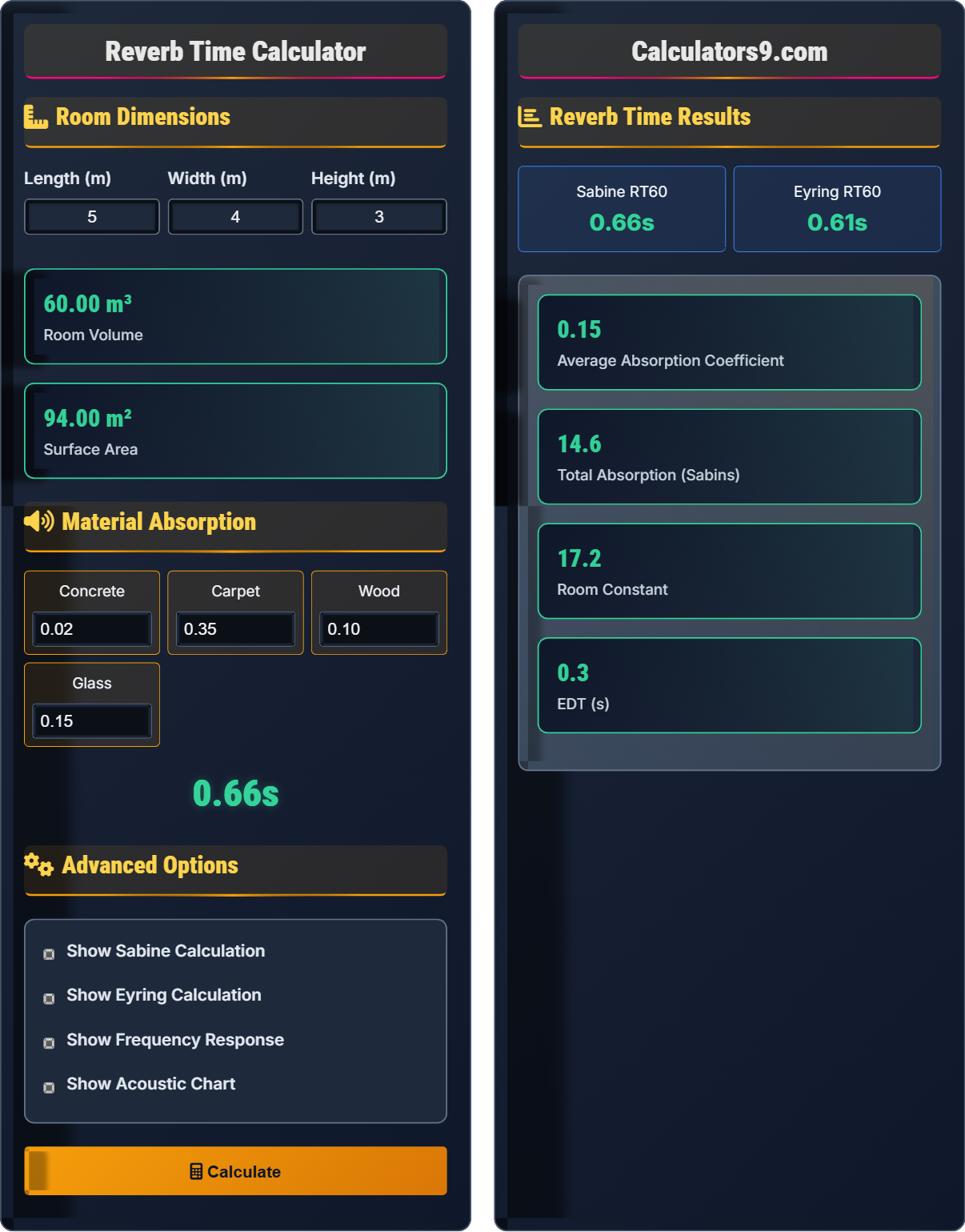
Reverb Time Calculator
RT60 calculator for room acoustics • Audio production tool
Sabine Formula:
Show Calculator\( RT60 = \frac{0.161 \times V}{S \times \alpha} \)
Where:
- \( RT60 \) = Reverberation time (seconds) to decay 60 dB
- \( V \) = Volume of the room (m³)
- \( S \) = Total surface area of the room (m²)
- \( \alpha \) = Average absorption coefficient
Eyring formula (more accurate for high absorption):
\( RT60 = \frac{0.161 \times V}{S \times \ln(\frac{1}{1-\alpha})} \)
These formulas are fundamental in architectural acoustics for predicting how long sound persists in a room after the source stops. RT60 values help determine if a room is suitable for speech, music, or recording.
Room Dimensions
Material Absorption
Advanced Options
Reverb Time Results
Reverberation Time Fundamentals
Reverberation time (RT60) is the time required for sound in a room to decay by 60 decibels after the sound source has stopped. It's a critical parameter in architectural acoustics that determines how "live" or "dead" a room sounds.
Sabine Formula: \( RT60 = \frac{0.161 \times V}{S \times \alpha} \)
Eyring Formula: \( RT60 = \frac{0.161 \times V}{S \times \ln(\frac{1}{1-\alpha})} \)
Where V is volume, S is surface area, and α is average absorption coefficient.
- Speech: RT60 0.3-0.6s (intimate conversation)
- Music: RT60 1.0-2.0s (depending on genre)
- Recording: RT60 0.2-0.4s (controlled environment)
- Higher absorption = shorter reverb time
Applications in Audio Production
RT60 calculations are essential for studio design, live room treatment, and determining optimal acoustic conditions for different recording scenarios.
- Control Room design
- Vocal booth setup
- Live room optimization
- Acoustic treatment planning
- Reverb simulation accuracy
- Frequency-dependent absorption varies by material
- Room geometry affects reverb distribution
- Occupancy changes absorption characteristics
- Humidity and temperature affect sound speed
Reverb Time Learning Quiz
What does RT60 represent in acoustics?
The answer is B) Time for sound to decay by 60 dB. RT60 stands for "Reverberation Time 60 dB" and measures how long it takes for sound energy in a room to decrease by 60 decibels after the sound source stops. This metric quantifies the "liveness" of a room's acoustics.
RT60 is fundamental to understanding room acoustics. The decay time is measured from the moment the sound stops until the residual sound drops to 1/1,000,000th of its original intensity (60 dB below the original level). This logarithmic scale matches human perception of loudness changes.
RT60: Reverberation time for 60 dB decay
Decibel (dB): Logarithmic unit measuring sound intensity
Reverberation: Persistence of sound in a space after source stops
• RT60 measures exponential decay of sound energy
• Lower RT60 = more absorbent/controlled room
• Higher RT60 = more reflective/lively room
• Remember: RT60 = Reverberation Time for 60 dB decay
• Think of it as the "echo duration" of a room
• RT60 is frequency-dependent in real rooms
• Confusing RT60 with echo delay time
• Thinking RT60 is a fixed value regardless of frequency
• Misunderstanding that RT60 measures decay, not propagation
Calculate the RT60 for a rectangular room that is 6m long, 4m wide, and 3m high with an average absorption coefficient of 0.20 using the Sabine formula. Show your work.
Using the Sabine formula: \( RT60 = \frac{0.161 \times V}{S \times \alpha} \)
Step 1: Calculate volume (V) = length × width × height = 6 × 4 × 3 = 72 m³
Step 2: Calculate surface area (S) = 2(l×w + l×h + w×h) = 2(6×4 + 6×3 + 4×3) = 2(24 + 18 + 12) = 2(54) = 108 m²
Step 3: Apply Sabine formula: \( RT60 = \frac{0.161 \times 72}{108 \times 0.20} = \frac{11.592}{21.6} \approx 0.54 \) seconds
Therefore, the RT60 for this room is approximately 0.54 seconds.
This calculation demonstrates the relationship between room dimensions, surface materials, and acoustic response. Notice how the absorption coefficient in the denominator makes RT60 inversely proportional to absorption—higher absorption leads to shorter reverb times.
Sabine Formula: Original reverberation time equation
Volume: Three-dimensional space measurement (m³)Surface Area: Total area of all room surfaces (m²)
• Volume calculation: length × width × height
• Surface area: 2(lw + lh + wh) for rectangular rooms
• Higher absorption coefficient = shorter RT60
• Remember the surface area formula: 2(lw + lh + wh)
• The 0.161 constant is for metric units
• Always double-check your unit conversions
• Forgetting to calculate total surface area correctly
• Using incorrect units (metric vs imperial)
• Misplacing decimal points in calculations
A recording engineer wants to design a vocal booth that has an RT60 of 0.4 seconds at 500 Hz. The booth will be 3m × 2.5m × 2.4m. What average absorption coefficient is needed to achieve this target?
Using the Sabine formula rearranged to solve for α: \( \alpha = \frac{0.161 \times V}{S \times RT60} \)
Step 1: Calculate volume (V) = 3 × 2.5 × 2.4 = 18 m³
Step 2: Calculate surface area (S) = 2(3×2.5 + 3×2.4 + 2.5×2.4) = 2(7.5 + 7.2 + 6) = 2(20.7) = 41.4 m²
Step 3: Apply formula: \( \alpha = \frac{0.161 \times 18}{41.4 \times 0.4} = \frac{2.898}{16.56} \approx 0.175 \)
Therefore, an average absorption coefficient of approximately 0.18 is needed.
This reverse calculation is common in acoustic design. By knowing the desired RT60 and room dimensions, we can determine the required absorption properties. This helps engineers specify appropriate materials for acoustic treatment.
Absorption Coefficient: Measure of how much sound a material absorbs (0-1)
Acoustic Treatment: Materials added to control room acoustics
Design Target: Desired acoustic parameter value
• Rearrange formulas to solve for unknown variables
• Absorption coefficient ranges from 0 (perfectly reflective) to 1 (perfectly absorptive)
• Higher absorption reduces RT60
• When designing for specific RT60, work backwards from the formula
• Combine materials with different absorption properties for desired average
• Consider frequency-specific absorption for critical applications
• Forgetting to rearrange the formula correctly
• Using incorrect surface area calculation
• Getting absorption coefficient values greater than 1
For a room with 80 m³ volume, 120 m² surface area, and average absorption coefficient of 0.35, calculate RT60 using both Sabine and Eyring formulas. Why might you choose one over the other?
Sabine Formula: \( RT60 = \frac{0.161 \times 80}{120 \times 0.35} = \frac{12.88}{42} \approx 0.307 \) seconds
Eyring Formula: \( RT60 = \frac{0.161 \times 80}{120 \times \ln(\frac{1}{1-0.35})} = \frac{12.88}{120 \times \ln(\frac{1}{0.65})} = \frac{12.88}{120 \times 0.431} = \frac{12.88}{51.69} \approx 0.249 \) seconds
The Sabine formula gives 0.307s, while the Eyring formula gives 0.249s. The Eyring formula is more accurate for rooms with higher absorption coefficients (α > 0.2), as it better models the non-linear relationship between absorption and reverb time.
The difference between formulas becomes significant with higher absorption coefficients. The Sabine formula assumes uniform sound distribution and linear absorption, while the Eyring formula accounts for non-uniform distribution and provides more accurate results for rooms with moderate to high absorption.
Sabine Formula: Original RT60 equation (accurate for low-medium absorption)
Eyring Formula: Modified equation (more accurate for higher absorption)
Sound Distribution: How evenly sound energy is spread in a room
• Use Sabine for absorption < 0.2
• Use Eyring for absorption > 0.2
• Both formulas assume diffuse sound field
• For rooms with carpets/wall panels, use Eyring formula
• For empty concrete rooms, Sabine is usually sufficient
• The difference increases with higher absorption values
• Using the wrong formula for the absorption level
• Forgetting to use natural logarithm in Eyring formula
• Not accounting for the non-linear relationship in high absorption rooms
Which RT60 range is most appropriate for a control room used in mixing music?
The answer is C) 0.2-0.4 seconds. Control rooms require neutral acoustics to allow engineers to make accurate judgments about the mix. Too much reverb would color the sound and make it difficult to assess the true tonal balance and spatial characteristics of the mix. This controlled environment ensures that what is heard in the control room translates well to other playback systems.
Control rooms are designed to be acoustically neutral, allowing engineers to hear the mix as it truly is without room coloration. The low RT60 ensures that early reflections don't interfere with direct sound, providing accurate monitoring conditions. This is different from live rooms designed for recording, which may have longer RT60 values.
Control Room: Acoustically treated space for audio mixing/mastering
Neutral Acoustics: Minimal room coloration for accurate monitoring
Translation: How well a mix sounds on different systems
• Control rooms: Low RT60 (0.2-0.4s) for neutrality
• Live rooms: Higher RT60 (1.0-2.0s) for musical ambiance
• Speech: Medium RT60 (0.3-0.6s) for clarity
• Control rooms prioritize accuracy over musicality
• Use variable acoustics for versatility when possible
• Consider speaker placement in relation to room RT60
• Designing control rooms with too much reverb
• Confusing live room and control room acoustic requirements
• Not considering the impact of RT60 on mix translation
FAQ
Q: What's the difference between RT60 and EDT (Early Decay Time)?
A: RT60 measures the time for sound to decay 60 dB from the initial level, while EDT measures the decay time from the initial level to -10 dB. The relationship is: \( EDT = \frac{-60}{\text{slope from 0 to -10 dB}} \times \text{time for 60 dB decay} \).
EDT is considered more representative of human perception because our hearing is more sensitive to early reflections. In a perfect diffuse field, EDT ≈ RT60, but in real rooms with distinct reflections, EDT can differ significantly from RT60. EDT is particularly important for concert halls and performance spaces.
Q: How does RT60 vary with frequency and why does this matter?
A: RT60 typically varies with frequency because absorption coefficients of materials are frequency-dependent. High frequencies are absorbed more readily than low frequencies, leading to longer low-frequency RT60 values.
For example, in a typical room: 125 Hz RT60 might be 1.8s, while 4 kHz RT60 might be 0.8s. This matters because:
- Speech intelligibility depends heavily on mid-frequency RT60 (500 Hz - 2 kHz)
- Music mixing requires balanced RT60 across the spectrum
- Low-frequency build-up can cause muddiness
- High-frequency absorption affects brightness and clarity
Professional measurements are taken at multiple frequencies (125, 250, 500, 1k, 2k, 4k Hz) to characterize the full acoustic response.