Sample Rate Calculator
Nyquist theorem and bandwidth calculator • Audio production tool
Nyquist-Shannon Sampling Theorem:
Show Calculator\( f_s > 2 \times f_{max} \)
Where:
- \( f_s \) = Sampling frequency (sample rate)
- \( f_{max} \) = Maximum frequency in the signal
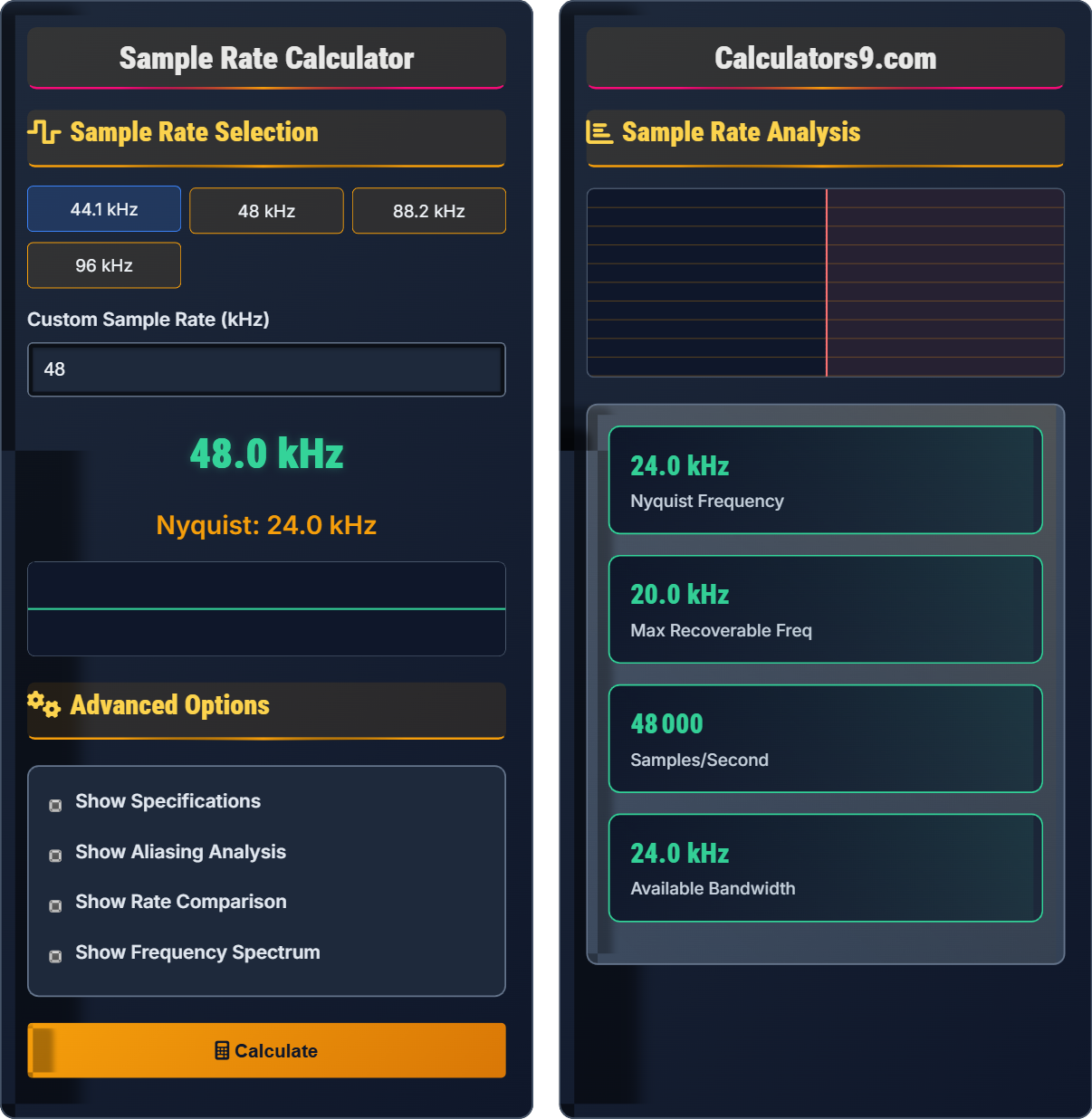
The Nyquist-Shannon theorem states that to accurately reconstruct a signal, the sampling rate must be greater than twice the highest frequency component. The Nyquist frequency (half the sample rate) represents the theoretical maximum frequency that can be captured without aliasing.
Sample Rate Selection
Advanced Options
Sample Rate Analysis
Sample Rate Fundamentals
Sample rate is the number of samples of audio carried per second, measured in Hertz (Hz) or kilohertz (kHz). It determines the frequency range that can be accurately captured and reproduced in digital audio systems.
\( f_s > 2 \times f_{max} \)
The sampling rate must be greater than twice the highest frequency component in the signal to avoid aliasing. The Nyquist frequency is half the sample rate: \( f_N = \frac{f_s}{2} \)
- Sample rate must exceed 2× highest frequency
- Human hearing: 20 Hz - 20 kHz
- CD standard: 44.1 kHz (Nyquist: 22.05 kHz)
- Anti-aliasing filters prevent higher frequencies
Applications in Audio Production
Sample rate selection affects the entire audio production chain, from recording to distribution. Different rates are optimal for various applications and workflows.
- 44.1 kHz: CD distribution
- 48 kHz: Video production, DVD
- 88.2/96 kHz: High-resolution recording
- 176.4/192 kHz: Ultra-high resolution
- 192 kHz: Professional mastering
- Higher rates require more storage/bandwidth
- Conversion may introduce artifacts
- Consider delivery format requirements
- Equipment limitations may apply
Sample Rate Learning Quiz
According to the Nyquist-Shannon sampling theorem, what is the minimum sample rate required to accurately reproduce a 20 kHz signal?
The answer is C) 40 kHz. According to the Nyquist-Shannon theorem: \( f_s > 2 \times f_{max} \)
For a 20 kHz signal: \( f_s > 2 \times 20,000 = 40,000 \) Hz
Therefore, the minimum sample rate must be greater than 40 kHz. This is why CD quality uses 44.1 kHz, which provides a safety margin above the theoretical minimum.
The Nyquist theorem is fundamental to digital signal processing. It establishes the minimum sampling rate required to avoid aliasing. In practice, engineers use rates higher than the theoretical minimum to accommodate anti-aliasing filter rolloff and provide a safety margin.
Nyquist Theorem: Minimum sampling rate requirement
Aliasing: Distortion from undersampling
Anti-aliasing Filter: Prevents frequencies above Nyquist
• Sample rate > 2 × max frequency
• Human hearing extends to 20 kHz
• Practical rates include safety margins
• Remember: Need to sample faster than signal changes
• 44.1 kHz covers human hearing with margin
• Higher rates capture ultrasonic content
• Using exactly 2× the max frequency (need > 2×)
• Confusing sample rate with bit depth
• Not accounting for filter rolloff requirements
Calculate the Nyquist frequency and available bandwidth for a 96 kHz sample rate. Show your work.
The Nyquist frequency is half the sample rate:
\( f_N = \frac{f_s}{2} \)
For 96 kHz: \( f_N = \frac{96,000}{2} = 48,000 \) Hz = 48 kHz
The available bandwidth for audio signals is from DC (0 Hz) to the Nyquist frequency:
Bandwidth = 48 kHz
Therefore, the Nyquist frequency is 48 kHz and the available bandwidth is 48 kHz.
The Nyquist frequency represents the theoretical maximum frequency that can be accurately captured without aliasing. For 96 kHz sampling, frequencies up to 48 kHz can be represented. This provides ample headroom above human hearing range (20 Hz - 20 kHz).
Nyquist Frequency: Half the sample rate
Bandwidth: Usable frequency range
Aliasing: Frequency folding due to undersampling
• Nyquist = Sample Rate ÷ 2
• Available bandwidth = Nyquist frequency
• Anti-aliasing filters protect against higher frequencies
• Nyquist is always half the sample rate
• Higher rates provide wider bandwidth
• Consider human hearing when selecting rates
• Forgetting to divide by 2 for Nyquist calculation
• Confusing bandwidth with sample rate
• Not considering filter rolloff in practical applications
A recording engineer wants to capture a piano performance that produces harmonics up to 18 kHz. What sample rate should be used to avoid aliasing? Include a safety margin for the anti-aliasing filter.
Step 1: Apply Nyquist theorem
Minimum sample rate = 2 × 18,000 Hz = 36,000 Hz = 36 kHz
Step 2: Add safety margin for anti-aliasing filter
Anti-aliasing filters need transition band (rolloff region)
Practical sample rate should be significantly higher than minimum
Standard options: 44.1 kHz (CD), 48 kHz (professional video)
Either 44.1 kHz or 48 kHz would be appropriate, with 48 kHz providing more headroom.
For high-quality recording, 88.2 kHz or 96 kHz would provide even more headroom.
This problem demonstrates the practical application of the Nyquist theorem. While the theoretical minimum is 36 kHz, real-world systems need additional margin for filter rolloff. Anti-aliasing filters cannot instantaneously cut off frequencies at the Nyquist limit, so additional headroom is required.
Harmonics: Integer multiples of fundamental frequency
Transition Band: Filter rolloff region
Safety Margin: Extra range beyond theoretical minimum
• Always include margin for filter rolloff
• Consider the entire signal spectrum
• Use standard rates when possible
• Double the highest frequency as starting point
• Add 10-20% margin for filters
• Consider future-proofing with higher rates
• Using only the theoretical minimum
• Not accounting for anti-aliasing filter requirements
• Ignoring harmonic content beyond fundamental
A mastering engineer has recorded a session at 96 kHz but needs to deliver a CD-quality master at 44.1 kHz. What precautions should be taken during the down-sampling process to maintain audio quality?
Step 1: Apply low-pass filter before down-sampling
Remove frequencies above 22.05 kHz (half of 44.1 kHz) to prevent aliasing
Step 2: Use high-quality resampling algorithm
Employ steep anti-aliasing filters and interpolation algorithms
Step 3: Consider dithering
Add low-level noise to prevent quantization artifacts
Step 4: Verify frequency response
Check that no aliasing products remain in the audible spectrum
Proper down-sampling preserves the quality of the original while ensuring compatibility with the target format.
Down-sampling requires careful attention to prevent aliasing. When reducing sample rate, the new Nyquist frequency is lower, so higher frequencies must be removed before the conversion. This is why professional sample rate conversion tools use sophisticated filtering and interpolation algorithms.
Down-sampling: Reducing sample rate
Resampling: Changing sample rate with processing
Dithering: Adding noise to reduce quantization artifacts
• Always filter before down-sampling
• Use high-quality conversion algorithms
• Verify results with spectrum analysis
• Use professional sample rate conversion tools
• Apply anti-aliasing filter before conversion
• Consider leaving headroom in final master
• Down-sampling without filtering (causes aliasing)
• Using poor-quality conversion algorithms
• Not verifying the final frequency response
Why is 44.1 kHz the standard sample rate for CDs?
The answer is B) It provides safety margin above human hearing. The human hearing range extends to approximately 20 kHz, so the Nyquist frequency needs to exceed this. 44.1 kHz gives a Nyquist frequency of 22.05 kHz, providing a comfortable margin above the 20 kHz upper limit of human hearing. This allows for practical anti-aliasing filter design with adequate rolloff.
The 44.1 kHz standard was chosen to satisfy the Nyquist criterion while providing practical headroom for anti-aliasing filters. The 2.05 kHz margin above the human hearing limit allows for gradual filter rolloff rather than an impractical brick-wall filter.
Human Hearing: 20 Hz - 20 kHz range
Anti-aliasing Filter: Prevents frequencies above Nyquist
Brick-wall Filter: Infinite slope filter (impractical)
• Sample rate must exceed 2× max audible frequency
• Include margin for filter rolloff
• 44.1 kHz covers hearing range with safety margin
• 44.1 kHz is sufficient for human hearing
• 48 kHz is common in video production
• Higher rates capture ultrasonic content
• Thinking 44.1 kHz is exactly at Nyquist for 20 kHz
• Not understanding the role of filter rolloff
• Assuming higher rates always mean better audible quality
FAQ
Q: What are the advantages and disadvantages of recording at higher sample rates like 96 kHz?
A: Advantages of higher sample rates:
- Greater bandwidth for ultrasonic content
- More headroom for processing before aliasing
- Less stringent anti-aliasing filter requirements
- Potential for better transient response
Disadvantages:
- Double the file size compared to 48 kHz
- Higher CPU and storage requirements
- No audible benefit for most content
- Compatibility issues with some older equipment
For most applications, 48 kHz is sufficient. 96 kHz is beneficial for high-frequency content like cymbals or when extensive processing is planned.
Q: What happens if I try to sample a 30 kHz signal with a 44.1 kHz sample rate?
A: According to the Nyquist theorem, a 44.1 kHz sample rate has a Nyquist frequency of 22.05 kHz. Attempting to sample a 30 kHz signal would result in aliasing.
The 30 kHz signal would fold back into the audible spectrum as an aliased frequency at: \( f_{alias} = |f_s - f_{input}| = |44.1 - 30| = 14.1 \) kHz.
This aliased signal would appear as a false 14.1 kHz tone in the digital output, causing distortion. This is why anti-aliasing filters are placed before the ADC to remove frequencies above the Nyquist limit.