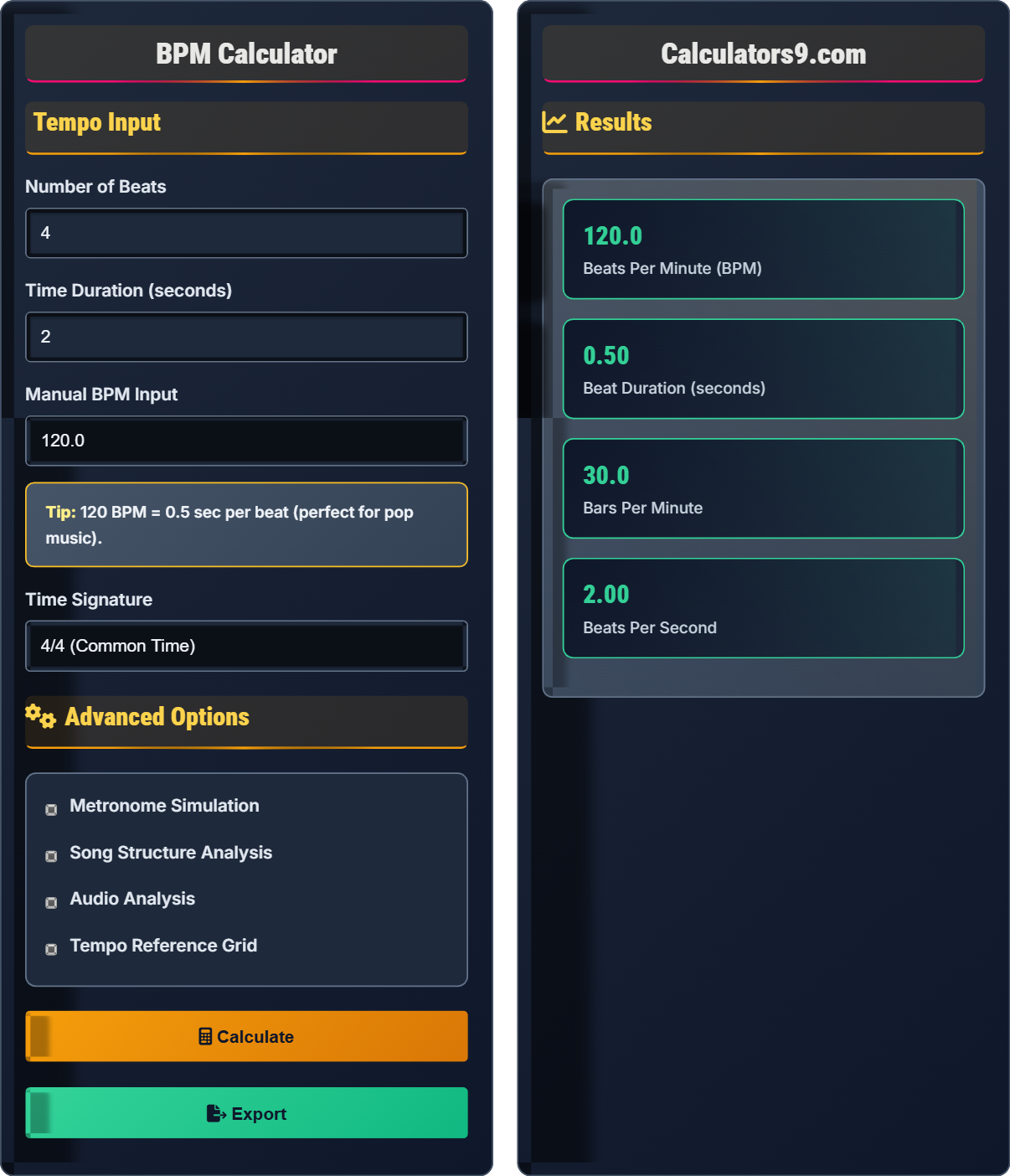
BPM Calculator
Music tempo calculator • 2026 audio tools
BPM Calculation Formula:
Show the calculator\( \text{BPM} = \frac{60}{\text{Beat Duration (seconds)}} \)
Where:
- \( \text{BPM} \) = Beats Per Minute
- \( 60 \) = Seconds in a minute
- \( \text{Beat Duration} \) = Time interval between beats in seconds
Alternatively, to find beat duration from BPM:
\( \text{Beat Duration} = \frac{60}{\text{BPM}} \)
This formula is fundamental in music production for determining tempo and timing relationships.
Example: For a song at 120 BPM:
Beat Duration = \( \frac{60}{120} = 0.5 \) seconds per beat
Thus, each beat occurs every 0.5 seconds.
Tempo Input
Advanced Options
Results
Comprehensive Music Production Guide
Beats Per Minute (BPM) is a unit of measurement for tempo in music, indicating the number of beats that occur in one minute. It's fundamental to music production, performance, and analysis. BPM determines the speed or pace of a piece of music and is crucial for synchronization in recording, mixing, and live performance.
The BPM calculation uses the relationship between time and beats:
Where:
- \(BPM\) = Beats Per Minute
- \(\text{Beat Duration}\) = Time between beats in seconds
- \(\text{Beats}\) = Count of beats in measured time
- \(\text{Time}\) = Duration in seconds
- Death Metal: 180-220+ BPM (very fast)
- House Music: 120-130 BPM (perfect for dancing)
- Pop Music: 100-130 BPM (catchy and accessible)
- Hip-Hop: 80-110 BPM (groove-focused)
- Classical: 40-200+ BPM (varies by composition)
- Syncopation: Off-beat rhythms that create groove
- Time Stretching: Changing tempo without affecting pitch
- Quantization: Aligning notes to grid based on tempo
- Tempo Maps: Changes in BPM throughout a song
- Sidechaining: Ducking bass when kick drum hits
BPM Fundamentals
Beats Per Minute - tempo measurement in music.
\(BPM = \frac{60}{\text{Beat Duration}}\)
Where BPM=beats per minute, Duration=time per beat in seconds.
- Higher BPM = faster tempo
- Standard for dance music: 120-140 BPM
- 4/4 time signature = 4 beats per bar
Production Tips
Emphasizing weak beats to create rhythmic interest.
- Count beats in measured time
- Calculate BPM using formula
- Apply to DAW grid settings
- Adjust for musical feel
- Human timing has natural variations
- Some genres benefit from "loose" timing
- Tempo affects emotional impact
Music Theory Learning Quiz
What does BPM stand for in music production?
The answer is B) Beats Per Minute. BPM stands for Beats Per Minute, which is the standard unit for measuring tempo in music. It indicates how many beats occur in one minute of time. For example, a song at 120 BPM has 120 beats occurring in one minute, which means each beat occurs every 0.5 seconds.
Understanding BPM is fundamental to music production and performance. It's the primary way musicians and producers communicate tempo. The "minute" part of BPM is important because it provides a consistent time reference regardless of the length of the piece. This standardization allows musicians worldwide to play together and producers to set timing parameters accurately.
BPM: Beats Per Minute - tempo measurement
Beat: Basic unit of musical time
Tempo: Speed or pace of music
• BPM measures the frequency of beats per minute
• Higher BPM means faster tempo
• Standard metronome settings use BPM
• Remember: B-P-M = Beats Per Minute
• Use 120 BPM as reference point (common for pop music)
• Confusing BPM with BPS (Beats Per Second)
• Mixing up beats with bars
If a song has a beat duration of 0.75 seconds, what is the BPM? Use the formula BPM = 60/beat duration. Show your work.
Using the BPM formula: \(BPM = \frac{60}{\text{Beat Duration}}\)
Given:
- Beat Duration = 0.75 seconds
Step 1: Apply the formula
BPM = 60 ÷ 0.75
Step 2: Calculate
BPM = 80
Therefore, a song with a beat duration of 0.75 seconds has a tempo of 80 BPM.
This calculation shows the inverse relationship between beat duration and BPM. As the time between beats increases (longer duration), the BPM decreases (slower tempo). Conversely, as beats occur closer together (shorter duration), the BPM increases (faster tempo). This relationship is crucial for understanding how tempo affects the feel of music.
Beat Duration: Time interval between consecutive beats
Inverse Relationship: As one value increases, the other decreases
Tempo Calculation: Mathematical determination of musical speed
• BPM and beat duration are inversely proportional
• Use the formula BPM = 60/beat_duration
• Always verify calculations with reasonable expectations
• Remember: BPM = 60 ÷ seconds_per_beat
• For quick estimates: 60/BPM gives seconds per beat
• Use 120 BPM as a reference (0.5 seconds per beat)
• Dividing by 60 instead of dividing 60 by the duration
• Confusing multiplication with division in the formula
• Forgetting to include units in calculations
A song is played at 140 BPM. If the song has 16 bars in 4/4 time signature, how long does this section last in seconds? Remember that 4/4 time has 4 beats per bar.
Step 1: Calculate total number of beats
16 bars × 4 beats per bar = 64 beats
Step 2: Calculate time per beat
Time per beat = 60 seconds ÷ 140 BPM = 0.4286 seconds per beat
Step 3: Calculate total time
Total time = 64 beats × 0.4286 seconds per beat = 27.43 seconds
Therefore, 16 bars at 140 BPM in 4/4 time lasts approximately 27.43 seconds.
This problem combines multiple concepts: time signatures, BPM, and musical structure. Understanding how many beats are in each bar (based on time signature) is crucial for calculating song timing. This knowledge is essential for producers when planning song structures, arranging sections, and synchronizing with other tracks.
Time Signature: Indicates beats per bar (e.g., 4/4 = 4 beats per bar)
Bar: Basic unit of musical time containing a specific number of beats
Beat: Basic pulse of music
• First calculate total beats: bars × beats_per_bar
• Then calculate time: total_beats × seconds_per_beat
• Always consider the time signature
• Count total beats first, then apply tempo
• Remember: 4/4 = 4 beats per bar
• Use: Total time = (beats × 60) ÷ BPM
• Forgetting to account for time signature (assuming 1 beat per bar)
• Calculating seconds per beat incorrectly
• Arithmetic errors with decimals
A DJ wants to mix two songs: Song A at 128 BPM and Song B at 132 BPM. If both songs are in 4/4 time, how many bars of Song A will equal the same time duration as 32 bars of Song B? This is important for harmonic mixing.
Step 1: Calculate time for 32 bars of Song B
32 bars × 4 beats/bar = 128 beats
Time per beat for Song B = 60 ÷ 132 = 0.4545 seconds per beat
Total time = 128 beats × 0.4545 seconds = 58.18 seconds
Step 2: Calculate how many bars of Song A fit in 58.18 seconds
Time per beat for Song A = 60 ÷ 128 = 0.46875 seconds per beat
Time per bar of Song A = 4 beats/bar × 0.46875 seconds = 1.875 seconds per bar
Number of bars of Song A = 58.18 ÷ 1.875 = 31.03 bars
Therefore, approximately 31 bars of Song A equal the time duration of 32 bars of Song B.
This demonstrates the importance of tempo matching in DJing and music production. When mixing songs at different tempos, DJs need to calculate timing relationships to ensure smooth transitions. The slight difference in tempo (128 vs 132 BPM) results in a significant timing difference over longer sections, which affects the mixing strategy.
DJ Mixing: Transitioning between tracks while maintaining rhythm
Harmonic Mixing: Combining tracks with compatible keys and tempos
Beat Matching: Aligning beats of different tracks
• Calculate total time first, then convert to other song's timing
• Consider both BPM and time signature
• Small tempo differences accumulate over time
• Use: Bars_A = (Bars_B × BPM_B) ÷ BPM_A
• Crossfade timing depends on tempo differences
• BPM differences become more significant over longer sections
• Assuming equal bars equal equal time (ignoring tempo differences)
• Forgetting to account for time signature in calculations
• Not verifying that the answer makes sense
Which of the following best describes the relationship between BPM and the perceived energy of a song?
The answer is C) Higher BPM generally correlates with higher perceived energy. While there are exceptions based on genre, instrumentation, and arrangement, faster tempos typically create a sense of urgency, excitement, and energy. For example, death metal at 200+ BPM feels intense, while ballads at 60 BPM feel calm.
However, energy is also influenced by dynamics, harmony, melody, and arrangement, so BPM is not the only factor.
While BPM is a primary factor in perceived energy, it works in conjunction with other musical elements. The correlation is strong enough that producers and DJs use tempo as a tool for controlling the energy of a performance or playlist. However, context matters - a fast tempo in a minor key with sparse arrangement might feel tense rather than energetic.
Perceived Energy: Subjective feeling of intensity in music
Dynamics: Variation in loudness and intensity
Arrangement: Organization of instruments and sounds
• Higher BPM generally increases perceived energy
• Other factors also influence energy perception
• Genre context affects the relationship
• Use BPM as a starting point for energy planning
• Consider the entire musical context, not just tempo
• Different genres have different BPM-energy relationships
• Assuming BPM is the only factor in perceived energy
• Ignoring genre-specific tempo conventions
• Not considering cultural differences in tempo perception
FAQ
Q: How do I calculate BPM if I only know the time between beats?
A: To calculate BPM from the time between beats, use the formula:
\( \text{BPM} = \frac{60}{\text{Time Between Beats (seconds)}} \)
For example, if you measure 0.5 seconds between beats:
\( \text{BPM} = \frac{60}{0.5} = 120 \text{ BPM} \)
This is the fundamental relationship in music: BPM represents how many 60-second intervals fit into the time between beats. The faster the tempo (higher BPM), the shorter the time between beats.
Q: What's the difference between BPM and Hz in music?
A: BPM (Beats Per Minute) and Hz (Hertz) measure different aspects of music:
- BPM: Measures tempo - how many beats occur per minute. Example: 120 BPM = 120 beats in 60 seconds
- Hz: Measures frequency - how many cycles per second. Example: A4 note = 440 Hz = 440 cycles per second
They can be related mathematically: If a song is at 120 BPM, that's 2 beats per second, which could be thought of as 2 Hz for the pulse. However, BPM is the standard unit for musical tempo, while Hz is used for pitch and frequencies.