Event Ticket Pricing Calculator
Optimize charity fundraiser revenue • 2026 metrics
Event Ticket Pricing Formula:
\( T = \frac{Total\ Costs + Desired\ Profit}{Expected\ Attendance \times (1 - Discount\ Rate)} \)
Where:
- \( T \) = Ticket Price
- \( Total\ Costs \) = All event expenses (venue, catering, entertainment, etc.)
- \( Desired\ Profit \) = Target revenue above costs
- \( Expected\ Attendance \) = Estimated number of attendees
- \( Discount\ Rate \) = Percentage of tickets offered at reduced rates
For nonprofits, the formula is often simplified to cover costs and achieve fundraising goals:
\( T = \frac{Total\ Costs + Fundraising\ Goal}{Expected\ Attendance} \)
Example: If an event has $10,000 in costs, a $5,000 fundraising goal, and expects 200 attendees:
\( T = \frac{\$10{,}000 + \$5{,}000}{200} = \frac{\$15{,}000}{200} = \$75 \)
Thus, tickets should be priced at $75 each to meet the goal.
Event Details
Advanced Options
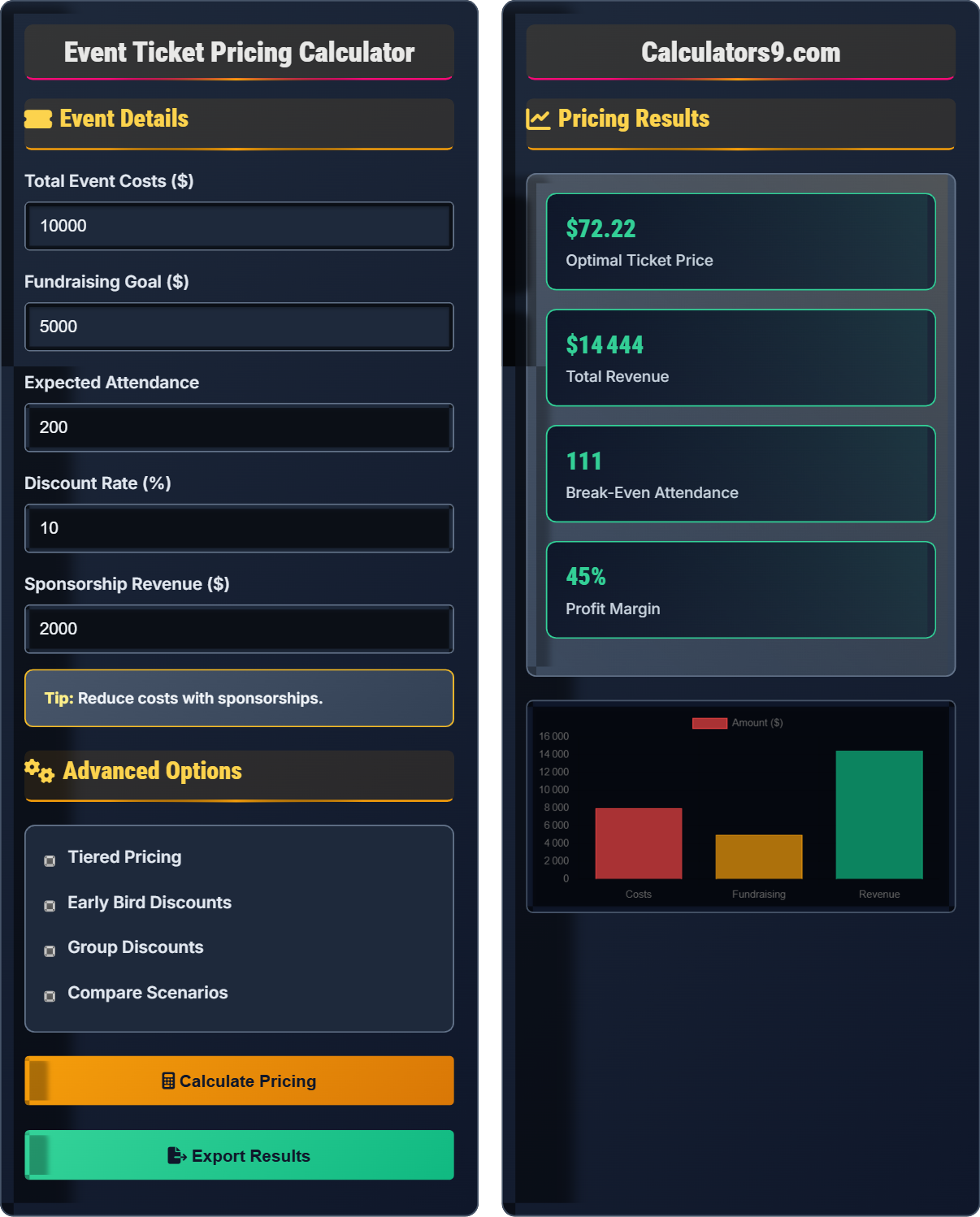
Pricing Results
| Metrics | Value |
|---|---|
| Base Price | $75.00 |
| Expected Revenue | $15,000 |
| Total Costs | $10,000 |
| Profit | $5,000 |
| Category | Amount | Percentage |
|---|
Event Ticket Pricing Guide
Event ticket pricing is the strategic determination of admission fees for nonprofit fundraisers, balancing affordability for supporters with the need to cover costs and achieve fundraising goals. Effective pricing considers the target audience, event type, local market conditions, and organizational mission.
The fundamental event ticket pricing calculation uses the following formula:
Where:
- \(T\) = Ticket Price
- \(Total\ Costs\) = All event expenses (venue, catering, entertainment, etc.)
- \(Fundraising\ Goal\) = Target revenue above costs
- \(Expected\ Attendance\) = Estimated number of attendees
- \(Discount\ Rate\) = Percentage of tickets offered at reduced rates
Essential metrics to track for effective event pricing:
- Break-Even Attendance: Minimum number of tickets needed to cover costs
- Price Elasticity: How attendance changes with price adjustments
- Revenue Per Attendee: Average revenue generated per person
- Profit Margin: Percentage of revenue that becomes profit
- Registration Conversion Rate: Percentage of interested to actual attendees
- Research Your Market: Understand what supporters can afford
- Offer Multiple Options: Provide various price points to maximize attendance
- Consider Timing: Early bird pricing can boost registration
- Factor in Sponsors: Sponsorships can reduce ticket prices
- Communicate Value: Clearly explain what ticket includes
Event Ticket Pricing Learning Quiz
If an event has $12,000 in costs and tickets are priced at $60 each, how many tickets must be sold to break even?
Break-Even Attendance = Total Costs ÷ Ticket Price
Break-Even Attendance = $12,000 ÷ $60 = 200
The answer is B) 200.
Break-even analysis is fundamental to event pricing. It tells you the minimum number of tickets you need to sell to cover all costs. This calculation assumes all tickets are sold at the same price. In practice, you'll likely have different ticket types and discount rates, which would modify this calculation.
Break-Even Point: The number of units sold where total revenue equals total costs
Fixed Costs: Expenses that don't change with attendance (venue, entertainment)
Variable Costs: Expenses that change with attendance (food, materials)
• Break-Even = Total Costs ÷ Ticket Price
• Plan to sell more than break-even for profit
• Consider different ticket types in calculations
• Always plan for lower than expected attendance
• Set realistic pricing based on your audience
• Include buffer for unexpected costs
• Forgetting to include all event costs in the calculation
• Not accounting for complimentary tickets
• Setting unrealistic attendance expectations
If an event has $15,000 in costs and expects $3,000 in sponsorships, how does this affect the ticket price needed to achieve a $5,000 fundraising goal with 200 attendees?
Without sponsorships:
Ticket Price = ($15,000 + $5,000) ÷ 200 = $20,000 ÷ 200 = $100
With sponsorships:
Net Costs = $15,000 - $3,000 = $12,000
Ticket Price = ($12,000 + $5,000) ÷ 200 = $17,000 ÷ 200 = $85
Sponsorships reduce the ticket price from $100 to $85, making the event more accessible.
This example demonstrates how sponsorships directly reduce the burden on ticket buyers. For every dollar in sponsorships, you need $1 less in ticket revenue to meet your goals. This makes events more affordable for supporters while still achieving fundraising targets.
Sponsorship Revenue: Funds provided by businesses in exchange for promotional benefits
Net Costs: Total costs minus any outside funding received
Cost-Sharing: Distributing event costs among multiple funding sources
• Subtract sponsorships from total costs before pricing
• Communicate sponsorship benefits clearly
• Ensure sponsorships align with mission
• Develop tiered sponsorship packages
• Leverage existing corporate relationships
• Offer non-monetary benefits to sponsors
• Not accounting for sponsorships in pricing calculations
• Overpromising benefits to sponsors
• Failing to secure sponsorships before setting prices
A charity gala has 200 expected attendees and $10,000 in costs. They want to raise $5,000. If they offer 150 general admission tickets at $60 and 50 VIP tickets at a higher price, what should the VIP ticket price be to meet their goal?
Required Revenue = $10,000 + $5,000 = $15,000
General Admission Revenue = 150 × $60 = $9,000
VIP Revenue Needed = $15,000 - $9,000 = $6,000
VIP Ticket Price = $6,000 ÷ 50 = $120
The VIP tickets should be priced at $120 each to meet the fundraising goal.
This example demonstrates how tiered pricing allows organizations to offer different price points while meeting overall revenue goals. The general admission price is set at an accessible level, while VIP tickets provide additional revenue from supporters willing to pay more. This strategy maximizes both accessibility and revenue potential.
Tiered Pricing: Offering multiple ticket types at different price points
Price Discrimination: Charging different prices based on willingness to pay
Value Proposition: Benefits offered at each price tier
• Ensure each tier offers distinct value
• Price tiers should reflect actual value differences
• Calculate total revenue across all tiers
• Offer meaningful differences between tiers
• Limit availability of premium tiers to create scarcity
• Clearly communicate tier benefits
• Not offering enough value difference between tiers
• Pricing tiers too close together
• Failing to calculate total revenue across all tiers
An organization plans an event with 300 expected attendees at $75 per ticket. They expect 40% to register early. If they offer a 20% early bird discount, what is the impact on total revenue compared to a flat $75 price for all tickets?
Early Registrants: 300 × 40% = 120 people
Regular Registrants: 300 - 120 = 180 people
Early Bird Price: $75 × (1 - 0.20) = $75 × 0.80 = $60
Revenue with Early Bird: (120 × $60) + (180 × $75) = $7,200 + $13,500 = $20,700
Revenue without Early Bird: 300 × $75 = $22,500
Revenue Difference: $20,700 - $22,500 = -$1,800
The early bird pricing reduces revenue by $1,800, but may increase registration volume.
This demonstrates the trade-off in early bird pricing: lower per-ticket revenue in exchange for increased registration certainty and cash flow. While this example shows a revenue decrease, early bird pricing often increases total attendance, which can offset the per-ticket discount. The key is ensuring that increased volume compensates for lower prices.
Early Bird Pricing: Reduced prices for advance registration
Price Elasticity: How demand changes with price changes
Registration Conversion: Percentage who commit to attend
• Calculate the trade-off between volume and price
• Ensure early bird increases net attendance
• Set early bird deadline strategically
• Test different early bird discounts
• Set deadlines far enough in advance
• Bundle early bird with other incentives
• Not measuring whether early bird increases total attendance
• Offering discounts too deep, hurting revenue
• Setting early bird deadlines too close to event
Which pricing strategy is most effective for increasing attendance at charity events?
The answer is D) All of the above. Each strategy has proven effectiveness in different contexts: odd pricing creates perception of lower cost, charm pricing sets psychological thresholds, and anchoring with premium tiers makes mid-tier options appear more reasonable. The most effective approach combines multiple strategies tailored to your audience.
Pricing psychology significantly impacts charitable giving. People make emotional decisions about donating, and pricing strategies can influence their willingness to participate. Odd pricing ($79.99) makes prices seem lower, charm pricing ($75) sets mental thresholds, and anchoring (showing high options first) makes middle options seem reasonable. For nonprofits, these strategies help balance mission accessibility with revenue needs.
Pricing Psychology: How pricing affects consumer behavior
Anchoring Effect: First presented option influences perception of others
Charm Pricing: Ending prices in 5 or 9 for psychological effect
• Test pricing strategies with your audience
• Align pricing with mission values
• Communicate value clearly regardless of price
• A/B test different pricing strategies
• Survey your supporters about price sensitivity
• Emphasize mission impact over cost
• Ignoring psychological pricing principles
• Setting prices without understanding audience
• Failing to communicate value behind prices
Pricing Metrics
Minimum tickets needed to cover all event costs.
\(Break\ Even = \frac{Total\ Costs}{Ticket\ Price}\)
Where Break Even=attendees needed, Total Costs=all expenses, Ticket Price=admission fee.
- Plan for 10-20% below expected attendance
- Consider all costs including hidden expenses
- Factor in sponsorships and donations
Best Practices
Combine multiple approaches for optimal results.
- Research competitor pricing
- Survey your audience
- Offer multiple tiers
- Test and optimize
- Break-even: 70-80% of expected attendance
- Profit margin: 20-30%
- Early bird: 10-20% discount
- Group discount: 5-15%
FAQ
Q: How do I determine the right ticket price for my charity event?
A: Determining the right ticket price involves balancing several factors:
- Cost Coverage: \( Ticket\ Price = \frac{Total\ Costs + Fundraising\ Goal}{Expected\ Attendance} \)
- Market Research: Compare with similar events in your area
- Audience Analysis: Consider your supporters' financial capacity
- Value Perception: What benefits does the event provide?
For example, if your event costs \( C = \$12{,}000 \), you want to raise \( G = \$3{,}000 \), and expect \( A = 200 \) attendees:
\( T = \frac{C + G}{A} = \frac{\$12{,}000 + \$3{,}000}{200} = \frac{\$15{,}000}{200} = \$75 \)
This gives you a baseline of $75 per ticket, which you can then adjust based on market conditions and audience capacity.
Q: Should we offer different pricing tiers for our charity event?
A: Yes, tiered pricing is highly recommended for charity events. It increases accessibility while maximizing revenue:
- General Admission: Affordable option for broad participation
- Sponsor Level: Higher price with recognition benefits
- VIP Experience: Premium price with exclusive access
For example, you might structure as follows:
- General: $75 (60% of attendees)
- Sponsor: $150 (30% of attendees)
- VIP: $300 (10% of attendees)
This approach can increase average revenue per attendee while maintaining accessibility for supporters at all economic levels.