Fundraising ROI Calculator
Measure campaign performance • 2026 metrics
Fundraising ROI Formula:
\( ROI = \frac{Total\ Revenue - Total\ Costs}{Total\ Costs} \times 100 \)
Where:
- \( ROI \) = Return on Investment percentage
- \( Total\ Revenue \) = Total donations received
- \( Total\ Costs \) = All campaign expenses including staff, marketing, events, etc.
This formula calculates the percentage return on investment for a fundraising campaign, showing how much profit is generated for each dollar spent.
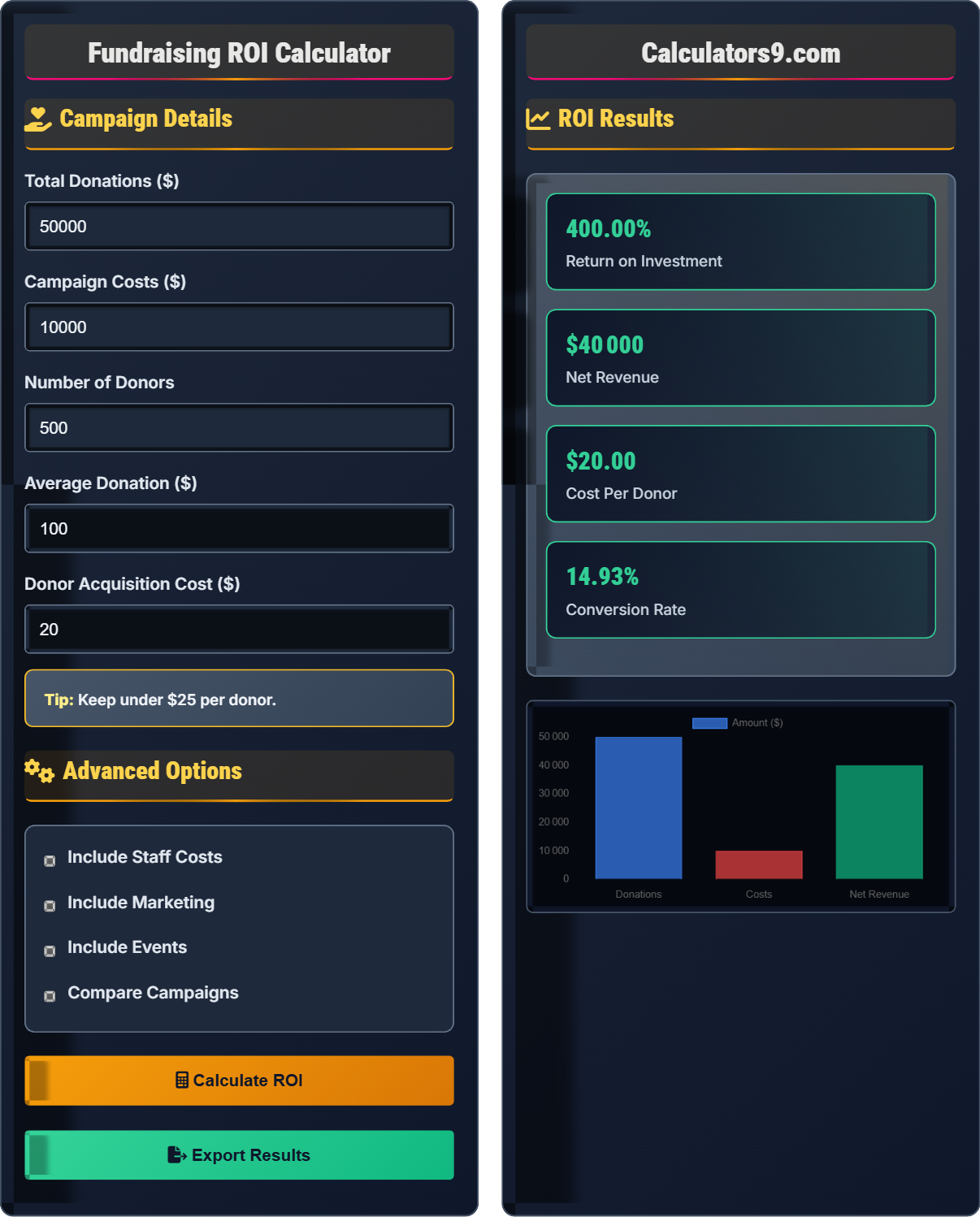
Example: If a campaign generates \( \$50{,}000 \) in donations with \( \$10{,}000 \) in costs:
\( ROI = \frac{50{,}000 - 10{,}000}{10{,}000} \times 100 = 400\% \)
Thus, the fundraiser achieved a 400% ROI, generating $4 in revenue for every $1 spent.
Campaign Details
Advanced Options
ROI Results
| Metrics | Value |
|---|---|
| Total Donations | $50,000 |
| Total Costs | $10,000 |
| Net Revenue | $40,000 |
| ROI | 400% |
| Category | Amount | Percentage |
|---|
Fundraising ROI Guide
Fundraising ROI (Return on Investment) measures the efficiency of a fundraising campaign by comparing the revenue generated to the costs incurred. It's a critical metric for nonprofit organizations to evaluate the effectiveness of their fundraising efforts and make data-driven decisions about resource allocation.
The standard fundraising ROI calculation uses the following formula:
Where:
- \(ROI\) = Return on Investment percentage
- \(Total\ Revenue\) = Total donations received
- \(Total\ Costs\) = All campaign expenses (marketing, staff, events, etc.)
Essential metrics to track alongside ROI:
- Cost Per Donor: Total costs divided by number of donors acquired
- Donor Retention Rate: Percentage of donors who give again
- Donation Conversion Rate: Percentage of contacts who donate
- Average Gift Size: Total donations divided by number of gifts
- Donor Lifetime Value: Estimated total revenue from a donor over time
- Segment Your Audience: Target different donor groups with personalized appeals
- Focus on Retention: It costs 6-7 times more to acquire a new donor than retain an existing one
- Test and Optimize: A/B test campaigns to improve ROI
- Multi-Channel Approach: Combine online and offline methods for maximum reach
- Track All Costs: Include staff time, materials, and overhead in calculations
Fundraising ROI Learning Quiz
What is the ROI of a campaign that raised $75,000 with $15,000 in costs?
Using the ROI formula: ROI = (Total Revenue - Total Costs) / Total Costs × 100
ROI = ($75,000 - $15,000) / $15,000 × 100
ROI = $60,000 / $15,000 × 100 = 4 × 100 = 400%
The answer is A) 400%.
This calculation shows that for every dollar spent on the campaign, $4 in revenue was generated. ROI is expressed as a percentage and represents the net gain relative to the investment. A 400% ROI means the organization earned 4 times the amount invested, plus got the original investment back.
ROI (Return on Investment): The percentage return on an investment relative to its cost
Total Revenue: The total amount of money raised during a campaign
Total Costs: All expenses associated with running the fundraising campaign
• ROI = (Revenue - Costs) / Costs × 100
• Positive ROI indicates profit, negative indicates loss
• Higher ROI means more efficient fundraising
• Remember: (Revenue - Costs) / Costs × 100
• Think of ROI as "profit per dollar invested"
• Always include ALL costs in your calculation
• Forgetting to subtract costs from revenue in the numerator
• Not multiplying by 100 to get a percentage
• Omitting some costs in the calculation
If a campaign costs $20,000 and acquires 400 new donors, what is the cost per donor? How does this compare to the industry benchmark of $25 per donor?
Cost Per Donor = Total Campaign Costs / Number of New Donors
Cost Per Donor = $20,000 / 400 = $50 per donor
This is double the industry benchmark of $25 per donor, indicating the campaign was less efficient than average.
Cost per donor is a crucial metric for evaluating fundraising efficiency. A lower cost per donor means the organization is spending less to acquire each new supporter. The industry benchmark of $25 is considered reasonable, though it varies by channel and organization size. At $50 per donor, this campaign may need optimization.
Cost Per Donor: The average amount spent to acquire a new donor
Industry Benchmark: Standard metrics used to compare organizational performance
Fundraising Efficiency: How cost-effectively an organization raises funds
• Cost Per Donor = Total Costs / New Donors Acquired
• Lower cost per donor indicates greater efficiency
• Industry benchmarks vary by channel and organization size
• Track cost per donor by channel to optimize spending
• Focus on donor retention to maximize lifetime value
• Compare costs across campaigns to identify best practices
• Confusing cost per donor with cost per gift
• Not tracking all associated costs accurately
• Ignoring donor lifetime value when evaluating efficiency
Charity ABC ran a multi-channel campaign with these results: Direct mail raised $100,000 at a cost of $20,000, email campaigns raised $50,000 at a cost of $3,000, and events raised $75,000 at a cost of $25,000. Which channel had the highest ROI, and what was the overall campaign ROI?
Direct Mail ROI: ($100,000 - $20,000) / $20,000 × 100 = 400%
Email ROI: ($50,000 - $3,000) / $3,000 × 100 = 1,567%
Events ROI: ($75,000 - $25,000) / $25,000 × 100 = 200%
Overall Campaign: ($225,000 - $48,000) / $48,000 × 100 = 369%
The email channel had the highest ROI at 1,567%.
This example demonstrates the importance of channel-specific ROI analysis. Email campaigns typically have very high ROIs due to low costs, while events often have lower ROIs due to higher expenses. However, events may provide additional value like community building that isn't captured in pure financial ROI. Organizations should consider both financial metrics and strategic value when evaluating channels.
Channel-Specific ROI: ROI calculated for individual fundraising channels
Multi-Channel Campaign: A campaign using multiple fundraising approaches
Strategic Value: Benefits beyond immediate financial returns
• Calculate ROI separately for each channel
• Consider both financial and strategic value
• Track costs specific to each channel
• Allocate shared costs proportionally across channels
• Track channel performance over time
• Invest more in high-performing channels
• Not tracking costs by channel
• Mixing direct and indirect costs incorrectly
• Focusing only on financial ROI without considering strategic value
A nonprofit spends $10,000 on a campaign that acquires 200 new donors. The average first-year donation is $50, with a 60% renewal rate and average subsequent annual gift of $75. Calculate the 3-year donor lifetime value (LTV) and determine if the campaign was financially viable when considering LTV.
Year 1 Revenue: 200 donors × $50 = $10,000
Year 2 Donors: 200 × 60% = 120 donors
Year 2 Revenue: 120 × $75 = $9,000
Year 3 Donors: 120 × 60% = 72 donors
Year 3 Revenue: 72 × $75 = $5,400
3-Year LTV: $10,000 + $9,000 + $5,400 = $24,400
Net Profit: $24,400 - $10,000 = $14,400
While the first-year ROI was 0%, the 3-year LTV shows a positive return.
This demonstrates the importance of considering long-term donor value beyond initial campaign results. While the campaign broke even in the first year, the ongoing donations from retained donors created significant value over three years. This is why focusing solely on first-year ROI can be misleading for nonprofits that prioritize building lasting relationships.
Donor Lifetime Value (LTV): The total value of a donor over their entire relationship
Donor Retention Rate: Percentage of donors who continue giving
Acquisition vs. Retention: Costs of getting new donors vs. keeping existing ones
• Consider multi-year value when evaluating campaigns
• Retention is more cost-effective than acquisition
• Long-term relationships provide stable revenue streams
• Factor in donor retention when calculating ROI
• Invest in stewardship programs to increase LTV
• Segment donors based on LTV potential
• Only measuring first-year ROI without considering retention
• Underestimating the value of donor relationships
• Focusing too heavily on acquisition at the expense of retention
Which of the following fundraising strategies typically offers the highest ROI?
The answer is C) Grant funding. When properly secured, grants typically offer 100% ROI since they represent pure revenue without matching costs. Major gifts also offer high ROI due to lower acquisition costs per dollar raised. Direct mail typically has moderate ROI (4-7%), and events often have lower ROI due to high production costs (though they may offer other strategic benefits).
Grant funding stands out as having exceptional ROI because foundations typically provide funding without requiring the nonprofit to match the amount. However, grant writing requires specialized skills and significant time investment. The actual ROI depends on success rates and the time/cost of grant writing. Major gifts also offer high ROI because wealthy donors often require personal attention but provide substantial contributions.
Major Gifts: Large donations from individual donors (typically $1,000+)
Grant Funding: Money provided by foundations, corporations, or government
Event Fundraising: Revenue generated through fundraising events
• Grant funding can offer 100% ROI if secured successfully
• Major gifts have high ROI but require relationship building
• Events often have lower financial ROI but higher engagement ROI
• Diversify funding sources to reduce risk
• Invest in grant writing skills for high ROI potential
• Track both financial and engagement ROI
• Assuming all high-dollar activities have high ROI
Fundraising Metrics
Return on Investment measures fundraising efficiency.
\(ROI = \frac{Revenue - Costs}{Costs} \times 100\)
Where ROI=return percentage, Revenue=donations, Costs=expenses.
- Include all campaign costs
- Track donor acquisition costs
- Consider long-term donor value
Best Practices
Track cost per donor, retention rate, and lifetime value.
- Segment donor lists
- Focus on retention
- Test messaging
- Optimize channels
- Cost per donor < $25
- Retention > 60%
- ROI > 300%
- Conversion > 5%
FAQ
Q: How do I calculate fundraising ROI when campaigns span multiple years?
A: Calculating ROI for multi-year campaigns requires tracking both initial costs and revenue streams over time. The formula remains the same, but you need to account for:
- Initial campaign costs: Staff time, materials, marketing expenses
- Ongoing stewardship costs: Relationship management, communication
- Multi-year revenue: Recurring donations from acquired donors
For example, if a campaign costs \( C = \$20{,}000 \) in year 1 and generates \( R_1 = \$40{,}000 \) in year 1, \( R_2 = \$25{,}000 \) in year 2, and \( R_3 = \$15{,}000 \) in year 3, the 3-year ROI would be:
\( ROI = \frac{(R_1 + R_2 + R_3) - C}{C} \times 100 = \frac{80{,}000 - 20{,}000}{20{,}000} \times 100 = 300\% \)
This approach captures the full value of donor relationships, which is crucial for sustainable nonprofit operations.
Q: What's considered a good fundraising ROI for different types of campaigns?
A: ROI expectations vary significantly by fundraising method:
- Direct Mail: 3:1 to 5:1 (300% to 500%) is considered good
- Email Marketing: 5:1 to 10:1 (500% to 1000%) is typical
- Major Gifts: 8:1 to 15:1 (800% to 1500%) for successful programs
- Events: 1.5:1 to 3:1 (150% to 300%) - often lower due to event costs
- Grant Funding: Potentially 100:1 (10,000%) if successful
However, these benchmarks should be adjusted for your organization's size, mission, and donor base. Smaller organizations may have lower ROIs due to economies of scale, while established organizations with strong donor relationships often achieve higher returns.