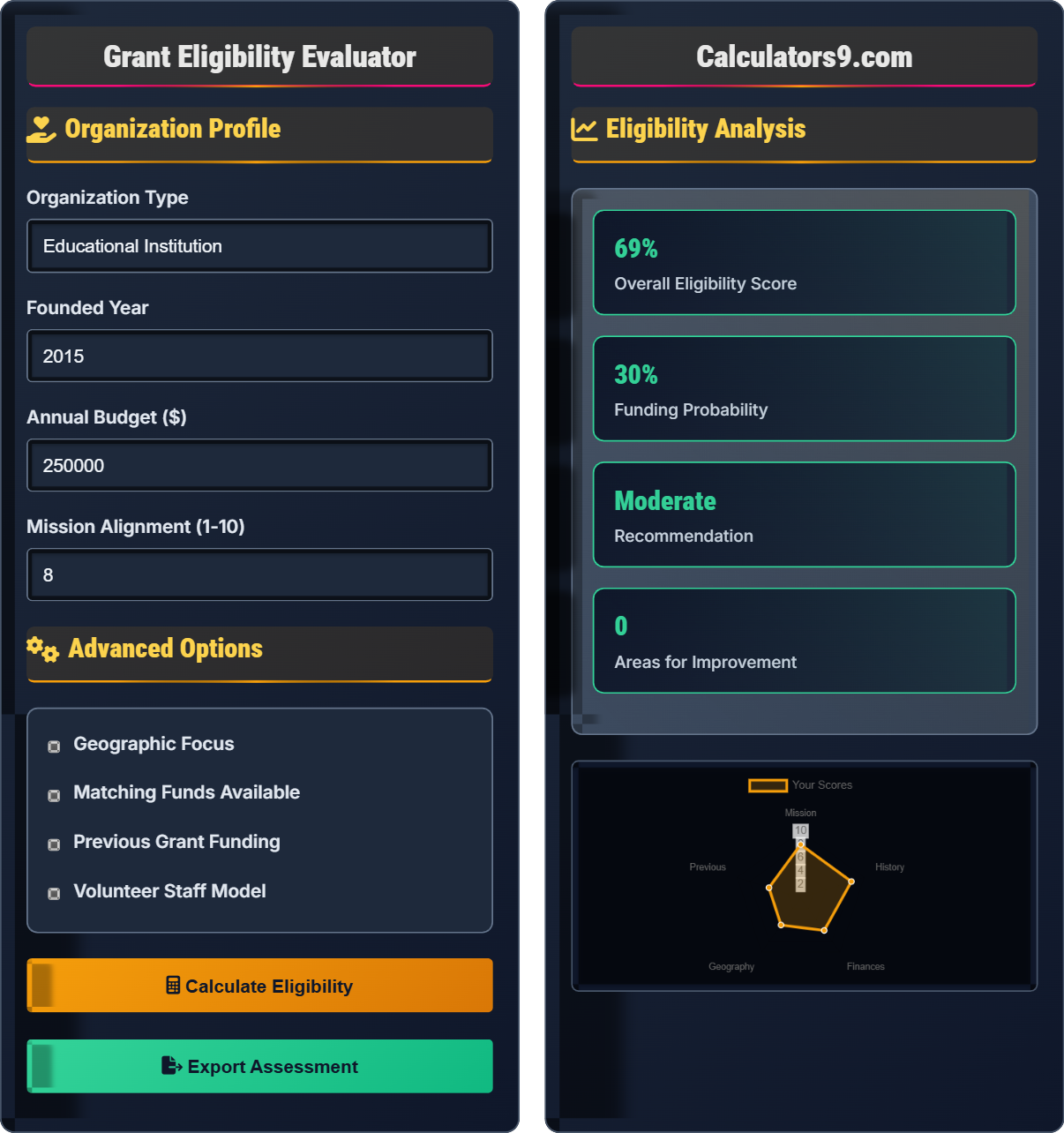
Grant Eligibility Evaluator
Funding assessment & application tools • 2026 edition
Organization Profile
Advanced Options
Eligibility Analysis
| Category | Score | Weight | Impact |
|---|
| Funding Source | Amount | Deadline | Fit Rating |
|---|
Grant Application Strategy Guide
Successful grant applications require demonstrating alignment between your organization's mission and the funder's priorities. The industry standard for grant success rates is 15-25%, with competitive foundations having lower acceptance rates. Eligibility is typically evaluated across five core areas: mission alignment (30%), organizational capacity (25%), project impact (20%), financial stability (15%), and geographic focus (10%).
Effective grant seekers use multiple strategies to identify funding opportunities:
- Grant Databases: Foundation Directory Online, GrantSpace, Grants.gov
- Network Connections: Professional associations, peer organizations
- Funder Websites: Direct exploration of foundation sites
- Government Resources: State and federal funding portals
- Grant Writing Consultants: Professional guidance services
- Early Start: Begin preparation 3-6 months before deadline
- Clear Goals: Define measurable outcomes and impact metrics
- Compelling Narrative: Tell your story with data and testimonials
- Realistic Budget: Align expenses with proposed activities
- Follow Guidelines: Adhere strictly to application requirements
Grant Application Learning Quiz
According to industry standards, which factor typically carries the highest weight in grant eligibility assessments?
The answer is B) Mission Alignment. Mission alignment typically carries the highest weight (30-40%) in grant eligibility assessments because funders want to ensure their investment supports their strategic priorities. Without alignment, other qualifications become irrelevant.
Understanding factor weights is crucial for strategic grant seeking. Mission alignment represents the fundamental match between your organization's purpose and the funder's goals. Even organizations with perfect credentials will be rejected if their mission doesn't align with the funder's priorities. This is why careful funder research is essential before applying.
Mission Alignment: Compatibility between applicant and funder goals
Strategic Priorities: Funder's focus areas and objectives
Factor Weight: Relative importance of evaluation criteria
• Always research funder priorities before applying
• Demonstrate clear alignment in proposal narrative
• Focus on mutual benefit in relationship
• Use funder's language in your proposal
• Reference specific funder initiatives in narrative
• Show measurable impact aligned with funder's mission
• Not demonstrating clear connection to funder priorities
• Focusing only on organizational needs without funder benefits
If a grant application scores 8/10 for mission alignment (weight: 30%), 7/10 for organizational history (weight: 25%), and 9/10 for financial stability (weight: 20%), what is the weighted composite score?
Step 1: Calculate mission alignment contribution = (8/10) × 0.30 = 0.24
Step 2: Calculate organizational history contribution = (7/10) × 0.25 = 0.175
Step 3: Calculate financial stability contribution = (9/10) × 0.20 = 0.18
Step 4: Calculate total weighted score = 0.24 + 0.175 + 0.18 = 0.595 = 59.5%
The weighted composite score is 59.5%.
This calculation demonstrates the weighted scoring method used by grant reviewers. Each factor contributes proportionally to the total score based on its assigned weight. This approach allows funders to emphasize the most important criteria while still considering other factors. The weighted average provides a fair assessment across different evaluation areas.
Weighted Score: Calculation accounting for relative importance of factors
Composite Score: Overall evaluation result from multiple criteria
Scoring Matrix: Framework for evaluating applications
• Weights must sum to 100%
• Normalize scores to common scale (e.g., 0-10)
• Apply weights consistently across all applications
• Focus improvement efforts on highest-weighted areas
• Use weighted scoring for internal prioritization
• Benchmark against successful applications
• Weights not summing to 100%
• Inconsistent application of scoring criteria
Sarah's organization has a 75% eligibility score. The average score for funded applicants is 82%. If she can improve her mission alignment score from 7 to 9 (30% weight), how much will this improve her overall eligibility score?
Step 1: Calculate current mission alignment contribution = (7/10) × 0.30 = 0.21
Step 2: Calculate improved mission alignment contribution = (9/10) × 0.30 = 0.27
Step 3: Calculate improvement = 0.27 - 0.21 = 0.06 = 6 percentage points
Step 4: Calculate new overall score = 75% + 6% = 81%
Improving the mission alignment score will increase the overall score by 6 percentage points to 81%.
This example demonstrates the strategic value of focusing improvement efforts on high-weighted criteria. Since mission alignment has a 30% weight, a 2-point improvement in this area has a significant impact on the overall score. This calculation helps prioritize which areas to strengthen for maximum impact on eligibility.
Competitive Analysis: Comparison with successful applicants
Impact Maximization: Focusing efforts where they yield greatest returns
Strategic Improvement: Prioritizing high-value enhancements
• Focus on highest-weighted criteria for maximum impact
• Benchmark against funded applicants' scores
• Calculate potential impact before investing effort
• Research funded applications to understand scoring thresholds
• Improve multiple criteria simultaneously for greater impact
• Focus on easiest improvements first for quick wins
• Not calculating impact before making improvements
• Focusing on areas already performing well
Mike's foundation has a $500,000 grant pool and expects 200 applications with an average eligibility score of 65%. If they fund applications with scores above 75%, approximately how many grants will be awarded assuming a normal distribution of scores?
Step 1: Identify mean score = 65%
Step 2: Identify cutoff score = 75%
Step 3: Calculate difference = 75% - 65% = 10 percentage points
Step 4: Estimate standard deviation = approximately 10 points
Step 5: Calculate Z-score = 10 ÷ 10 = 1
Step 6: Find percentile for Z-score of 1 = approximately 16% of applications
Step 7: Calculate number of awards = 200 × 0.16 = 32 grants
Approximately 32 grants will be awarded.
This problem demonstrates statistical analysis in grant selection. With a normal distribution, scores 1 standard deviation above the mean represent approximately the top 16% of applications. This calculation helps applicants understand their position relative to the competition and the likelihood of funding.
Normal Distribution: Statistical pattern of scores around mean
Z-Score: Standardized measure of deviation from mean
Percentile Ranking: Position relative to all applications
• Understand your position relative to competition
• Focus on improving scores above the threshold
• Research historical funding thresholds
• Target funders with higher acceptance rates
• Apply to multiple funders to increase chances
• Improve scores to exceed competitive thresholds
• Applying to highly competitive funders without preparation
• Not understanding statistical position in pool
What is the average success rate for competitive foundation grants?
The answer is B) 15-25%. The average success rate for competitive foundation grants is 15-25%. This low acceptance rate reflects the high demand for limited funding pools and the rigorous evaluation processes. Government grants often have higher success rates (20-35%) due to larger funding amounts.
Understanding success rates is crucial for realistic planning. The 15-25% rate means that most applications will be rejected, emphasizing the need for careful selection of funders and thorough preparation. This knowledge helps organizations set realistic funding expectations and diversify their funding strategies.
Success Rate: Percentage of applications that receive funding
Competitive Grant: Limited funding with multiple applicants
Acceptance Rate: Proportion of applications approved
• Plan for multiple applications per funding goal
• Diversify funding sources to mitigate risk
• Track application success rates for planning
• Target 3-5 grants for each funding need
• Apply to funders with higher acceptance rates first
• Build relationships with funders over time
• Not diversifying funding applications
• Focusing only on large, competitive grants
Application Basics
Success rate: 15-25%. Mission alignment: 30% weight. History: 25% weight. Budget: 20% weight. Geography: 15%. Previous: 10%.
Weighted average: (Score₁ × Weight₁) + (Score₂ × Weight₂) + ... = Composite Score. Example: (8×0.3) + (7×0.25) + (9×0.2) = 7.95/10.
- Always research funder priorities first
- Align narrative with funder's language
- Provide measurable outcomes and impact
Planning Tips
Use Foundation Directory Online, Grants.gov, and funder websites. Network with other nonprofits.
- Research funder thoroughly
- Confirm eligibility
- Develop compelling narrative
- Prepare realistic budget
- Submit well before deadline
- Allow 3-6 months for preparation
- Track all application deadlines
- Follow up appropriately
- Learn from rejections
FAQ
Q: How do we apply for grants if we're a new organization?
A: Focus on funders that support emerging organizations. Emphasize founder credentials, clear mission, and community need. Consider capacity-building grants first.
Q: What if our mission doesn't perfectly align?
A: Don't apply unless you can demonstrate clear alignment. Focus on funders whose priorities match your work. It's better to find the right fit than to force alignment.