Matching Gift Calculator
Maximize corporate giving impact • 2026 metrics
Matching Gift Formula:
\( MG = D \times R \)
Where:
- \( MG \) = Matching Gift Amount
- \( D \) = Donor's Original Donation
- \( R \) = Company's Match Ratio (expressed as a decimal)
For partial matches:
\( MG = Min(D \times R, ML) \)
Where \( ML \) = Maximum Match Limit
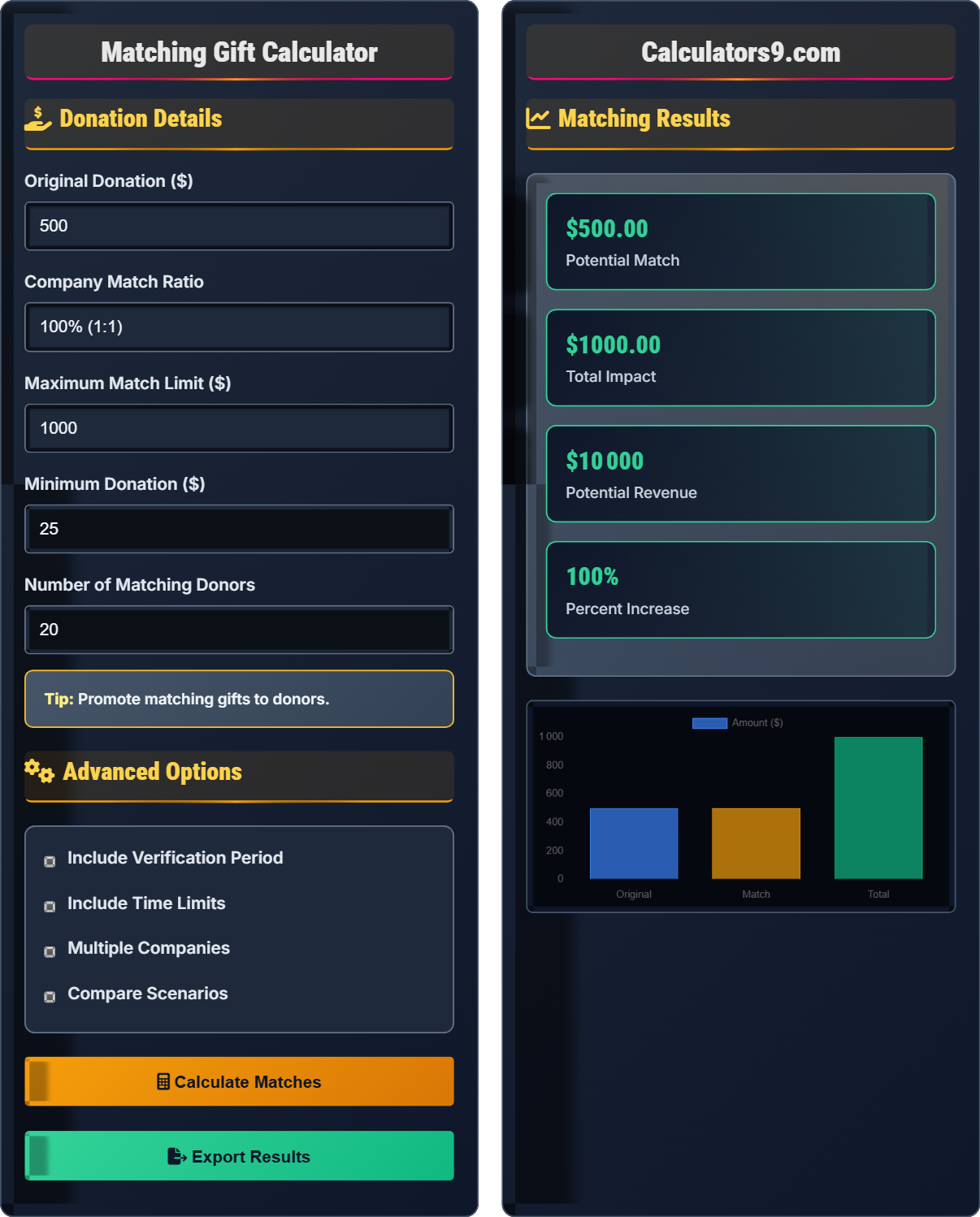
Example: If a donor gives $500 and their company offers a 1:1 match:
\( MG = \$500 \times 1.0 = \$500 \)
Thus, the organization receives $1,000 total ($500 from donor + $500 from company).
Donation Details
Advanced Options
Matching Results
| Metrics | Value |
|---|---|
| Original Donation | $500.00 |
| Match Ratio | 100% |
| Match Amount | $500.00 |
| Total Impact | $1,000.00 |
| Category | Amount | Percentage |
|---|
Matching Gift Guide
Matching gifts are corporate donation programs where employers contribute money to match charitable donations made by their employees. These programs effectively double or even triple the impact of individual donations, providing significant additional revenue for nonprofit organizations.
The standard matching gift calculation uses the following formula:
Where:
- \(MG\) = Matching Gift Amount
- \(D\) = Donor's Original Donation
- \(R\) = Company's Match Ratio (expressed as a decimal)
- \(ML\) = Maximum Match Limit
Essential metrics to track for effective matching gift programs:
- Participation Rate: Percentage of eligible donors who submit requests
- Completion Rate: Percentage of submitted requests that result in matches
- Match Value: Average amount per completed match
- Processing Time: Average time from submission to receipt
- Revenue Impact: Total additional revenue from matching gifts
- Promote Programs: Actively inform donors about available matching gift programs
- Simplify Process: Provide clear instructions and easy submission methods
- Follow Up: Remind donors to submit matching gift forms
- Track Results: Monitor completion rates and outcomes
- Thank Donors: Acknowledge both the original donation and the company match
Matching Gift Learning Quiz
If an employee donates $300 to a charity and their company offers a 2:1 match, how much will the company contribute?
A 2:1 match means the company contributes $2 for every $1 donated by the employee.
Company Contribution = $300 × 2 = $600
The answer is C) $600.
In a 2:1 match, for every dollar the employee donates, the company adds two dollars. So if the employee gives $300, the company contributes $600, making the total gift $900. This type of generous matching program can significantly increase the impact of individual donations.
Match Ratio: The proportion of employee donation matched by employer
2:1 Match: Company contributes twice the amount of employee donation
Corporate Philanthropy: Charitable giving by businesses
• Match Amount = Donation × Match Ratio
• Total Impact = Original Donation + Match Amount
• Check maximum limits for each program
• Remember: 2:1 means company gives 2 for every 1 given by employee
• Higher ratios mean more impact per donation
• Always verify match limits before promoting
• Confusing 2:1 with 1:2 ratio
• Forgetting to check maximum match limits
• Not accounting for minimum donation requirements
An employee donates $800 to charity. Their company offers a 1:1 match with a maximum limit of $500. How much will the company contribute?
Step 1: Calculate potential match
Potential Match = $800 × 1.0 = $800
Step 2: Apply maximum limit
Actual Match = Min($800, $500) = $500
The company will contribute $500, which is the maximum allowed.
This example demonstrates how maximum limits cap the company's contribution regardless of the donation amount. Even though the employee gave $800 and the company offers a 1:1 match, the maximum limit of $500 restricts the company's contribution to $500. This is why it's important to know both the match ratio and the maximum limit.
Maximum Limit: The highest amount a company will match
Cap: Upper boundary on match amount
Threshold: Minimum requirement for matching
• Actual Match = Min(Potential Match, Maximum Limit)
• Maximum limits are often set annually
• Some programs reset limits each fiscal year
• Always check both ratio and maximum limit
• Consider spreading donations across multiple charities
• Time donations to maximize matching opportunities
• Assuming the full match amount will be given
• Not considering annual maximum limits
• Forgetting to apply minimum requirements
A nonprofit has 25 donors whose employers offer matching gifts. On average, each donor gives $400 and their companies offer a 1:1 match with a $500 limit. If 60% of donors submit their matching gift forms, what is the potential additional revenue?
Active Matching Donors = 25 × 60% = 15 donors
Match per Donor = Min($400 × 1.0, $500) = $400
Potential Additional Revenue = 15 × $400 = $6,000
The nonprofit could receive an additional $6,000 through matching gifts.
This example shows how to calculate the aggregate impact of multiple matching gift opportunities. It incorporates the participation rate, which is crucial for realistic projections. In practice, not all eligible donors submit their matching gift forms, so actual revenue may be lower than theoretical maximums.
Participation Rate: Percentage of eligible donors who submit forms
Aggregate Impact: Combined effect of multiple matching opportunities
Theoretical Maximum: Potential revenue if all donors participate
• Aggregate Revenue = Active Donors × Average Match
• Participation rates typically range from 30-70%
• Always account for practical limitations
• Follow up with donors about matching gifts
• Create simple submission processes
• Track participation rates for future planning
• Assuming 100% participation rate
• Not accounting for submission deadlines
• Forgetting to verify company eligibility
An employee donates $1,000 to charity. Their company offers a 50% match (0.5:1) with a maximum annual limit of $750. If this is the employee's third donation this year, totaling $1,500 in donations, and the company has already matched $400, how much will the company match for this donation?
Step 1: Calculate potential match for current donation
Potential Match = $1,000 × 0.5 = $500
Step 2: Calculate remaining annual limit
Remaining Limit = $750 - $400 = $350
Step 3: Determine actual match
Actual Match = Min($500, $350) = $350
The company will match $350 for this donation.
This example demonstrates how annual maximum limits work cumulatively. The company has already contributed $400 toward the $750 annual maximum, leaving only $350 available for future matches. Even though the potential match for this donation is $500, the remaining annual limit of $350 caps the actual match.
Annual Maximum: Total match limit per calendar year
Cumulative Matching: Tracking matches over time periodsRemaining Limit: Available match amount after previous contributions
• Remaining Limit = Annual Maximum - Previous Matches
• Actual Match = Min(Potential Match, Remaining Limit)
• Annual limits typically reset each fiscal year
• Track annual limits for each company
• Advise donors to time donations strategically
• Monitor remaining limits throughout the year
• Forgetting about annual maximums
• Not tracking previous matches against limits
• Assuming limits are per donation rather than annual
Which approach is most effective for maximizing matching gift revenue?
The answer is B) Proactively promote matching gift programs. Studies show that most employees are unaware of their company's matching gift programs. Proactive outreach increases awareness and participation, leading to higher matching gift revenue. Simply waiting for donors to inquire or relying on word-of-mouth results in missed opportunities.
Proactive promotion is essential because matching gift programs are often underutilized due to lack of awareness. Research indicates that only 10-15% of eligible donors take advantage of matching gift programs without proactive outreach. By actively promoting these opportunities, nonprofits can significantly increase their matching gift revenue with minimal additional cost.
Proactive Outreach: Actively informing donors about opportunities
Underutilized Resources: Available benefits not being used
Matching Gift Awareness: Knowledge of available programs
• Most employees don't know about matching programs
• Proactive promotion increases participation rates
• Small donations can lead to significant matches
• Include matching gift information in all donation appeals
• Create simple, accessible submission processes
• Follow up with donors about pending matches
• Assuming donors know about matching programs
• Not tracking matching gift revenue separately
• Failing to thank both donor and company
Matching Metrics
Additional revenue generated through corporate matching programs.
\(Match = Min(Donation \times Ratio, Max\ Limit)\)
Where Match=corporate contribution, Donation=original gift, Ratio=match rate.
- Always check company eligibility
- Verify both ratio and maximum limits
- Submit forms promptly after donation
Best Practices
Actively inform donors about available matching opportunities.
- Include matching info in donation receipts
- Create dedicated matching gift pages
- Send reminder emails to donors
- Provide simple submission tools
- Participation Rate: 30-70%
- Completion Rate: 80-95%
- Avg Match Value: $200-800
- Revenue Impact: 5-15% of total donations
FAQ
Q: How do I identify which donors have matching gift opportunities?
A: Identifying matching gift opportunities requires proactive outreach and systematic tracking:
- Donor Surveys: Ask donors if their employer offers matching gifts
- Database Tools: Use matching gift databases like Double the Donation
- Donation Forms: Include matching gift questions in your donation process
- Follow-up: Send post-donation communications about matching opportunities
The formula for estimating potential matches is: \( PM = \sum_{i=1}^{n} Min(D_i \times R_i, ML_i) \)
Where \( PM \) = Potential Matches, \( D_i \) = Donation from donor \( i \), \( R_i \) = Match Ratio, and \( ML_i \) = Maximum Limit.
Q: What's the typical impact of matching gift programs on nonprofit revenue?
A: Matching gift programs can significantly impact nonprofit revenue:
- Revenue Increase: 5-15% of total individual donations
- Typical Match: $200-800 per completed match
- Participation: 30-70% of eligible donors submit forms
- Completion: 80-95% of submissions result in actual matches
For example, if your organization receives $100,000 in individual donations and 20% come from employees of companies with 1:1 matching up to $500, the potential additional revenue would be: \( Revenue = 0.20 \times 100{,}000 \times 0.50 = \$10{,}000 \) (assuming 50% participation rate).