Overhead Ratio Calculator
Optimize nonprofit financial health • 2026 metrics
Overhead Ratio Formula:
\( OR = \frac{Administrative\ Costs + Fundraising\ Costs}{Total\ Expenses} \times 100 \)
Where:
- \( OR \) = Overhead Ratio percentage
- \( Administrative\ Costs \) = Management and general expenses
- \( Fundraising\ Costs \) = Costs to raise funds
- \( Total\ Expenses \) = All organization expenses
For a healthy nonprofit, overhead should typically be 15-35% of total expenses. Higher overhead may indicate inefficiency, while extremely low overhead may suggest underinvestment in organizational capacity.
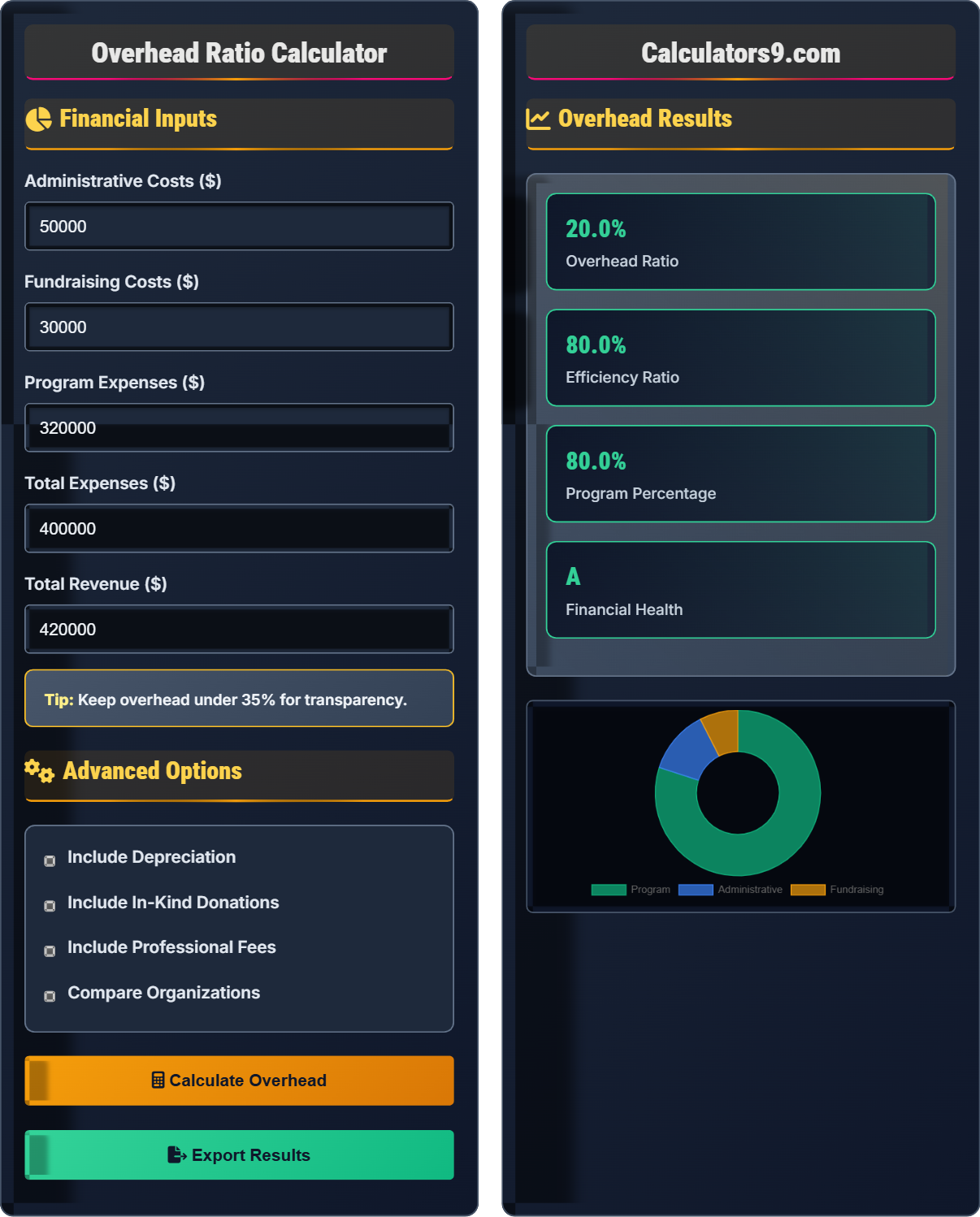
Example: If administrative costs are $50,000, fundraising costs are $30,000, and total expenses are $400,000:
\( OR = \frac{\$50{,}000 + \$30{,}000}{\$400{,}000} \times 100 = \frac{\$80{,}000}{\$400{,}000} \times 100 = 20\% \)
Thus, the overhead ratio is 20%, which is considered healthy.
Financial Inputs
Advanced Options
Overhead Results
| Metrics | Value |
|---|---|
| Administrative Costs | $50,000 |
| Fundraising Costs | $30,000 |
| Program Expenses | $320,000 |
| Total Expenses | $400,000 |
| Category | Amount | Percentage |
|---|
Overhead Ratio Guide
Overhead ratio measures the percentage of an organization's total expenses that go toward administrative and fundraising activities rather than program delivery. It's a key indicator of organizational efficiency and is often used by donors and rating agencies to evaluate nonprofits.
The standard overhead ratio calculation uses the following formula:
Where:
- \(OR\) = Overhead Ratio
- \(Admin\ Costs\) = Management and general expenses
- \(Fundraising\ Costs\) = Costs associated with raising funds
- \(Total\ Expenses\) = All organizational expenses
Essential metrics to track for effective financial management:
- Overhead Ratio: 15-35% is generally considered healthy
- Program Ratio: 65-85% is typically expected
- Fundraising Efficiency: $0.10-0.25 per dollar raised
- Working Capital: 3-6 months of operating expenses
- Debt-to-Assets: Below 20% for stability
- Invest in Infrastructure: Adequate overhead supports long-term sustainability
- Transparency: Clearly report how funds are allocated
- Efficiency Balance: Optimize without compromising quality
- Regular Review: Monitor ratios quarterly
- Stakeholder Communication: Explain the value of overhead investments
Overhead Ratio Learning Quiz
If a nonprofit has $40,000 in administrative costs, $20,000 in fundraising costs, and $240,000 in program expenses, what is the overhead ratio?
Step 1: Calculate total expenses
Total Expenses = Administrative + Fundraising + Program
Total Expenses = $40,000 + $20,000 + $240,000 = $300,000
Step 2: Calculate overhead
Overhead = (Admin + Fundraising) ÷ Total Expenses × 100
Overhead = ($40,000 + $20,000) ÷ $300,000 × 100 = $60,000 ÷ $300,000 × 100 = 20%
The answer is B) 20%.
This calculation demonstrates how overhead is calculated as a percentage of total expenses. The overhead ratio is the sum of administrative and fundraising costs divided by total expenses. This metric helps stakeholders understand what percentage of funds goes toward supporting the organization's operations versus delivering programs directly.
Overhead Ratio: Percentage of expenses for administration and fundraising
Administrative Costs: Management and general organizational expenses
Fundraising Costs: Expenses associated with raising money
• Overhead = (Admin + Fundraising) ÷ Total Expenses × 100
• Healthy range is typically 15-35%
• Include all relevant administrative and fundraising costs
• Remember: Overhead includes both admin and fundraising costs
• Don't forget to multiply by 100 to get percentage
• Total expenses = Admin + Fundraising + Program
• Forgetting to include fundraising costs in overhead
• Using revenue instead of expenses in denominator
• Not converting to percentage
A nonprofit has $100,000 in total expenses with $25,000 in overhead costs. What percentage goes to programs, and how does this compare to industry standards?
Step 1: Calculate program expenses
Program Expenses = Total Expenses - Overhead Costs
Program Expenses = $100,000 - $25,000 = $75,000
Step 2: Calculate program percentage
Program Percentage = (Program Expenses ÷ Total Expenses) × 100
Program Percentage = ($75,000 ÷ $100,000) × 100 = 75%
The organization spends 75% on programs, which meets the industry standard of 65-85%.
This example shows how to determine program efficiency by calculating the percentage of expenses dedicated to program delivery. The 75% program ratio indicates that 3 out of every 4 dollars goes directly to program activities, which is considered excellent performance. This helps donors understand how much of their contribution directly supports the mission.
Program Efficiency: Percentage of expenses going to program delivery
Industry Standards: Benchmarks for nonprofit financial performanceEfficiency Ratio: Percentage of resources devoted to mission
• Program Percentage = (Program Expenses ÷ Total Expenses) × 100
• Industry standard: 65-85% for programs
• Higher program percentage indicates better efficiency
• Program Percentage = 100% - Overhead Percentage
• Aim for 75%+ program efficiency
• Consider quality alongside efficiency
• Confusing program expenses with program percentage
• Not accounting for all administrative costs
• Ignoring the importance of adequate overhead
A nonprofit raises $500,000 in donations while spending $75,000 on fundraising activities. Calculate the cost per dollar raised and determine if this is efficient according to industry standards.
Cost Per Dollar Raised = Fundraising Expenses ÷ Total Funds Raised
Cost Per Dollar Raised = $75,000 ÷ $500,000 = $0.15
This means it costs $0.15 to raise each dollar, which is efficient (industry standard is $0.10-0.25).
Fundraising efficiency measures how cost-effectively an organization raises money. The $0.15 per dollar raised indicates excellent efficiency, as it falls well within the industry standard range. This metric helps evaluate the effectiveness of fundraising strategies and ensures donors' money is being used efficiently to generate more support.
Fundraising Efficiency: Cost to raise each dollar of donations
Cost Per Dollar Raised: Fundraising expenses divided by funds raised
Efficient Fundraising: Low cost relative to funds generated
• Cost Per Dollar = Fundraising Expenses ÷ Funds Raised
• Efficient range: $0.10-0.25 per dollar
• Lower cost per dollar indicates better efficiency
• Compare across different fundraising methods
• Track efficiency over time
• Consider both efficiency and effectiveness
• Not tracking fundraising costs accurately
• Focusing only on efficiency without considering effectiveness
• Comparing across different types of organizations
A nonprofit has $300,000 in total expenses: $45,000 administrative, $15,000 fundraising, and $240,000 program. If they aim to reduce overhead to 15% while maintaining program spending, what would be the maximum total expenses allowed?
Current Overhead = ($45,000 + $15,000) ÷ $300,000 = $60,000 ÷ $300,000 = 20%
Target: Overhead should be 15% of total expenses
If Program Expenses remain at $240,000 and must represent 85% of total expenses (100% - 15%):
Let X = Total Expenses
$240,000 = 0.85X
X = $240,000 ÷ 0.85 = $282,353
Maximum total expenses would be $282,353 to achieve 15% overhead while maintaining program spending.
This problem demonstrates how to work backwards from a target overhead ratio. Since program expenses must remain constant at $240,000 and should represent 85% of total expenses (to keep overhead at 15%), we can calculate the maximum total expenses that would allow this ratio. This helps organizations plan for financial goals while maintaining their programmatic commitments.
Financial Planning: Strategic approach to achieving financial goals
Ratio Targeting: Setting specific financial performance targets
Program Commitment: Maintaining spending on mission-critical activities
• If Program % = Target, then Total Expenses = Program ÷ Program %
• Overhead % + Program % = 100%
• Maintain balance between efficiency and effectiveness
• Use algebra to solve for unknown totals
• Always verify calculations by checking ratios
• Consider impact on program quality when reducing overhead
• Attempting to reduce overhead without considering program impact
• Not accounting for the relationship between all expense categories
• Setting unrealistic overhead targets
Which statement best describes the relationship between overhead costs and nonprofit effectiveness?
The answer is C) Moderate overhead supports organizational capacity and effectiveness. Research shows that nonprofits with very low overhead (under 10%) may struggle with sustainability and effectiveness due to underinvestment in infrastructure, staff, and systems. A balanced approach with moderate overhead (15-35%) typically supports long-term organizational health and mission effectiveness.
Modern thinking on nonprofit effectiveness recognizes that adequate overhead is essential for organizational sustainability and mission achievement. Investments in administrative systems, staff development, technology, and fundraising capabilities ultimately enhance program delivery. The old "overhead myth" that lower overhead automatically means better effectiveness has been debunked by research showing that organizations need sufficient infrastructure to be effective.
Organizational Capacity: Infrastructure and resources that support mission
Overhead Myth: Misconception that lower overhead always means better effectiveness
Infrastructure Investment: Spending on systems and support functions
• Moderate overhead (15-35%) supports organizational health
• Very low overhead may indicate underinvestment
• Focus on outcomes, not just ratios
• Evaluate effectiveness based on outcomes, not just ratios
• Consider the value of infrastructure investments
• Look at trends over time, not just current ratios
• Assuming lower overhead always equals better performance
• Not considering the value of infrastructure investments
• Focusing only on ratios without considering mission outcomes
Financial Metrics
Percentage of expenses for administrative and fundraising activities.
\(OR = \frac{Admin\ Costs + Fundraising\ Costs}{Total\ Expenses} \times 100\)
Where OR=overhead percentage, Admin=administrative expenses, Total=all expenses.
- Healthy range: 15-35% overhead
- Include all administrative and fundraising costs
- Consider organizational capacity needs
Best Practices
Balanced approach to organizational efficiency.
- Track ratios quarterly
- Invest in organizational capacity
- Communicate value of overhead investments
- Focus on outcomes, not just ratios
- Overhead: 15-35%
- Program: 65-85%
- Fundraising Cost: $0.10-0.25/dollar
- Working Capital: 3-6 months expenses
FAQ
Q: What's considered a good overhead ratio for nonprofits?
A: A "good" overhead ratio typically ranges from 15-35% of total expenses, though this varies by organization size and type:
- Small Organizations: May have higher overhead (25-40%) due to fixed costs
- Large Organizations: Often achieve lower overhead (15-25%) through economies of scale
- Service Organizations: May have higher administrative costs for compliance
Formula: \( Overhead\ Ratio = \frac{Admin\ Costs + Fundraising\ Costs}{Total\ Expenses} \times 100 \)
For example, if administrative costs are \( AC = \$40{,}000 \), fundraising costs are \( FC = \$20{,}000 \), and total expenses are \( TE = \$300{,}000 \):
\( OR = \frac{\$40{,}000 + \$20{,}000}{\$300{,}000} \times 100 = \frac{\$60{,}000}{\$300{,}000} \times 100 = 20\% \)
Remember that very low overhead might indicate underinvestment in organizational capacity.
Q: How do I calculate overhead if my organization doesn't separate costs clearly?
A: When costs aren't clearly separated, you can use allocation methods:
- Time Allocation: Assign costs based on staff time spent on each function
- Space Allocation: Assign facility costs based on square footage used
- Revenue Allocation: Assign costs proportionally based on revenue generated
For example, if an executive director splits time equally between administration (40%) and fundraising (20%), and earns $100,000:
Administrative allocation: \( \$100{,}000 \times 40\% = \$40{,}000 \)
Fundraising allocation: \( \$100{,}000 \times 20\% = \$20{,}000 \)
Implement a formal cost allocation plan to ensure accurate tracking for future years.