Tax Deduction Calculator
Optimize charity giving benefits • 2026 metrics
Tax Deduction Formula:
\( TD = Min(C, AGI \times Limit) \)
Where:
- \( TD \) = Tax Deduction Amount
- \( C \) = Charitable Contributions
- \( AGI \) = Adjusted Gross Income
- \( Limit \) = Deduction Limit Percentage (0.50, 0.60, etc.)
For cash donations: \( Limit = 60\% \) of AGI
For appreciated assets: \( Limit = 30\% \) of AGI
Example: If AGI is $100,000 and charitable giving is $7,000:
\( TD = Min(\$7{,}000, \$100{,}000 \times 0.60) = Min(\$7{,}000, \$60{,}000) = \$7{,}000 \)
Thus, the taxpayer can deduct $7,000 from taxable income.
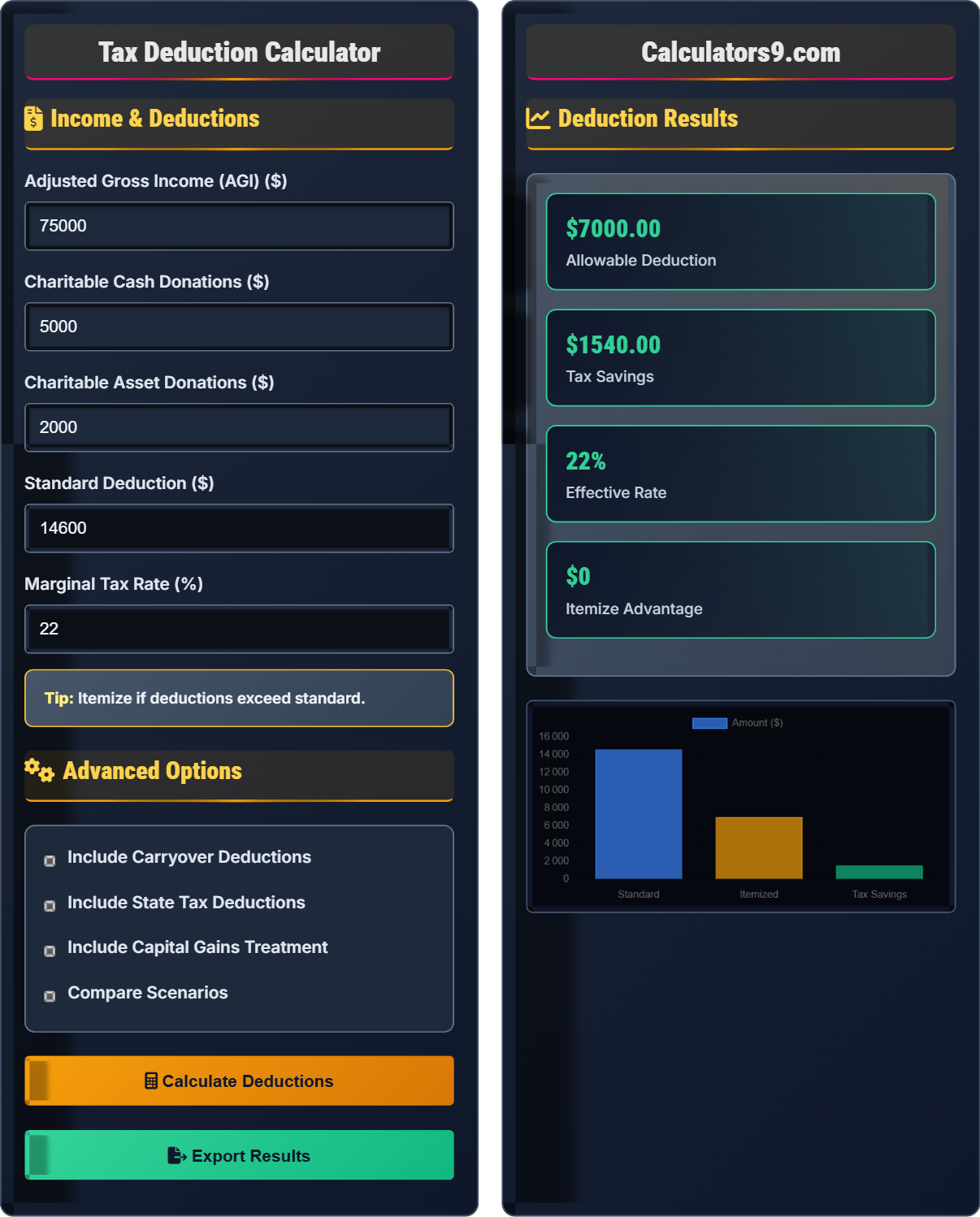
Income & Deductions
Advanced Options
Deduction Results
| Metrics | Value |
|---|---|
| AGI | $75,000 |
| Cash Donations | $5,000 |
| Asset Donations | $2,000 |
| Total Deduction | $7,000 |
| Category | Amount | Percentage |
|---|
Tax Deduction Guide
Tax deductions reduce your taxable income, which lowers the amount of tax you owe. For charitable giving, taxpayers can deduct qualifying donations to qualified nonprofit organizations. The deduction amount depends on your income, the type of donation, and applicable limits.
The standard charitable deduction calculation uses the following formula:
Where:
- \(TD\) = Tax Deduction Amount
- \(C\) = Charitable Contributions
- \(AGI\) = Adjusted Gross Income
- \(Limit\) = Deduction Limit Percentage (0.50, 0.60, etc.)
Essential metrics to track for effective tax planning:
- Itemized vs Standard: Choose option that provides greater benefit
- AGI Percentage: How much of AGI is deductible
- Tax Savings: Actual tax benefit from deductions
- Carryover Potential: Unused deductions carried to future years
- Effective Rate: Marginal tax rate applied to deductions
- Bundle Deductions: Concentrate charitable giving in alternating years
- Donate Appreciated Assets: Avoid capital gains while claiming deductions
- Consider Timing: Donate in high-income years for greater benefit
- Plan Ahead: Estimate AGI to optimize deduction limits
- Keep Records: Maintain documentation for all charitable donations
Tax Deduction Learning Quiz
What is the maximum charitable deduction limit for cash donations in 2026?
The maximum charitable deduction limit for cash donations is 60% of AGI. This means you can deduct up to 60% of your Adjusted Gross Income for cash donations to qualified nonprofits.
The answer is C) 60% of AGI.
The 60% limit on cash donations is designed to prevent individuals from completely eliminating their tax liability through charitable giving. Different types of donations have different limits: appreciated assets have a 30% limit, while inventory donations have a 50% limit. Understanding these limits helps donors plan their giving strategy effectively.
AGI (Adjusted Gross Income): Your gross income minus certain adjustments
Cash Donations: Monetary contributions to qualified nonprofits
Deduction Limit: Maximum percentage of AGI that can be deducted
• Cash donations: 60% of AGI limit
• Appreciated assets: 30% of AGI limit
• Excess amounts can carry over to next 5 years
• Remember: 60% for cash, 30% for appreciated assets
• Plan giving to stay within limits
• Consider bundling donations in high-income years
• Assuming all donations have the same limit
• Not tracking AGI throughout the year
• Forgetting about carryover provisions
If a taxpayer with a 24% marginal tax rate claims a $10,000 charitable deduction, what is their tax savings?
Tax Savings = Deduction Amount × Marginal Tax Rate
Tax Savings = $10,000 × 0.24 = $2,400
The taxpayer saves $2,400 in federal income taxes.
This calculation shows how the marginal tax rate applies to deductions. The taxpayer saves money equal to their marginal tax rate multiplied by the deduction amount. This is why higher-income taxpayers benefit more from charitable deductions than lower-income taxpayers.
Marginal Tax Rate: The tax rate applied to the last dollar earned
Tax Savings: Reduction in tax liability from deductions
Effective Rate: Average tax rate on all income
• Tax Savings = Deduction × Marginal Rate
• Higher rates mean greater savings
• Savings apply to federal and state taxes
• Higher earners save more per dollar donated
• Consider both federal and state tax implications
• Time donations for maximum benefit
• Using effective rate instead of marginal rate
• Not considering state tax implications
• Forgetting about phase-out provisions
A taxpayer with $100,000 AGI donates $70,000 in cash to charity. How much can they deduct this year, and how much can be carried over to future years?
Step 1: Calculate deduction limit
LIMIT = $100,000 × 60% = $60,000
Step 2: Determine allowable deduction
ALLOWABLE = Min($70,000, $60,000) = $60,000
Step 3: Calculate carryover
CARRYOVER = $70,000 - $60,000 = $10,000
The taxpayer can deduct $60,000 this year and carry over $10,000 to future years (up to 5 years).
This example demonstrates how excess charitable contributions can be carried forward to future tax years. The taxpayer can only deduct up to 60% of their AGI in the current year, but the excess amount can be used in future years, subject to the same AGI limits. This feature allows donors to maximize their tax benefits over time.
Carryover: Excess deductions moved to future tax years
AGI Limit: Maximum percentage of income that can be deducted
Forward Carry: Unused deductions applied to future years
• Excess deductions carry forward up to 5 years
• Same AGI limits apply in future years
• Must use carryovers before current donations
• Plan large donations in high-income years
• Track carryovers carefully
• Consider spreading donations across years
• Forgetting about carryover provisions
• Not tracking AGI limits in future years
• Losing documentation for carryovers
A taxpayer normally donates $3,000 annually but expects a higher income year in 2026. If they donate $9,000 in 2026 (instead of $3,000 each year for 3 years), what is the tax advantage? Assume AGI is $80,000 and tax rate is 22%.
Scenario 1 (Spread): 3 years × $3,000 = $9,000 total
Tax Savings: 3 × ($3,000 × 0.22) = $1,980
Scenario 2 (Bundled): $9,000 in one year
Check AGI limit: $80,000 × 60% = $48,000
Since $9,000 < $48,000, full deduction allowed
Tax Savings: $9,000 × 0.22 = $1,980 in first year
In subsequent years, no deduction = $0
Total: $1,980 (same total, but concentrated benefit)
This example shows that while the total tax savings over time remain the same, bundling donations can concentrate the benefit in high-income years. In this case, the taxpayer gets the full benefit in the high-income year rather than spreading it across multiple years. This strategy is particularly valuable when the standard deduction threshold is a concern.
Bundling Strategy: Concentrating donations in specific years
AGI Threshold: Income level that affects deduction benefits
Concentrated Benefit: Focusing tax advantages in specific years
• Bundling works best in high-income years
• Verify AGI limits aren't exceeded
• Consider standard deduction implications
• Use bundling when near standard deduction threshold
• Consider alternating years strategy
• Factor in changing tax laws
• Assuming bundling always increases total savings
• Not considering AGI fluctuations
• Forgetting about other itemized deductions
When should a taxpayer choose to itemize deductions instead of taking the standard deduction?
The answer is A) When itemized deductions exceed standard deduction. Taxpayers should choose the option that provides the greater tax benefit. If their itemized deductions (including charitable contributions, mortgage interest, state taxes, etc.) exceed the standard deduction amount, they should itemize.
This fundamental tax principle helps taxpayers minimize their tax liability. The choice between itemizing and taking the standard deduction is made each year based on which provides the greater benefit. For charitable givers, the key is determining whether their total itemized deductions, including charitable contributions, exceed the standard deduction threshold.
Itemized Deductions: Specific expenses deducted individually
Standard Deduction: Fixed amount for all taxpayers
Tax Benefit: Reduction in tax liability
• Choose higher of standard or itemized deductions
• Calculate annually based on circumstances
• Charitable giving can tip balance toward itemizing
• Calculate both options each year
• Consider charitable giving as itemizing incentive
• Plan giving to maximize itemizing benefits
• Automatically choosing standard deduction
• Not considering charitable giving impact
• Failing to recalculate annually
Deduction Metrics
Reduction in tax liability from charitable deductions.
\(Savings = Deduction \times Marginal\ Tax\ Rate\)
Where Savings=reduction in taxes, Deduction=allowable amount, Rate=marginal rate.
- Use marginal tax rate for calculations
- Verify AGI limits apply
- Consider state tax implications
Best Practices
Time donations for maximum tax benefits.
- Bundle deductions in high-income years
- Donate appreciated assets to avoid capital gains
- Consider Donor Advised Funds
- Plan for AGI fluctuation
- Cash limit: 60% of AGI
- Asset limit: 30% of AGI
- Carryover: 5 years maximum
- Effective rate: Marginal rate
FAQ
Q: How do I determine if charitable giving will benefit me tax-wise?
A: To determine if charitable giving benefits you tax-wise, compare your potential itemized deductions to the standard deduction:
- Calculate Total Itemized Deductions: Charitable giving + mortgage interest + state taxes + medical expenses
- Compare to Standard: For 2026, standard deduction is $14,600 (single) or $29,200 (married filing jointly)
- Tax Savings: \( Savings = Charitable\ Deduction \times Marginal\ Tax\ Rate \)
For example, if your other itemized deductions total $12,000 and you donate $5,000, your total itemized deductions would be $17,000. If you're single, this exceeds the standard deduction of $14,600, so you'd benefit from itemizing. Your tax savings would be: \( \$5{,}000 \times Marginal\ Rate \).
Q: What documentation do donors need for charitable tax deductions?
A: Documentation requirements vary by donation amount:
- $250 or less: Bank record or written acknowledgment
- $250-$500: Written acknowledgment from organization
- $500-$5,000: Detailed written acknowledgment with property description
- $5,000+: Qualified appraisal required
Written acknowledgments must include: (1) Description of donated property, (2) Statement of whether goods/services were provided in return, (3) Good faith estimate of value of goods/services. For cash donations, the acknowledgment must state that no goods/services were provided in return.