Volunteer Hour Value Calculator
Calculate nonprofit labor contribution • 2026 metrics
Volunteer Hour Value Formula:
\( VHV = \frac{Total\ Economic\ Impact}{Total\ Volunteer\ Hours} \)
Where:
- \( VHV \) = Volunteer Hour Value
- \( Total\ Economic\ Impact \) = Estimated value of services provided
- \( Total\ Volunteer\ Hours \) = Total hours contributed by volunteers
Alternatively, using the Independent Sector method:
\( VHV = Average\ Private\ Wage + Benefits + Overhead \)
For 2026, the estimated volunteer hour value is approximately $31.80, representing the average hourly compensation for workers in the private sector.
Example: If a nonprofit organization receives 1,000 volunteer hours:
\( Total\ Value = 1{,}000 \times \$31.80 = \$31{,}800 \)
Thus, the volunteers contributed approximately $31,800 worth of labor.
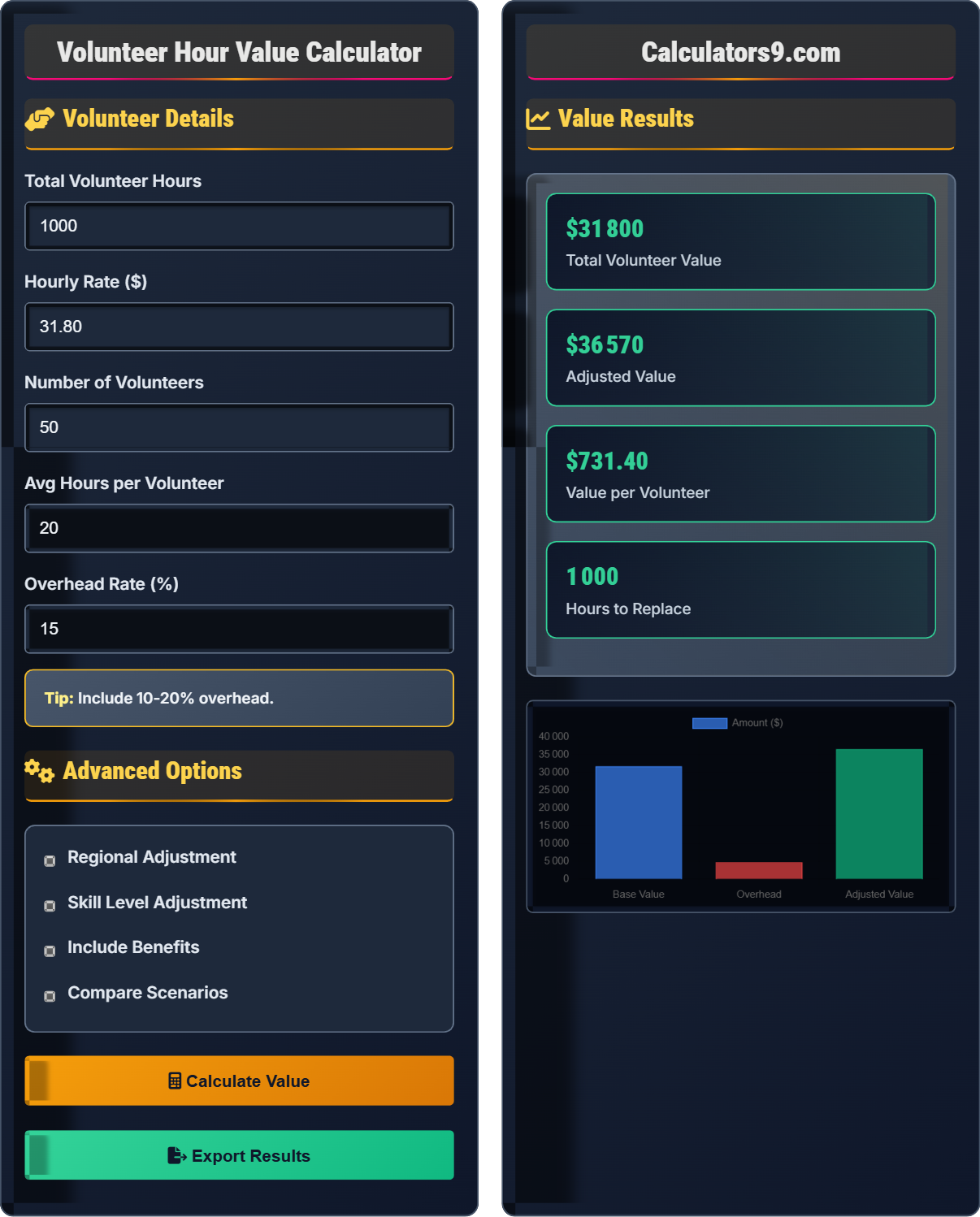
Volunteer Details
Advanced Options
Value Results
| Metrics | Value |
|---|---|
| Total Hours | 1,000 |
| Base Rate | $31.80 |
| Overhead | 15% |
| Total Value | $36,570 |
| Category | Amount | Percentage |
|---|
Volunteer Hour Value Guide
Volunteer Hour Value (VHV) is a standardized method to assign monetary value to volunteer time, helping nonprofit organizations demonstrate their economic impact and justify their existence to stakeholders. The Independent Sector, a national leadership network for nonprofits, publishes annual estimates of volunteer hour value based on private-sector wages and benefits.
The standard volunteer hour value calculation uses the following formula:
Where:
- \(VHV\) = Volunteer Hour Value
- \(Average\ Private\ Wage\) = Average hourly wage in private sector
- \(Benefits\) = Average employee benefits as percentage of wage
- \(Overhead\) = Additional costs associated with employment
Essential metrics to track alongside volunteer hour value:
- Volunteer Productivity: Value generated per volunteer hour
- Volunteer Retention Rate: Percentage of returning volunteers
- Volunteer Satisfaction: Quality of volunteer experience
- Volunteer-to-Staff Ratio: Balance of volunteer and paid staff
- Volunteer Lifetime Value: Estimated value over time
- Recognize Contributions: Acknowledge volunteer value with awards and recognition
- Provide Training: Enhance volunteer skills to increase productivity
- Match Skills to Tasks: Align volunteer abilities with appropriate roles
- Track Impact: Document volunteer contributions for reporting
- Offer Flexibility: Accommodate different schedules and preferences
Volunteer Hour Value Learning Quiz
If the base volunteer hour value is $31.80 and overhead is 15%, what is the adjusted value per hour?
Adjusted Value = Base Rate + (Base Rate × Overhead Percentage)
Adjusted Value = $31.80 + ($31.80 × 0.15)
Adjusted Value = $31.80 + $4.77 = $36.57
The answer is B) $36.57.
This calculation shows how overhead costs increase the effective value of volunteer time. Overhead represents the additional costs associated with employing someone, such as office space, equipment, insurance, and administrative support. These costs are added to the base wage to reflect the true economic value of the volunteer's contribution.
Volunteer Hour Value (VHV): The monetary value assigned to an hour of volunteer work
Overhead: Additional costs beyond wages associated with employing someone
Independent Sector: Organization that publishes annual volunteer hour value estimates
• Adjusted Value = Base Rate + (Base Rate × Overhead)
• Include benefits and overhead in value calculations
• Adjust for regional differences in wages
• Remember: Base Rate × (1 + Overhead Rate)
• Use current Independent Sector values
• Consider skill level adjustments
• Forgetting to add overhead costs
• Using outdated base values
• Not adjusting for regional differences
If a nonprofit in San Francisco has 500 volunteer hours with a base rate of $31.80, and San Francisco has a 30% regional adjustment, what is the total value of the volunteer work?
Step 1: Calculate adjusted hourly rate
Adjusted Rate = Base Rate × (1 + Regional Adjustment)
Adjusted Rate = $31.80 × (1 + 0.30) = $31.80 × 1.30 = $41.34
Step 2: Calculate total value
Total Value = Total Hours × Adjusted Rate
Total Value = 500 × $41.34 = $20,670
The total value of the volunteer work is $20,670.
Regional adjustments account for differences in living costs and wages across geographic areas. San Francisco, with its high cost of living, has a significantly higher average wage than the national average, which translates to a higher volunteer hour value. This ensures that volunteer contributions are valued appropriately based on local economic conditions.
Regional Adjustment: Factor to adjust value based on local wage differences
Cost of Living: Expenses required to live in a particular area
Wage Differential: Difference in wages between regions
• Apply regional adjustments to base rates
• Higher cost areas have higher volunteer values
• Use regional wage data for accurate calculations
• Research local wage data for accurate adjustments
• Consider using Bureau of Labor Statistics data
• Adjust for skill level variations within regions
• Applying regional adjustments to total value instead of hourly rate
• Using national averages for high-cost areas
• Not accounting for regional variations in skill premiums
A nonprofit organization has 300 hours of volunteer work: 100 hours of administrative work (base rate), 150 hours of legal services (skill adjustment of +50%), and 50 hours of board leadership (skill adjustment of +100%). If the base rate is $31.80, what is the total value of all volunteer work?
Administrative Value: 100 hours × $31.80 = $3,180
Legal Services Value: 150 hours × ($31.80 × 1.50) = 150 × $47.70 = $7,155
Board Leadership Value: 50 hours × ($31.80 × 2.00) = 50 × $63.60 = $3,180
Total Value: $3,180 + $7,155 + $3,180 = $13,515
The total value of all volunteer work is $13,515.
This example demonstrates how different skill levels command different values. Administrative work uses the base rate, while specialized skills like legal services receive a premium. Board leadership roles, which require high-level decision-making and responsibility, receive the highest premium. This approach reflects the market value of different types of work and helps organizations justify their volunteer needs to stakeholders.
Skill Premium: Additional value assigned to specialized skills
Market Rate: Current wage for similar work in the job market
Volunteer Role Classification: Categorizing volunteer work by skill level
• Different skill levels have different values
• Apply adjustments to hourly rates, not total hours
• Document skill classifications for audit purposes
• Create standard classifications for volunteer roles
• Use O*NET database for skill level guidance
• Regularly review and update classifications
• Applying skill adjustments to total hours instead of rates
• Misclassifying volunteer roles
• Not documenting classification rationale
A food bank wants to report the economic impact of its volunteer program to funders. They have 2,000 hours of general volunteer work ($31.80/hour) and 300 hours of specialized food safety training ($45.00/hour). If they include a 20% overhead rate, what is the total economic impact of their volunteer program?
General Volunteer Value: 2,000 hours × $31.80 = $63,600
Specialized Training Value: 300 hours × $45.00 = $13,500
Subtotal: $63,600 + $13,500 = $77,100
With 20% Overhead: $77,100 × 1.20 = $92,520
The total economic impact of the volunteer program is $92,520.
This demonstrates how nonprofits can quantify the economic value of their volunteer programs for reporting purposes. By combining different types of volunteer work and applying appropriate rates, organizations can show the significant financial impact of their volunteer workforce. Adding overhead costs provides a more complete picture of the value that would need to be replaced with paid staff.
Economic Impact: Total financial value created by an activity
Financial Reporting: Documenting financial contributions for stakeholders
Volunteer Workforce: Total hours contributed by unpaid workers
• Calculate different volunteer categories separately
• Apply overhead to the total value
• Use appropriate rates for each volunteer type
• Keep detailed records of volunteer hours by category
• Document rationale for rate selections
• Create templates for consistent reporting
• Mixing different volunteer categories without proper distinction
• Applying overhead to individual categories instead of total
• Using inconsistent rates across reporting periods
According to Independent Sector research, which factor has the greatest impact on volunteer hour value?
The answer is C) Average private-sector wages. The Independent Sector's annual estimate of volunteer hour value is primarily based on the average hourly wage in the private sector, with adjustments for benefits and other factors. While geographic location and skill level are important considerations that can be applied as adjustments, the base value is fundamentally tied to private-sector wage trends.
The volunteer hour value is anchored to the private-sector economy because it represents the opportunity cost of volunteer time. When someone volunteers, they're giving up the chance to earn wages in the private sector. Therefore, the value of volunteer time is fundamentally connected to what people could earn if they were working instead of volunteering. This connection ensures that volunteer values remain relevant to the broader economy.
Opportunity Cost: The value of the next best alternative forgone
Private-Sector Wages: Average compensation in non-governmental employment
Independent Sector: National leadership network for nonprofits
• Base value comes from private-sector wages
• Adjust for regional and skill differences
• Update annually to reflect economic changes
• Monitor Independent Sector announcements for updates
• Use regional BLS data for local adjustments
• Document your methodology for consistency
• Creating arbitrary values without economic basis
• Not updating values annually
• Ignoring regional economic differences
VHV Metrics
Volunteer Hour Value measures nonprofit labor contribution.
\(VHV = Base\ Rate + (Base\ Rate \times Overhead)\)
Where VHV=value per hour, Base Rate=wage, Overhead=additional costs.
- Use current Independent Sector values
- Adjust for regional differences
- Account for skill level variations
Best Practices
Track volunteer contributions and recognize impact.
- Provide training to increase skills
- Match volunteers to appropriate roles
- Track and report impact regularly
- Recognize and retain volunteers
- Base Rate: $31.80 (2026)
- Overhead: 10-20%
- Retention > 60%
- Recognition > 90%
FAQ
Q: How do I determine the appropriate hourly rate for different types of volunteer work?
A: Determining appropriate hourly rates for volunteer work involves categorizing tasks by skill level and market value. The Independent Sector provides a baseline value based on average private-sector wages ($31.80 for 2026), but you should adjust for different skill levels:
- General Support: 100% of baseline (data entry, filing, basic tasks)
- Skilled Labor: 125-150% of baseline (construction, IT, specialized tasks)
- Professional Services: 150-200% of baseline (legal, medical, accounting)
- Leadership: 200-300% of baseline (board positions, executive roles)
For example, if a volunteer provides legal services, the calculation would be: \( VHV = \$31.80 \times 1.75 = \$55.65 \) per hour (assuming a 75% premium). The key is to research comparable market rates for similar work and apply proportional adjustments.
Q: How should we use volunteer hour value in our annual reports and grant applications?
A: Volunteer hour value is a powerful tool for demonstrating impact in annual reports and grant applications:
- Quantify Impact: "Our 2,000 volunteer hours contributed $63,600 worth of services"
- Justify Needs: Show how volunteers supplement limited staff capacity
- Demonstrate Community Support: Highlight community engagement and investment
- Support Budget Requests: Illustrate potential costs if volunteers were replaced by staff
For example: "In 2025, our volunteers contributed 3,500 hours valued at $111,300 ($31.80/hour × 3,500 hours), equivalent to 1.8 full-time staff positions. This represents 40% of our operational capacity."
Always document your methodology and use consistent, defensible values like those published by Independent Sector.