Intermittent Fasting Calculator
Eating window & nutrition planner • 2026 standards
Intermittent Fasting Formula:
Show the calculator\( \text{Fasting Window} = 24 - \text{Eating Window} \)
\( \text{Calories per Meal} = \frac{\text{Daily Calorie Goal}}{\text{Number of Meals}} \)
Where:
- \( \text{Fasting Window} \) = hours of fasting per day
- \( \text{Eating Window} \) = hours of eating per day
- \( \text{Daily Calorie Goal} \) = total daily calorie intake
- \( \text{Number of Meals} \) = meals consumed during eating window
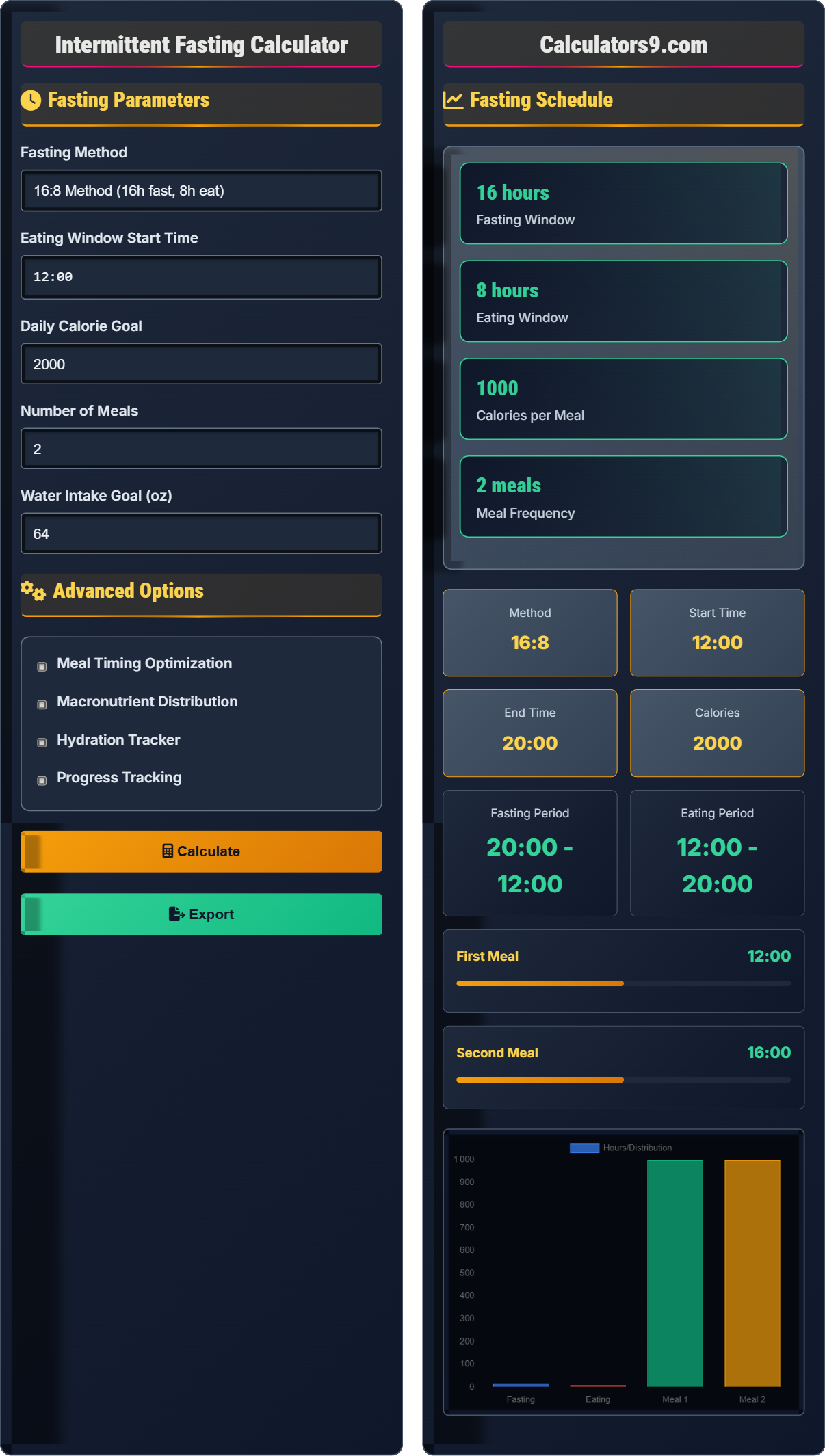
These formulas calculate the fasting and eating periods for different intermittent fasting protocols. The 16:8 method involves 16 hours of fasting and 8 hours of eating. Calories per meal adjusts based on the number of meals consumed during the eating window.
Example: For 16:8 method with 2,000 daily calories and 2 meals: Fasting = 16 hours, Eating = 8 hours, Calories per meal = 2,000 ÷ 2 = 1,000 calories per meal.
Fasting Parameters
Advanced Options
Fasting Schedule
| Meal | Time | Calories | Notes |
|---|
| Nutrient | Amount | Daily Goal | Status |
|---|
| Day | Completed | Calories | Notes |
|---|
Intermittent Fasting Protocols
Intermittent fasting (IF) is an eating pattern that cycles between periods of eating and fasting. It doesn't specify which foods to eat but rather when to eat them. The goal is to create a calorie deficit and allow the body to tap into fat stores for energy during fasting periods.
Where:
- \( \text{16:8 Method} \) = 16 hours fasting, 8 hours eating
- \( \text{14:10 Method} \) = 14 hours fasting, 10 hours eating
- \( \text{20:4 Method} \) = 20 hours fasting, 4 hours eating
- 16:8 Method: Skip breakfast, eat between 12 PM - 8 PM
- 14:10 Method: Eat between 10 AM - 8 PM
- 20:4 Method: Eat within 4-hour window (OMAD)
- 5:2 Method: Normal eating 5 days, restrict to 500-600 calories 2 days
- Hydration: Drink water, black coffee, tea during fasting
Fasting Methods Comparison
Fasting Success Tips
- Start Gradually: Begin with 12:12 and progress to 16:8
- Stay Hydrated: Drink plenty of water during fasting
- Eat Nutritious Foods: Focus on whole foods during eating windows
- Listen to Your Body: Adjust timing based on energy levels
- Be Consistent: Maintain regular schedule for best results
- Starting too aggressive (20:4 for beginners)
- Not eating enough during eating windows
- Dehydrating during fasting periods
- Overeating after breaking fast
- Ignoring hunger cues and forcing adherence
Intermittent Fasting Quiz
If someone follows the 16:8 method and eats 2,000 calories per day in 2 meals, how many calories should each meal contain?
The answer is A) 1,000 calories. The calculation is: Total daily calories ÷ Number of meals = 2,000 ÷ 2 = 1,000 calories per meal. The fasting method doesn't change the calorie distribution; it only determines when the calories are consumed.
Intermittent fasting is about timing, not changing total calorie intake. The daily calorie goal remains the same regardless of the fasting protocol. The difference lies in how those calories are distributed across meals during the eating window. This understanding is crucial for maintaining proper nutrition while following IF protocols.
Fasting Window: Time period when no food is consumed
Eating Window: Time period when food can be consumed
Calorie Distribution: How daily calories are allocated across meals
• Total daily calories remain constant regardless of fasting method
• Fasting affects timing, not quantity of food
• Proper nutrition is maintained during eating windows
• Use the formula: Daily calories ÷ Number of meals = Calories per meal
• Plan nutrient-dense meals during eating windows
• Adjust meal timing to energy needs and schedule
• Thinking IF means eating less overall
A person following the 16:8 method consumes 2,000 calories daily in 2 meals. If they aim for 30% protein, 40% carbs, and 30% fat, calculate the grams of each macronutrient per meal. Show your work and explain the importance of proper macronutrient distribution during IF.
Per meal calories: 2,000 ÷ 2 = 1,000 calories per meal. Protein: 30% of 1,000 = 300 calories ÷ 4 cal/g = 75g protein. Carbs: 40% of 1,000 = 400 calories ÷ 4 cal/g = 100g carbs. Fat: 30% of 1,000 = 300 calories ÷ 9 cal/g = 33g fat. Each meal should contain approximately 75g protein, 100g carbs, and 33g fat.
Proper macronutrient distribution during IF is crucial because you have fewer meals to meet your daily nutritional needs. Ensuring each meal contains adequate protein, healthy fats, and complex carbs helps maintain satiety, preserves muscle mass, and supports metabolic health.
With fewer meals during IF, each meal becomes more important for meeting nutritional requirements. The 4-4-9 rule (4 calories per gram for protein and carbs, 9 for fat) is fundamental for calculating macronutrient amounts. Proper distribution ensures that essential nutrients are consumed even with limited meal opportunities.
Macronutrients: Protein, carbohydrates, and fats needed in large amounts
Calorie Density: Calories per gram of macronutrient (4-4-9 rule)
Nutrient Timing: Strategic consumption of nutrients during eating windows
• Protein: 4 calories per gram
• Carbohydrates: 4 calories per gram
• Fat: 9 calories per gram
• Calculate per-meal macros to ensure adequate nutrition
• Prioritize protein to maintain muscle mass during fasting
• Include fiber-rich carbs to support satiety
• Not calculating adequate protein during limited meals
• Focusing only on calories without considering macros
• Not planning nutrient-dense foods during eating windows
Nutrition Q&A
Q: Can I drink anything during fasting periods?
A: Yes, you can drink calorie-free beverages during fasting periods. Water is essential and should be consumed liberally. Black coffee and plain tea without sugar or milk are also allowed. Some people include zero-calorie sweeteners, but plain versions are preferred to maintain the fasted state.
Staying hydrated is crucial during fasting. Aim for at least 8-10 glasses of water daily. Coffee and tea can help suppress appetite and provide antioxidants. Avoid any drinks with calories, artificial sweeteners, or additives that might trigger insulin response.
Q: How should I break my fast?
A: Break your fast gently with easily digestible foods. Start with a small meal containing protein and healthy fats, followed by complex carbohydrates. Examples include Greek yogurt with berries, eggs with vegetables, or a small portion of lean protein with cooked vegetables.
Avoid breaking fasts with high-sugar or processed foods, as this can cause blood sugar spikes and digestive discomfort. Listen to your body's signals and eat mindfully. The first meal should be nourishing but not overwhelming to your digestive system.