Daily Calorie Intake Calculator
Nutrition planning tool • 2026 standards
Calorie Intake Formulas:
Show the calculator\( \text{BMR} = 10 \times \text{Weight (kg)} + 6.25 \times \text{Height (cm)} - 5 \times \text{Age} + s \)
\( \text{TDEE} = \text{BMR} \times \text{Activity Factor} \)
\( \text{Calorie Goal} = \text{TDEE} + \text{Surplus/Deficit} \)
Where:
- \( \text{BMR} \) = Basal Metabolic Rate (calories/day)
- \( \text{TDEE} \) = Total Daily Energy Expenditure (calories/day)
- \( s \) = 5 for men, -161 for women
- \( \text{Calorie Goal} \) = Daily intake for specific goals
These formulas calculate daily calorie needs based on body composition and activity level. The Mifflin-St Jeor equation is most accurate for BMR calculation. TDEE incorporates activity level to estimate total daily needs.
Example: For a 30-year-old male weighing 80kg, 180cm tall, moderately active:
\( \text{BMR} = 10 \times 80 + 6.25 \times 180 - 5 \times 30 + 5 = 1,740 \text{ kcal/day} \)
\( \text{TDEE} = 1,740 \times 1.55 = 2,697 \text{ kcal/day} \)
For weight loss goal (-500 kcal deficit):
\( \text{Goal} = 2,697 - 500 = 2,197 \text{ kcal/day} \)
This results in a 2,197 kcal/day intake for weight loss.
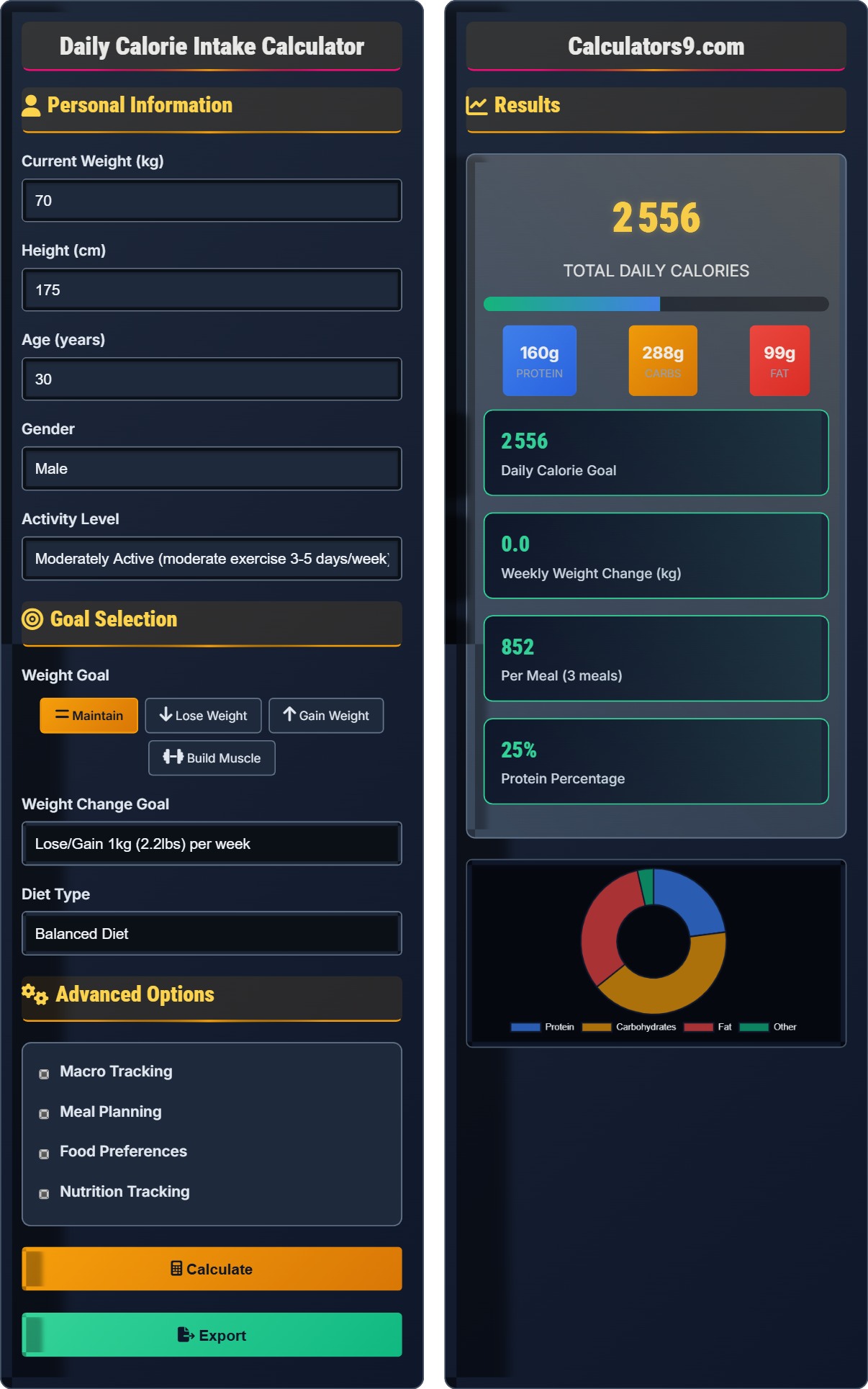
Personal Information
Goal Selection
Advanced Options
Results
| Nutrient | Amount | Percentage | Daily Goal |
|---|
| Meal | Time | Calories | Food Suggestions |
|---|
Comprehensive Nutrition Planning Guide
Daily calorie intake is the amount of energy (measured in calories) you should consume each day to meet your body's needs and achieve your health goals. This includes energy for basic bodily functions (BMR) and daily activities.
The most accurate formula for calculating daily needs:
Where:
- \( \text{BMR} \) = Basal Metabolic Rate
- \( s \) = 5 for men, -161 for women
- \( \text{TDEE} \) = BMR × Activity Factor
Recommended macronutrient distribution:
- Protein: 15-30% (0.8-2.2g per kg body weight)
- Carbohydrates: 45-65% (4-7g per kg body weight)
- Fat: 20-35% (0.8-1.5g per kg body weight)
- Fiber: 25-35g daily (women and men respectively)
- Water: 30-40ml per kg body weight
- Prep Ahead: Batch cooking for consistency
- Portion Control: Use measuring tools initially
- Balance: Include all macronutrients
- Variety: Rotate foods to prevent boredom
- Timing: Eat regularly to maintain energy
Calorie Fundamentals
Energy needed for body functions and goals.
\( \text{TDEE} = \text{BMR} \times \text{Activity Factor} \)
Where TDEE = Total Daily Energy Expenditure.
- 500 cal deficit = ~1lb/week loss
- Safe ranges: 1200-5000 cal/day
- Adjust for activity level
Applications
Calculating intake for specific outcomes.
- Weight loss goals
- Weight gain goals
- Muscle building
- Maintenance
- Metabolic health
- Activity level
- Age and gender
- Medical conditions
Nutrition Planning Learning Quiz
What does BMR stand for and what does it measure?
The answer is B) Basal Metabolic Rate - calories needed at rest. BMR represents the number of calories your body needs to maintain basic life-sustaining functions like breathing, circulation, and cell production while at complete rest. It accounts for about 60-75% of your total daily energy expenditure.
Basal Metabolic Rate is fundamental to understanding daily calorie needs. It's the baseline energy requirement for survival. BMR varies based on age, gender, weight, height, and muscle mass. Understanding BMR helps calculate total daily energy needs by adding activity factors.
BMR: Basal Metabolic Rate - calories at complete rest
Energy Expenditure: Total calories burned daily
Metabolic Rate: Rate of energy use by body
• BMR is at complete rest
• Accounts for 60-75% of daily calories
• Increases with muscle mass
• Build muscle to increase BMR
• BMR decreases with age
• Men typically have higher BMR
• Confusing BMR with total daily calories
• Not accounting for activity level
• Assuming BMR is constant
Calculate the BMR for a 25-year-old female who weighs 60kg and is 165cm tall using the Mifflin-St Jeor equation. Show your work.
Step 1: Identify the Mifflin-St Jeor formula for women
\( \text{BMR} = 10 \times \text{Weight (kg)} + 6.25 \times \text{Height (cm)} - 5 \times \text{Age} - 161 \)
Step 2: Substitute the values
\( \text{BMR} = 10 \times 60 + 6.25 \times 165 - 5 \times 25 - 161 \)
Step 3: Calculate each component
\( \text{BMR} = 600 + 1,031.25 - 125 - 161 \)
Step 4: Final calculation
\( \text{BMR} = 1,345.25 \text{ calories/day} \)
Therefore, the BMR is approximately 1,345 calories per day.
The Mifflin-St Jeor equation is considered the most accurate for calculating BMR. Note the different constants for men (+5) and women (-161). This formula accounts for weight, height, age, and gender differences in metabolic rate. BMR represents the calories needed at complete rest.
BMR: Basal Metabolic Rate - calories at rest
Mifflin-St Jeor: Most accurate BMR calculation method
TDEE: Total Daily Energy Expenditure
• Women: subtract 161 in formula
• Men: add 5 in formula
• BMR is at rest only
• Use kg for weight, cm for height
• Age affects metabolism
• TDEE = BMR × Activity Factor
• Using wrong gender constant
• Mixing up units (lbs vs kg)
• Confusing BMR with TDEE
A person has a BMR of 1,500 calories per day and is moderately active (activity factor of 1.55). What is their TDEE? If they want to lose 1kg per week, what should their daily calorie intake be?
Step 1: Calculate TDEE
TDEE = BMR × Activity Factor
TDEE = 1,500 × 1.55 = 2,325 calories/day
Step 2: Calculate calorie goal for weight loss
For 1kg weight loss per week, need 7,700 calorie deficit over 7 days
Daily deficit = 7,700 ÷ 7 = 1,100 calories/day
Calorie goal = TDEE - Daily deficit
Calorie goal = 2,325 - 1,100 = 1,225 calories/day
Therefore, TDEE is 2,325 calories/day, and the weight loss goal is 1,225 calories/day.
This problem demonstrates the relationship between BMR, activity level, and weight goals. TDEE represents total daily needs including activity. For weight loss, a calorie deficit is needed. Note that 1kg of body fat is approximately 7,700 calories, not the traditional 7,000.
TDEE: Total Daily Energy Expenditure
Activity Factor: Multiplier for physical activity
Calorie Deficit: Energy gap for weight loss• TDEE = BMR × Activity Factor
• 1kg fat ≈ 7,700 calories
• Safe deficit: 500-1000 cal/day
• Verify calorie intake is safe (≥1200 cal)
• Combine diet and exercise for best results
• Recalculate as weight changes
• Using 3,500 calories per lb instead of 7,700 per kg
• Not accounting for activity level
• Creating unsafe deficits
A person is consuming 2,000 calories daily with a macro distribution of 30% protein, 40% carbohydrates, and 30% fat. Calculate the grams of each macronutrient they consume daily. (Note: Protein = 4 cal/g, Carbs = 4 cal/g, Fat = 9 cal/g)
Step 1: Calculate calories per macronutrient
Protein: 2,000 × 0.30 = 600 calories
Carbohydrates: 2,000 × 0.40 = 800 calories
Fat: 2,000 × 0.30 = 600 calories
Step 2: Convert calories to grams
Protein: 600 ÷ 4 = 150 grams
Carbohydrates: 800 ÷ 4 = 200 grams
Fat: 600 ÷ 9 = 67 grams
Therefore, they consume 150g protein, 200g carbs, and 67g fat daily.
This problem demonstrates macro distribution calculations. The 30/40/30 ratio is common for weight loss diets. Higher protein helps preserve lean mass, while moderate carbs provide energy. The different caloric densities of macros (4, 4, 9) are important for accurate calculations.
Macronutrients: Protein, carbs, and fat
Caloric Density: Calories per gram (4, 4, 9)
Macro Distribution: Percentage of calories from each macro
• Protein = 4 calories per gram
• Carbs = 4 calories per gram
• Fat = 9 calories per gram
• Higher protein preserves muscle
• Adjust macros based on activity
• Track consistently for accuracy
• Using wrong caloric values for macros
• Not accounting for protein needs
• Forgetting to verify total calories
Which of the following is NOT considered a healthy eating pattern according to nutritional guidelines?
The answer is C) Elimination of all carbohydrates for weight loss. Completely eliminating any food group is not considered healthy. Carbohydrates are essential for brain function, energy, and digestive health. Healthy diets include complex carbohydrates from whole grains, fruits, and vegetables.
Healthy eating patterns emphasize variety, balance, and moderation. Extreme diets that eliminate entire food groups often lack essential nutrients. The Mediterranean and DASH diets are evidence-based patterns associated with health benefits. Balance across all food groups supports optimal nutrition.
Healthy Eating: Balanced, varied, and moderate
Food Groups: Carbs, protein, fat, vitamins, minerals
Extreme Diets: Eliminate entire food groups
• Variety across all food groups
• Moderation in all foods
• No elimination of essential nutrients
• Include all food groups in moderation
• Focus on whole, unprocessed foods
• Consult professionals for guidance
• Following extreme restrictive diets
• Eliminating entire food groups
• Not consulting professionals
FAQ
Q: How accurate are the different equations for calculating BMR?
A: The accuracy of BMR equations varies:
Mifflin-St Jeor Equation: Most accurate, ±10% for 82% of subjects
Harris-Benedict Equation: Older but still used, ±10% for 62% of subjects
Revised Harris-Benedict: Improved version, ±10% for 70% of subjects
Cunningham Equation: Includes lean body mass, more accurate for athletes
The Mifflin-St Jeor equation is recommended by the American Dietetic Association. However, individual variations can be significant due to genetics, medical conditions, medications, and other factors.
For precise measurements, indirect calorimetry is the gold standard but rarely accessible.
Q: What's the optimal protein intake for different goals?
A: Protein needs vary by goal and individual:
General Health: 0.8-1.0 g/kg body weight
Weight Loss: 1.6-2.2 g/kg body weight (to preserve lean mass)
Muscle Building: 1.6-2.2 g/kg body weight
Older Adults: 1.0-1.2 g/kg body weight (to prevent muscle loss)
For a 70kg person:
- General: 56-70g protein/day
- Weight Loss: 112-154g protein/day
- Muscle Building: 112-154g protein/day
Research shows higher protein intakes (1.6-2.2g/kg) are safe for healthy individuals and beneficial for body composition goals.