Food Calorie Counter
Calorie tracking calculator • 2026 nutrition standards
Calorie Calculation Formula:
Show the calculator\( \text{Total Calories} = \sum(\text{Food Calories} \times \text{Quantity}) \)
\( \text{Macronutrient Calories} = (\text{Protein g} \times 4) + (\text{Carbs g} \times 4) + (\text{Fat g} \times 9) \)
Where:
- \( \text{Food Calories} \) = Calories per serving of each food item
- \( \text{Quantity} \) = Number of servings consumed
- \( \text{Protein} \) = Grams of protein (4 cal/g)
- \( \text{Carbs} \) = Grams of carbohydrates (4 cal/g)
- \( \text{Fat} \) = Grams of fat (9 cal/g)
This formula calculates total daily caloric intake and macronutrient distribution.
Example: For 100g chicken breast (165 cal) and 1 cup rice (205 cal):
Total Calories = 165 + 205 = 370 calories
Macronutrient breakdown:
Protein: 31g × 4 = 124 cal
Carbs: 45g × 4 = 180 cal
Fat: 3.6g × 9 = 32 cal
Total: 124 + 180 + 32 = 336 cal (slight variance due to rounding)
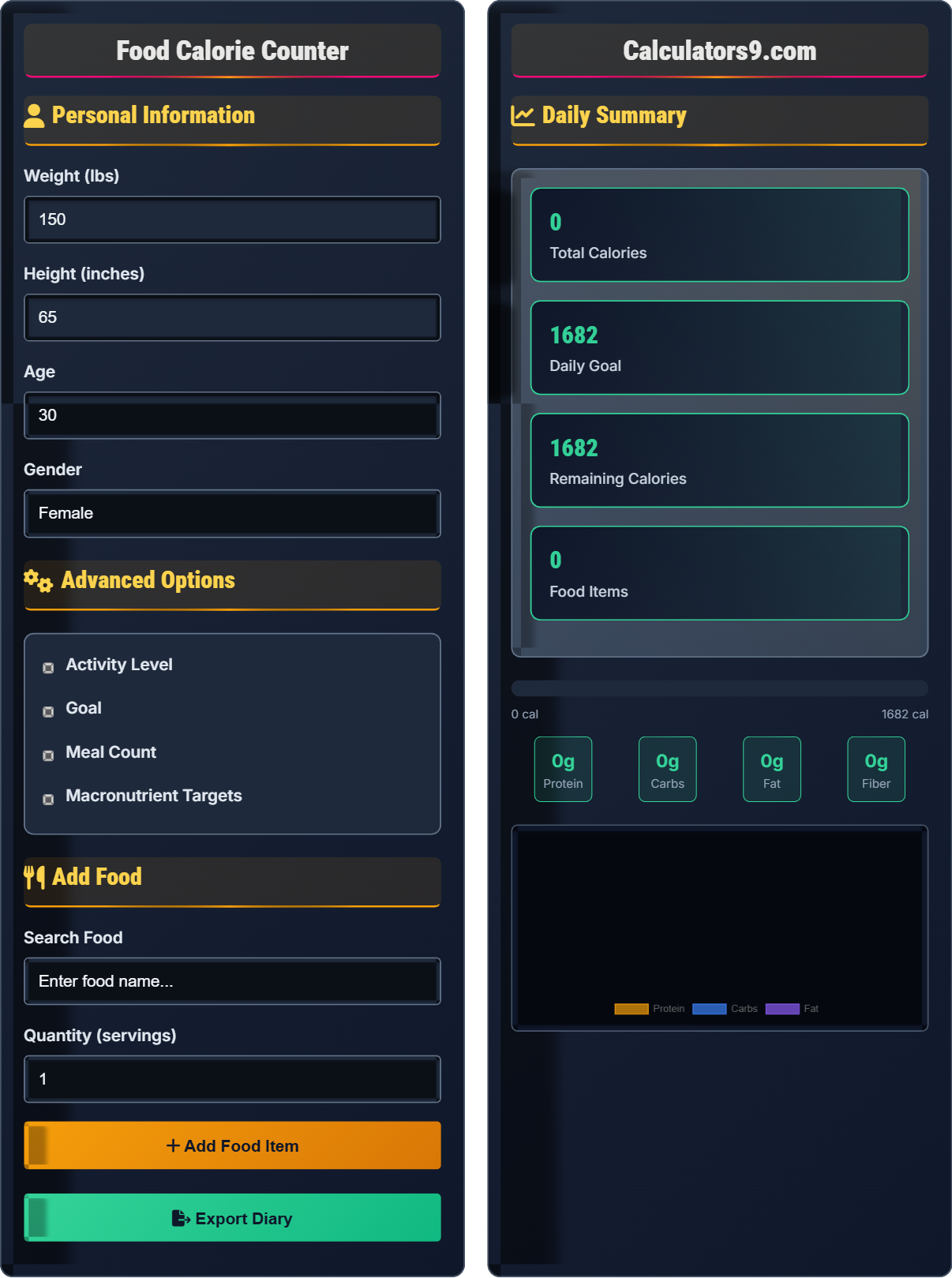
Personal Information
Advanced Options
Add Food
Daily Summary
| Food | Qty | Calories | Action |
|---|
| Nutrient | Amount | % of Goal | Status |
|---|
Comprehensive Nutrition Guide
A calorie is a unit of energy that measures how much energy food provides to your body. When you consume more calories than your body needs, the excess is stored as fat. When you consume fewer calories than your body needs, it burns stored fat for energy. Understanding calories is fundamental to managing weight and maintaining good health.
Calories come from three main macronutrients:
Each gram provides:
- Protein: 4 calories per gram
- Carbohydrates: 4 calories per gram
- Fat: 9 calories per gram
Recommended macronutrient distribution for optimal health:
- Protein: 10-35% of total calories
- Carbohydrates: 45-65% of total calories
- Fat: 20-35% of total calories
- Fiber: 25-35 grams daily
- Measure portions: Use measuring cups or kitchen scale
- Read labels: Check serving sizes and nutrition facts
- Track consistently: Record everything you eat and drink
- Use technology: Apps can simplify tracking
- Plan ahead: Pre-portion meals and snacks
Nutrition Fundamentals
Unit of energy from food. Used to measure energy content and body's energy expenditure.
\( \text{Calories} = (\text{Protein g} \times 4) + (\text{Carbs g} \times 4) + (\text{Fat g} \times 9) \)
Accurate tracking requires knowledge of macronutrient content.
- Track all food and beverages
- Measure portions accurately
- Record immediately after eating
Tracking Tips
Controlling serving sizes is crucial for accurate calorie tracking.
- Use food diary apps
- Take photos of meals
- Measure portions with tools
- Estimate using familiar objects
- Account for cooking oils
- Include beverages
- Track restaurant meals
- Don't skip meals
Nutrition Learning Quiz
How many calories are in 1 gram of fat?
The answer is C) 9 calories. Fat contains 9 calories per gram, which is more than twice the calories in protein or carbohydrates (4 calories per gram each). This is why high-fat foods tend to be more calorie-dense. Alcohol is the only other macronutrient with a different caloric value at 7 calories per gram.
Understanding the caloric density of macronutrients is crucial for accurate calorie counting. Fat is the most energy-dense macronutrient, which is why even small amounts of high-fat foods can contribute significantly to daily caloric intake. This knowledge helps explain why portion control is especially important with high-fat foods.
Caloric Density: Amount of calories per unit of weight
Macronutrient: Nutrients needed in large amounts (protein, carbs, fat)
Energy Yield: Calories provided per gram of nutrient
• Fat = 9 cal/g
• Protein = 4 cal/g
• Carbs = 4 cal/g
• Remember: Fat has 9, Protein and Carbs have 4
• High-fat foods are more calorie-dense
• Measure portions of high-fat foods carefully
• Assuming all macronutrients have equal calories
• Underestimating calories in high-fat foods
• Not accounting for cooking oils
Calculate the total calories in a meal containing 25g protein, 30g carbohydrates, and 12g fat.
Step 1: Calculate protein calories = 25g × 4 cal/g = 100 calories
Step 2: Calculate carbohydrate calories = 30g × 4 cal/g = 120 calories
Step 3: Calculate fat calories = 12g × 9 cal/g = 108 calories
Step 4: Total calories = 100 + 120 + 108 = 328 calories
Therefore, the meal contains 328 total calories.
This calculation demonstrates how to determine total calories from macronutrient information. Each macronutrient contributes differently to the total calorie count, with fat contributing the most per gram. This method is commonly used when analyzing nutrition labels or calculating calories for homemade meals where you know the ingredient amounts.
Macronutrient Breakdown: Distribution of calories among protein, carbs, and fat
Calorie Contribution: How much each nutrient contributes to total calories
Nutrition Analysis: Calculating nutritional content of foods
• Multiply grams by caloric value per gram
• Sum all contributions for total calories
• Check calculations for accuracy
• Always use the correct caloric values (4, 4, 9)
• Double-check multiplication and addition
• Round appropriately for practical use
• Using incorrect caloric values
• Multiplying by wrong numbers
• Forgetting to add all components together
A serving of olive oil is 1 tablespoon (14g). If someone uses 3 tablespoons in cooking, how many calories from fat does this add to their meal?
Step 1: Calculate total grams of fat = 14g per tbsp × 3 tbsp = 42g
Step 2: Calculate calories from fat = 42g × 9 cal/g = 378 calories
Step 3: Verify: 42g of fat at 9 cal/g = 378 calories
Therefore, 3 tablespoons of olive oil adds 378 calories from fat to the meal.
This example illustrates how seemingly small additions to meals can significantly increase caloric content. Olive oil is 100% fat, so all calories come from fat. Even 3 tablespoons (which seems modest) adds almost 400 calories to a meal. This demonstrates why measuring cooking oils and dressings is important for calorie tracking.
Portion Size: Standardized amount of food
Volume Conversion: Converting between units (tbsp to grams)
Hidden Calories: Calories not obvious in food preparation
• Measure cooking oils and fats
• Account for preparation methods
• Track all ingredients
• Use spray oils to reduce calories
• Not tracking cooking oils
• Estimating rather than measuring
• Forgetting to include preparation fats
A restaurant meal has 45g protein, 60g carbohydrates, and 25g fat. If the menu claims the meal is 600 calories, is this accurate? What's the actual calorie count?
Step 1: Calculate protein calories = 45g × 4 cal/g = 180 calories
Step 2: Calculate carbohydrate calories = 60g × 4 cal/g = 240 calories
Step 3: Calculate fat calories = 25g × 9 cal/g = 225 calories
Step 4: Actual total calories = 180 + 240 + 225 = 645 calories
Step 5: Compare with menu claim = 645 vs 600 calories
The menu is inaccurate - the actual calorie count is 645 calories, which is 45 calories higher than claimed.
This problem demonstrates the importance of verifying nutritional information, especially when eating out. Restaurant menus aren't always accurate, and even small discrepancies in macronutrient values can lead to significant differences in total calories. When tracking calories precisely, it's important to be aware that published values may not always match reality.
Nutrition Accuracy: Precision of stated nutritional values
Restaurant Accountability: Reliability of nutritional information
Verification: Checking stated values against calculations
• Menu values may not be exact
• Verify when precision is important
• Allow for some variance in restaurant meals
• Ask for detailed nutrition info when available
• Estimate when exact values aren't provided
• Account for possible discrepancies
• Assuming menu values are always accurate
• Not accounting for preparation variations
• Relying solely on stated values
If someone's daily calorie goal is 2000 calories and they've consumed 1500 calories, what does this mean for their weight management goal?
The answer is B) They will lose weight. When you consume fewer calories than your body needs (1500 vs 2000), your body will burn stored energy (fat) to make up the difference. This creates a caloric deficit of 500 calories, which typically leads to weight loss over time. Generally, a 3500-calorie deficit equals approximately 1 pound of weight loss.
This demonstrates the fundamental principle of weight management: caloric balance. When calories consumed are less than calories burned, the body uses stored energy, leading to weight loss. Conversely, when calories consumed exceed calories burned, the excess is stored as fat, leading to weight gain. The 500-calorie daily deficit in this example would theoretically result in about 1 pound of weight loss per week (500 × 7 = 3500 calories).
Caloric Deficit: Consuming fewer calories than burned
Energy Balance: Relationship between calories consumed and burned
Metabolic Rate: Calories burned by the body at rest
• Deficit = Weight Loss
• Surplus = Weight Gain
• Balance = Weight Maintenance
• Aim for 500-750 cal daily deficit for weight loss
• Combine with exercise for better results
• Monitor consistently for accuracy
• Confusing deficit with surplus
• Not accounting for all calories consumed
• Setting deficits that are too aggressive
FAQ
Q: How accurate do I need to be when tracking calories?
A: For most people, being within 100-200 calories of your target is sufficient for weight management. The mathematical principle is:
\( \text{Daily Variance} \leq 200 \text{ calories} \)
Over time, small daily variances average out. The key is consistency rather than perfect accuracy. Tracking to the nearest 50 calories is usually adequate for most goals. The formula for weekly impact:
\( \text{Weekly Difference} = \text{Daily Difference} \times 7 \)
So a 100-calorie daily overestimation results in only 700 extra calories per week.
Q: Should I track calories from vegetables?
A: Non-starchy vegetables like lettuce, celery, and broccoli have very few calories (typically 5-25 calories per cup), so they don't significantly impact your daily total. However, starchy vegetables like potatoes, corn, and peas are higher in calories and should be tracked.
General rule:
- Non-starchy vegetables: 0-25 calories per cup (optional to track)
- Starchy vegetables: 100+ calories per cup (recommended to track)
For example, 1 cup of spinach (7 calories) vs 1 cup of corn (177 calories) shows the significant difference.