Intermittent Fasting Timer
Fasting schedule calculator • 2026 nutrition standards
Fasting Schedule Formula:
Show the calculator\( \text{Fasting Window} = \text{Sleep Hours} + \text{Active Fasting Hours} \)
\( \text{Eating Window} = 24 - \text{Fasting Window} \)
Where:
- \( \text{Sleep Hours} \) = Hours spent sleeping (typically 7-9 hours)
- \( \text{Active Fasting Hours} \) = Hours of conscious fasting (varies by method)
Common intermittent fasting methods and their ratios:
- \( 16:8 \) = 16 hours fasting, 8 hours eating
- \( 14:10 \) = 14 hours fasting, 10 hours eating
- \( 20:4 \) = 20 hours fasting, 4 hours eating
Example: For 16:8 method with 8 hours sleep:
Active fasting = 16 - 8 = 8 hours awake fasting
Eating window = 24 - 16 = 8 hours
If starting eating at noon, fasting ends at 8 PM and resumes at 12 PM next day.
Personal Information
Advanced Options
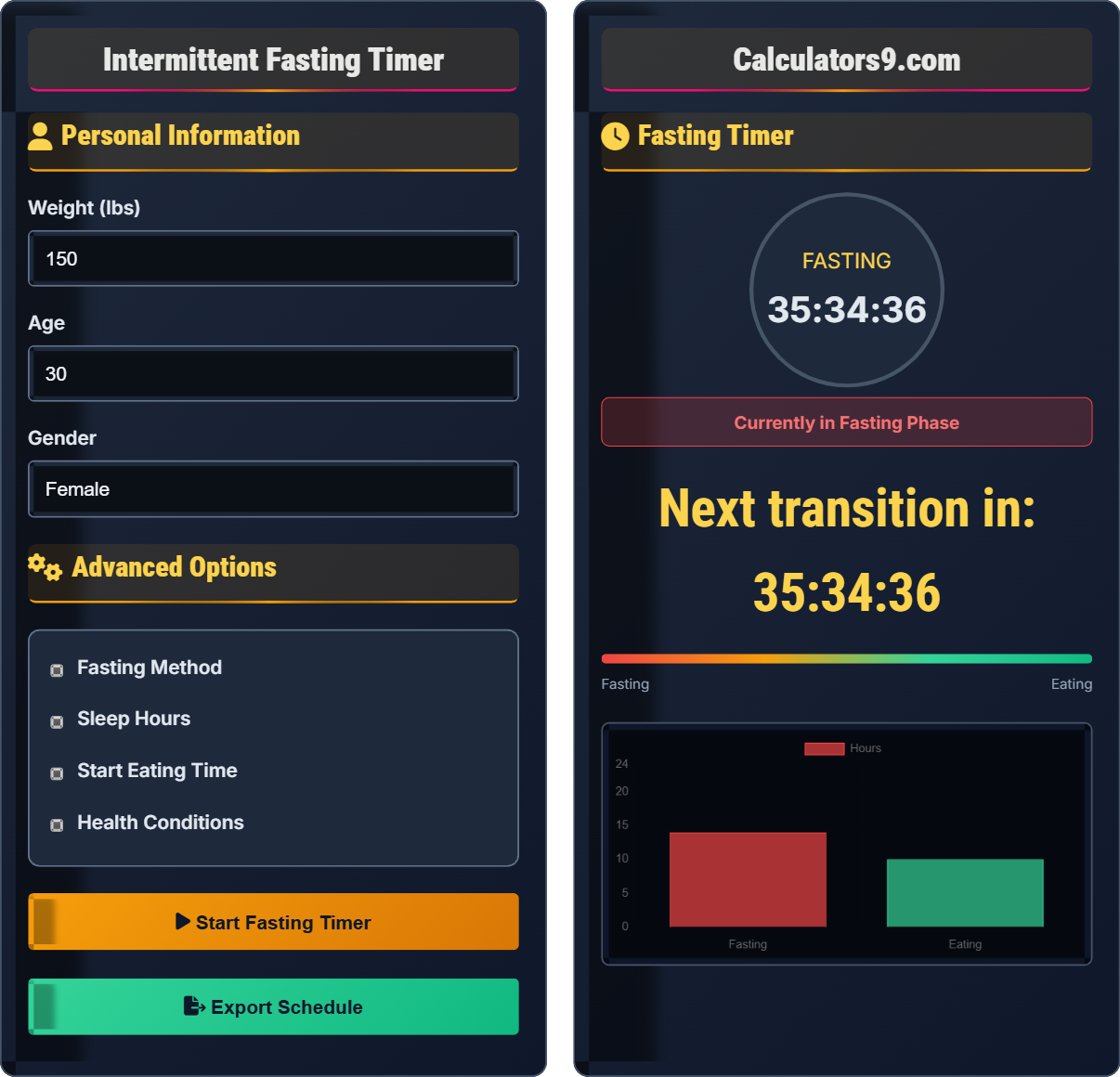
Fasting Timer
| Time | Phase | Duration | Activity |
|---|
Recommended Meals During Eating Window
Allowed During Fasting
Comprehensive Intermittent Fasting Guide
Intermittent fasting (IF) is an eating pattern that cycles between periods of fasting and eating. Rather than specifying which foods to eat, it focuses on when to eat them. This approach allows the body to tap into fat stores for energy during fasting periods, promoting various health benefits including weight loss, improved insulin sensitivity, and cellular repair processes.
Common intermittent fasting methods and their time distributions:
Popular methods:
- 16:8 Method: 16 hours fasting, 8 hours eating window
- 14:10 Method: 14 hours fasting, 10 hours eating window
- 20:4 Method: 20 hours fasting, 4 hours eating window
- 5:2 Method: Normal eating 5 days, restricted calories 2 days
Research-backed benefits of intermittent fasting:
- Weight Loss: Creates natural caloric deficit and boosts metabolism
- Improved Insulin Sensitivity: Helps regulate blood sugar levels
- Cellular Repair: Triggers autophagy, removing damaged cells
- Brain Health: May improve cognitive function and protect against neurodegenerative diseases
- Longevity: Associated with increased lifespan in studies
- Start gradually: Begin with shorter fasting windows
- Stay hydrated: Drink plenty of water during fasting
- Choose nutrient-dense foods: Focus on whole foods during eating windows
- Listen to your body: Stop if experiencing adverse effects
- Be consistent: Follow the same schedule daily for best results
Fasting Fundamentals
Periodic abstinence from food, allowing body to use stored energy. Time-based approach to eating.
\( 16:8 = \text{16 hours fasting}, \text{8 hours eating} \)
Adjust based on personal goals and tolerance.
- No caloric intake during fasting
- Stay hydrated with water/coffee
- Focus on nutrition during eating
Fasting Tips
Essential during fasting to prevent dehydration and hunger pangs.
- Choose a beginner-friendly method
- Start with shorter windows
- Gradually increase duration
- Track your progress
- Consult healthcare provider first
- Stop if feeling unwell
- Adjust for medications
- Consider social factors
Intermittent Fasting Learning Quiz
In a 16:8 intermittent fasting schedule, how many hours are available for eating?
The answer is B) 8 hours. In the 16:8 method, the first number represents fasting hours (16) and the second number represents eating hours (8). So 8 hours are available for consuming all daily calories. The total of fasting and eating hours equals 24 (16 + 8 = 24).
The notation X:Y in intermittent fasting represents the ratio of fasting to eating hours. The first number is always the fasting period, and the second number is the eating window. Understanding this notation is crucial for implementing any intermittent fasting protocol correctly. The 16:8 method is popular because it's manageable for most people while still providing significant benefits.
Eating Window: The time period when food consumption is allowed
Fasting Period: The time period when no caloric intake is permitted
Time-Restricted Feeding: Eating within a specific timeframe daily
• First number = fasting hours
• Second number = eating hours
• Total = 24 hours
• 16:8 = 16 hours fasting, 8 hours eating
• Sleep time counts toward fasting
• Start with 12:12 and progress gradually
• Confusing fasting and eating hours
• Not accounting for sleep in fasting time
• Starting with too aggressive protocols
If someone starts their eating window at 12:00 PM using a 16:8 schedule, what time will their next fasting period begin?
Step 1: Identify eating window duration = 8 hours
Step 2: Start time = 12:00 PM
Step 3: End of eating window = 12:00 PM + 8 hours = 8:00 PM
Step 4: Fasting begins at 8:00 PM and continues for 16 hours until 12:00 PM the next day
Therefore, the next fasting period begins at 8:00 PM on the same day.
This calculation demonstrates the cyclical nature of intermittent fasting schedules. Once the eating window closes, the fasting period begins and continues until the next day's eating window opens. Understanding these transitions is essential for planning meals and managing hunger expectations. The 16-hour fasting period often includes sleep time, making it more manageable.
Transition Time: When switching between fasting and eating phases
Cycle Length: Total time for one complete fasting/eating cycle
Schedule Adherence: Following the same timing daily
• Eating window ends = Fasting begins
• Fasting ends = New eating window begins
• Schedules repeat daily
• Use calendar apps to set reminders
• Align eating windows with social schedule
• Plan meals in advance
• Extending eating windows beyond designated time
• Breaking fast too early
• Not accounting for preparation time
Sarah sleeps from 10:00 PM to 6:00 AM and follows a 16:8 intermittent fasting schedule. If she starts eating at 12:00 PM, how many hours of conscious fasting does she have?
Step 1: Calculate sleep time = 10:00 PM to 6:00 AM = 8 hours
Step 2: Total fasting requirement = 16 hours
Step 3: Conscious fasting = Total fasting - Sleep time
Step 4: Conscious fasting = 16 - 8 = 8 hours
Step 5: Verify - From 6:00 AM to 12:00 PM = 6 hours
Wait, let me recalculate: If eating starts at 12:00 PM and lasts 8 hours until 8:00 PM, then fasting starts at 8:00 PM. From 8:00 PM to 6:00 AM = 10 hours of conscious fasting. Then 6:00 AM to 12:00 PM = 6 more hours = 16 total. But 10 hours awake fasting is excessive.
Correct approach: Fasting starts at 8:00 PM (end of eating window). Sleep from 10:00 PM to 6:00 AM = 8 hours. So conscious fasting = 8:00 PM to 10:00 PM = 2 hours before sleep, plus 6:00 AM to 12:00 PM = 6 hours after sleep = 8 hours conscious fasting.
This problem illustrates how sleep time contributes to the fasting period, making intermittent fasting more manageable. The 8 hours of sleep count toward the 16-hour fasting requirement, leaving only 8 hours of conscious fasting. This demonstrates why many people find the 16:8 method achievable - much of the fasting occurs during sleep.
Unconscious Fasting: Fasting that occurs during sleep
Conscious Fasting: Fasting while awake and alert
Sleep Integration: Using sleep time to fulfill fasting requirements
• Sleep time counts toward fasting
• Unconscious fasting is easier to manage
• Plan eating windows around sleep schedule
• Align fasting with natural sleep patterns
• Not counting sleep time as fasting
• Overestimating conscious fasting time
• Choosing schedules that conflict with sleep
John follows the 5:2 intermittent fasting method, eating normally for 5 days and restricting calories to 500-600 for 2 non-consecutive days. If he chooses Monday and Thursday for restricted eating, what percentage of his week is spent in caloric restriction?
Step 1: Identify restricted days = 2 days (Monday and Thursday)
Step 2: Total days in week = 7 days
Step 3: Calculate percentage = (Restricted days / Total days) × 100
Step 4: Percentage = (2 / 7) × 100 = 28.57%
Step 5: Rounded = 29% of the week is spent in caloric restriction
Therefore, John spends approximately 29% of his week in caloric restriction with the 5:2 method.
The 5:2 method is a flexible approach that allows normal eating most days while incorporating two days of caloric restriction. This method is different from time-restricted feeding as it focuses on caloric intake rather than timing. The 29% restriction represents a significant but manageable portion of the week, allowing for social dining and normal eating patterns on most days.
Caloric Restriction: Limiting calorie intake below normal levels
Non-Consecutive Days: Restricted days not occurring back-to-back
Flexible Fasting: Adapting fasting patterns to lifestyle
• 5:2 = 5 normal days, 2 restricted days
• Choose less social days for restriction
• Plan nutrient-dense meals for restricted days
• Stay hydrated during restriction
• Choosing weekends for restriction
• Not planning meals for restricted days
• Extending restriction to more than 2 days
Which of the following individuals should consult a healthcare provider before starting intermittent fasting?
The answer is D) Both B and C. Individuals with diabetes taking medication and pregnant women should consult healthcare providers before starting intermittent fasting. Diabetes management requires careful coordination of meals and medication, while pregnancy requires consistent nutrition for fetal development. Other groups that should consult providers include those with eating disorders, chronic conditions, or taking certain medications.
Intermittent fasting is not appropriate for everyone and requires medical supervision in certain populations. The body's metabolic needs change significantly with certain conditions, medications, and life stages. Healthcare providers can help determine if IF is safe and how to adapt protocols to individual health needs.
Medical Supervision: Professional oversight for health interventions
Contraindications: Conditions where IF is not recommended
Medication Timing: Coordinating drugs with eating patterns
• Consult provider with diabetes
• Avoid IF during pregnancy
• Review medications before starting
• Discuss IF with your doctor first
• Monitor blood sugar if diabetic
• Start gradually and monitor symptoms
• Starting IF without medical clearance when needed
• Not adjusting medications accordingly
• Ignoring warning signs during fasting
FAQ
Q: Can I drink anything during my fasting window?
A: Yes, during fasting you can consume:
- Water: Unlimited, helps with hunger and hydration
- Black Coffee: Zero calories, may suppress appetite
- Plain Tea: Herbal or green tea, no milk/sugar
- Diet Beverages: Controversial, some may trigger cravings
Anything with calories (>5-10 calories) technically breaks the fast. Black coffee and tea are acceptable because they maintain the metabolic state of fasting while helping manage hunger. The mathematical principle is that calories trigger insulin release, ending the fasting state.
Q: How do I adjust IF for irregular work schedules?
A: For shift workers, consider flexible approaches:
- Reverse Schedule: Eat during your "day" (when you're active)
- Consistent Hours: Maintain same fasting window regardless of shifts
- Modified Approach: 12:12 instead of 16:8 for flexibility
Example: If you work nights, your eating window might be 7 PM - 11 PM (your "morning") and 2 AM - 6 AM (your "evening"). The key is consistency in your personal schedule, not the clock time. The formula remains the same: Fasting Hours + Eating Hours = 24.