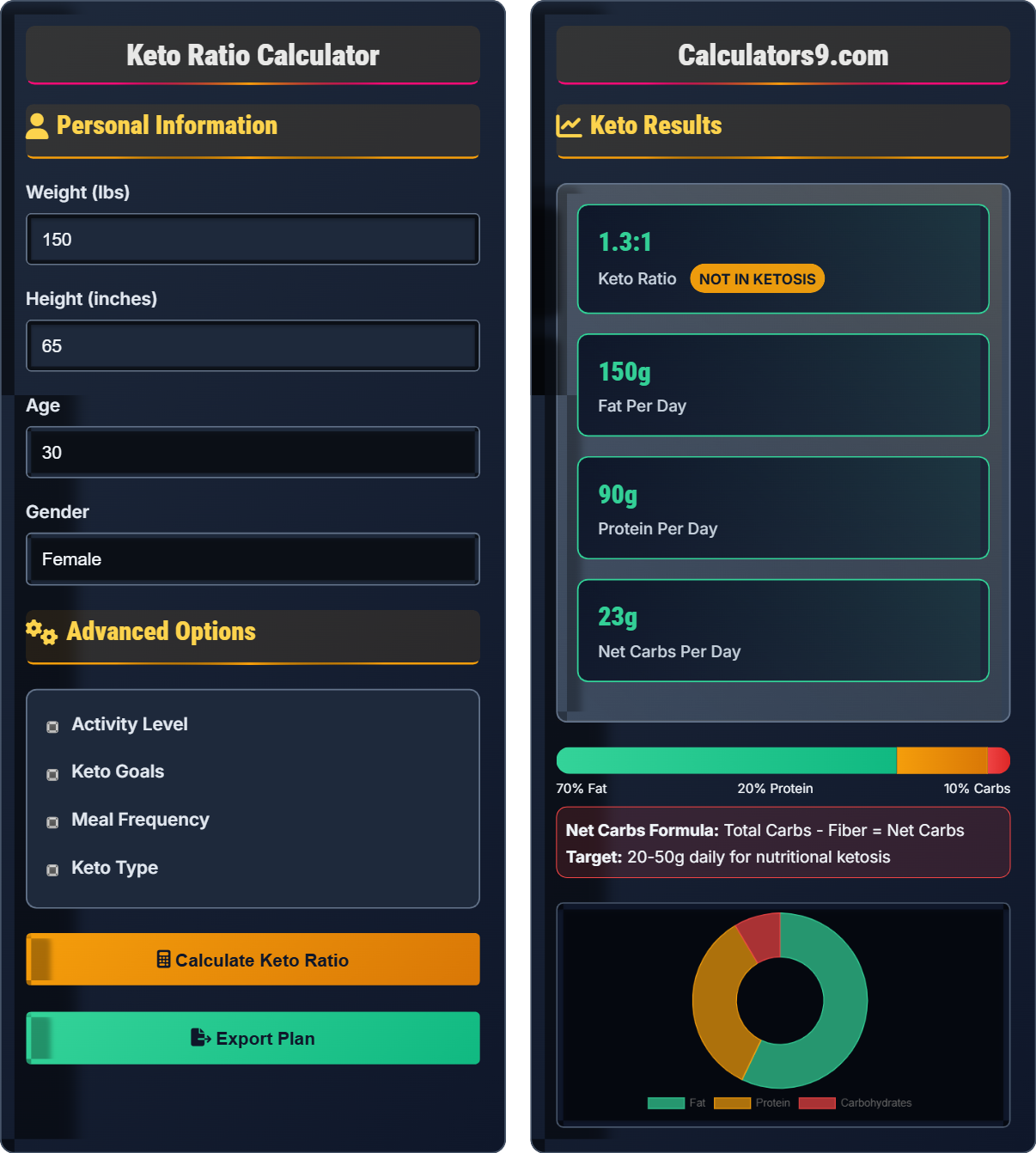
Keto Ratio Calculator
Ketogenic diet calculator • 2026 nutrition standards
Ketogenic Ratio Formula:
Show the calculator\( \text{Keto Ratio} = \frac{\text{Fat (g)}}{\text{Protein (g)} + \text{Net Carbs (g)}} \)
Where:
- \( \text{Fat (g)} \) = Total grams of fat consumed
- \( \text{Protein (g)} \) = Total grams of protein consumed
- \( \text{Net Carbs (g)} \) = Total carbs (g) - Fiber (g)
This formula calculates the ketogenic ratio, which determines the proportion of fat to protein and carbs. A ratio of 3:1 or 4:1 is considered therapeutic, while 1:1 to 2:1 is typical for dietary ketosis.
Example: For a meal with 30g fat, 10g protein, and 5g net carbs:
Keto Ratio = \( \frac{30}{10 + 5} = \frac{30}{15} = 2:1 \)
This represents a 2:1 ratio, which is suitable for maintaining nutritional ketosis.
Personal Information
Advanced Options
Keto Results
Target: 20-50g daily for nutritional ketosis
| Macronutrient | Amount | Calories | % of Calories |
|---|
| Meal | Time | Fat (g) | Protein (g) | Net Carbs (g) | Keto Ratio |
|---|
Comprehensive Ketogenic Diet Guide
Ketosis is a metabolic state where your body burns fat for fuel instead of carbohydrates. When carbohydrate intake is restricted (typically below 50g net carbs daily), the liver produces ketones from fat, which become the primary energy source. This metabolic shift offers various benefits including weight loss, improved mental clarity, and stable energy levels.
The ketogenic ratio determines the proportion of fat to protein and carbs:
Common ratios:
- 1:1 to 2:1: Standard nutritional ketosis
- 3:1: Therapeutic ketosis
- 4:1: Classical medical ketogenic diet
Recommended foods for maintaining ketosis:
- Fats: Avocados, olive oil, coconut oil, butter, nuts, seeds
- Proteins: Fish, meat, eggs, cheese, Greek yogurt
- Low-Carb Vegetables: Leafy greens, broccoli, cauliflower, zucchini
- Net Carbs: Total carbs minus fiber (important for calculation)
- Track net carbs: Monitor total carbs minus fiber
- Stay hydrated: Drink plenty of water and electrolytes
- Moderate protein: Don't overconsume protein
- Focus on healthy fats: Choose quality fat sources
- Plan meals: Prepare keto-friendly meals in advance
Keto Fundamentals
Metabolic state where body burns fat for fuel instead of carbs. Achieved with <50g net carbs daily.
\( \text{Ratio} = \frac{\text{Fat (g)}}{\text{Protein (g)} + \text{Net Carbs (g)}} \)
Target 2:1 ratio for nutritional ketosis.
- Limit net carbs to 20-50g daily
- Get 70-80% calories from fat
- Moderate protein intake
Keto Tips
Total carbs minus fiber. Essential for keto calculations.
- Track fat, protein, and net carbs
- Calculate keto ratio regularly
- Adjust based on ketosis levels
- Monitor ketone levels
- Electrolyte balance is crucial
- Keto flu is temporary
- Quality over quantity
- Listen to your body
Keto Learning Quiz
What keto ratio represents the standard for nutritional ketosis?
The answer is B) 2:1. A 2:1 ratio means for every 2 grams of fat consumed, you consume 1 gram of combined protein and net carbs. This ratio is considered standard for nutritional ketosis. A 1:1 ratio would be too low to maintain ketosis, while 3:1 and 4:1 ratios are typically reserved for therapeutic or medical ketogenic diets.
The ketogenic ratio is fundamental to understanding how to structure a ketogenic diet. The ratio compares the amount of fat consumed to the combined amount of protein and net carbs. A 2:1 ratio ensures that fat makes up the majority of calories, forcing the body to use ketones for fuel. This mathematical relationship is crucial for achieving and maintaining ketosis.
Keto Ratio: The proportion of fat to protein and net carbs (Fat/(Protein+Net Carbs))
Nutritional Ketosis: Metabolic state achieved with 2:1 ratio or higher
Therapeutic Ketosis: Higher ratio (3:1 or 4:1) for medical purposes
• 2:1 ratio is standard for nutritional ketosis
• Higher ratios are for therapeutic purposes
• Ratios below 1:1 won't maintain ketosis
• Aim for 2:1 ratio to maintain ketosis
• Use the formula: Fat / (Protein + Net Carbs)
• Track net carbs, not total carbs
• Confusing total carbs with net carbs
• Not accounting for protein in the ratio
• Using ratios too low to maintain ketosis
Calculate the keto ratio for a meal containing 25g fat, 8g protein, and 3g net carbs. Is this ratio sufficient for ketosis?
Step 1: Apply the keto ratio formula:
Keto Ratio = Fat / (Protein + Net Carbs)
Keto Ratio = 25 / (8 + 3) = 25 / 11 = 2.27:1
Step 2: Compare to ketosis threshold:
A ratio of 2.27:1 is above the 2:1 threshold needed for nutritional ketosis. Therefore, this meal would contribute to maintaining ketosis.
This calculation demonstrates how to apply the keto ratio formula to individual meals. The 2.27:1 ratio exceeds the minimum 2:1 requirement for ketosis, indicating this meal composition supports the ketogenic diet. The calculation emphasizes the importance of including both protein and net carbs in the denominator, as both can potentially interfere with ketosis if consumed in excess.
Net Carbs: Total carbohydrates minus fiber (since fiber doesn't raise blood sugar)
Ketosis Threshold: Minimum ratio (typically 2:1) needed to maintain ketosis
Individual Meal Ratio: Keto ratio calculated for a single meal or food item
• Include both protein and net carbs in denominator
• Aim for 2:1 ratio or higher for ketosis
• Track individual meals to maintain daily average
• Use nutrition tracking apps for easy calculations
• Remember: Net Carbs = Total Carbs - Fiber
• Calculate ratios for entire meals, not just snacks
• Forgetting to include protein in the calculation
• Using total carbs instead of net carbs
• Not accounting for the cumulative daily ratio
Sarah wants to maintain a 2:1 keto ratio throughout the day. If she plans to eat 100g of protein and 30g of net carbs daily, how much fat should she consume to maintain ketosis?
Step 1: Set up the keto ratio equation with the desired ratio:
Keto Ratio = Fat / (Protein + Net Carbs)
2 = Fat / (100 + 30)
2 = Fat / 130
Step 2: Solve for Fat:
Fat = 2 × 130 = 260g
Step 3: Verify the ratio:
Keto Ratio = 260 / (100 + 30) = 260 / 130 = 2:1
Therefore, Sarah should consume 260g of fat daily to maintain a 2:1 keto ratio with 100g protein and 30g net carbs.
This problem demonstrates how to work backwards from a target keto ratio to determine fat requirements. By rearranging the keto ratio formula, we can solve for any missing variable when the others are known. This approach is valuable for meal planning and macro tracking, allowing individuals to adjust their intake to meet specific ketosis goals.
Rearranging Formulas: Mathematical technique to solve for unknown variables
Daily Macro Planning: Calculating daily intake to meet keto ratio targets
Target Ratio Maintenance: Adjusting intake to sustain desired ketosis level
• Keto ratio = Fat / (Protein + Net Carbs)
• To find fat: Fat = Ratio × (Protein + Net Carbs)
• Always verify your calculated ratio
• Rearrange the formula to solve for any variable
• Plan macros for the entire day, not just meals
• Use spreadsheets for complex calculations
• Forgetting to multiply by the ratio in reverse calculations
• Not verifying the final ratio after calculation
• Mixing up the order of operations in formulas
John follows a cyclical ketogenic diet, eating keto for 5 days and high-carb for 2 days. On keto days, he maintains a 2.5:1 ratio with 80g protein and 15g net carbs. On high-carb days, he consumes 400g carbs and 100g protein with 100g fat. What is his weekly average keto ratio?
Step 1: Calculate keto day intake (5 days):
Fat = 2.5 × (80 + 15) = 2.5 × 95 = 237.5g per day
Weekly keto fat = 237.5 × 5 = 1,187.5g
Weekly keto protein = 80 × 5 = 400g
Weekly keto net carbs = 15 × 5 = 75g
Step 2: Calculate high-carb day intake (2 days):
Weekly high-carb fat = 100 × 2 = 200g
Weekly high-carb protein = 100 × 2 = 200g
Weekly high-carb net carbs = 400 × 2 = 800g
Step 3: Calculate totals for the week:
Total fat = 1,187.5 + 200 = 1,387.5g
Total protein = 400 + 200 = 600g
Total net carbs = 75 + 800 = 875g
Step 4: Calculate weekly average ratio:
Weekly ratio = 1,387.5 / (600 + 875) = 1,387.5 / 1,475 = 0.94:1
The weekly average ratio is 0.94:1, which is below ketosis threshold, but the 5 days of strict ketosis provide the benefits.
This complex problem demonstrates how cyclical ketogenic diets work mathematically. While the weekly average ratio falls below the ketosis threshold, the cyclical approach allows for metabolic flexibility. The body adapts to using ketones during low-carb phases and can handle occasional higher-carb periods. This shows how averaging macros over time differs from maintaining consistent daily ratios.
Cyclical Ketogenic Diet: Alternating periods of ketosis and higher carb intake
Metabolic Flexibility: Ability to switch between fat and carb oxidation
Periodization: Structuring nutrition around specific time periods• Cyclical approaches have different weekly averages
• Strict ketosis occurs during low-carb phases
• Benefits come from the cycling pattern
• Track phases separately in cyclical approaches
• Understand that weekly averages don't reflect daily states
• Plan high-carb days strategically around workouts
• Expecting consistent ketosis in cyclical approaches
• Calculating weekly averages for daily decisions
• Not understanding the purpose of cycling
Which of the following statements about modified ketogenic approaches is TRUE?
The answer is B) Modified keto allows for higher net carb intake. Modified ketogenic diets, such as the Modified Atkins Diet (MAD) or Low Glycemic Index Treatment (LGIT), allow for more flexible carb intake compared to classical ketogenic diets. These approaches typically permit 30-50g net carbs daily compared to 20-30g in standard keto, making them easier to follow while still achieving ketosis.
Modified ketogenic approaches were developed to provide the benefits of ketosis with greater dietary flexibility. These variations allow for higher carb intake while maintaining ketosis, making the diet more sustainable long-term. The modified approach still focuses on high fat intake but with more lenient carb restrictions compared to the classical 4:1 medical ketogenic diet.
Modified Atkins Diet (MAD): Less restrictive than classical keto, with higher carb allowance
Low Glycemic Index Treatment (LGIT): Focuses on low-GI carbs rather than strict restriction
Therapeutic Flexibility: Allowing more dietary options while maintaining benefits
• Modified approaches allow 30-50g net carbs daily
• Still maintain high fat percentage (60-70%)
• More sustainable than classical keto
• Modified keto is good for beginners
• Allows more food variety while maintaining ketosis
• Easier to socialize and eat out with modified approaches
• Thinking modified keto is the same as standard keto
• Not monitoring ketone levels with modified approaches
• Consuming too many carbs even in modified versions
FAQ
Q: How do I calculate net carbs for the keto ratio?
A: Net carbs are calculated as:
\( \text{Net Carbs} = \text{Total Carbs} - \text{Fiber} \)
For example, if an avocado has 12g total carbs and 10g fiber, the net carbs are \( 12 - 10 = 2g \).
In the keto ratio formula:
\( \text{Keto Ratio} = \frac{\text{Fat (g)}}{\text{Protein (g)} + \text{Net Carbs (g)}} \)
You must use net carbs, not total carbs, in the denominator. This is critical because fiber doesn't raise blood sugar or interfere with ketosis.
Q: Can I do targeted keto around my workouts?
A: Yes, targeted ketogenic diet (TKD) allows for strategic carb intake around workouts. Typically, 20-50g of fast-acting carbs are consumed 30-60 minutes before or after intense exercise.
The approach maintains ketosis most of the time while providing fuel for high-intensity training:
- Pre-workout: 15-25g carbs 30min before exercise
- Post-workout: 25-50g carbs immediately after
- Daily: Still maintain 20-30g net carbs outside workout windows
This helps fuel performance while maintaining the metabolic benefits of ketosis for most of the day.